Bringing a Kentucky Quad Across for a Weekend
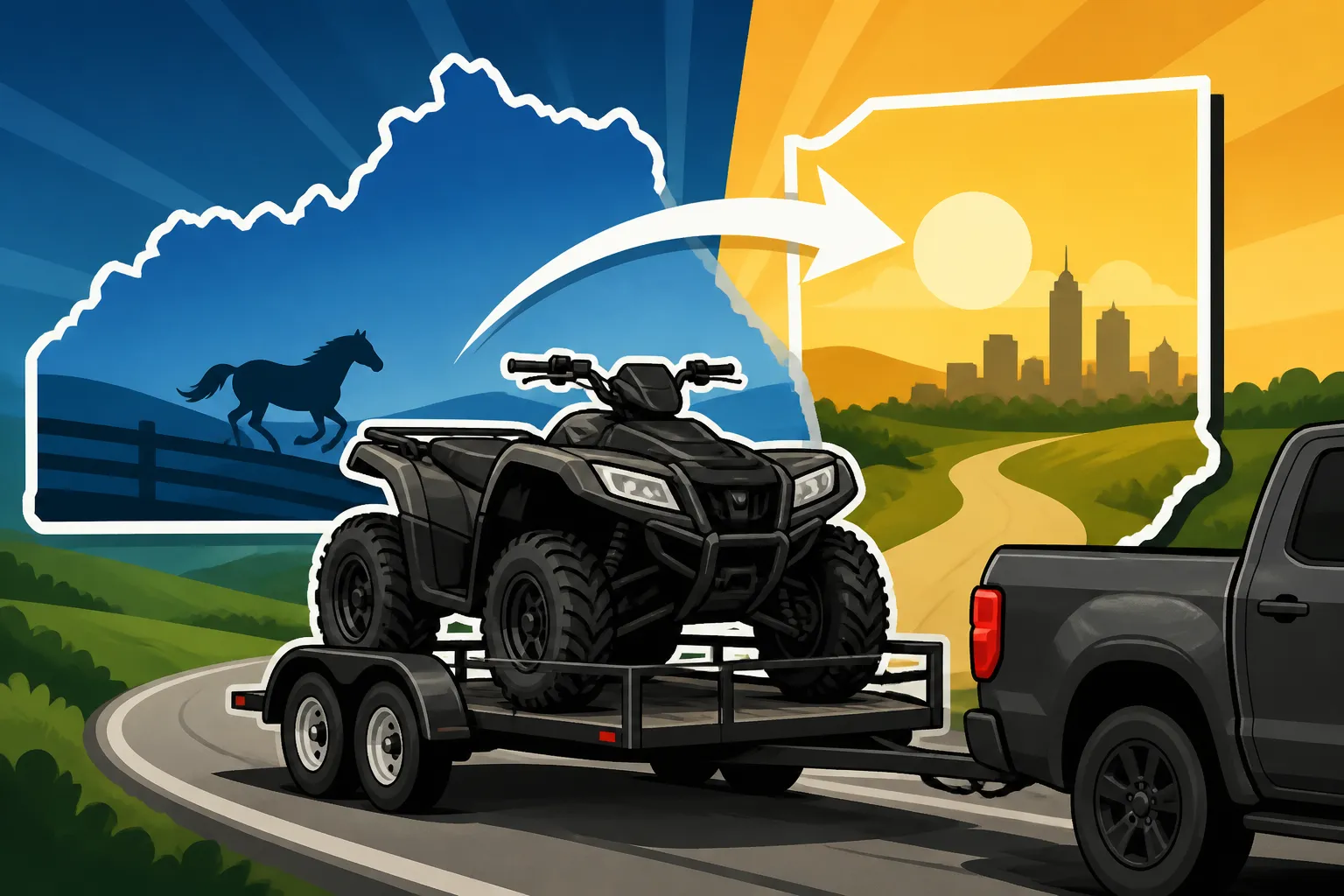
A weekend ride from Kentucky to Indiana can seem straightforward until registration, trail permits, and road access get mixed together. The key distinction is that a Kentucky registration may satisfy Indiana’s visitor exemption for a limited time, but it does not automatically grant access to every trail or road. Here’s how to sort out the paperwork and plan a legal ride.
What a Kentucky registration lets you do in Indiana
If your quad is registered in Kentucky, Indiana generally allows you to operate it without getting a separate Indiana ORV registration for a short visit. According to the Indiana Bureau of Motor Vehicles, nonresidents operating an ORV registered in another state are exempt from Indiana registration for up to 20 days in one calendar year.
That exemption is based on the machine being registered in another state. Bring proof of the Kentucky registration, and make sure the registration is valid for the entire visit. If you are unsure whether your paperwork qualifies as a current registration, confirm with the relevant Kentucky authority before you travel. A bill of sale or an out-of-state trail permit is not the same thing as an out-of-state registration.
The 20-day allowance is an annual limit, not a weekend pass that resets each time you cross the state line. According to the Indiana Bureau of Motor Vehicles, the limit applies within one calendar year. If you have already ridden in Indiana earlier in the year, count those days when deciding whether the exemption still covers your plans.
| Your situation | What it means for Indiana |
|---|---|
| Your quad has a valid Kentucky registration | The Indiana registration exemption for nonresidents may cover your visit, subject to the annual day limit. |
| Your quad is not registered in Kentucky or another state | Do not assume an Indiana trail permit replaces registration. Confirm the correct registration path before riding. |
| You plan to ride at Redbird or Interlake | Check the site’s trail-use permit and entrance requirements separately from vehicle registration. |
| You plan to use an Indiana road open to ORVs | The machine must be registered in Kentucky or through the Indiana BMV, and the road must be open to ORV use. |
A permit for riding a particular property solves a different problem from registration. According to the Indiana Department of Natural Resources, a motorized trail use permit is not an ORV registration. It may authorize trail use at a designated property, but it does not create a registration exemption for riding elsewhere.
For a broader overview of how the visitor limit works, see Indiana’s Twenty-Day Visitor Rule and Does Indiana Honor Out-of-State Registration?. If your plan includes an Indiana county road, don’t assume the visitor exemption makes the road legal: Indiana Rules for Riding a County Road explains why road access must be checked separately.
Trail permits at Redbird and Interlake
For a weekend trip, Redbird Off-Road State Recreation Area and Interlake Off-Road State Recreation Area are the two Indiana DNR properties specifically covered by the out-of-state motorized trail permit. According to the Indiana Department of Natural Resources, visitors from outside Indiana can purchase an Out of State Motorized Trail Use permit to ride at those properties. The permit is valid only at Redbird and Interlake.
That restriction matters. The out-of-state trail permit is not a general Indiana riding permit, and it does not authorize use at a private riding park or on a county road. It also does not substitute for registration. If you’re choosing a destination, Indiana’s Two State ORV Areas Compared can help you weigh the two DNR areas, while Where to Ride an ORV in Indiana covers other kinds of riding locations.
According to the Indiana Department of Natural Resources, the Out-of-State ORV Trail Use Permit costs $20 per ORV for non-registered out-of-state ORVs as of November 2026. The agency also lists a daily trail-use fee of $15 per ORV and an annual ORV Trail Use Permit for $95 per ORV. These are trail-use charges, not registration fees. Confirm which option applies to your Kentucky-registered quad and your intended visit with the property before leaving home; the non-registered out-of-state permit should not be treated as the automatic choice for a machine already registered in Kentucky.
The vehicle’s status and the property’s access rules are separate checks. A valid Kentucky registration may address Indiana’s visitor-registration requirement, but it does not by itself show that you have paid the trail-use charge or met the park’s entry requirements. Conversely, paying for a trail-use permit does not make an unregistered machine registered for Indiana road use.
Before you load up, identify the exact property and ask about the permit that matches your machine’s registration status. Have the registration details available when you ask. If you’re planning a visit to Redbird, Redbird Off-Road State Recreation Area offers destination-specific information; for Interlake, see Interlake Off-Road State Recreation Area. The DNR’s trail rules also include requirements about marked areas and equipment, so check Indiana Rules for Riding a Reclaimed Mine Park before assuming a trail is open to your quad.
Road use is a separate question
A Kentucky quad that qualifies for Indiana’s nonresident registration exemption is not automatically allowed on public roads. Indiana road access depends on whether the county has opened a particular road to ORV use and what local restrictions apply. The Indiana Department of Natural Resources says county rules may specify roads, townships, vehicle types, operating hours, age limits, insurance, helmets, lights, or width.
Before planning a route between a hotel, campground, or trailhead, check the ordinance for the county where you expect to ride. A road that is open in one county may be closed in another, and a county’s rules may include additional conditions. For help checking the local rules, see How to Find an Indiana County ORV Ordinance and Where Indiana Allows ORVs on Public Roads.
According to the Indiana Department of Natural Resources, out-of-state visitors who want to drive on Indiana roadways open to ORV use must have their ORVs registered in their home state or through the Indiana BMV. If your quad is registered in Kentucky, keep proof with you. If it is not registered in its home state, the agency says an out-of-state owner who needs to use Indiana roadways must apply in person at an Indiana BMV branch. A trail-use permit alone does not fill that role.
Also distinguish a public-road connection from simply crossing or riding beside a road. Indiana has separate rules for shoulders, ditches, and crossings, and the details depend on the location. The fact that a road is near a trail does not mean it is open to ORVs. For the specific situations, see Indiana Rules for Crossing a Highway and Indiana Rules for Riding a Highway Shoulder.
If your weekend plan is trail-only, keep the quad on the property’s permitted trails and use a trailer or other legal transport to move between locations. If road riding is part of the plan, verify both the county rule and your registration status before setting out. A park permit is not a shortcut around either check.
Pre-trip checks for the quad and riders
Paperwork is only part of a smooth trip. Indiana’s riding requirements can apply even when the machine is registered in another state, so check the quad, passenger setup, and protective gear before heading out.
According to the Indiana Department of Natural Resources, children under 18 must wear a helmet on or in an ORV in Indiana, including an ATV, UTV, side-by-side, or dirt bike. The helmet rule applies on public and private property. Approved helmets must meet U.S. Department of Transportation standards, and helmets meeting FMVSS 218 must have a DOT sticker on the outside back. A car seat does not remove the helmet requirement. For more detail, read Indiana’s ORV Helmet Rule Explained.
If you need to buy a helmet or riding gear before traveling, Amazon may be one place to compare options, but don’t rely on a product listing alone to establish compliance. Check the helmet itself for the required DOT marking and confirm that the gear fits the intended rider. For children, also consider that the ORV operator may be held responsible for a helmet violation.
Check the machine’s passenger arrangement before loading it. According to the Indiana Department of Natural Resources, passengers are not allowed on ATVs unless the ATV was designed by the manufacturer for two-up riding. UTV and side-by-side rules differ, so use the machine’s intended seating positions rather than assuming an extra seat or cargo area is suitable for a passenger. See Indiana Rules for Carrying a Passenger if your group includes riders who will share a machine.
For use at Indiana DNR ORV properties, the agency also specifies equipment and operating rules. According to the Indiana Department of Natural Resources, ORVs must have functioning spark arrestors and mufflers, and vehicles must remain on marked trails and designated areas. The agency states that tire chains and studded tires are prohibited. Check the current property rules before you pack; a quad that runs well at home may still need attention before it meets a park’s requirements.
A practical pre-departure checklist:
- Confirm the Kentucky registration is current and bring proof of registration.
- Check how many days the quad has already been operated in Indiana during the calendar year.
- Confirm the exact trail-use permit and entrance requirements with Redbird or Interlake.
- Keep the quad off public roads unless the road is open to ORVs and the registration and local requirements are satisfied.
- Check helmets, passenger seating, muffler, spark arrestor, and tires.
- Review trail notices and stay on marked routes.
- Keep the permit receipt and registration documents accessible during the ride.
If the quad is newly purchased and still has only a bill of sale, don’t confuse that situation with the Kentucky-registered visitor exemption. According to the Indiana Bureau of Motor Vehicles, an operator with a bill of sale from a dealer or private individual that is no more than 45 days old is exempt from registration. The bill of sale must contain the purchase date, make, model, and VIN, according to the Indiana Department of Natural Resources. This is a separate exemption with its own conditions, so check the paperwork carefully and see Riding on a Fresh Bill of Sale before relying on it.
For a Kentucky rider with a properly registered quad, the main takeaway is simple: carry proof of the home-state registration, track Indiana riding days, and treat trail access and road access as separate questions. Confirm the right permit for your destination, then check local rules before adding any road riding to the weekend.
Sources
- Indiana Department of Natural Resources — State Parks: ORV/Snowmobile Registration FAQs (checked November 3, 2026)
- Indiana Department of Natural Resources — State Parks: Motorized Recreation (checked November 3, 2026)
- Indiana Bureau of Motor Vehicles — Registrations & Plates: Off-Road Vehicles and Snowmobiles (checked November 3, 2026)
- Indiana Department of Natural Resources — State Parks: Interlake Off-Road State Recreation Area (checked November 3, 2026)
- Indiana Bureau of Motor Vehicles — Registrations & Plates: Off-Road Vehicles and Snowmobiles (checked November 3, 2026)
Disclaimer
This article is for general informational purposes only and does not constitute professional advice. Laws, prices and regulations vary by location and change over time. Consult a qualified professional for guidance on your specific situation.