Where Indiana Allows ORVs on Public Roads
The dream of hopping on your ATV or UTV and cruising down an Indiana road, feeling the breeze and taking in the scenery, is a common one for many off-road enthusiasts. However, the reality in the Hoosier State is often far more complex and frustrating than simply gassing up and going. This guide will cut through the confusion, clearly outlining where and under what very specific conditions Indiana allows ORVs on public roads, helping you avoid fines and stay safe.
The General Rule: Why Indiana Roads Are Typically Closed to ORVs
It’s easy to look at your quad or side-by-side and think, "It has headlights, taillights, a horn – why can't I just take it to the store?" The answer lies in how Indiana law classifies off-road vehicles. They're designed and intended for off-pavement use, and because of this fundamental distinction, they are largely kept off public roadways by default. This can be a huge source of frustration, especially when the trail system you want to access is just across a short stretch of blacktop.
The Default Stance: Not a Car, Not a Road
In Indiana, an Off-Road Vehicle (ORV) is legally defined by its design: it's built for rough terrain, not for paved public streets. This classification means ORVs don't automatically comply with the safety and operational requirements mandated for street-legal vehicles like cars, trucks, or motorcycles. Things like turn signals, specific tire types, and crash-worthiness standards are often different or entirely absent from ORV design.
This legislative intent is crucial to understanding the rules. Lawmakers in Indiana generally view ORVs as recreational vehicles meant for designated trails, private property, or specialized terrain. They're not designed to share busy roadways with cars traveling at highway speeds, nor are they typically equipped with features that would make them safe for such environments. This primary focus on off-road capability is why the default assumption in Indiana is that ORVs belong off the pavement.
For many riders, this can feel like an unnecessary restriction, especially in rural areas where roads are less traveled and the convenience of linking trails or reaching local services by ORV would be immense. It means a lot of extra loading, unloading, and trailering, which adds time and hassle to every outing. But from the state's perspective, this default closure is a blanket safety measure, aiming to prevent accidents between vehicles with vastly different operational characteristics.
Understanding Limited-Access Highways and State Routes
When we talk about public roads, it's important to distinguish between different types. Limited-access highways, like interstates or major bypasses, are at the absolute top of the "no-go" list for ORVs. These roads are specifically designed for high-speed, uninterrupted traffic flow, and there are simply no exceptions for ORVs to operate on them. Even crossing these types of highways is generally prohibited, as it would require entering the flow of fast-moving traffic. [Why Limited-Access Highways Stay Closed]
State routes, often marked with an "IN" shield, are also typically off-limits. While they might not be as high-speed as interstates, they are still under state jurisdiction and generally follow the same prohibitive rules for ORV use. These roads connect towns and cities, often have higher speed limits than local county roads, and see significant traffic volume. The safety risks of an ORV operating on these routes are deemed too high by the state.
The rationale is clear: safety. An ORV, with its open cabin (if a UTV), lower top speed, and different handling characteristics, is not built to withstand the forces involved in a collision with a passenger vehicle traveling at 55-70 mph. Furthermore, the sheer volume of traffic on these routes means an ORV would pose a significant hazard not just to its occupants but to other motorists as well, creating unexpected obstacles and speed differentials.
Why Local Ordinances Are Key
While state law sets the overarching framework, local control is where exceptions can and do happen. Individual counties, and in some rare cases, municipalities, have the authority to pass ordinances that allow ORVs on certain public roads within their jurisdiction. This local power is the lifeline for riders hoping to legally use their machines on specific stretches of pavement. [Indiana Local Ordinances on ORV Riding]
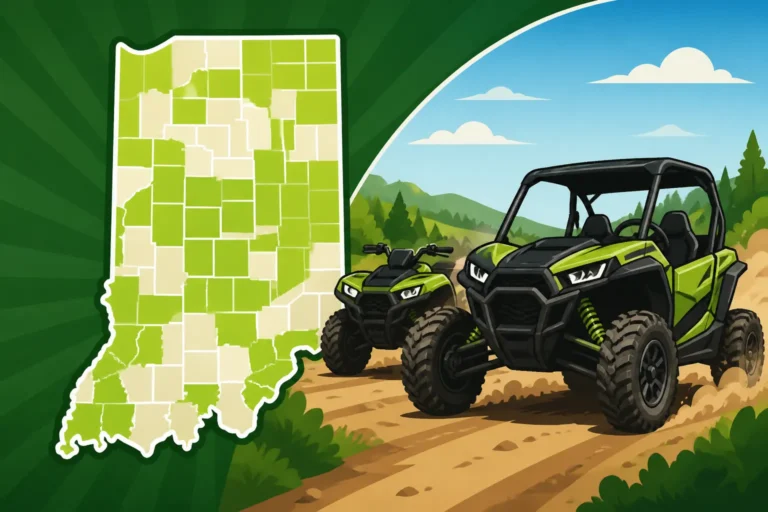
These ordinances are not uniform; they vary dramatically from one county to another. Some counties might open nearly all their paved and gravel roads to ORVs, while others might designate only a few specific routes, or none at all. This creates a patchwork of regulations across Indiana, meaning what's legal in Hancock County might be strictly forbidden just over the county line in another.
The burden is entirely on the rider to know and understand the specific ordinances of the county they plan to ride in. You cannot assume that because you saw ORVs on the road in one part of Indiana, it's permissible everywhere else. Ignorance of the law is never an excuse, and a simple ride could turn into a costly citation if you haven't done your homework on local regulations.
Exceptions to the Rule: When You Can Legally Ride Indiana Roads
Despite the general prohibition, there are specific, limited circumstances where ORVs can legally interact with public roads in Indiana. These aren't blanket permissions, but rather carefully defined exceptions designed to facilitate access or address practical needs. Knowing these nuances is crucial for any rider who wants to stay on the right side of the law.
Crossing Roads: The Quick Dash Across
One of the most common and widely recognized exceptions allows ORV operators to cross a public road. This isn't about riding on the road for any distance, but rather bridging a gap between two pieces of private property, or two sections of a trail, where a public road intervenes. Imagine you're on your own land, and your property continues on the other side of a county road – you can cross it.
The rules for crossing are strict and must be followed precisely to remain legal. You must come to a complete stop before entering the roadway. Then, you must yield to all oncoming traffic, ensuring the path is clear. Finally, you must cross the road at a right angle (as close to 90 degrees as possible) to the flow of traffic, taking the most direct route across to the other side. You can't weave, drive along the road to find a better crossing point, or make a casual turn. [Crossing a Road on an ORV in Indiana]
This exception is designed for minimal interaction with public traffic and maximum safety. It acknowledges the reality of land parcels and trail systems being bisected by roads, providing a legal way to navigate these interruptions without opening the floodgates to general road use. Remember, this is a quick, direct transit, not a detour or a short ride down the pavement. [Crossing Square to the Lanes]
Riding Shoulders and Ditches: The "Safe Harbor" Zones
In situations where a designated ORV trail or private property is adjacent to a public road, Indiana law sometimes permits ORV operators to ride in the shoulder or ditch. This isn't a license to cruise down the road; it's a very specific allowance intended for situations where there's "sufficient width" on the shoulder or in the ditch to operate safely, completely away from the traveled portion of the roadway.
"Sufficient width" is the key here. It means there must be enough space for your ORV to travel entirely off the paved or graveled surface meant for vehicular traffic, without infringing on it. This also implies that the shoulder or ditch must be passable and safe for ORV use, free from deep culverts, dangerous drop-offs, or dense vegetation that would force you closer to the roadway. You can’t just squeeze by on a narrow shoulder if it puts you too close to passing cars.
This exception allows riders to navigate along certain stretches, perhaps to reach a designated crossing point, access a drive, or connect to another section of off-road property, without ever entering the main flow of traffic. It's a practical solution for land access, but it demands extreme caution. Always be aware of your surroundings, other vehicles, and pedestrians, and be prepared to stop or yield if conditions become unsafe. [The Shoulder and Ditch Exception in Indiana]
Designated County Roads: The Local Option
The most significant way ORVs gain access to public roads in Indiana is through local county ordinances. Counties have the power to designate specific roads, or even categories of roads, within their jurisdiction as open to ORV use. This is where the real opportunities for road riding arise, but it also creates the complex, county-by-county variability that riders must navigate. [How an Indiana County Opens Its Roads]
When a county passes such an ordinance, it typically outlines which roads are open (e.g., all county roads, only specific marked routes, or only gravel roads), along with any additional rules that apply. These rules can include restrictions on hours of operation, age limits for drivers, specific lighting requirements (beyond what's standard on an ORV), and sometimes even mandatory insurance. It's not a free-for-all; it's a structured permission.
These designated roads are usually county roads, which are maintained by the county highway department and are distinct from state routes or city streets. Often, they are less trafficked and have lower speed limits, making them potentially safer for shared use. Riders need to be acutely aware of where county jurisdiction ends and city or state jurisdiction begins, as the rules can change immediately. [County Roads Outside a City's Limits]
Navigating County Ordinances: Finding Open Roads Near You
The idea of riding your ORV on public roads in Indiana sounds liberating, but the reality is that it requires a good deal of homework. You can’t just assume the rules from one county apply to the next. Each local ordinance is a unique puzzle, and understanding its specific pieces is your responsibility as a rider.
Researching Local Laws: Your First Step
Before you even think about putting tires on pavement, your absolute first step must be to research the specific ORV ordinances of the county you intend to ride in. This isn't a suggestion; it's a necessity. What's legal in one county could lead to a hefty fine and a stern lecture from a sheriff's deputy in an adjacent one. The state provides a framework, but the counties fill in the details.
The best place to start your research is often the county clerk's office or the county government's official website. Many counties publish their ordinances online, making them relatively accessible. Look for terms like "Off-Road Vehicle Ordinance," "ATV/UTV Use," or similar phrasing. If you can't find it online, a call to the county clerk's office or the county sheriff's department can usually point you in the right direction. Remember, asking is always better than getting caught unaware. [How to Find an Indiana County ORV Ordinance]
This due diligence is crucial because there is no statewide "map" of ORV-friendly roads. Each county has made its own decision, often based on local factors like population density, road types, and citizen input. For example, a rural county with vast farmlands might be more inclined to open roads for farm access than a suburban county focused on residential traffic. Validating the rules for your specific area is non-negotiable.
Key Elements to Look For in an Ordinance
Once you've found a county's ORV ordinance, don't just skim it. Read it carefully, because the devil is in the details. Local ordinances often include specific requirements that go beyond general state ORV registration. These can be critical to whether your machine is considered legal for road use in that particular area.
Look for provisions concerning operator age. Some counties, like Vanderburgh, raise the minimum age for road operation to 18, even if the state allows younger riders off-road under supervision. Pay close attention to lighting requirements; while most ORVs have basic lights, some ordinances might mandate additional headlights, taillights, or even turn signals to be street-legal. [Indiana Lighting Requirements for ORVs] You might find that enhancing your lighting with aftermarket kits from a brand like SuperATV could be necessary to meet specific county requirements for visibility.
Insurance is another big one. While Indiana doesn't broadly mandate ORV insurance for all riding, specific county ordinances often do require proof of liability insurance for road use. This protects both the rider and other motorists in case of an accident. Finally, check for any time-of-day restrictions (e.g., no night riding) or prohibitions on certain types of roads (e.g., no state highways, even within county limits). Understanding these specific demands is what separates a legal ride from a ticket.
Notable Counties That Have Opened Roads (and Their Quirks)
Indiana's approach to ORV road use is a patchwork quilt, with several counties having taken the initiative to open up their roads. However, even among these, the rules are rarely identical. Here are a few examples of how different counties have approached the issue, highlighting the need for specific research.
Hancock County is one example where ORVs are allowed on county roads. Riders can access the majority of the county roads, providing significant freedom of movement. However, even in Hancock County, you still need to be mindful of city limits and state highways, where the county ordinance does not apply. [Riding Hancock County Roads] This means a seemingly continuous route can quickly become illegal if you cross into a town or onto a state-maintained road.
Dearborn County has also opened its county roads, notably through Section 70.04 of its ordinance. This allows for ORV use on county roads, but again, the details matter. Riders must adhere to specific safety rules and respect the limits of the ordinance, ensuring they're not inadvertently entering prohibited areas or violating speed limits. [Riding Dearborn County Roads] This level of detail confirms that general knowledge isn't enough; you must dive into the specific text.
Vanderburgh County offers a more detailed example with its color-coded map, which helps residents visualize designated ORV-friendly roads. [Reading Vanderburgh's Color-Coded Map] However, Vanderburgh also imposes stricter operator requirements, mandating that ORV operators on public roads must be at least eighteen years old and possess a valid driver's license. [Vanderburgh's Eighteen-Year-Old Operator Rule] This is a significant difference from off-road park rules or the state's general age guidelines, emphasizing why local rules must be prioritized. They also require carrying proof of insurance.
Brown County enacted an ORV ordinance in 2024, responding to local interest and the unique landscape of the area. [Brown County's 2024 ORV Ordinance] Like other counties, it sets out specific parameters for where and how ORVs can be ridden on its roads. This continuous development of local laws means riders must check for the most current information, as ordinances can be amended or new ones created.
Rider Responsibilities and Safety When Road Riding
Getting permission to ride on an Indiana road is just the first step. True responsibility lies in understanding and adhering to the safety requirements and best practices that accompany this privilege. Riding an ORV on a public road, even a legally designated one, is inherently different and potentially more dangerous than trail riding.
Essential Gear and Machine Requirements
When you're riding your ORV on designated public roads, your machine needs to be in top condition, and you need to be properly equipped. While most ORVs come with basic lights, some county ordinances may demand more. For instance, specific brightness levels for headlights, additional taillights, or even turn signals might be required to ensure your machine is as visible as possible to other motorists. Checking these details in the local ordinance is key.
Beyond lighting, ensure your brakes are in perfect working order, and your tires are suitable for mixed terrain, as pavement can wear off-road-specific tires quickly. While not always mandated by law for ORVs, consider adding mirrors if your machine doesn't have them, especially if you're riding on roads with traffic. Having a clear view of what's behind you is a fundamental safety practice on any public road. You can find robust aftermarket mirrors and enhanced lighting options from companies like SuperATV that are built to withstand off-road abuse but provide street-level visibility.
And, of course, protective gear. Indiana law mandates helmets for all ORV riders under 18 on public lands and public roads. [Indiana Helmet Law for Riders Under 18] However, even if you're an adult and not legally required to wear a helmet on a county-designated road (where the rules can vary), it's always the safest choice. A DOT-compliant helmet, eye protection, sturdy footwear, and long pants/sleeves offer vital protection in the event of a fall or collision. [Indiana Helmet Law for ORV Riders]
Understanding Age and Supervision Rules on Public Roads
Age restrictions for ORV operators can be a maze, varying significantly between state-level recreational rules, state parks, and local county road ordinances. While Indiana generally allows younger riders (e.g., 14 and older) to operate ORVs on private property or designated trails, often with adult supervision, these rules frequently tighten up when it comes to public roads.
Many county ordinances that open roads to ORVs will raise the minimum operator age to 16 or even 18, and typically require the operator to hold a valid driver's license. [Indiana Minimum Age to Ride an ORV] This is because operating an ORV on a public road means sharing space with licensed drivers in traditional vehicles, and the assumption is that the ORV operator should possess similar driving experience and understanding of road rules.
For example, Vanderburgh County specifically states an 18-year-old minimum for road riding. [Vanderburgh's Eighteen-Year-Old Operator Rule] If you're riding with a younger family member, you must confirm they meet all age, license, and supervision requirements for that specific county's road use. Allowing an underage or unlicensed rider on a public road, even a designated one, can result in severe penalties for both the rider and the owner of the machine. [Indiana Rules for a Rider Under 14]
Insurance and Registration: The Paperwork You Need
Before your wheels touch any Indiana road, even a designated county road, ensure all your paperwork is in order. First and foremost, your ORV must be properly registered with the Indiana Bureau of Motor Vehicles (BMV) and display the current ORV decal. This is a statewide requirement for almost all ORVs used off private property, and certainly for those used on any public land or designated public road. [Indiana ORV Registration Cost]
While Indiana does not have a statewide mandate for ORV insurance, many counties that allow ORVs on their roads do require liability insurance. This is a crucial detail to check in the specific county ordinance. If insurance is required, you must carry proof of that insurance with you whenever you're operating the ORV on their roads, just as you would with a car. [Indiana ORV Registration and Insurance Proof] This is about financial responsibility and protecting others on the road.
Always carry your ORV registration certificate and proof of insurance (if required) with you while riding. Keep them in a waterproof pouch or a secure compartment on your machine. Should you be stopped by law enforcement, these documents will be among the first things they ask for. Having them readily available and valid will make the interaction smooth and prevent further issues.
What Happens If You Ride Illegally?
The thrill of riding an ORV is undeniable, but the legal landscape around road use in Indiana is clear: disregard the rules, and you risk serious consequences. It's not just a slap on the wrist; illegal ORV operation on public roads can lead to significant financial penalties, legal trouble, and even the loss of your machine.
Penalties and Fines: Not Just a Warning
Operating an ORV illegally on an Indiana public road, whether it's an unregistered machine, riding on a non-designated road, or violating a county's specific ordinance, is typically classified as a Class C infraction. What does that mean for your wallet? A Class C infraction can carry a fine of up to $500. [What a Class C ORV Infraction Costs in Indiana] This isn't a minor parking ticket; it's a substantial sum that can quickly make your fun day out very expensive.
Beyond the initial fine, there can be additional costs. For instance, if your machine is unregistered when you're caught, you could face separate fines for that violation as well. [Indiana Fines for an Unregistered ORV] Repeated offenses can lead to escalating penalties, potentially moving from infractions to misdemeanors with even higher fines and more severe legal consequences.
Law enforcement officers, including county sheriffs and Indiana conservation officers, are well-versed in ORV regulations. They are actively patrolling, especially in areas known for illegal riding. They won't just give you a warning for flagrantly breaking the rules; they are there to enforce the law, and that often means issuing citations and fines.
Owner Liability and Machine Impoundment
It’s not just the rider who can face consequences; the owner of the ORV can also be held liable for illegal operation. Indiana law specifies that an owner can be held responsible if they knowingly permit an ORV to be operated illegally. [Why an Indiana Owner Is Liable] This means if you lend your quad to a friend or family member who then rides it on a prohibited road, you could face legal repercussions alongside them.
In more serious cases, especially for repeat offenses or if the ORV is involved in an accident while being operated illegally, the machine itself can be impounded. This means your prized ORV could be seized by law enforcement and held until fines are paid, court appearances are made, and any other legal requirements are met. The impoundment fees alone can quickly add up, turning an already costly situation into a nightmare.
Imagine having your machine towed away, paying hundreds of dollars in fines, and then facing additional storage fees just to get it back. This can quickly overshadow any momentary pleasure gained from an illegal ride. It's a stark reminder that the responsibility of safe and legal operation rests heavily on both the operator and the owner.
Safety Risks and Accident Liability
Beyond the legal and financial penalties, the most severe consequences of illegal ORV road use are the safety risks. ORVs are not designed for road travel. Their suspension, tires, and handling characteristics are optimized for off-road terrain, not high-speed pavement. Riding on paved roads can cause instability, especially when encountering other vehicles, potholes, or sudden braking situations. This significantly increases the risk of accidents.
If an accident occurs while you are operating an ORV illegally on a public road, your liability can be astronomical. Your standard ORV insurance policy might not cover incidents that occur while the machine is being used in violation of local laws. This means you could be personally responsible for property damage to other vehicles, medical expenses for injured parties, and even legal defense costs.
The human cost is also immeasurable. Collisions between ORVs and passenger vehicles often result in severe injuries or fatalities for the ORV operator and passengers due to the lack of protective enclosure. No shortcut or brief joyride is worth risking your life, the lives of your passengers, or the financial ruin that can come from an uninsured accident. Stick to the designated areas and respect the power of these machines.
Planning Your Road-Legal ORV Adventure in Indiana
Successfully and legally riding your ORV on Indiana’s public roads requires more than just knowing the rules; it demands careful planning and a commitment to responsible operation. Approaching it with a strategic mindset will ensure your adventures are both thrilling and compliant.
Combining Road Riding with Trail Access
For many riders, the primary appeal of road-legal ORV access isn't to cruise endless miles of pavement, but to connect the dots between trails, private lands, or even local gas stations and restaurants. Designated county roads can serve as invaluable links, allowing you to avoid trailering your machine for short distances between off-road areas. [Indiana Rules for Riding to a Trailhead]
The key here is meticulous route planning. You'll need to study maps, cross-reference them with county lines, and precisely identify which specific roads are designated for ORV use by local ordinances. Your goal is to create a seamless route that transitions from off-road trails to legal county roads and back again, without ever touching a prohibited section. This might mean longer, indirect routes, but it ensures legality.
Think of it like a puzzle. You have the main trail system, your private property, and then you're using the approved county roads as bridges to connect these pieces. Always know your entry and exit points for the designated roads, and have a clear understanding of the boundaries. Riding past a "Welcome to City X" sign could instantly turn your legal ride into an illegal one, as city ordinances often differ drastically from county rules.
Pre-Trip Checklist for Road Riding
Before you embark on any road-legal ORV adventure in Indiana, a comprehensive checklist can save you from headaches, fines, and potential dangers. This isn't just about legality; it's about ensuring your machine and your readiness for the unique challenges of road use.
- Ordinance Verification: Double-check the current county ordinance for your route. Rules can change, and what was legal last year might not be today.
- Machine Readiness:
- Tires: Inspect for proper inflation and wear. While knobby tires are great off-road, they wear faster on pavement and can affect handling.
- Brakes: Test thoroughly. You need reliable stopping power on roads.
- Lights: Check all headlights, taillights, and any additional lighting required by ordinance. Consider adding brighter LED options or mirrors from SuperATV for enhanced visibility.
- Horn: Ensure it’s working to alert other vehicles or pedestrians.
- Fluids: Top off oil, coolant, and check fuel levels.
- Safety Gear:
- Helmets: DOT-compliant for all riders, especially those under 18.
- Eye Protection: Goggles or a helmet visor are essential.
- Protective Clothing: Long sleeves, long pants, and sturdy footwear.
- Paperwork:
- ORV Registration: Current decal on the machine, and the physical certificate with you.
- Proof of Insurance: If required by the county ordinance.
- Driver's License: For all operators, if required by the county ordinance.
- Maps: Both digital and physical maps, highlighting your approved route.
Being prepared not only ensures compliance but also enhances your safety and enjoyment of the ride. A well-maintained machine and well-informed rider are the best defense against unforeseen issues.
Respecting the Community and Environment
When you ride your ORV on public roads, even legally designated ones, you become an ambassador for the entire off-roading community. Your actions reflect on everyone who enjoys this pastime. This means riding responsibly, courteously, and with respect for both the environment and the local community.
Keep noise levels in check. While ORVs can be loud, excessive noise can annoy residents and create negative perceptions. Drive respectfully, observe posted speed limits (which may be lower for ORVs in some ordinances), and yield to pedestrians, bicycles, and other vehicles. Remember that other road users might not be accustomed to sharing the road with ORVs, so extra caution and defensive driving are essential.
Never deviate from designated roads onto private property or sensitive environmental areas. Trespassing is a serious offense, and damaging fragile ecosystems can lead to trail closures and stricter regulations for everyone. By consistently demonstrating responsible behavior, you help foster a positive image for ORV enthusiasts and ensure that these road access privileges are maintained and potentially expanded in the future.
Indiana ORV Road Use Comparison
| Feature | General Indiana Road Use (Default) | Designated County Roads (Via Ordinance) |
|---|---|---|
| Legality | Generally Prohibited | Legal, but with specific conditions and limitations |
| Crossing Roads | Permitted (complete stop, yield, right angle crossing) | Same rules apply |
| Shoulder/Ditch Riding | Permitted if "sufficient width" and away from traveled lane | Same rules apply, may be integrated into designated routes |
| Limited-Access Highways | Strictly Prohibited | Strictly Prohibited |
| State Routes | Generally Prohibited | Generally Prohibited |
| Operator Age | Varies by private land/trail rules (e.g., 14+ w/supervision) | Often 16 or 18+, typically requires valid driver's license (county specific) |
| Helmet Requirement | Under 18 (public lands/roads) | Under 18 (county specific), recommended for all |
| Insurance Requirement | Not statewide for all ORV use | Often mandatory (county specific) |
| Registration (BMV) | Required for public land/road use | Always Required |
| Fines for Violation | Class C Infraction (up to $500), potential impoundment | Violation of ordinance can lead to similar fines and penalties |
| Best Practice | Always assume closed unless specific exception or ordinance applies | Research specific county ordinance thoroughly before riding |
Disclaimer
This article is for general informational purposes only and does not constitute professional advice. Laws, prices and regulations vary by location and change over time. Consult a qualified professional for guidance on your specific situation.