Indiana Rules for Riding a Highway Shoulder
It can be incredibly frustrating when you just want to move your ATV or UTV a short distance, say, from your cabin to a friend’s property down the road, or between two sections of private land that are divided by a public thoroughfare. You know that Indiana generally keeps off-road vehicles off paved roads, but what about the shoulder? Is there a hidden rule, an exception that allows you to ride the very edge of a highway? This guide is going to meticulously break down Indiana's specific rules regarding riding a highway shoulder, helping you understand exactly what's allowed, what's not, and the crucial details that could keep you out of trouble.
Understanding the General Prohibition of ORVs on Indiana Roads
Let's start with the baseline, because it's important to understand why the shoulder rule is even an exception. Generally speaking, off-road vehicles (ORVs) like ATVs, UTVs, and dirt bikes are not considered street-legal in Indiana. They aren't designed for road travel; they lack many of the safety features, like turn signals, rearview mirrors, and often the proper lighting, that regular cars and trucks are legally required to have. This isn't just about what your machine can do, but what the law permits it to do on public thoroughfares.
The frustration here is totally valid. You've got a perfectly capable machine, and you're not trying to cruise down I-65. You just need to cover a short, non-trail distance. However, the state's stance is pretty clear: most public roads are off-limits for ORVs. This blanket rule is designed for safety, aiming to keep slower, less visible, and differently-handled vehicles off roads designed for faster, more conventional traffic. It can feel restrictive, especially if you live in a rural area where a county road or state highway is the only thing separating your property from a fantastic riding spot or a neighbor's field. Many riders scratch their heads, wondering, "So, I can't even ride the edge of the road?" Well, sometimes you can, but it comes with very specific caveats, and it's not a free pass. It’s crucial to know [Why Indiana Roads Are Closed by Default].
The "Shoulder and Ditch" Exception in Indiana
This is where things get a little more nuanced and offer a glimmer of possibility for ORV riders. Indiana law does provide a limited exception for ORVs to operate on the shoulder or in the ditch of certain public highways. But before you get too excited and fire up your quad, there are some really important conditions you absolutely must understand. This isn't permission to travel miles down a state highway, nor is it a green light for every road in the state.
The primary intent of this exception isn't to create new riding trails, but rather to allow ORVs to legally connect properties or access trails where a brief, necessary interaction with a public road is unavoidable. Think of it as a very narrow bridge, not a highway ramp. The law is trying to balance public safety with the practical needs of landowners and riders in certain situations. It acknowledges that sometimes, there simply isn't an alternative path. It's important to remember that this is an exception to a general prohibition, meaning it's interpreted strictly. If you're on the shoulder, you're expected to be there for a specific, limited purpose and duration, not for recreational cruising.
Defining "Shoulder" and "Sufficient Width"
So, what exactly does Indiana mean by "shoulder"? It's more than just the grassy bit next to the pavement. Legally, the shoulder is that portion of the highway immediately adjacent to the roadway, designed for emergency use, parking, or where a driver might pull over. Crucially, it's not the paved lane itself. You must remain off the actual portion of the road intended for motor vehicle traffic.
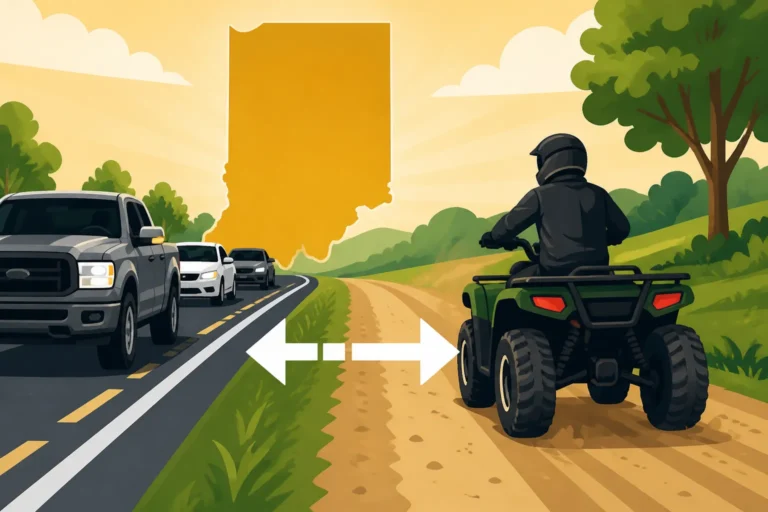
A critical part of this exception is the requirement for "sufficient width to ride away from traffic." This is perhaps the most subjective and important aspect of the rule. It means the shoulder or ditch must be wide enough for your ORV to safely operate without posing a hazard to other vehicles on the roadway, or to yourself. There's no exact measurement in the statute, which can be frustrating. What one officer considers "sufficient" might be different from another, or different from your own judgment. However, the general principle is clear: your machine should not encroach upon the travel lane, nor should you be riding so close to it that a sudden swerve or bump could put you in harm's way. This means riding as far to the right as safely possible, completely off the paved surface designed for cars. This is where [Sufficient Width to Ride Away From Traffic] becomes a real consideration. If the shoulder narrows, disappears, or is obstructed, your ability to legally use it likely ends right there.
Highways Where Shoulder Riding Is Strictly Prohibited
Even with the shoulder and ditch exception, there are absolute no-go zones. You are strictly prohibited from operating an ORV on any "limited access highway." These are typically major interstates, toll roads, and some four-lane divided highways where access is restricted to designated entrance and exit ramps, and where no direct access to adjacent property is provided. Think I-70, I-65, or I-74. You'll also find state routes and U.S. highways that are built to limited-access standards. This restriction is non-negotiable and for very good reason: the speeds are higher, the traffic volume is denser, and there simply isn't a safe "shoulder" in the same sense as a rural two-lane road. Attempting to ride an ORV on the shoulder of such a highway would be incredibly dangerous and would almost certainly result in a hefty citation for [Indiana Fines for Illegal ORV Road Use].
Conditions for Permissible Shoulder Use
Alright, so if you're not on a limited-access highway and the shoulder is wide enough, what else do you need to know to stay legal and safe? There are several other conditions that must be met, and they all boil down to safety and minimizing interference with regular road traffic.
Maintaining Minimal Interference
The core principle here is that your ORV use on the shoulder should cause the absolute minimum amount of interference or disruption to other traffic. This means you aren't allowed to impede the flow of traffic, even if you’re technically off the main lanes. If a road worker needs that shoulder, or an emergency vehicle needs to pass, you must yield immediately and ensure your presence doesn't create a hazard. This rule implicitly suggests that your travel on the shoulder should be relatively brief and purposive, not extended joyrides. You should be using the shoulder to accomplish a short, necessary traverse, not to extend your trail system.
Operating at Safe Speeds and With Care
While there might not be a specific speed limit for ORVs on shoulders in Indiana law, the expectation is that you will operate at a safe and reasonable speed given the conditions. This usually means a speed significantly lower than the posted speed limit for the roadway itself. You're not trying to keep up with cars; you're trying to safely traverse the shoulder. Extreme caution is paramount. The shoulder can have debris, uneven surfaces, soft spots, or sudden drop-offs that aren't present on the main roadway. You need to be constantly aware of your surroundings, both on the shoulder itself and the traffic moving beside you.
Furthermore, if you're riding a UTV, make sure everyone is properly belted in. Even if your machine is equipped with SuperATV aftermarket safety components like improved harnesses or roll cages, the law dictates that occupants are properly restrained. Your machine, whether an ATV or UTV, needs to be in good working order, with functional brakes and steering, just like any vehicle interacting with public infrastructure.
Visibility Requirements, Especially After Dark
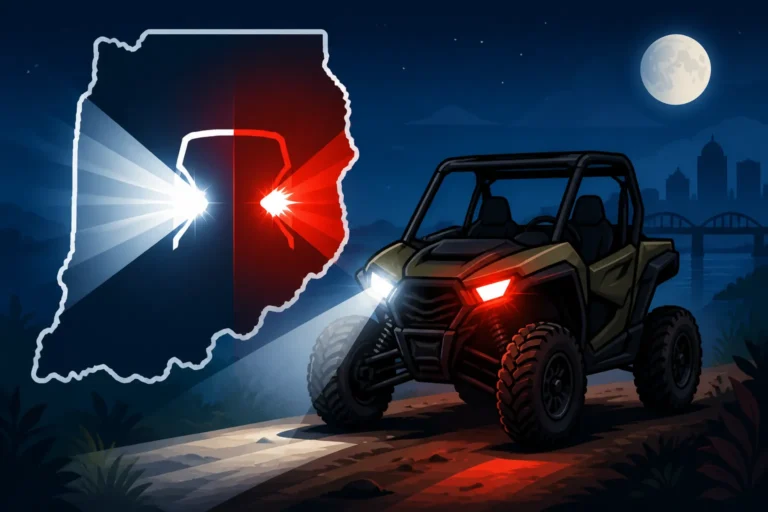
This is a huge one, and often overlooked. If you are operating an ORV on the shoulder during hours of darkness, or at any time when visibility is low (like fog or heavy rain), your machine must be equipped with proper lighting. This typically includes a headlight visible from at least 500 feet to the front and a taillight visible from at least 500 feet to the rear. Additionally, some riders choose to add amber lights or flags for increased visibility during the day, which is a smart move, even if not explicitly mandated for shoulder use by state law. Being seen is paramount, especially when sharing space, however minimal, with faster-moving traffic. You need to understand [Indiana Rules for Riding After Dark] and apply them stringently when on a shoulder.
Differentiating Shoulder Use from Designated County Roads
It's absolutely critical to understand that riding a highway shoulder under this specific exception is not the same thing as riding on a county road that has been designated as open to ORV traffic. This is a common point of confusion for riders, and misunderstanding it can lead to trouble.
When an Indiana county "opens" its roads to ORVs, it's a formal process. The county commissioners or council pass an ordinance specifically allowing ORV travel on certain roads within their jurisdiction. These roads are usually identified, sometimes by signage or a published map. On these designated roads, ORVs are often allowed to operate directly on the paved surface, much like a car, though still subject to speed limits, licensing requirements for the operator, and insurance mandates specific to that county's ordinance. [How an Indiana County Opens Its Roads] involves a clear legislative act.
The shoulder and ditch exception, however, is a state-level allowance that applies anywhere a shoulder or ditch of sufficient width exists, unless a local ordinance specifically prohibits it, or it's a limited-access highway. You're not operating on the road itself; you're operating beside it. This distinction is vital because the rules and expectations are different. If you're on a designated county road, you're expected to act more like a car (within the ORV-specific rules). If you're on a shoulder, you're expected to minimize your footprint and avoid the main flow of traffic entirely.
Here's a quick comparison to help clarify:
| Feature | Riding a Highway Shoulder (State Exception) | Riding a Designated County Road (Local Ordinance) |
|---|---|---|
| Location | Strictly on the unpaved or emergency-use portion adjacent to the main roadway. | Directly on the paved surface of specific, marked county roads. |
| Purpose | Brief transit, connecting properties, accessing trails; minimal interference. | Recreational travel, access; treated more like conventional vehicles (with ORV rules). |
| Visibility | Required lighting for low light conditions; caution is paramount. | Specific lighting often mandated, similar to vehicles; adherence to traffic laws. |
| Speed | Safe and reasonable, typically much lower than road traffic. | Often subject to posted speed limits for the road, or specific ORV limits. |
| Operator | Typically requires a valid driver's license if crossing a roadway. | Often requires a valid driver's license for public road operation. |
| Insurance | Good practice, but not always explicitly mandated by state for shoulder use. | Frequently mandated by county ordinances for designated road use. |
| Local Control | County can prohibit shoulder use via ordinance. | County allows and regulates road use via ordinance. |
| Restrictions | Not allowed on limited-access highways. | Can be on any county road the ordinance designates. |
When in doubt, always assume the stricter interpretation. Always check local ordinances before you ride, because a county may have its own rules that either reinforce or restrict the state's shoulder exception. Knowing [Indiana Local Ordinances on ORV Riding] can save you a lot of grief.
Encountering Law Enforcement on the Shoulder
So, what happens if an Indiana conservation officer or local sheriff’s deputy sees you riding on a highway shoulder? If you're following all the rules – sufficient width, not on a limited-access highway, operating safely, and not causing interference – you should be fine. However, "should be fine" isn't the same as an absolute guarantee. Law enforcement officers have discretion, and if they perceive your operation as unsafe or as exceeding the intent of the exception, they might stop you.
During a stop, an officer will likely check a few things. First, they'll want to verify your ORV's registration. Remember, even if you're on the shoulder, your machine still needs to be properly registered with the Indiana Bureau of Motor Vehicles (BMV) and display the current decal. This is a baseline requirement for almost all ORV operation in the state, even on private land, unless specifically exempted for farm use. You should always have proof of [Registering an ORV in Indiana] and your registration certificate with you.
Second, they’ll assess your operation. Were you actually on the shoulder, or were your tires encroaching on the paved lane? Were you traveling at a speed that felt unsafe given the circumstances? Was your machine causing a dust cloud that obscured visibility for drivers? Were you stopping traffic or drawing undue attention to yourself? They will also look at your personal safety gear. While Indiana's helmet law primarily applies to riders under 18, it's always a good idea to wear one. Understanding [What an Indiana Officer Checks Roadside] can help you prepare.
Finally, they'll consider the intent. Are you clearly trying to get from one private property to another, or does it look like you're just using the shoulder as an extension of a trail for recreational purposes? While the law doesn't explicitly define "purpose," officers generally look for practical, necessary reasons for ORV presence on or near public roads.
If an officer determines you're in violation, you could face fines for operating an unregistered ORV, illegal road use, or other infractions. These fines can add up, making a quick, illegal jaunt on the shoulder very costly. It’s always better to err on the side of caution and ensure you’re unequivocally within the bounds of the law. You definitely don't want to receive [Indiana Fines for an Unregistered ORV] on top of a road-use violation.
Conclusion: Ride Smart, Stay Legal
Riding a highway shoulder in Indiana is not a straightforward "yes" or "no" answer, which is often the source of so much confusion and frustration for ORV owners. The state does provide a very specific, limited exception for ORVs to use the shoulder or ditch of certain public highways. However, this exception comes with strict conditions: you must be on a shoulder of sufficient width to keep you entirely separated from traffic, it cannot be a limited-access highway, and your operation must be safe, brief, and cause minimal interference to other vehicles.
The key takeaway is that this exception is designed for necessity, not recreation. If you're unsure about the width of a shoulder, the nature of the highway, or any local ordinances that might apply, it's always best to find an alternative route. Using a trailer to transport your ORV to a designated riding area or to the specific private property you intend to ride on is always the safest and most legally sound option. Before you even think about putting tires on that shoulder, ensure your machine is properly registered, and you're prepared to demonstrate that you understand and are adhering to all the rules. It's about riding smart, staying safe, and keeping yourself and others on Indiana's roads out of harm's way.
Disclaimer
This article is for general informational purposes only and does not constitute professional advice. Laws, prices and regulations vary by location and change over time. Consult a qualified professional for guidance on your specific situation.