Do You Need a Helmet Inside a Roll Cage?
A roll cage can make a UTV feel protected, but it does not automatically remove Indiana’s helmet requirement. The key question is who is riding and where: Indiana’s statewide rule for children under 18 is broader than a roll-cage exception listed in rules for state ORV areas. Here’s how to apply the rules without assuming the cage is a substitute for a helmet.
The short answer: children under 18 still need helmets
According to the Indiana Department of Natural Resources (DNR), all children under 18 must wear a helmet on or in an off-road vehicle (ORV) in Indiana. The rule applies to ATVs, UTVs, side-by-sides, and dirt bikes, and it applies on both public and private property. A roll cage does not create a general exception to that statewide requirement.
That means a child riding in a side-by-side must wear a helmet even if the vehicle has a roll cage, roof, doors, or seat belt. The same applies to a child in a fully enclosed cab: the statewide rule concerns being on or in an ORV, not whether the vehicle has an overhead structure. The DNR also states that using a car seat does not exempt a child under 18 from wearing a helmet.
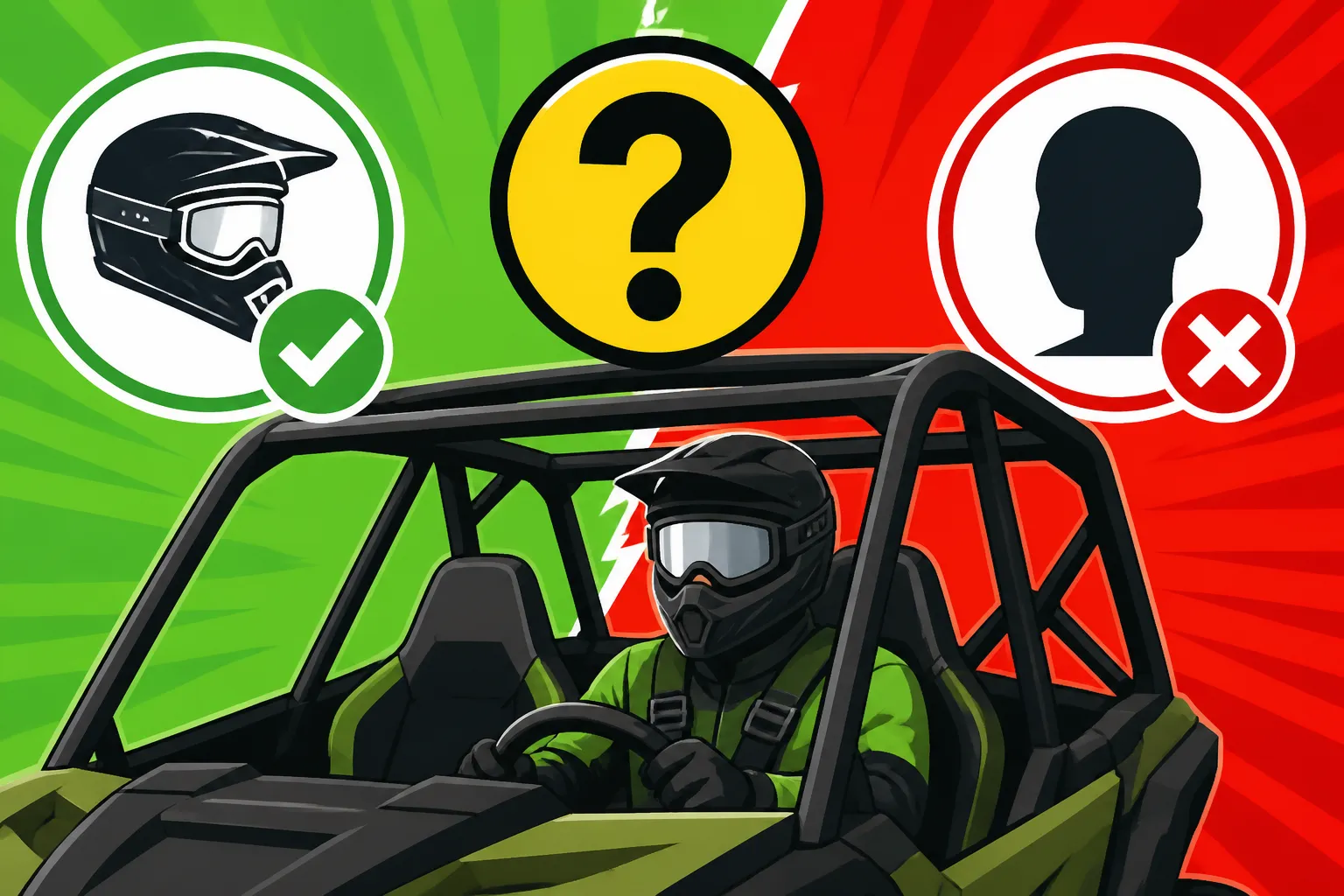
The rule is easy to mix up because DNR operating rules for its ORV properties describe a helmet exception for vehicles with fully enclosed metal cabs or roll bar protection. But that exception should not be read as permission for children to ride helmet-free. DNR separately states that children under 18 must wear helmets in side-by-side ORVs and UTVs. For a minor, the safe and rule-consistent answer is straightforward: wear a helmet, even inside the cage.
| Rider and vehicle | Does a roll cage remove the helmet requirement? | Practical answer |
|---|---|---|
| Child under 18 in an ATV, UTV, side-by-side, or dirt bike | No general statewide exception. The Indiana DNR requires children under 18 to wear helmets on or in ORVs. | Wear a helmet, including in a UTV with a cage or cab. |
| Adult in an ORV at a DNR ORV property | The DNR’s property rules list an exception for vehicles with fully enclosed metal cabs or roll bar protection. | Check the property’s current rules and any local requirements before riding. |
| Rider on private property | The Indiana DNR says the under-18 helmet rule applies on private as well as public property. | A private field or trail does not make a roll cage an exemption for a child. |
| Rider in a golf cart | The Indiana DNR excludes golf carts from the ORV helmet law. | Confirm that the vehicle is actually a golf cart, not a UTV or ORV described informally as one. |
For the broader statewide rule and its application to different machines, see Indiana Helmet Law for ORV Riders. If your question is about riding at a managed trail property, Indiana Helmet Rules at an ORV Park covers that setting, while The Enclosed Cab Exemption in Indiana focuses on the cab and roll-bar language.
Why the roll-cage language causes confusion
A roll cage or roll bar is a protective structure, but it is not the same thing as a helmet. More importantly, a rule that creates an exception for certain vehicles in one setting does not necessarily override a separate statewide requirement for a particular group of riders.
The DNR’s state-property operating rules say DOT-approved safety helmets are required except in vehicles with fully enclosed metal cabs or roll bar protection. The same DNR information says children under 18 must wear helmets in side-by-side ORVs and UTVs. Read together, the practical distinction is that the vehicle exception does not give a minor in a side-by-side permission to skip a helmet.
For an adult, the exception may matter at a DNR ORV property, but it should not be treated as a blanket statewide exemption. The statewide under-18 rule is clear, and county rules for road use can also add requirements. The DNR says laws governing ORV use on public roads are made individually by each county; local restrictions may cover helmet requirements as well as road access, hours, vehicle types, or insurance. If you plan to ride on a county road, check the rules for that county rather than relying on the vehicle’s cage.
A useful way to avoid confusion is to separate the questions:
- Is the rider under 18? If yes, the DNR’s statewide rule requires a helmet on or in an ORV, regardless of a roll cage.
- Is the ride on a DNR ORV property? Follow that property’s operating rules, including any rule for adult riders in a fully enclosed metal cab or a vehicle with roll bar protection.
- Is the ride on a public road? Check the local county ordinance. County road rules are not a substitute for the statewide rule for minors.
- Is the vehicle really a golf cart? Golf carts are excluded from the DNR’s ORV helmet law, but a UTV or side-by-side does not become a golf cart just because someone calls it one.
The private-property point is worth emphasizing. Riders sometimes assume that rules only apply at public parks or on roads. According to the Indiana DNR, the under-18 ORV helmet requirement applies on private property too. A family’s own land, a friend’s farm, or a private riding area is not a general helmet-law exception for a child. For more on that specific question, see Do You Need a Helmet on Your Own Land?.
Farm use has a separate qualification in the DNR information: the helmet law does not apply when an ORV is used for farm purposes, but it does apply when the machine is used for non-farm purposes. Do not assume that a machine is exempt simply because it belongs to a farm or is being ridden on farm property. The relevant issue is whether the ORV is being used for farm purposes. When the ride is recreational, treat it as a non-farm use and require a helmet for a child.
Choosing a helmet that meets Indiana’s standard
A helmet only helps with compliance if it meets the required standard. The Indiana DNR says approved ORV helmets must meet U.S. Department of Transportation standards. Helmets meeting FMVSS 218 must have a DOT sticker on the outside back of the helmet.
Check the actual helmet rather than relying on a product description, a cage, or a seller’s shorthand. A novelty helmet may look similar to a protective helmet without meeting the required standard. When buying, look for the DOT marking on the helmet itself and make sure the helmet fits the rider securely. If you shop through Amazon or another marketplace, verify the marking and product details before relying on a listing title or image.
For help checking the marking, see Checking for a DOT Sticker Inside Your Helmet. The title uses “inside,” but the DNR says the DOT sticker for a helmet meeting FMVSS 218 should be on the outside back. The physical marking on the helmet is the useful check.
A helmet also needs to be suitable for the rider and properly secured. A loose or poorly fitted helmet may shift during a ride, while a helmet that is too small may be uncomfortable enough that a child tries to remove it. Make helmet checks part of getting ready to ride: inspect the DOT marking, confirm the fit, and fasten the retention system before the vehicle moves. Those are practical safety steps; they do not replace the requirement to use an approved helmet.
Keep the same standard in mind for every seating position. A passenger in a side-by-side is still riding in an ORV, and a child’s seat belt or car seat is not a helmet substitute. The Indiana DNR specifically states that a car seat does not remove the helmet requirement for a child under 18. For more detail on the rule as it applies to UTVs, see Why Under-18 Riders Wear Helmets in a UTV and Indiana Rules for a Passenger Under 18.
Who can be held responsible if a child rides without one?
The obligation is not only on the child. The Indiana DNR says the operator of any vehicle is ultimately responsible for a helmet-law violation, and an adult responsible for the ATV can also be cited. Owners who allow children younger than 18 to ride an ORV without a helmet can be charged with a Class C infraction. According to the DNR, the maximum penalty for allowing a child under 18 to ride without a helmet is $500.
That is a reason to set the rule before anyone climbs in. An adult should check that each child has a compliant helmet, confirm it is fastened, and make clear that the roll cage does not excuse a minor from wearing it. If a child takes the helmet off during a stop, the vehicle should not move again until it is back on and secured.
The safest decision is also the clearest one: if anyone under 18 is riding in an ATV, UTV, side-by-side, or dirt bike, require a DOT-standard helmet even when the vehicle has roll-bar protection or an enclosed cab. Adults should check the applicable property and county rules, because a roll-cage exception in one set of operating rules does not automatically apply everywhere. When the rule is uncertain, wearing the helmet avoids relying on an assumption that may not fit the ride or location.
Sources
- Indiana Department of Natural Resources — Law Enforcement: Off-Road Vehicle Child Helmet Law (checked November 3, 2026)
- Indiana Department of Natural Resources — State Parks: Interlake Off-Road State Recreation Area (checked November 3, 2026)
Disclaimer
This article is for general informational purposes only and does not constitute professional advice. Laws, prices and regulations vary by location and change over time. Consult a qualified professional for guidance on your specific situation.