Showing a Permit at an Indiana Gate
A gate receipt, an ORV registration, and a decal do different jobs, and treating them as interchangeable can cause confusion before a ride even starts. If you are heading to an Indiana off-road area, the key is knowing which document the gate requires, what to keep with the operator, and why a trail-use permit does not replace vehicle registration.
What a permit at the gate proves
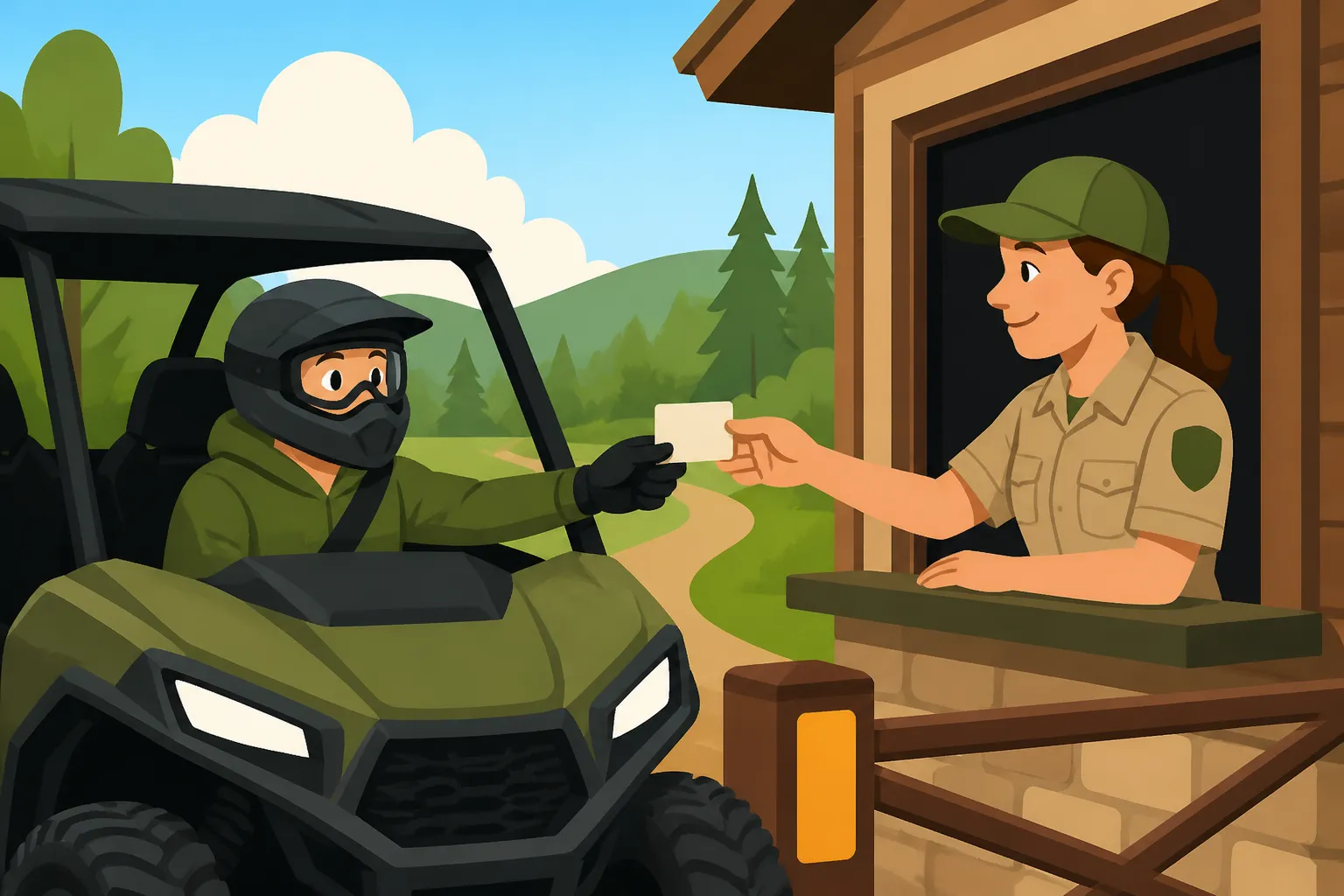
At Redbird and Interlake, the trail-use permit is about using the riding area. Indiana’s Department of Natural Resources says a valid daily receipt must be in the vehicle operator’s possession at all times. Keep it somewhere the operator can reach and show it if asked; do not leave it in the tow vehicle or with someone who is not riding.
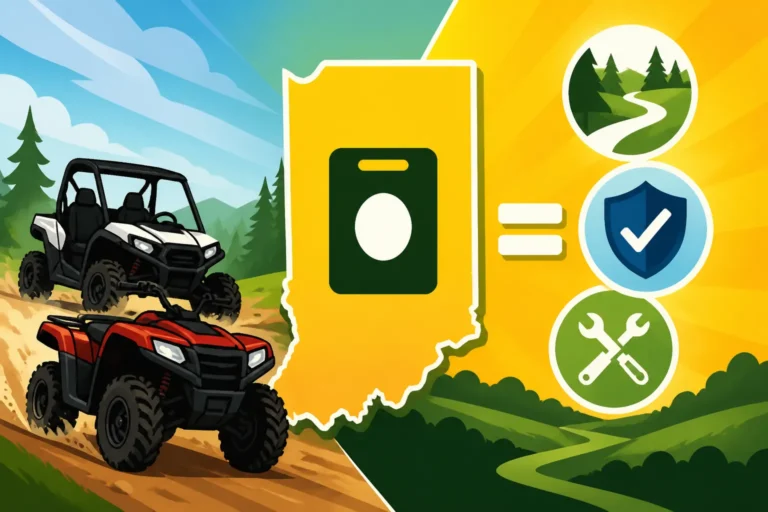
That receipt is not the same thing as an ORV registration. The Indiana Department of Natural Resources says a motorized trail-use permit is not an ORV registration. Registration and a trail permit answer separate questions: registration concerns the vehicle’s status under Indiana’s registration rules, while the trail-use permit concerns access to a particular riding property.
For a visit to Redbird or Interlake, plan to have the relevant trail-use permit or daily receipt ready for the riding area, along with any registration documentation that applies to your machine. The Indiana Department of Natural Resources identifies Redbird Off-Road State Recreation Area and Interlake Off-Road State Recreation Area as ORV properties. It also says the Out of State Motorized Trail Use permit is valid only at those two properties. A permit for those areas should not be treated as general permission to ride elsewhere in Indiana.
The distinction is easiest to keep straight when you think in terms of purpose:
| Item | What it is for | What it does not replace |
|---|---|---|
| Trail-use permit or valid daily receipt | Access to the designated riding property under its permit rules | Required ORV registration |
| ORV registration certificate | Registration information for the machine | A trail-use permit or entrance authorization |
| Registration decal | Display of the machine’s registration | The operator’s daily trail receipt |
| Bill of sale | Evidence of a recent purchase and, in qualifying cases, a temporary registration exemption | A trail-use permit |
The Indiana BMV issues a certificate of registration and two decals for each ORV registration. The Indiana Department of Natural Resources says the valid daily receipt must be in the operator’s possession at all times. Those are different documents, so having a decal attached to your machine does not mean you can leave the trail receipt behind.
For a fuller explanation of which permit fits your plans, see Indiana’s Daily and Annual Trail Permits. If you are deciding where to obtain one, Where to Buy an Indiana ORV Permit covers that question. Check current property instructions before leaving, especially if your trip involves a different type of permit or a change in plans.
What to have ready when you arrive
Before unloading, gather the documents that apply to your ride and make sure the operator can access them. The practical goal is to avoid searching through a truck, trailer, or several riders’ bags while trying to establish what covers the vehicle and the property.
A useful pre-arrival check is:
- Confirm the riding property and permit type. Make sure the permit is for the area where you intend to ride. The Indiana Department of Natural Resources says the Out of State Motorized Trail Use permit is valid only at Redbird and Interlake.
- Keep the trail receipt with the operator. The Indiana Department of Natural Resources requires the valid daily receipt to be in the vehicle operator’s possession at all times.
- Check the machine’s registration status. The Indiana BMV says ORVs operated in Indiana must be registered and display valid decals unless an exemption applies.
- Have the registration information available. The Indiana Department of Natural Resources says an ORV registration includes a registration number specific to the machine, along with owner and vehicle information.
- Keep any purchase paperwork accessible if the machine is newly bought. A qualifying bill of sale may matter for a temporary registration exemption, but it is separate from the trail permit.
The Indiana Department of Natural Resources says ORV registration must include a registration number specific to the ORV. It also lists owner name and address, year, manufacturer, make, model, and VIN as registration information. If your certificate is available, keep it with the rest of your ride paperwork rather than relying only on a photo of the decal.
The BMV issues the certificate and decals, while the DNR property’s trail-use rules govern the riding permit. That means a staff member checking a trail receipt and an officer checking registration are looking at different requirements. A permit receipt may show that you have paid or qualified for property use, but it does not by itself establish that the machine is registered.
A small document pouch can make the handoff from parking area to trail less hectic. Keep paper documents protected from mud and water, but do not store the only copy somewhere the operator cannot reach. A waterproof pouch available through Amazon may be one option; any suitable pouch works if it keeps the documents legible and easy to retrieve. For paperless backup, a phone photo can be useful, but do not assume it substitutes for a document the rules require you to possess.
It also helps to keep each machine’s paperwork together when several people are riding. Match the receipt and registration information to the correct machine before unloading. The specific registration number is tied to the ORV, and a group’s permit paperwork should not be confused with another rider’s documents. For situations involving multiple vehicles, Does Every Machine in the Truck Need Its Own Permit? can help you think through the permit question.
Visitors and two kinds of eligibility
Visitors from outside Indiana may have more than one route to consider, depending on where they will ride and whether the machine is registered elsewhere. The important distinction is between an exemption from Indiana registration for a limited visit, a trail-use permit for a DNR riding property, and registration needed for an ORV used on an Indiana roadway open to ORVs.
The Indiana BMV says a nonresident ORV registered in another state is exempt from Indiana registration for up to 20 days in one year. That exemption does not turn a trail-use permit into registration. It also does not mean a visitor can use an out-of-state trail permit as a substitute for the machine’s home-state registration.
Separately, the Indiana Department of Natural Resources says out-of-state visitors to Redbird and Interlake can purchase an Out of State Motorized Trail Use permit to ride at those properties. The agency describes that permit as an alternative to state ORV registration for use at those two DNR properties, but also says it is not an ORV registration and is valid only at Redbird and Interlake. Treat these as distinct rules: the property permit concerns riding there, while the registration exemption concerns whether Indiana registration is required for the qualifying nonresident machine.
If your trip includes an Indiana roadway that is open to ORV use, do not assume the property permit covers that part of the trip. The Indiana Department of Natural Resources says an out-of-state visitor who wants to drive on Indiana roadways open to ORV use must have the ORV registered in the home state or through the Indiana BMV. The agency also says out-of-state owners whose machines are not registered in their home state must apply in person at an Indiana BMV branch if they want to drive on those roadways.
Road access is another separate question. The Indiana Department of Natural Resources says counties make their own rules governing ORV use on public roads, and local restrictions can include limits on roads, vehicle types, hours, age, insurance, equipment, or other conditions. A trail-use permit does not grant road access. Before planning a route beyond the riding property, review Does Indiana Honor Out-of-State Registration? and Indiana’s Twenty-Day Visitor Rule, then check the rules for the county and roads involved. Indiana Rules for Riding a County Road explains why an open-road route requires its own check.
A simple way to sort a visitor’s paperwork is to ask:
- Is the machine registered in its home state?
- Is the riding planned only at Redbird or Interlake, or does it include a roadway?
- Does the rider have the property’s required trail-use permit or receipt?
- If riding on a roadway, does the home-state registration or Indiana BMV registration meet the applicable requirement?
Do not use the property permit as a shortcut through those questions. If your machine is registered out of state but your trip is limited to a DNR riding area, the property permit and registration exemption may be relevant in different ways. If you plan to leave the property and ride a road, the roadway rule matters too.
If your paperwork is missing or your situation is unusual
If you reach the gate and cannot find your receipt, pause before riding. The DNR requirement is that the operator possess the valid daily receipt at all times. Do not rely on another person’s receipt, a registration decal, or a general assumption that payment was completed. Ask the property staff what options are available before entering the trail system.
If the missing item is your registration certificate or decal, that is a separate issue from a missing trail receipt. The Indiana Department of Natural Resources says requests for replacement registration documents or decals must be processed at a BMV License Branch. A riding property’s trail-use permit cannot replace that BMV process. For the paperwork requirements, see Indiana ORV Registration Paperwork; for a lost decal, see Replacing a Lost Indiana ORV Decal.
A recent purchase can create a different paperwork situation. According to the Indiana BMV, an operator with a bill of sale from a dealer or private individual that is no more than 45 days old is exempt from registration. The Indiana Department of Natural Resources says the bill of sale must include the purchase date, make, model, and VIN, and allows operation of a newly purchased vehicle for 45 days after purchase. Keep the bill of sale available if relying on this exemption. It does not replace a trail-use permit or daily receipt.
The BMV also handles registration renewals, and the Indiana Department of Natural Resources says renewals can be completed online at mybmv.com. That does not mean every registration problem can be fixed online: the agency says replacement documents and decals must be handled at a BMV License Branch. If a decal is damaged or missing, sort that out through the stated replacement process rather than assuming a trail receipt will cover the gap.
Keep the machine’s registration decal visible and the operator’s receipt accessible. According to the Indiana BMV, registration decals must be attached on the forward half of the ORV. The agency does not issue a license plate for an ORV, regardless of modifications made to the vehicle. A plate-style holder or accessory should not be mistaken for a substitute for the required registration decal.
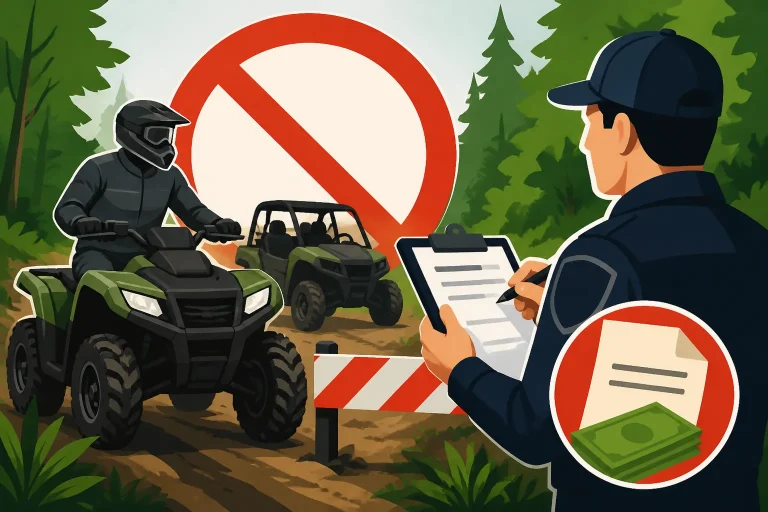
Finally, a permit does not suspend the other rules that apply at a property. The Indiana Department of Natural Resources says operators must stay in designated areas and on marked trails. It also sets requirements for helmets, supervision of young riders, passengers, seat belts in applicable vehicles, and vehicle equipment. For example, children under 18 must wear a helmet on or in an ORV in Indiana, according to the Indiana Department of Natural Resources. A receipt gets you only as far as the permit covers; the operator remains responsible for following the riding and safety rules.
Before the trip, verify the permit instructions for the specific property and check that the registration, decal, and any visitor documents match the machine you are bringing. On arrival, keep the daily receipt with the operator, and do not assume that one document can stand in for another. That simple separation—property access, vehicle registration, and any roadway eligibility—makes it much easier to show the right paperwork at the gate.
Sources
- Indiana Department of Natural Resources — State Parks: ORV/Snowmobile Registration FAQs (checked November 3, 2026)
- Indiana Department of Natural Resources — State Parks: Motorized Recreation (checked November 3, 2026)
- Indiana Department of Natural Resources — State Parks: Motorized Recreation (checked November 3, 2026)
- Indiana Bureau of Motor Vehicles — Registrations & Plates: Off-Road Vehicles and Snowmobiles (checked November 3, 2026)
- Indiana Department of Natural Resources — State Parks: Off Roading on County Roads (checked November 3, 2026)
- Indiana Department of Natural Resources — State Parks: Interlake Off-Road State Recreation Area (checked November 3, 2026)
- Indiana Bureau of Motor Vehicles — Registrations & Plates: Off-Road Vehicles and Snowmobiles (checked November 3, 2026)
Disclaimer
This article is for general informational purposes only and does not constitute professional advice. Laws, prices and regulations vary by location and change over time. Consult a qualified professional for guidance on your specific situation.