Indiana Helmet Rules at an ORV Park
Indiana’s helmet rules can feel unclear because a statewide age rule is only part of the picture: an ORV park may set additional conditions, and UTVs raise different questions from ATVs. The safest plan is to check the property’s current rules, bring a properly fitted helmet for every rider, and avoid assuming a roof or roll cage counts as an enclosed cab.
What Indiana’s helmet rule means at an ORV park
Indiana’s general rule focuses on riders under 18: a helmet is required for an operator or passenger under that age when riding an off-road vehicle. That rule gives families a useful baseline, but it does not automatically tell you every requirement at a particular trail system or private park.
A public ORV area can have property-specific rules. A private park can also set its own entry conditions. Those rules may be stricter than the statewide minimum, so an adult rider should not assume that being legally allowed to ride without a helmet means the park will let them ride without one. Check the park’s current information and posted signs before unloading.
| Situation | Practical approach |
|---|---|
| Rider or passenger under 18 | Wear a helmet; do not plan a ride without one |
| Adult at a DNR ORV area | Check the site’s current rules and signs; wearing a helmet is the safer default |
| Adult at a private park | Follow the park’s entry and riding requirements |
| UTV occupant | Check both helmet and seat-belt rules; a roof or roll cage is not automatically an enclosed cab |
| Unclear or conflicting instructions | Ask park staff before riding |
The statewide baseline is covered in Indiana Helmet Law for ORV Riders. For a closer look at the two state ORV areas, see Indiana Helmets at Redbird and Interlake and Indiana Helmet Rules at a State ORV Area. These distinctions matter because a rider may meet the general legal requirement but still be subject to a park’s own safety policy.
It also helps to separate a helmet requirement from other rules. A helmet does not make an unregistered or unpermitted vehicle legal, and it does not replace any age, supervision, or vehicle-operation conditions. Review Indiana Minimum Age to Ride Public Land if a young person is riding, and check Indiana State Park Rules for Riders Under 16 for the separate rules that can apply to younger riders.
Choosing a helmet that works for the ride
A helmet should fit securely, stay in place when fastened, and be appropriate for the type of riding. For trail use, riders commonly choose a full-face off-road helmet with eye protection. A helmet that is too loose, damaged, or difficult to fasten is a poor choice even if it looks suitable.
Look for a helmet that meets the applicable safety standard and has the required certification marking. In the United States, a DOT marking is commonly used to identify a helmet designed to meet federal motorcycle helmet standards. A decorative or novelty helmet may look similar but may not offer the same protection. Do not treat a product title, an attractive shell, or a seller’s general safety claim as proof of certification: inspect the helmet and its labeling.
Fit is just as important as the label. A helmet should sit level, feel snug around the head, and resist shifting when the rider moves it by hand. The chin strap should fasten securely. If the helmet presses painfully in one spot, slides around, or lifts easily, try another size or shape. Different brands can fit differently, so use the manufacturer’s sizing instructions and check the retailer’s return terms before ordering.
If shopping on Amazon, read the full product details and verify the certification marking on the actual helmet rather than relying only on a search result or product headline. Online listings can help compare sizes and styles, but a rider still needs to confirm that the helmet fits properly and is in sound condition. A used helmet with unknown crash history is difficult to assess, so replacing it is the more cautious choice.
Eye protection matters too. Dust, branches, and flying debris can make a trail difficult to navigate. Use goggles or a shield that works with the helmet and stays clear enough for the conditions. A helmet that fits but leaves the rider unable to see comfortably is not a good setup.
Bring a helmet for each person who might ride, not only the person operating the machine. A passenger may be covered by the same age-based rule, and a park may apply requirements to everyone on a vehicle. Avoid sharing one helmet among riders if it does not fit each person correctly.
ATVs, UTVs, and the enclosed-cab question
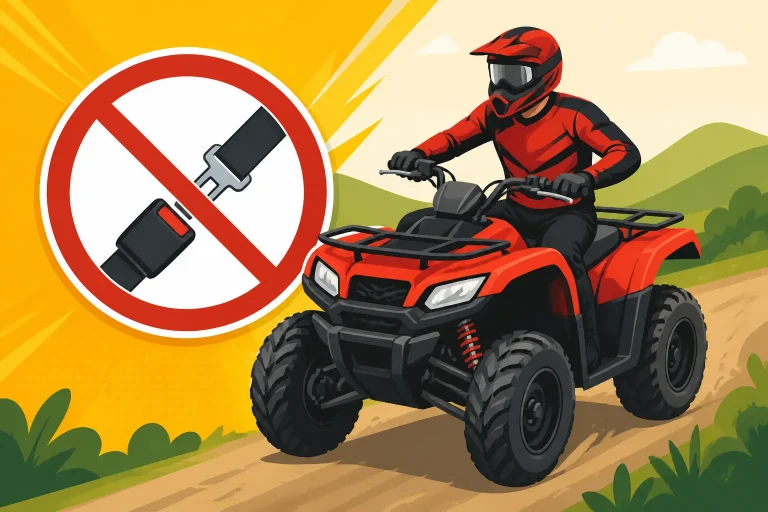
ATVs and UTVs are not the same from a helmet and restraint standpoint. An ATV typically does not have seat belts, while a side-by-side UTV usually has designated seats and restraint equipment. For a UTV, use the seat belt as designed and follow the park’s instructions about helmets.
Some Indiana rules recognize an exception for occupants in an enclosed cab. Do not assume that every UTV qualifies. A roll cage, roof, windshield, or doors by themselves do not necessarily make a vehicle an enclosed cab for purposes of an exception. If you believe an exception applies, verify the exact rule for your vehicle and the property where you plan to ride. When there is any doubt, wear a helmet.
Even if a vehicle has an enclosed cab, the exception should not be treated as a general safety recommendation. A UTV can roll over, collide with an obstacle, or expose occupants to debris. Wear the vehicle’s seat belts, keep all occupants seated, and use the helmet required by the park. The related rules are explained in Indiana Seat Belt Rules at an ORV Park.
Passengers also need a seat designed for them. Do not carry a person in a cargo area or on an improvised seat. Before the trip, make sure the vehicle’s capacity, restraints, and seating arrangements suit the people riding. If a child is involved, check the age and supervision rules as well as the helmet policy; Indiana Supervision Rules for Young Riders is useful context.
A helmet exemption, where it applies, does not mean the rider is exempt from every other park rule. It does not change the machine’s permitted use, passenger limits, seat-belt requirements, or trail restrictions. If the park staff gives an instruction that is stricter than your interpretation of a general rule, ask for clarification before riding rather than trying to resolve the issue on the trail.
Check requirements before unloading
Park rules can be updated, and special conditions may apply to a particular area, event, or vehicle. Confirm details directly with the property before a trip, especially if you are bringing a UTV, a young rider, or a helmet that may not have a familiar certification label.
A straightforward pre-ride check helps prevent a wasted trip:
- Identify whether the ride is at a state ORV area or a private park.
- Check the property’s current helmet and vehicle rules.
- Pack a correctly fitting helmet for every rider, including passengers.
- For a UTV, bring and use seat belts, and do not assume the vehicle qualifies for an enclosed-cab exception.
- Check age, supervision, permit, and trail conditions separately.
- Ask park staff before riding if a rule or vehicle classification is unclear.
Helmet requirements are only one part of preparing for public-land riding. Indiana state ORV areas may also have rules about permits, age, supervision, and vehicle operation. The park’s current instructions are the practical source for its entry conditions. Indiana’s Daily and Annual Trail Permits explains the separate permit question, while Indiana Safety Training for Riders covers training that can help young and new riders prepare.
A last-minute helmet problem is easier to solve at home than at the gate. Check the fit on every rider, confirm the strap works, and make sure the helmet is in good condition. If a rider needs a different size, handle that before the trip rather than counting on borrowing one at the park.
Disclaimer
This article is for general informational purposes only and does not constitute professional advice. Laws, prices and regulations vary by location and change over time. Consult a qualified professional for guidance on your specific situation.