Belting In at an Indiana Park Gate
At an Indiana off-road park, wearing a helmet does not take the place of fastening a seat belt. If you arrive in a UTV or another vehicle with seat belts, knowing which restraints apply can prevent a last-minute scramble at the gate—and help keep everyone riding safely. Here’s how the rules fit together, including the important distinction for ATVs and dirt bikes.
Which riders need to buckle up
At Indiana’s state off-road recreation areas, seat belts are required for vehicle operators and occupants, with an exception for ATVs and dirt bikes. The Indiana Department of Natural Resources (DNR) sets that rule for its ORV properties, including Redbird and Interlake.
That means a driver and passengers in a UTV or side-by-side should use the available seat belts. The same applies to occupants of other vehicles covered by the park’s rule. Being inside a roll cage does not, by itself, remove the seat-belt requirement. A protective structure and a restraint do different jobs: the structure helps protect occupants if the vehicle rolls, while a belt helps keep them in their seats.
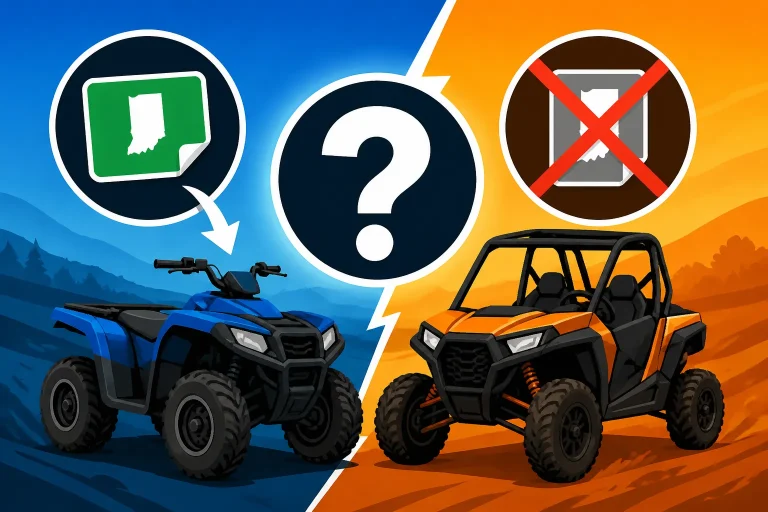
ATVs and dirt bikes are the exception because they do not use the same seat-belt rule. That does not mean every ATV can carry a passenger. The DNR says passengers are not allowed on ATVs or dirt bikes unless the machine was designed by its manufacturer for two-up riding. Check the vehicle’s design and instructions rather than assuming a passenger seat or rack makes a ride permissible.
| Machine at an Indiana DNR ORV area | Seat-belt rule | Practical takeaway |
|---|---|---|
| UTV or side-by-side | The DNR requires belts for operators and occupants. | Fasten each available belt before moving. |
| Other vehicle covered by the park rule | The DNR requires belts for operators and occupants. | Use the vehicle’s seat belts. |
| ATV | The DNR excludes ATVs from the seat-belt requirement. | Follow passenger limits; a passenger is allowed only on a model designed for two-up riding. |
| Dirt bike | The DNR excludes dirt bikes from the seat-belt requirement. | Ride as designed; the DNR does not allow a passenger unless the bike is built for two-up riding. |
The park’s seat-belt rule is separate from Indiana’s broader rules about helmets. If you are sorting out protective equipment for a family outing, Indiana Seat Belt Rules at an ORV Park and Indiana Helmet Rules at an ORV Park cover those requirements in more detail.
For practical purposes, treat a UTV’s belts as required riding equipment, not gear to use only on rough sections. Buckle up before setting off, keep the belt fastened while riding, and make sure each occupant has the restraint intended for their seat. A helmet, roll cage, or enclosed cab is not a reason to skip a belt where the park requires one.
Seat belts and helmets are separate requirements
It is easy to mix up the rules because seat belts, helmets, and roll protection all relate to rider safety. They are not interchangeable. The DNR requires seat belts for vehicle operators and occupants at its ORV areas, except on ATVs and dirt bikes. Its park rules also call for DOT-approved safety helmets, with an exception for vehicles with fully enclosed metal cabs or roll bar protection. Children under 18 must wear helmets in side-by-side ORVs and UTVs.
That last requirement matters: even if a vehicle has roll bar protection, a child under 18 still needs a helmet in a side-by-side or UTV under the DNR park rule. And where seat belts are required, helmet use does not replace them. Riders in an enclosed or protected vehicle should check both requirements, not choose between them.
Indiana’s general helmet rule also requires children under 18 to wear helmets on or in an ORV, including ATVs, UTVs, side-by-sides, and dirt bikes, according to the DNR. The rule applies on public and private property. The DNR says owners who allow a child under 18 to ride without a helmet can be charged with a Class C infraction, with a maximum penalty of $500 as of November 2026. A car seat does not remove the helmet requirement for a child under 18.
For helmets, the DNR recognizes those meeting U.S. Department of Transportation standards. A helmet meeting FMVSS 218 must have a DOT sticker on its outside back. If shopping online, including on Amazon, check the actual helmet and its certification details rather than relying on a listing title or product description alone. A novelty helmet or a label that cannot be verified may not meet the park’s requirement.
The DNR identifies a farm-use exception to the general helmet law, but that is not a general pass for recreational riding. When an ORV is used for a non-farm purpose, the helmet rule applies. A recreational trip to an ORV park is not transformed into farm use simply because the machine is also used for farm work at another time.
For a closer look at how the cab and roll-protection exception works alongside the child helmet rule, see The Enclosed Cab Exemption in Indiana and Why Under-18 Riders Wear a Helmet in a UTV. When requirements overlap, follow each applicable rule: a vehicle’s protection features do not automatically cancel every other safety requirement.
Get the vehicle and occupants ready before riding
A smooth arrival starts with checking the machine, the people riding in it, and the paperwork before unloading. The DNR requires all Indiana off-road vehicles to be registered or street legal at its ORV areas. It also requires vehicles to be used only in designated areas and to stay on marked trails.
For a UTV, check that the seat belts are present and usable, then confirm that every occupant has a place with an available belt. If a belt is damaged, missing, or will not latch, do not assume the roll cage makes the vehicle acceptable. Contact the park before the trip to ask what to do with that machine.
Before heading onto a trail, the DNR also requires functioning spark arrestors and mufflers on off-road vehicles. Tire chains and studded tires are prohibited at its ORV areas. These are separate from the belt rule, but checking them at home is easier than discovering a problem after you have arrived.
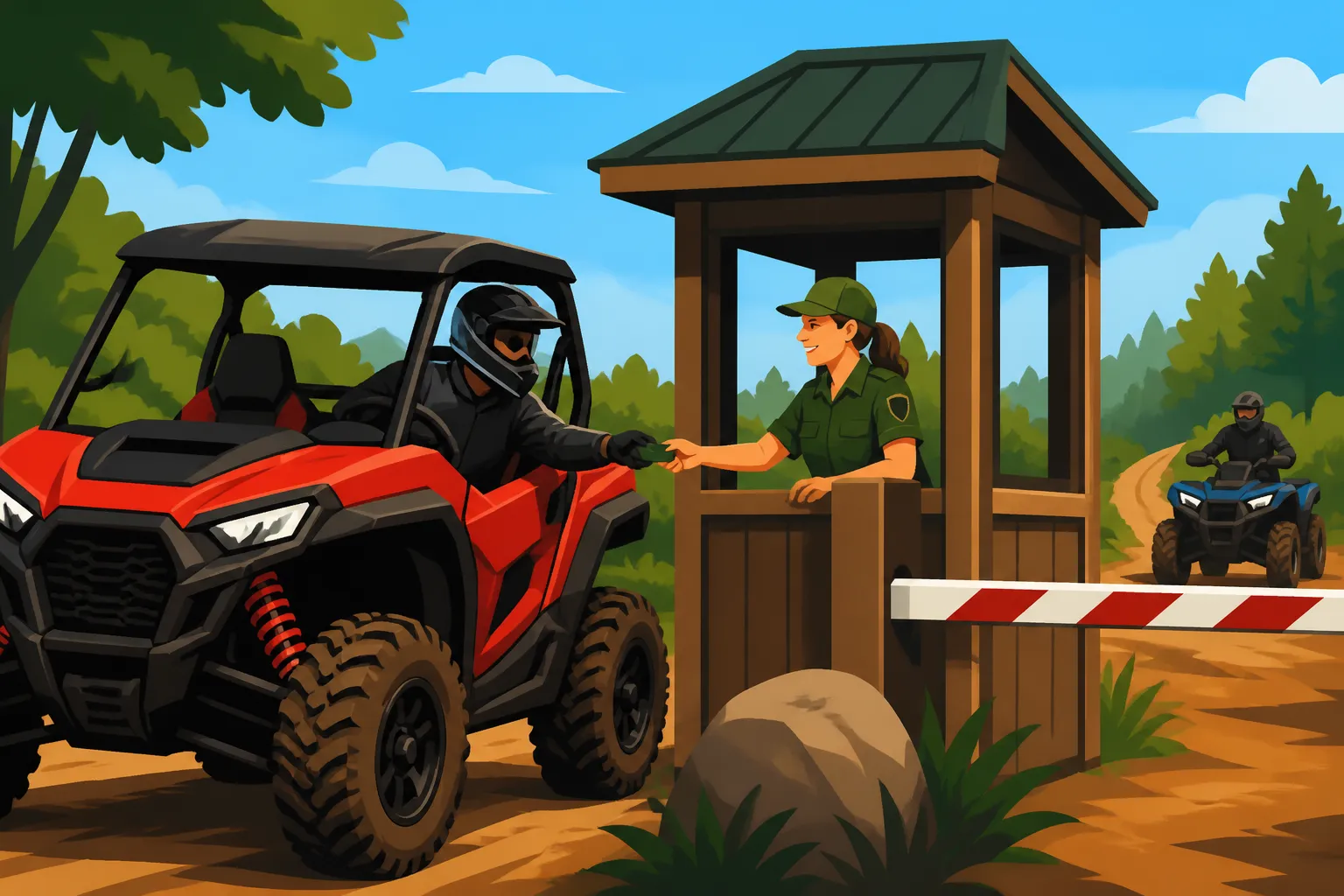
The DNR requires the valid daily receipt to be in the vehicle operator’s possession at all times. Keep it accessible while riding rather than buried in a bag or left in the tow vehicle. If you need an ORV trail permit, remember that a motorized trail use permit is not the same thing as an ORV registration. Indiana ORV Permits Explained and Do You Need a Permit for Indiana ORV Trails? can help distinguish the two.
It is also worth checking the rules for the particular property you plan to visit. Redbird and Interlake are DNR ORV properties, while privately operated riding areas may set their own entry requirements. Do not assume that a rule or permit accepted at one location applies everywhere. For state-property visits, Indiana’s Two State ORV Areas Compared can help with planning.
A pre-ride checklist can stay simple:
- Confirm that the vehicle is eligible to ride at the property and has the required registration or street-legal status.
- Check that every occupant who needs a seat belt can fasten one properly.
- Bring DOT-approved helmets and verify that riders who must wear them have one that fits.
- Keep the required daily receipt with the vehicle operator.
- Check the vehicle’s muffler and spark arrestor, and remove prohibited tire chains or studs.
- Review the park’s current information before loading, especially if the vehicle has a missing belt, unusual seating, or a modified cab.
These checks are useful whether the trip is a family outing or a ride with adults only. Adults are still subject to the seat-belt requirement in covered vehicles, and children may have additional helmet requirements. If the trip includes younger riders, A Passenger Under 18 at an Indiana Park is a useful companion topic.
What to do if your vehicle does not fit the rule clearly
Some machines do not fit neatly into an everyday label. A vehicle may have a cab, roll protection, unusual seating, or aftermarket changes. Do not guess that a modification changes its classification or exempts its occupants from restraints. The DNR says its helmet exception applies to vehicles with fully enclosed metal cabs or roll bar protection, while its seat-belt rule applies to vehicle operators and occupants except those on ATVs and dirt bikes.
If you are uncertain whether your machine counts as a UTV, another vehicle, or an ATV under the park’s rules, ask the property before traveling. Describe the machine and how it is configured rather than relying only on a sales label. A clear answer ahead of time is more useful than finding out at the entrance that your interpretation does not match the park’s.
Rental riders should ask the rental provider how the vehicle’s restraints work and whether every passenger has an appropriate seat and belt. Do not carry extra occupants on a lap or in a cargo area. The DNR’s passenger rule for ATVs and dirt bikes is based on whether the machine was designed for two-up riding; for other vehicles, follow the seating and restraint setup for that vehicle and the park’s requirements. For more on rentals, see Indiana Rules for Riding a Rented Machine.
If you are traveling from outside Indiana, do not confuse a park trail permit with permission to ride on public roads. The DNR says the out-of-state motorized trail-use permit is valid only at Redbird and Interlake. Nonresident ORVs registered in another state may be operated in Indiana for up to 20 days in one calendar year without Indiana registration, according to the Indiana Bureau of Motor Vehicles. If you want to ride a road open to ORV use, the DNR says your ORV must be registered in your home state or through the Indiana BMV. Indiana’s Twenty-Day Visitor Rule explains that distinction.
When you are packing, place helmets and any paperwork where they are easy to reach, and check that each UTV occupant knows how to latch and release their belt. The aim is not to turn arrival into a lengthy inspection routine. It is to avoid overlooking basic requirements while everyone is eager to unload and ride.
At the gate, the practical answer is straightforward: buckle up in a UTV or other covered vehicle, wear a helmet whenever required, and do not treat one form of protection as a substitute for another. If the machine’s classification or safety equipment is unclear, get confirmation from the park before the trip.
Sources
- Indiana Department of Natural Resources — State Parks: ORV/Snowmobile Registration FAQs (checked November 3, 2026)
- Indiana Department of Natural Resources — Law Enforcement: Off-Road Vehicle Child Helmet Law (checked November 3, 2026)
- Indiana Department of Natural Resources — State Parks: Interlake Off-Road State Recreation Area (checked November 3, 2026)
- Indiana Bureau of Motor Vehicles — Registrations & Plates: Off-Road Vehicles and Snowmobiles (checked November 3, 2026)
Disclaimer
This article is for general informational purposes only and does not constitute professional advice. Laws, prices and regulations vary by location and change over time. Consult a qualified professional for guidance on your specific situation.