Indiana Seat Belt Rules at an ORV Park
Indiana’s seat belt rule at an ORV park can be confusing because a quad and a side-by-side do not have the same equipment. The practical rule is straightforward: if the machine is equipped with seat belts, plan for every occupant to buckle up while riding on public land. Here’s how to apply that rule, what to check before setting out, and where park-specific rules may differ.
When Indiana’s seat belt rule applies
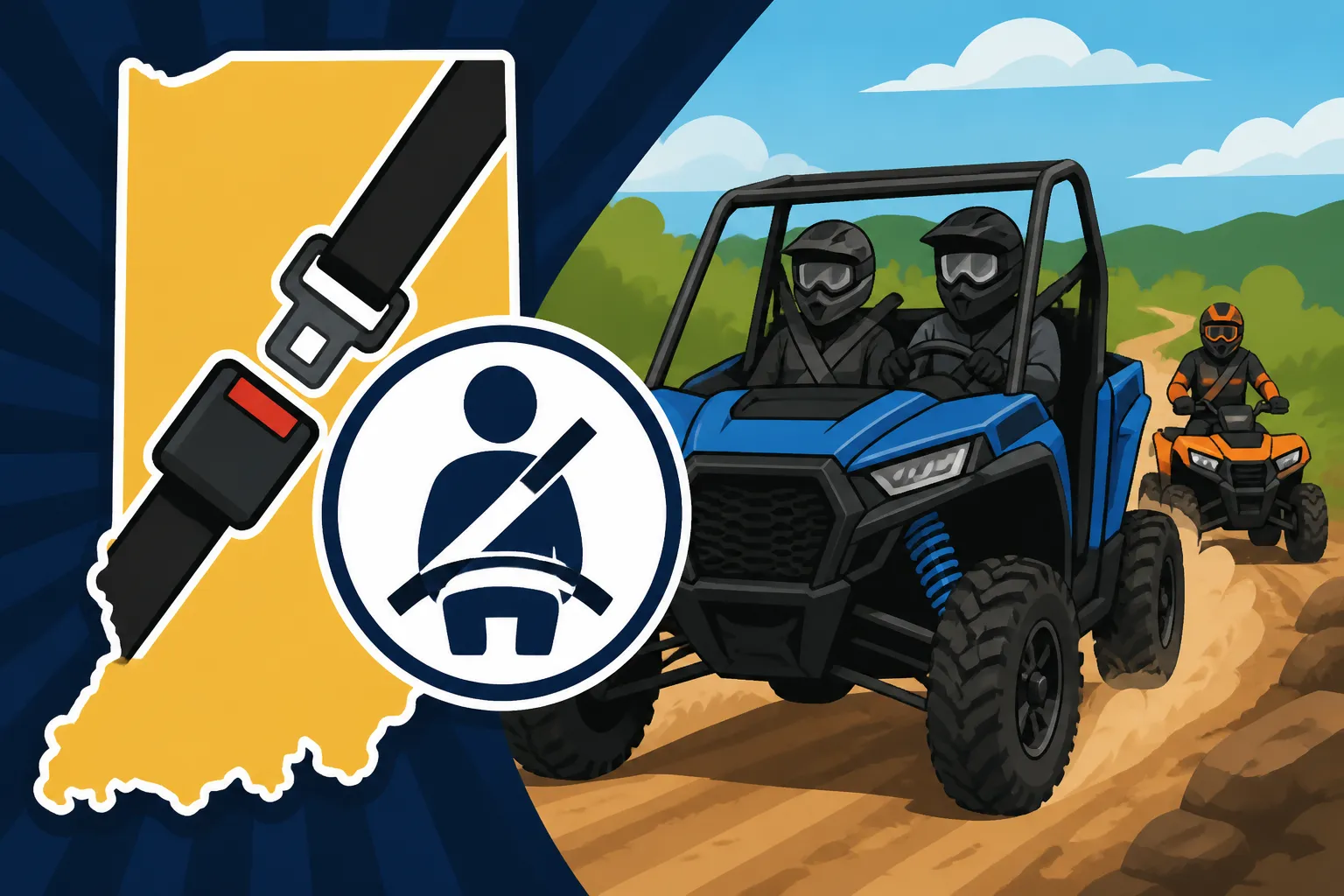
For riding on Indiana public land, use the seat belts installed in an ORV whenever the machine is equipped with them. That generally means the operator and passengers in a belt-equipped side-by-side should be buckled while the vehicle is moving. A state recreation area is public land, so do not assume that riding inside a designated ORV area makes the rule irrelevant.
The key distinction is equipment, not what riders happen to call the machine. A side-by-side with factory-installed belts is not exempt simply because it is being used off-road rather than on a public road. A passenger should not ride unbelted in a vehicle that has a belt for that seating position.
This rule is separate from registration and trail permits. A valid BMV decal or DNR permit does not replace the need to use required safety equipment. If you are unsure which permit applies to a visit, see Indiana ORV Permits Explained. Rules for visiting machines are covered in Does Indiana Honor Out-of-State Registration?.
The rule also does not mean that any belt arrangement is automatically acceptable. Use the belt provided for the seat, and keep the occupant in the intended seating position. Do not put two people in one belted seat, carry a passenger on a lap, or use a cargo area as a passenger seat. A belt cannot protect someone who is sitting somewhere it was not designed to secure.
Public land and private parks
Indiana’s public-land rules are not the only rules a rider may encounter. Private ORV parks can set their own operating and safety requirements, and those rules may apply in addition to state law. A park may, for example, require occupants to use belts, set passenger restrictions, or limit which machines may use particular trails.
Check the rules for the specific riding area before loading up. That matters if the trip includes both a private park and a state recreation area: a rule that applies at one location may not describe the requirements at the other. [Indiana Rules for Riding a Private Park] explains why a private riding area’s rules deserve a separate check.
Also check notices at the entrance and any trail-specific signs. Park rules, closures, and permitted vehicle types can vary by location and may change. A permit lets you use the area under its applicable conditions; it is not a blanket exemption from posted restrictions.
| Machine or situation | Seat belt approach |
|---|---|
| Side-by-side equipped with belts | Buckle each occupant into the belt for that seat while riding on public land |
| Quad or dirt bike without seat belts | There is no seat belt to wear; follow the separate rules for that machine |
| Belt-equipped machine at a private park | Follow the park’s rules as well as any applicable state requirements |
| Passenger without a designated seat and belt | Do not carry the passenger in that position |
| Belt that is damaged, missing, or will not latch | Do not treat the seat as safe to use; repair it before carrying an occupant |
Side-by-sides, quads, and passengers
A side-by-side usually has individual seats and a belt system because the occupants sit inside a frame or protective structure. If it has belts for the seats, occupants should use them. This applies to the operator as well as passengers; the driver’s belt is not optional just because the machine is traveling slowly or the route looks easy.
A quad is different. Many quads are designed with straddle seating and do not have seat belts. The belt rule does not create a belt where the machine has none, nor does it mean that a quad rider should improvise a restraint. Why Quads and Dirt Bikes Skip the Belt Rule covers that distinction. The absence of a belt does not remove other requirements, including rules about helmets, passengers, permits, and where the machine may be ridden.
Passenger capacity is another separate question. The number of belts does not necessarily tell you everything about who may ride or where. Follow the machine manufacturer’s passenger seating design and the park’s passenger rules. If a vehicle has a passenger seat and belt, use both as intended. If it has no passenger seat, a belt attached to a cargo rack or an improvised strap does not turn the rack into a passenger seat.
This is especially important for children. A child who cannot sit properly and stay secured by the belt may not be safely accommodated in that seat, even if the child is technically able to climb into the vehicle. Check fit before the ride: the belt should latch, sit correctly, and remain secured as the child sits back in the seat. Do not use a loose extension, tie, or other improvised adjustment to make a poorly fitting restraint seem usable.
Seat belts and helmets serve different purposes. A belt holds an occupant in the seat; a helmet protects the head. Wearing one does not cancel the other. Indiana’s public-land helmet requirements have their own age and equipment details, so check Indiana Helmet and Seat Belt Rules on Public Land and Indiana Helmet Rules at an ORV Park rather than assuming that a roll cage or belt answers every helmet question.
An enclosed cab can affect the helmet rule in some circumstances, but it does not make a seat belt unnecessary. If a machine has belts, continue to use them even when doors or a cab enclosure are installed. For the helmet distinction, see When an Enclosed Cab Excuses the Helmet Rule.
How to check belts before a ride
A belt rule is easier to follow when the vehicle is ready before reaching the trail. Inspect every seating position that will be occupied, not just the driver’s. Belts may be damaged, dirty, twisted, or difficult to latch after storage or a muddy outing.
Before leaving home:
- Count the occupants and seating positions. Confirm that each person has a proper seat and a working belt. Do not plan to carry more people than the machine is designed to seat.
- Inspect each belt. Look for cuts, fraying, pulled stitching, damaged buckles, or a retractor that does not work normally. Clear mud or debris that prevents the buckle from latching.
- Test the buckle. Latch and release each belt before loading the machine. A buckle that will not stay closed needs attention before the vehicle carries an occupant.
- Check the owner’s information. Use the manufacturer’s instructions for how the belt should fit and how the restraint system should be maintained. Do not substitute a generic strap for a model-specific restraint.
- Recheck after a repair or modification. If a seat, cage, belt, or mounting point has been changed, confirm that the restraint system is still suitable for that vehicle and seating position.
If a belt is missing or damaged, do not carry a passenger in that seat until it is properly repaired. A lap belt, shoulder belt, or complete restraint system should be replaced with a compatible part for the machine, not a piece of hardware selected only because it appears to fit. A dealer or qualified repair shop can help identify the correct replacement. Amazon may help locate parts by make and model, but confirm compatibility and installation instructions before ordering.
Do not remove a belt because it is uncomfortable, muddy, or inconvenient to clean. Nor should you change a belt’s mounting point or route it around a seat in a way the manufacturer did not intend. A restraint system works as a whole: the belt, buckle, anchor points, seat, and vehicle structure all matter.
Before riding, give passengers a short briefing. Show them how to buckle and release the belt, ask them to keep it fastened while moving, and explain that they should not lean outside the vehicle. The operator remains responsible for making sure everyone is seated and secured before moving off.
For a larger group, decide in advance which machine will carry each person. A spare seat in a different vehicle is not a safe plan unless that seat is designed for a passenger and has a functioning restraint where required. If someone cannot be seated and secured correctly, leave that person out of the ride rather than trying to improvise at the trailhead.
What to do at the park
At the entrance, read the current park notices and ask staff if a rule is unclear. That is particularly useful when a trip involves a rental, a borrowed machine, or a private riding area with its own conditions. Do not rely solely on what another rider says about a previous visit.
A rental does not automatically remove the operator’s responsibility to check the vehicle. Before leaving the staging area, confirm that the belts are present, latch correctly, and are being used by every occupant. If a belt is broken or a vehicle lacks the required seating arrangement for your group, ask the rental provider to resolve the problem before riding. See Indiana Rules for a Rented Machine for more on checking rules that apply to rented ORVs.
It is also worth distinguishing a belt issue from a permit or decal issue. Park entry requirements, an Indiana ORV permit, and the BMV registration decal address different obligations. A machine may need more than one of these depending on where it is being used. The documents do not authorize riding with a broken restraint or carrying an occupant in an unsuitable position. For permit planning, Where to Buy an Indiana ORV Permit and Indiana Rules for a Visiting Rider may help.
If an officer or park employee stops the group, stay calm and follow instructions. Be ready to show the required permit or registration documents and explain any equipment problem plainly. If a belt has failed during the day, stop using that seating position and contact park staff or the rental provider for guidance rather than continuing with an unbelted occupant.
The simplest way to avoid confusion is to check the machine, the passenger positions, and the rules for the riding area before the trip. For a belt-equipped side-by-side on public land, buckle every occupant into the proper seat. For a quad or dirt bike without belts, follow the rules that apply to that machine instead. Then check the park’s current requirements, because local conditions and private-park rules can add requirements beyond the general state rule.
Disclaimer
This article is for general informational purposes only and does not constitute professional advice. Laws, prices and regulations vary by location and change over time. Consult a qualified professional for guidance on your specific situation.