Carrying a Spare Can at Interlake
A spare fuel can can extend a ride at Interlake, but it also adds fire, spill, and handling risks. Before loading one, confirm that the park allows the container and how it must be carried. Then secure it for rough trails and plan where and how you will refuel without putting riders, machines, or the park’s land at risk.
Check Interlake’s rules before you pack fuel
A trail permit and permission to ride do not automatically answer whether a spare gasoline can may be carried, stored, or used at a particular park. Interlake’s current directions and site rules are the best place to check. If the guidance is unclear, contact the park before leaving home and ask specifically about portable gasoline containers on ORVs, in trailers, and at staging areas.
That extra check matters because rules can apply to different parts of a trip. A container might be treated differently while secured to a machine, sitting in a tow vehicle, or being used in a parking or staging area. Don’t rely on a rider’s post or an old trip report as proof that a practice is allowed today. Check current notices and ask park staff if you need a clear answer. Checking an Indiana Trail Notice First and Calling a Park Office Before You Load are useful steps when plans depend on a detail that isn’t obvious.
Keep the fuel question separate from the permit question. Indiana’s daily and annual trail permits cover trail access under the applicable program; they do not tell you how a fuel container must be handled. If you’re still sorting out access, see Indiana’s Daily and Annual Trail Permits. Riders visiting from another state should also check whether the Indiana Out-of-State ORV Permit or the visitor rule applies to their machine. Neither should be treated as a substitute for confirming fuel-container rules with Interlake.
Before heading to the park, check the current trail and facility notices as well. A closure, temporary restriction, or other operational notice can affect where you can ride or stop. Interlake at Lynnville is a useful starting point for planning the visit, while Indiana Trail Conditions Before You Ride can help you build a broader pre-trip check.
If you call or speak to staff, ask practical questions rather than only asking, “Can I bring gas?” For example:
- Is a portable gasoline can allowed on an ORV, or only in a tow vehicle?
- Are there restrictions on container type, size, or placement?
- Where may a rider safely refuel?
- Are fuel containers allowed in the staging or parking area?
- Is there a current closure or notice that affects my route or plan?
Write down the answer and follow any posted directions when you arrive. If a staff member or sign gives more specific instructions than your general trip plan, follow the park’s directions. If you cannot confirm that carrying the can is permitted, don’t assume it is; make a different fuel plan.
Choose and secure a suitable container
Use a container explicitly designed and rated for gasoline. A random jug, drink bottle, or container intended for another liquid is not a safe substitute. Fuel can damage unsuitable materials, leak through a poor seal, or create hazardous vapors. If buying online, including through Amazon, check that the listing identifies the container as suitable for gasoline and review its closure and carrying design rather than relying on a product photo alone.
A useful container should close securely, remain upright, and be appropriate for the way you plan to transport it. Follow the container maker’s instructions about filling, storage, and handling. Don’t fill it beyond the stated limit, and don’t leave fuel in a container that is cracked, swollen, damaged, or missing a cap or seal. If you’re unsure whether a container is in good condition, replace it rather than taking it on a rough ride.
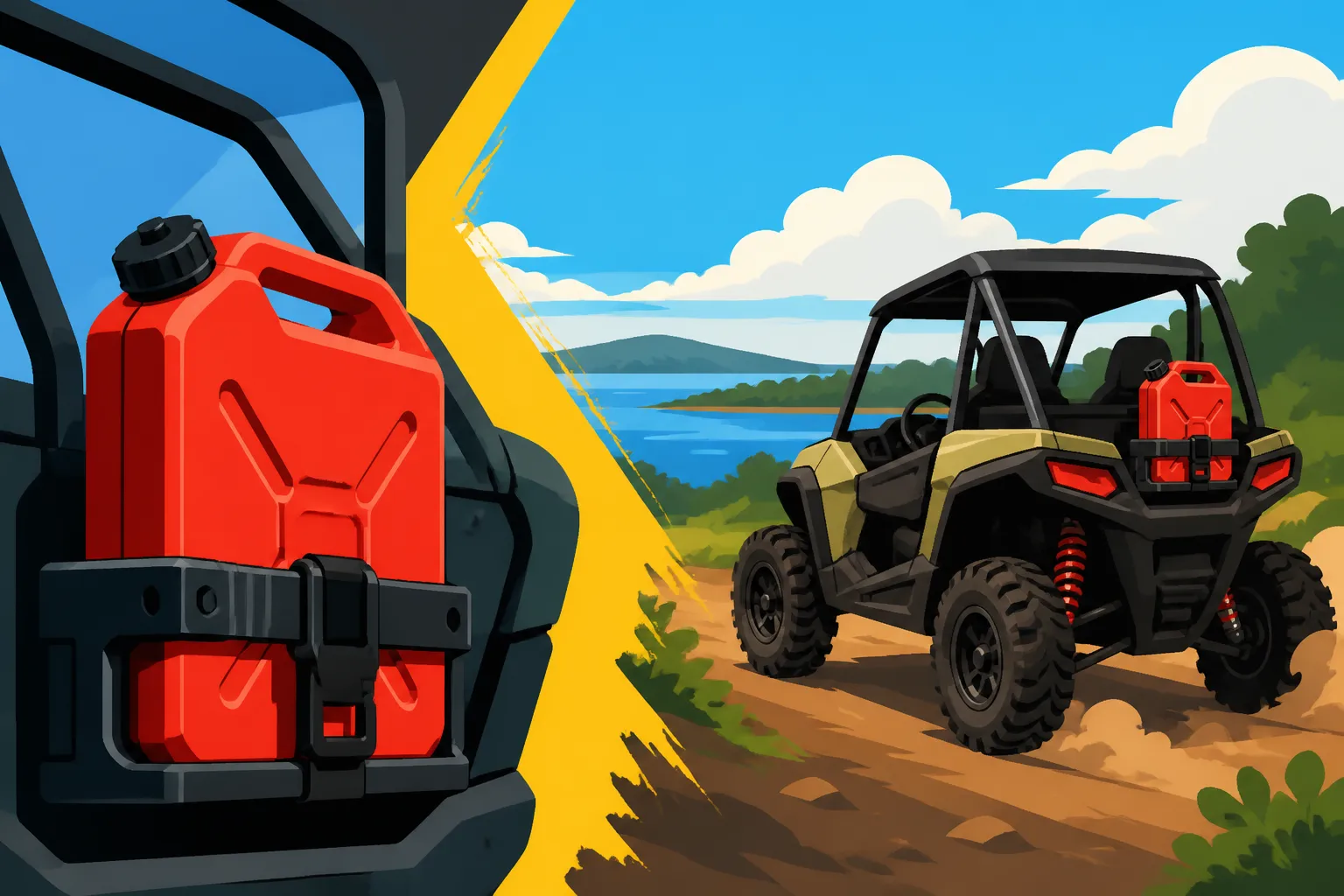
The biggest practical challenge on an ATV or UTV is keeping the can stable. Trail bumps, ruts, steep pitches, and repeated vibration can shift a poorly restrained load. Before riding, secure the can so it cannot slide, bounce loose, tip, rub against sharp or hot parts, or interfere with steering, suspension, controls, passengers, or your ability to get on and off the machine. Use a purpose-made carrier or a suitable restraint system, and check the setup by gently pushing and pulling the can before you set off.
Do not place a fuel can where it could be crushed in a rollover or spill onto a hot engine or exhaust. Avoid carrying it in a rider’s lap or loose inside the passenger area. On a UTV, a cargo bed may look convenient, but the can still needs to be secured against movement and protected from contact with hot surfaces. On an ATV, don’t improvise a mount that blocks the rider’s movement or puts the can close to heat. If there is no safe, stable place for it, carry it in the tow vehicle instead, if park rules allow that arrangement.
| Before the trip | What to check |
|---|---|
| Container | It is designed for gasoline, undamaged, and closes securely |
| Mounting | It stays upright and cannot shift, fall, or contact hot parts |
| Placement | It does not obstruct controls, a passenger, or safe access to the machine |
| Park rules | Staff or current notices confirm where the can may be carried and used |
| Fuel plan | You know when and where to refuel without rushing or improvising |
A can that is too large can be harder to secure and may add unnecessary weight. Bring only the amount that fits your route and machine, and account for the extra load when riding. A loaded machine can handle differently, especially on turns, slopes, and uneven ground. Keep luggage balanced and avoid stacking gear so high that it blocks your view or makes the machine unstable.
Do not carry an open container or leave a fuel-soaked rag with your gear. Keep fuel away from cigarettes, flames, sparks, and other ignition sources. If you transport the can in a tow vehicle, follow the container maker’s instructions and keep it upright and restrained; avoid leaving gasoline where vapors could collect in an enclosed space. If you have questions about transport in a vehicle or trailer, check the relevant safety guidance as well as the park’s rules.
Refuel carefully and respond to a spill
Refuel only in a place where the park allows it and where you can stop safely. Park on stable ground, away from other riders and sources of ignition. Turn the machine off and let hot components cool before opening the fuel container or tank. Follow the manufacturer’s refueling instructions for your machine and container. Never pour fuel while the engine is running, and don’t refuel in a way that spills gasoline onto the ground, water, a hot surface, or another person.
Take your time. Rushing to leave a stop is a common way to knock over a can, cross-thread a cap, or spill fuel. Keep the container steady while pouring, avoid overfilling the machine’s tank, and close both the container and tank securely afterward. Wipe up small drips with an appropriate absorbent material, handle the material safely, and don’t leave it behind. If a spill is larger than you can safely manage, or fuel reaches soil or water, stop and notify park staff. Don’t try to hide or wash it away.
A small spill can create more than a cleanup problem. Gasoline can ignite, damage vegetation, and contaminate water or soil. Keep children and other riders away from a spill, avoid starting a nearby machine, and don’t use a flame or anything that could spark. Follow staff instructions and any posted emergency directions. If there is a fire or immediate danger, move people away and contact emergency services.
Recheck the can and its restraint after rough sections and at each longer stop. Look for a loose strap, a shifted mount, a wet patch, or a strong fuel odor. If you notice a leak, don’t continue riding with the can attached. Move people away from ignition sources, avoid starting the machine, and ask park staff for help with the safest next step. A can that appears secure in the driveway may move after repeated jolts.
The simplest fuel plan is often the safest: estimate your machine’s consumption conservatively, start with an appropriate amount in the tank, and decide whether the extra can is actually needed. A spare can can be useful for a longer day or a machine with limited range, but it should not be a reason to ride farther than your fuel, daylight, equipment, and experience allow. For more park-specific considerations, see [Indiana Rules for Carrying Fuel] and Indiana Rules for Riding a Reclaimed Mine Park.
If Interlake’s current directions don’t clearly allow your intended setup, leave the can secured in your tow vehicle or change the plan only if that option is permitted. Don’t improvise a mount at the trailhead or assume another rider’s setup is acceptable. Confirm the rules before you unload, secure the container properly, and refuel only where and how staff allow.
Disclaimer
This article is for general informational purposes only and does not constitute professional advice. Laws, prices and regulations vary by location and change over time. Consult a qualified professional for guidance on your specific situation.