Overnight Parking at an Indiana Park
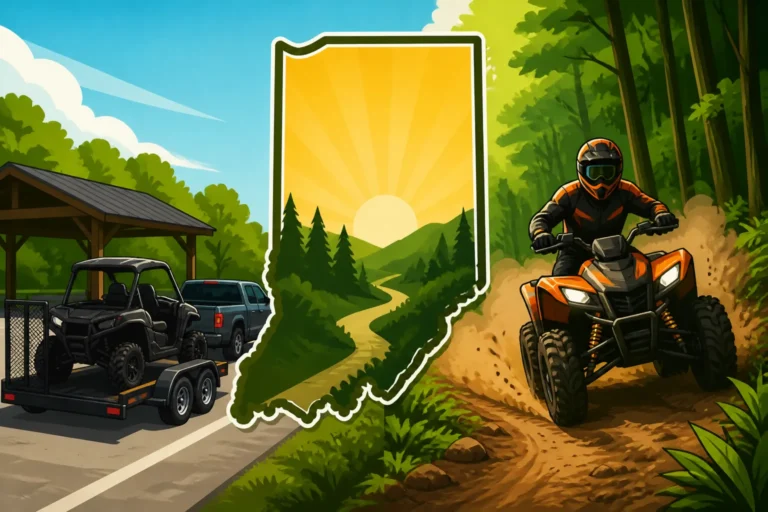
Arriving at an Indiana off-road park late, or wanting to leave a truck and trailer overnight, can turn a fun ride into a stressful guessing game. A staging lot is not automatically an overnight parking area, and park rules can differ. This guide explains how to check permission, choose a safer place to leave your rig, and avoid confusing overnight parking with camping.
Start by separating overnight parking from camping
A truck left overnight is not the same as a campsite
“Overnight parking” can mean several different things: leaving a tow vehicle in a staging area while you camp elsewhere, sleeping in a truck or trailer, or parking at a designated campsite. A park may allow one arrangement and prohibit another. It may also have different rules for cars, trailers, and off-highway vehicles.
That distinction matters at Indiana riding areas such as Redbird Off-Road State Recreation Area near Dugger and Interlake Off-Road State Recreation Area near Lynnville. A lot used for unloading during the day should not be treated as a place where you can leave a rig overnight unless the park or land manager says so. A gate being open when you arrive does not necessarily mean overnight parking is allowed.
Before you make plans, describe exactly what you want to do. For example: “Can I leave my truck and enclosed trailer in the staging lot overnight if I’m staying at a nearby campground?” is more useful than asking, “Can I park overnight?” If you plan to sleep in the vehicle, say so. If you have a trailer, ask whether it can stay attached or must be stored separately.
Camping permission does not automatically include parking permission
A campsite may include a place to park, but that does not mean every nearby staging lot is available for overnight use. Likewise, permission to park a vehicle overnight does not necessarily permit sleeping in it, setting up a tent, or unloading an ATV after closing time.
This is easy to overlook when a campground appears close to the trailhead. The camping area and the riding area may be managed separately, have different hours, or require different reservations or payments. Ask whether your campsite accommodates the tow vehicle and trailer together, and whether there are restrictions on extra vehicles.
If you are comparing camping options, Camping Near Indiana ORV Trails and Camping at an Indiana State Recreation Area can help you think through the difference between staying near a riding area and leaving a vehicle at the riding area itself. Confirm the specific arrangement directly with the campground or park before you travel.
Private parks and public recreation areas may set different conditions
Indiana has public ORV areas as well as private riding parks. A private park can establish its own parking, camping, gate, and check-in procedures. Public areas may have rules tied to the recreation area, campground, or managing agency. Do not assume that permission at one location carries over to another, even if the places are only a short drive apart.
For instance, a weekend plan that works at a private park near Attica may not work at a state recreation area in southern Indiana. A park might permit overnight stays only in a designated campground, require advance arrangements, or prohibit leaving unattended vehicles after the riding area closes. The operator’s rules—not another rider’s experience at a different park—are what matter.
When researching private options, Indiana Private Off-Road Parks offers useful context about the different kinds of places riders use. For a particular visit, however, contact the location directly and ask about the exact vehicle, trailer, and overnight arrangement you have in mind.
How to confirm overnight parking before you leave
Contact the park with the details that affect the answer
A quick call or message can prevent a long drive followed by an awkward search for a legal place to leave your trailer. Have the basics ready: your arrival and departure times, the number of vehicles, whether you are towing, the trailer’s approximate size, and where you intend to sleep.
Ask these questions clearly:
- Is overnight parking allowed in the staging or trailhead lot?
- Can a truck and trailer remain together, or must the trailer be parked elsewhere?
- Is sleeping in a vehicle permitted, or is overnight parking only for unattended vehicles?
- Is there a separate campground or designated overnight area?
- Do you need a reservation, permit, or check-in before the office closes?
- What time must vehicles be moved, and when does the gate close?
- Are there restrictions on generators, fires, or unloading after hours?
- Is the parking area monitored, and what should I do if I arrive after staff have left?
If the answer is “usually,” ask what that means for your dates and setup. A typical weekday arrangement may not apply during a busy weekend, an event, or a period when an area is closed. Keep a note of the person or office you spoke with and the instructions they gave you.
Check official park information and maps separately
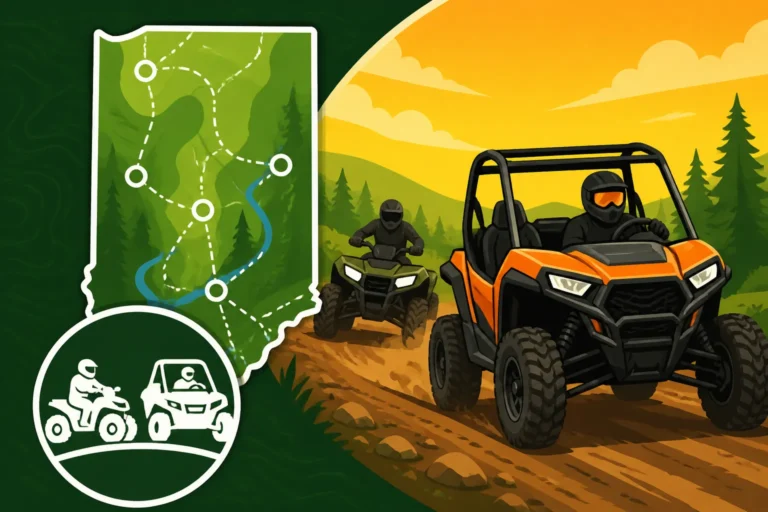
Use the park’s official information to confirm rules, fees, hours, closures, and camping arrangements. A map can help you understand where the entrance, staging area, campground, and nearby roads are, but a map does not grant permission to park. The Indiana DNR’s published information is a useful starting point for public recreation areas; confirm any detail that affects an overnight stay with the managing office.
For route planning, onX Offroad can help you view riding-area context and organize your approach. Treat it as a planning aid, not as confirmation that an access road is open or that a parking lot permits overnight stays. Cross-check the route and access details against official park information, especially if your arrival depends on a gate or a particular entrance.
You can also review Indiana Trail Maps From the DNR and Indiana Trail Closures to Check before leaving. A trail map may help with orientation, while a closure notice may affect whether a route or access point is usable. Neither replaces a direct answer from park staff about overnight parking.
Make a backup plan for late arrivals
A late arrival is when assumptions tend to unravel. You may reach a gate after the office has closed, discover that the staging area has emptied, or find that a lot is intended for day use only. If you do not have clear permission to remain overnight, do not rely on a “no one will mind” approach.
Choose a nearby campground, lodging option, or other location that has confirmed it can accommodate your vehicle and trailer. Ask about arrival procedures and where to park if you expect to arrive after check-in hours. If you have to change plans, avoid leaving a loaded trailer in an unapproved lot while you look for a place to stay.
onX Offroad can be handy for comparing your planned route with nearby roads and locations, but verify any alternative stop with the business or land manager before counting on it. Save the park’s phone number and directions somewhere accessible offline as well. Cell service can be uneven in rural areas, so a plan that depends on searching for options after dark is fragile.
Compare your overnight options
The best option depends on whether you need a place to sleep, a place to store your rig, or both. Use this table as a planning checklist—not as a statement that a particular Indiana park offers every option.
| Option | What it may solve | What to confirm |
|---|---|---|
| Designated campground | A place to stay near the riding area, sometimes with vehicle parking | Whether a truck and trailer fit, reservation needs, check-in hours, and separate fees |
| Park-approved overnight lot | A place to leave a vehicle without using a campsite | Whether unattended parking is allowed, how long it may remain, and whether sleeping in the vehicle is prohibited |
| Nearby private campground | A separate place for the group and tow rig | Trailer space, arrival procedure, distance from the park, and access the next morning |
| Nearby lodging | A bed and a more predictable overnight stop | Trailer parking availability, security, and whether the lot can accommodate the rig |
| Day-use staging lot | Unloading and parking while riding during open hours | Whether vehicles must leave before closing and whether overnight use is expressly permitted |
Designated campgrounds are usually the easiest plan to verify
If your group needs a place to sleep as well as somewhere to park, start by asking about a designated campground. Confirm that your full setup fits. A compact truck may fit easily where a long enclosed trailer and a second vehicle do not. Ask whether you can keep the trailer connected overnight and whether the site includes space for all vehicles in your group.
Also check whether camping is close enough to make the next morning practical. “Near the park” can still mean a drive to the entrance, a separate check-in, or a route that takes longer than expected. If your group plans to ride early, make sure you understand when the park opens and whether you need to arrive before a gate or office closes.
Keep an eye on Indiana ORV Park Hours while building the schedule. Opening and closing hours affect when you can unload, enter, or return to a lot, but they do not establish an overnight parking right. Ask about both hours and overnight permission rather than treating one as proof of the other.
Staging lots are for staging unless the park says otherwise
A staging lot is convenient because it is designed for unloading and organizing machines. That convenience can make it tempting to assume the lot is also suitable for overnight storage. Unless the park explicitly allows that, plan as if the lot is for day use only.
This is especially important for a large trailer. A trailer may occupy several spaces, block access, or be difficult to move if the lot is needed for a morning crowd. Even if you see a few vehicles remaining after hours, that does not tell you whether they have permission or whether the arrangement is allowed on the night you plan to visit.
For additional parking considerations, see Parking a Trailer at a State Recreation Area. Think about where the trailer will sit, how it will be secured, and whether you can leave it without interfering with park operations. If staff approve a specific location, follow that instruction rather than choosing a more convenient spot on arrival.
Nearby accommodation can reduce pressure on the park lot
A campground or lodging option away from the trailhead may be the simplest choice when the park does not permit overnight parking. It can also make the trip more comfortable if your group is arriving late, traveling with children, or hauling a machine that needs to be unloaded before the riding day.
The tradeoff is the extra drive and the need to manage your equipment. Ask the accommodation whether trailers can remain on the property overnight and whether there are rules about securing them. Do not assume that a motel or campground has room just because it appears to have a large lot on a map.
Use onX Offroad or another map tool to estimate the route between your overnight stop and the riding area, then confirm the practical details with the accommodation and the park. A map can show distance, but it cannot tell you whether a trailer can be parked there or whether the route will be open when you arrive.
Protect your equipment and avoid a stressful morning
Park only where you have permission and leave room for others
Once you have permission, follow the assigned parking instructions. Leave room for emergency access, park staff, and other riders who need to unload. Avoid blocking gates, maintenance access, marked lanes, or another vehicle’s ability to turn around. A trailer that fits physically may still be in the wrong place if it blocks the working area.
Remove valuables from the cab and trailer where possible, lock doors and storage compartments, and use the security measures that make sense for your equipment. Take a quick record of where you parked and what you left there. These are sensible precautions, but they do not turn an unapproved space into an approved one or guarantee that property will be secure.
If the park asks you to move the vehicle by a certain time, plan around that deadline. A relaxed morning ride can become a problem if the tow vehicle is in a spot that must be cleared before the group is ready to leave.
Prepare for limited signal and changing conditions
Rural routes around southern Indiana riding areas can be unfamiliar, and phone service may not be dependable everywhere. Save directions, contact details, reservation information, and the park’s parking instructions before you leave. Tell someone in your group where the vehicle and trailer are supposed to stay, especially if riders will be returning separately.
For navigation, onX Offroad may help you prepare a route and understand the surrounding area. Download or save what you need before you reach a weak-signal zone, and keep an official contact method available. Mapping tools can support the plan, but the park’s stated instructions should guide your decision.
Check for changes shortly before the trip. Weather, maintenance, special events, or trail closures can affect access and parking. Indiana Trail Conditions Before You Ride is a useful companion when you are planning the riding day, but call the park if a closure or access change could affect where you leave the rig.
Build a plan that still works if the first choice fails
A reliable overnight plan has a primary option and a backup. For example, your first choice might be a confirmed campground near the riding area, with a second nearby accommodation that has agreed to accept your trailer if the campground is unavailable. Write down the address and directions for both before departure.
Agree on a cutoff time for changing plans. If you reach the park and the approved area is closed or full, do not leave the trailer in a day-use lot while you debate what to do. Follow the park’s instructions, contact the operator if possible, and use the verified alternative.
The extra preparation may feel excessive for one night, especially when other riders say they have parked wherever they found space. But confirming the rules takes far less effort than dealing with a vehicle that has been moved, a missed check-in, or a trip that starts with uncertainty. A clear answer about your exact vehicle and overnight plan is the most useful part of the packing list.
Disclaimer
This article is for general informational purposes only and does not constitute professional advice. Laws, prices and regulations vary by location and change over time. Consult a qualified professional for guidance on your specific situation.