Parking a Trailer at a State Recreation Area
Arriving at an Indiana off-road park with a trailer can turn stressful fast if the staging lot is crowded, the entrance is unfamiliar, or your rig needs more room to turn than you expected. This guide explains how to plan trailer parking at a state recreation area, unload safely, and avoid assuming that overnight parking or a particular space is allowed.
Plan your trailer parking before leaving home
Confirm the park’s current access and parking rules
A trail map can show where a recreation area is, but it may not tell you whether a particular lot has room for a long truck-and-trailer combination, where unloading is permitted, or whether overnight parking is allowed. Before setting out, check the Indiana Department of Natural Resources information for the park and contact the park office if you have a specific question about trailer parking. Rules and conditions can vary by site and may change with events, construction, weather, or seasonal operations.
This is especially useful if you are heading to Redbird Off-Road State Recreation Area near Dugger in Sullivan County or Interlake State Recreation Area near Lynnville, across Pike and Warrick counties. Don’t assume that because a trailer fit at one property, the same layout or parking arrangement will work at the other. For an overview of how the two riding areas differ, see Indiana’s Two State ORV Areas Compared.
Make your questions concrete. Ask whether you may park a trailer in the day-use lot, whether there is a designated unloading area, and whether your vehicle and trailer can remain there while you ride. If you plan to camp, ask whether the trailer belongs in a campground space rather than the riding-area staging lot. For anything involving overnight parking, get a clear answer instead of relying on a guess based on what another visitor did.
Check the route and the rig as a complete unit
A destination that looks close on a phone map may still involve narrow roads, awkward turns, or a tight entrance. Before leaving, look at the entire route with your truck and trailer in mind—not just the distance from the highway to the park. Check for places where you can safely fuel up, pull over, or stop to adjust straps without blocking traffic.
Mapping tools such as onX Offroad can help you orient yourself and review nearby roads or riding areas, but use official park information for access rules and the final approach. A digital map is a planning aid, not a promise that a road is suitable for your trailer or open to public use. If the route is unfamiliar, compare the directions with the park’s official guidance and avoid following a shortcut that leads onto private property or an unsuitable road.
It also helps to measure or know the approximate length of your full setup: tow vehicle, hitch, and trailer. If you are towing two machines, add the length needed to load and unload them safely. That information makes it easier to decide whether you need an alternate parking arrangement or should call ahead before driving into a busy lot. For more trip-planning basics, see Trailering an ORV Across Indiana.
Choose a parking and unloading setup that works
Look for a space that lets you unload without blocking others
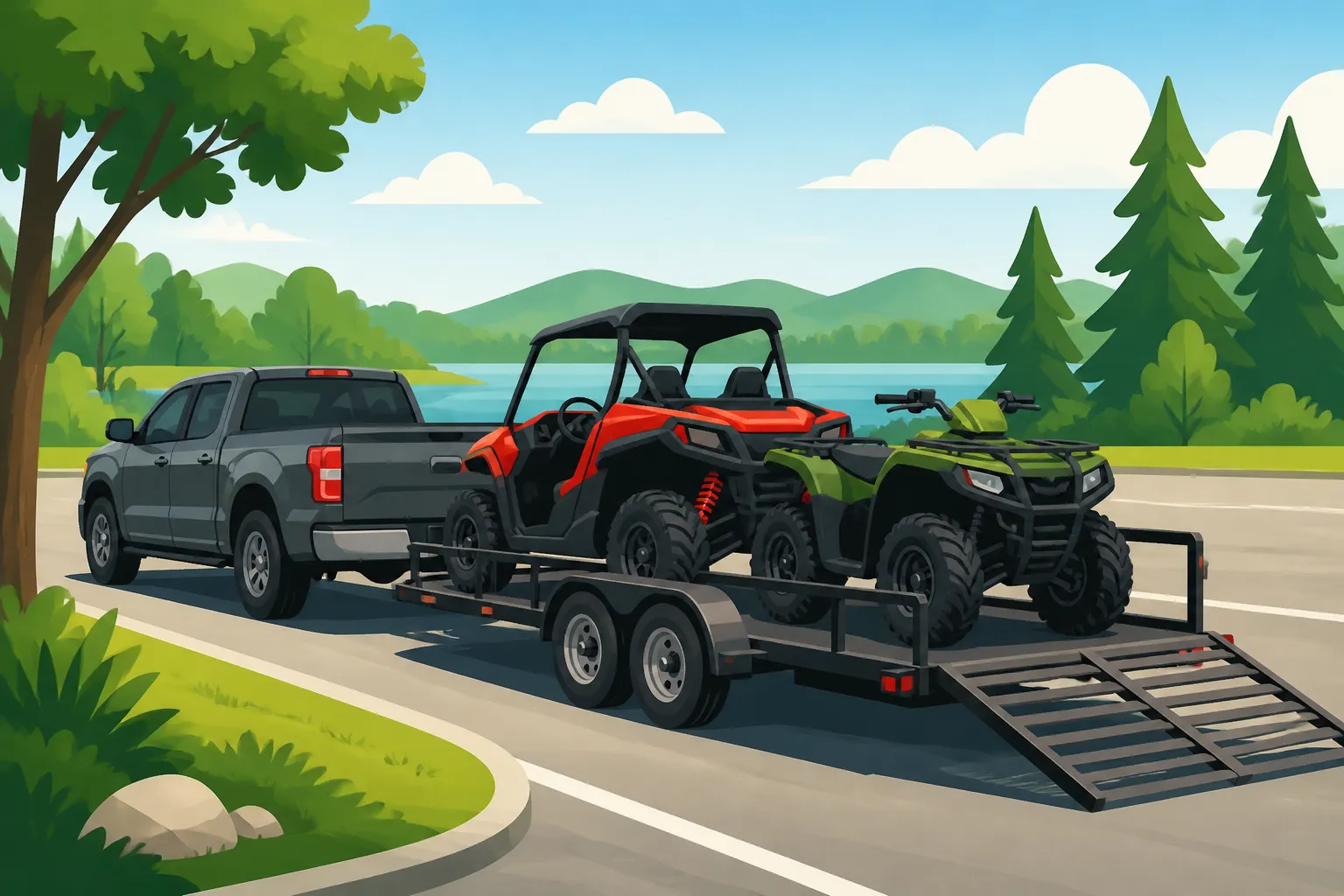
When you arrive, follow posted signs and staff directions rather than selecting a spot just because it appears convenient. A good parking position gives you enough room to secure the truck and trailer, unload your machine, and move equipment without spilling into a driving lane or blocking another visitor’s access. Keep the trailer connected unless staff or posted instructions indicate otherwise; disconnecting it in a cramped or busy lot can make it harder to maneuver and easier for the trailer to obstruct traffic.
Before unloading, take a moment to read the layout. Notice where vehicles are entering and leaving, where pedestrians are walking, and whether other trailers are backing into spaces. If you are arriving during a popular weekend, the first available opening may not be the safest place to unload. It can be better to pause and ask park staff where they want trailers staged than to squeeze into a spot that leaves no room to work.
Make the unloading sequence deliberate. Park securely, check that the machine is stable on the trailer, and keep children and pets away from moving vehicles and ramps. Put ramps on firm, level ground when possible, and have one person guide the process if visibility is limited. Don’t unload into an active traffic lane or assume that an open patch of ground is an approved staging area.
Keep the lot usable for other visitors
A state recreation area parking lot is shared space. Leave room for emergency access, park vehicles, and other riders to turn and pass. Avoid spreading tools, fuel cans, coolers, or riding gear across an adjacent space. If you need time to adjust a machine or repair a tie-down, move your work to a safe place where you are not creating a bottleneck.
If the lot is filling up, don’t claim extra space with loose gear or park across marked lines to make your setup more comfortable. Ask staff where a longer trailer should go. The best solution may be a different section of the lot, a designated overflow area, or another arrangement the park allows. Never assume that a grassy shoulder or nearby access road is an acceptable substitute for a marked parking area.
A phone map can help you understand the general layout, but follow on-site signs and directions at the gate. onX Offroad may be useful for organizing your route and locating nearby riding areas, but it cannot tell you whether a specific parking space is reserved, closed, or suitable for unloading. For another useful planning read, see Indiana Trail Maps From the DNR.
| Situation | Safer approach |
|---|---|
| You have a long truck-and-trailer setup | Call ahead and ask which area can accommodate it |
| The lot is busy when you arrive | Follow staff directions and avoid unloading in a traffic lane |
| You plan to leave the trailer overnight | Confirm that overnight parking is permitted before your trip |
| You need to camp with the trailer | Ask whether camping requires a separate designated space |
| A map suggests a shortcut or alternate entrance | Verify access through official park information |
| Signs or directions are unclear | Stop and ask park staff before unloading |
Prepare for the day you arrive
Pack for a safe, organized unload
A little preparation at home can prevent a lot of fumbling in a crowded staging area. Tie down each machine securely and make sure you can reach the straps without unloading half the trailer first. Keep ramps, gloves, wheel chocks, and basic tools together so you are not searching through loose gear while other vehicles wait to pass.
Organize equipment so items needed first are easy to reach. For example, put ramps where they can be removed without shifting fuel cans or camp gear. Keep paperwork, permits, and anything you need to show at the entrance in a predictable place. If you’re not sure what permits apply to your ride, review Indiana ORV Permits Explained before leaving, then check the park’s current instructions.
Before towing, walk around the vehicle and trailer. Check that the hitch is secured, the lights work, the load is balanced, and loose equipment cannot slide during the trip. A stop along the way is a good time to recheck the tie-downs, but choose a safe place that gives you room to pull fully off the road. Avoid stopping at the park entrance or in a narrow access lane to rearrange gear.
Have a backup plan for crowding or bad conditions
Parking can be more complicated after rain, during a busy riding weekend, or when an event draws extra visitors. A lot that looked spacious in a photo may be full by the time you arrive. Check park notices before setting off and, when possible, arrive early enough to avoid rushing through the gate and unloading process. See Indiana Trail Conditions Before You Ride for more on checking conditions before a trip.
If the staging area is full, don’t improvise by leaving your trailer along a road, in a field, or in an unmarked area. Ask park staff what options are available. If there is no approved place for your setup, you may need to wait, adjust your plan, or return another time. That’s frustrating after a long tow, but it is safer than risking a blocked access route, getting stuck, or having to move the trailer under pressure.
Rain also changes what “easy parking” means. Soft ground can make it difficult to turn or pull away, especially with a loaded trailer. Follow closures and staff directions, and don’t drive onto grass or a muddy shoulder just because it seems like a shortcut around a line. For seasonal planning, Indiana Trail Closures to Check First can help you remember to verify the riding area before loading up.
Know what to do once the trailer is parked
Separate day parking from camping and overnight parking
Parking a trailer while you ride is not necessarily the same as camping with one or leaving it overnight. These uses may be governed by different rules and may be allowed only in particular areas. If you intend to stay overnight, ask whether the trailer must be in a campground, whether reservations or a separate fee apply, and whether the riding-area lot closes at a particular time. Never treat a day-use lot as an overnight site unless park staff or official guidance says that is permitted.
If you are planning a trip around both riding and camping, decide where the trailer will stay before you leave home. A campsite may have different access, space, or setup requirements than a day-use staging lot. Read Camping at an Indiana State Recreation Area and confirm details with the specific property rather than assuming that every state recreation area offers the same arrangement.
For an overnight plan, also think about what stays in the trailer. Keep valuable items out of sight, secure equipment, and follow the park’s instructions about where vehicles may be left. A locked trailer is sensible, but it does not replace the park’s rules or guarantee that a location is approved for overnight use.
Leave the area as orderly as you found it
When you return from the trail, take a moment before loading to check the surroundings. Make sure the trailer is still positioned safely, watch for people walking nearby, and keep the loading area clear of passing vehicles. Load one machine at a time, secure it before moving on to the next, and do a final walk-around before driving out.
Pack out trash, spilled gear, and any maintenance materials. Don’t dump wash water, fuel, oil, or other fluids on the ground. If mud has collected on the machine, follow the park’s instructions for cleaning and avoid tracking debris into areas where it can create a hazard. If you need to make a repair, move to an appropriate place and ask staff if you are unsure where work is allowed.
The same courtesy applies when leaving. Wait until you can pull out safely, watch for traffic at the exit, and avoid cutting through a crowded lot to save a few seconds. A calm arrival and departure make the experience better for everyone—especially families unloading youth machines or riders maneuvering long trailers through a tight space. For practical arrival planning, Staging Early at Interlake and Reading the Gate Board Before You Unload are useful related reads.
Disclaimer
This article is for general informational purposes only and does not constitute professional advice. Laws, prices and regulations vary by location and change over time. Consult a qualified professional for guidance on your specific situation.