Riding a Quad at Fifteen With a Parent Along
A fifteen-year-old can ride an ATV or UTV in Indiana, but simply having a parent nearby is not the whole rule. The key is direct, continuous supervision by a parent or legal guardian. This article explains what that means in practice, which helmet and passenger rules matter, and how trail permits differ from vehicle registration.
What Indiana’s age rule means for a fifteen-year-old
According to the Indiana Department of Natural Resources, an operator under 16 who rides a dirt bike, ATV, or UTV must be directly supervised at all times by a parent or legal guardian. A fifteen-year-old falls within that under-16 group. The rule applies to the rider’s supervision, not merely to whether a parent came along for the day.
That distinction matters if a teenager rides ahead, takes a separate trail, or is left at a staging area while the supervising adult goes elsewhere. The state rule calls for direct supervision throughout the ride. The Indiana Department of Natural Resources does not define a specific following distance in the facts summarized here, so do not treat any particular number of feet or yards as an official standard. Keep the adult close enough to actively monitor the teenager and respond if something goes wrong.
The adult needs to be the teen’s parent or legal guardian. An older sibling, family friend, or other adult who is not a parent or legal guardian should not be assumed to meet the supervision requirement. If the parent cannot attend, confirm with the relevant property or official authority what documentation or arrangement is accepted before setting out; do not assume that a general adult escort is enough.
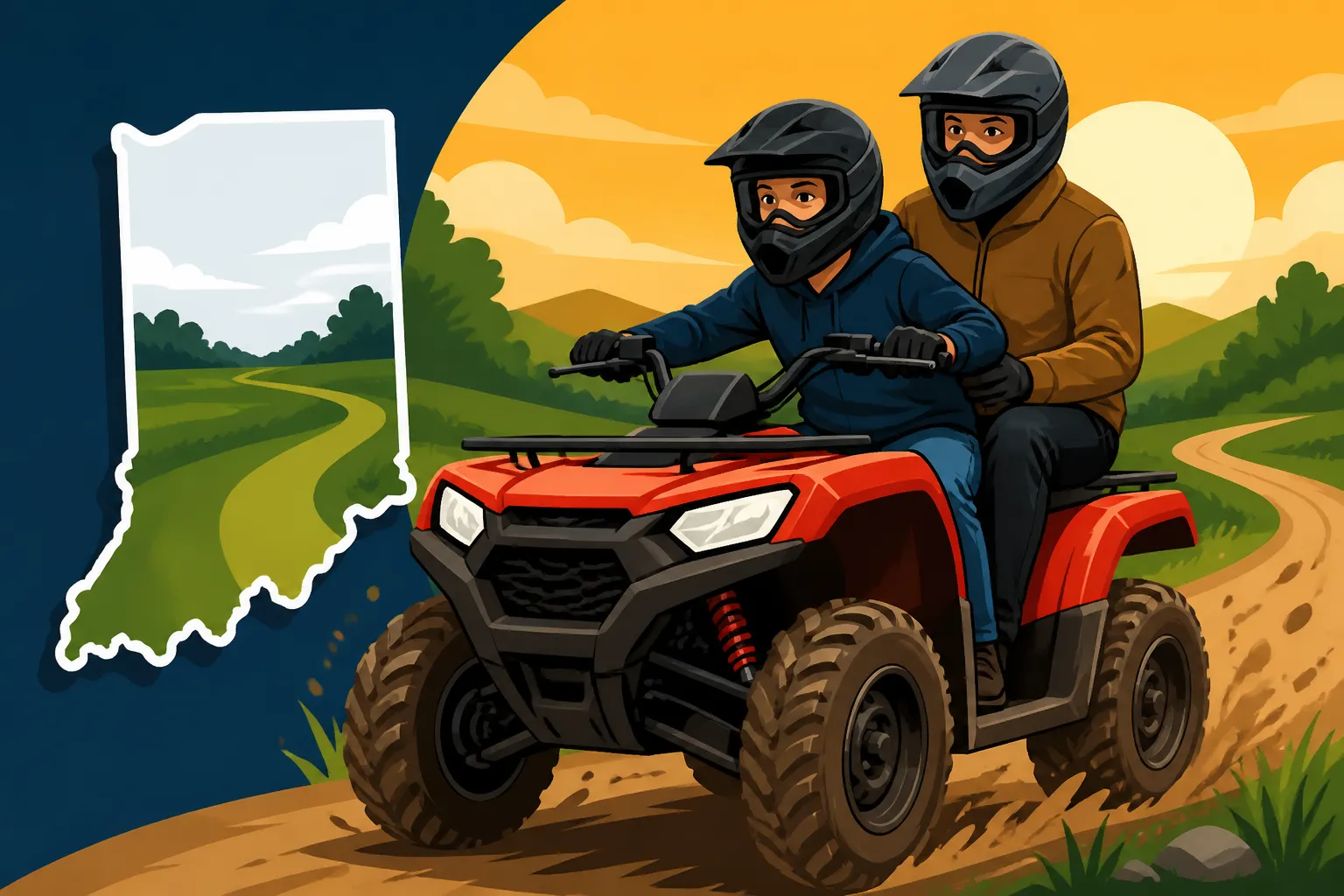
The requirement is about supervision, not a rule that the teenager must ride on the same machine. A parent can supervise while riding a separate machine, provided the supervision remains direct and continuous. If a parent plans to carry the teenager as a passenger, the passenger rules matter too: the Indiana Department of Natural Resources says passengers are not allowed on ATVs or dirt bikes unless the machine was designed by its manufacturer for two-up riding. A second seat added later does not establish that the machine was designed for a passenger.
For an overview of the age limits that apply to different machines and settings, see Indiana Minimum Age to Ride an ORV. If the rider is approaching the age threshold for riding without a parent or legal guardian, Indiana Supervision Rules for Minors can help clarify the broader rules for young operators.
| Question | Practical answer |
|---|---|
| Can a fifteen-year-old ride an ATV or UTV in Indiana? | Yes, but the Indiana Department of Natural Resources requires a parent or legal guardian to directly supervise a rider under 16 at all times. |
| Is it enough for the parent to be at the park? | No. The requirement is direct supervision throughout the ride, not simply being somewhere on the property. |
| Can another adult supervise instead? | Do not assume so. The stated rule names a parent or legal guardian. |
| Can the teen ride as a passenger? | Only on an ATV designed by its manufacturer for two-up riding, according to the Indiana Department of Natural Resources. |
| Does supervision replace a helmet? | No. Indiana’s helmet requirement for riders under 18 still applies. |
Helmets, passengers, and other rules that still apply
Supervision does not replace the safety rules that apply to the rider or machine. The Indiana Department of Natural Resources requires everyone under 18 to wear a helmet on or in an off-road vehicle, including an ATV, UTV, side-by-side, or dirt bike. The helmet requirement applies on public and private property. A parent’s presence, a short ride, or riding on private land does not remove it.
The helmet must meet U.S. Department of Transportation standards. The Indiana Department of Natural Resources says a helmet meeting FMVSS 218 must have a DOT sticker on the outside back. If you are comparing helmets on Amazon or elsewhere, check that the helmet itself meets the required standard and has the appropriate label; do not rely only on a product title or a seller’s broad safety claim. For more detail, see Indiana’s ORV Helmet Rule Explained and Checking for a DOT Sticker Inside Your Helmet.
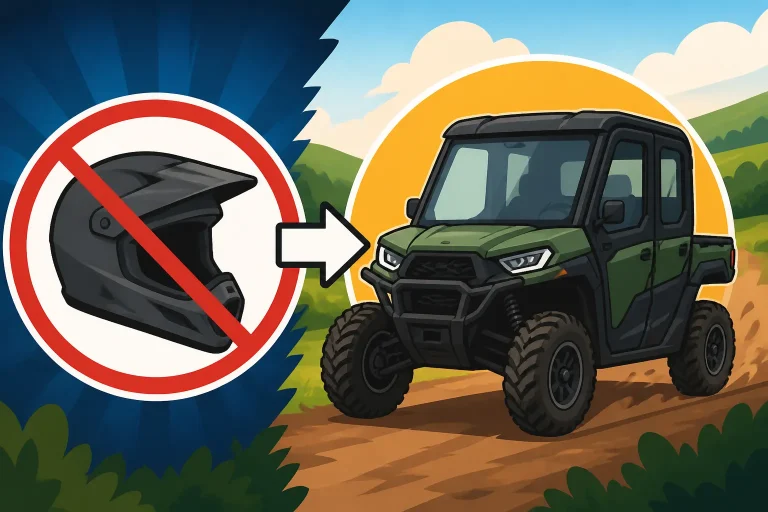
A UTV’s protective structure does not generally eliminate the under-18 helmet requirement described by the Indiana Department of Natural Resources. Its facts identify an exception for certain vehicles with fully enclosed metal cabs or roll-bar protection in the rules for DNR riding areas, but a rider should not assume that any roof, windshield, cage, or side-by-side structure qualifies. For a fifteen-year-old, the straightforward choice is to wear a compliant helmet unless the applicable official rules clearly confirm an exception for that exact vehicle and setting.
Passengers need separate attention. The Indiana Department of Natural Resources says passengers are not allowed on ATVs or dirt bikes unless the machine was designed by its manufacturer for two-up riding. This matters if the parent intends to ride with the teenager on one ATV. Check the owner’s manual and the machine’s design before carrying a passenger. A UTV’s seating arrangement may be different, but it does not change the age-supervision rule: the teen operator still needs direct supervision by a parent or legal guardian.
The machine and the place of riding also matter. Indiana’s off-road vehicles are designed for off-road use, and public-road use is not automatically allowed because a machine is registered or because a parent is present. According to the Indiana Department of Natural Resources, counties make their own rules for ORV use on public roads, and local restrictions can address matters such as age, vehicle type, roads, hours, helmets, insurance, and equipment. Check the applicable county rules before planning any road segment; Indiana Counties That Allow ORVs on Roads and How to Find an Indiana County ORV Ordinance are useful starting points.
At state ORV properties, the Indiana Department of Natural Resources requires machines to be registered or street-legal and says riders must use designated areas and stay on marked trails. The agency also requires functioning spark arrestors and mufflers. These requirements are separate from the age rule: a supervised teen still needs to ride a suitable, properly documented machine and follow the property’s trail restrictions. See Indiana Rules for a Rider Under 14 for related rules affecting younger riders, and Indiana Helmet Rules at an ORV Park for the park-specific helmet context.
Registration and trail permits are different
A park trail permit is not a substitute for registering the ATV. The Indiana Department of Natural Resources says ORV registration is handled through the Indiana Bureau of Motor Vehicles, and that a motorized trail use permit is not an ORV registration. In other words, paying for access to a riding area does not, by itself, complete the machine’s state registration.
According to the Indiana Department of Natural Resources, ORVs purchased after December 31, 2003, must be registered, unless an exemption applies. The Indiana Bureau of Motor Vehicles says Indiana registrations include a registration number specific to the machine, the owner’s information, and vehicle details. The BMV issues a certificate of registration and decals. For help sorting out a machine’s paperwork, see Indiana ORV Registration Paperwork and How Indiana ORV Registration Works.
A newly purchased machine may have a temporary registration exemption. The Indiana Bureau of Motor Vehicles says an operator with a bill of sale from a dealer or private seller that is no more than 45 days old is exempt from registration during that period. The Indiana Department of Natural Resources says the bill of sale must include the purchase date, make, model, and VIN. Treat this as a limited transition period, not a replacement for registering the machine. For the details, see Riding on a Fresh Bill of Sale and Indiana ORV Bill of Sale Requirements.
The title requirement is separate again. According to the Indiana Bureau of Motor Vehicles, an ORV purchased after December 31, 2009, must be titled. The BMV says the owner must apply for a title within 45 days of purchase to avoid an administrative penalty. Registration, title, and a trail-use permit serve different purposes; having one does not automatically satisfy the others. If the family is buying a used machine, Do You Need a Title for an ATV in Indiana? and Checking Paperwork Before You Pay can help identify what to check before riding.
If the family is visiting Indiana from another state, check both the registration rule and the destination’s permit rules. The Indiana Bureau of Motor Vehicles says a nonresident ORV registered in another state is exempt from Indiana registration for up to 20 days in one year. That exemption is about state registration; it does not automatically provide admission or trail access at a particular riding area.
The Indiana Department of Natural Resources offers an Out-of-State Motorized Trail Use permit for nonresident visitors riding at Redbird Off-Road State Recreation Area or Interlake Off-Road State Recreation Area. The agency says that permit is valid only at those two properties and is not an ORV registration. Visitors planning to ride on Indiana roadways open to ORVs need to check the registration requirements separately. For more on those distinctions, see Indiana’s Out-of-State Annual Permit, Does Indiana Honor Out-of-State Registration?, and Indiana Twenty-Day Visitor Rule.
A practical plan before the ride
Before loading the machine, work through the ride plan with the parent or legal guardian who will supervise. The goal is to avoid finding out at the trailhead that the paperwork, machine, or supervision arrangement does not fit the rules.
-
Choose a suitable riding area. Confirm that the property allows the type of machine you plan to bring and check its current operating conditions and rules. State recreation areas and private parks can have their own access requirements. Where to Ride an ORV in Indiana can help compare riding options.
-
Confirm the supervising adult. For a fifteen-year-old on an ATV or UTV, the Indiana Department of Natural Resources requires direct supervision at all times by a parent or legal guardian. Decide in advance how the adult will remain engaged with the teen throughout the ride, including during breaks or if the group separates.
-
Check the machine’s passenger setup. If the teenager will ride as a passenger on an ATV, confirm that the manufacturer designed that machine for two-up riding. Otherwise, do not carry a passenger on it, as the Indiana Department of Natural Resources prohibits ATV passengers except on machines designed for that use.
-
Inspect the helmet and basic equipment. For a rider under 18, use a helmet that meets the applicable DOT standard and check for the required label. Make sure the machine’s muffler and spark arrestor function properly, as required at Indiana DNR ORV properties. A correctly fitted helmet is still necessary when the rider is supervised.
-
Sort out registration and access separately. Check whether the machine needs Indiana registration, whether its title paperwork is in order, and whether the destination requires a separate trail-use permit or entrance payment. Do not treat a park permit as proof of state registration.
-
Read the local rules if any road use is involved. County rules can vary, and some counties may impose age or equipment restrictions. Verify that the specific road is open to ORVs and that the planned ride complies with local requirements. Indiana Rules for Riding a County Road explains why permission to use a trail does not automatically extend to nearby roads.
If the teen is riding at a DNR property, stay on marked trails and follow the instructions posted at the site. If the rules for a specific vehicle or access situation are unclear, confirm them with the park or relevant agency before the trip rather than relying on assumptions made from another riding area.
Sources
- Indiana Department of Natural Resources — State Parks: ORV/Snowmobile Registration FAQs (checked November 3, 2026)
- Indiana Department of Natural Resources — State Parks: Motorized Recreation (checked November 3, 2026)
- Indiana Department of Natural Resources — State Parks: Motorized Recreation (checked November 3, 2026)
- Indiana Bureau of Motor Vehicles — Registrations & Plates: Off-Road Vehicles and Snowmobiles (checked November 3, 2026)
- Indiana Department of Natural Resources — State Parks: Interlake Off-Road State Recreation Area (checked November 3, 2026)
- Indiana Department of Natural Resources — State Parks: Redbird Off-Road State Recreation Area (checked November 3, 2026)
- Indiana Bureau of Motor Vehicles — Registrations & Plates: Off-Road Vehicles and Snowmobiles (checked November 3, 2026)
Disclaimer
This article is for general informational purposes only and does not constitute professional advice. Laws, prices and regulations vary by location and change over time. Consult a qualified professional for guidance on your specific situation.