Paying $15 for a Trail Day
Paying $15 for a trail day in Indiana can feel confusing when the park may also charge an entrance fee. The key is to separate the machine’s trail-use permit from the cost of getting into the recreation area. This guide explains what the daily permit covers, when you need one, and how to avoid surprises at the gate.
What the $15 Indiana trail-day payment covers
A daily permit is for trail use, not park entry
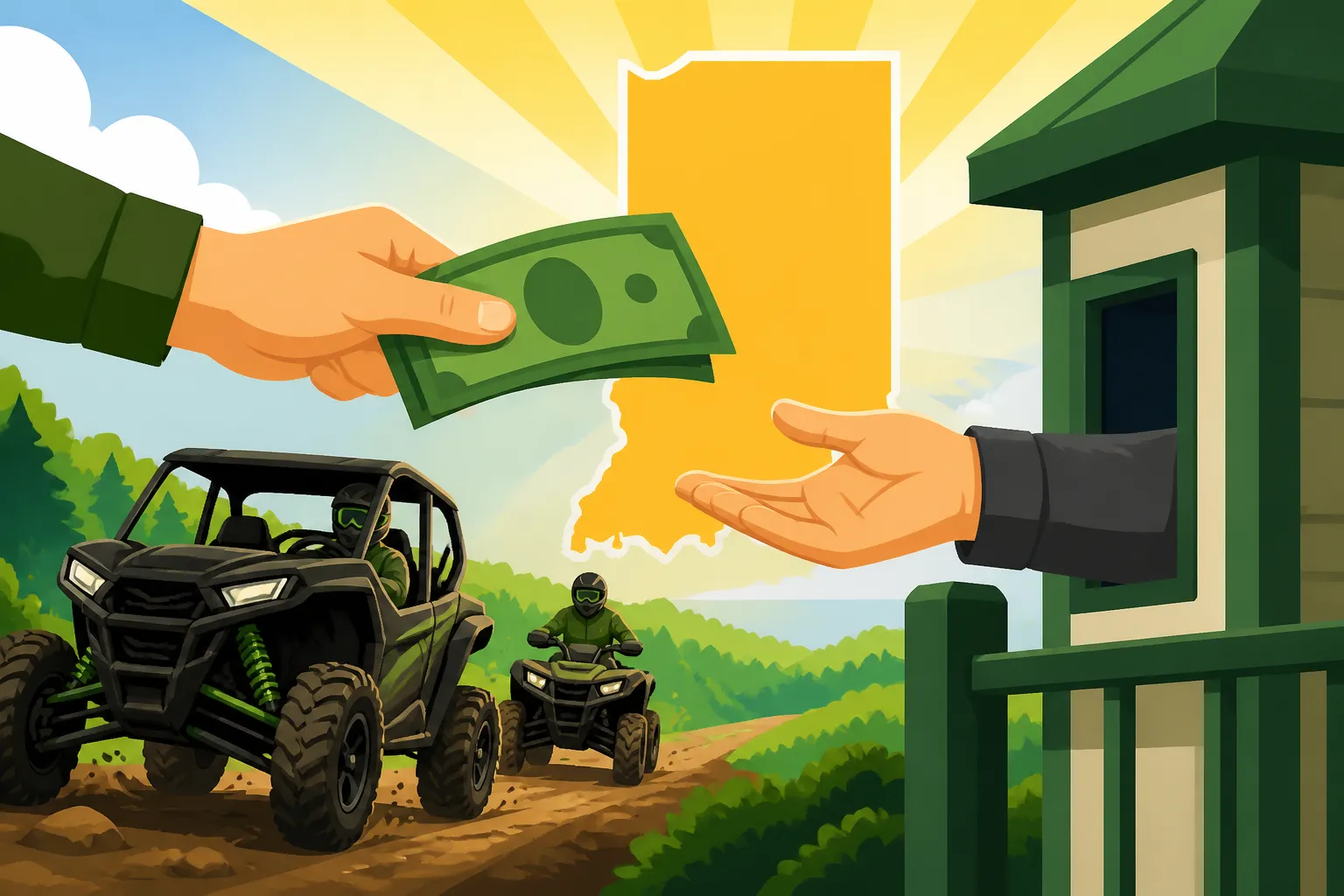
Indiana’s daily ORV trail permit is commonly listed at $15 per machine. It covers that machine’s trail use at participating state off-road areas for the day. It is not the same as an entrance fee, so you may need to pay both charges.
That distinction catches people off guard. You might arrive at Redbird or Interlake expecting the daily trail permit to be the only cost, then discover that access to the recreation area is charged separately. When you budget, think of the two payments as separate: one for the machine’s trail use and another for entering the site.
The permit is generally tied to a vehicle, not to the whole group. If you unload two ATVs, plan on needing a permit for each machine that will ride. A passenger does not make a second permit necessary for the same machine, but a second machine in the truck is a separate vehicle for permit purposes. For group planning, [Does Every Machine in the Truck Need Its Own Permit?] explains why counting machines matters.
The permit and entrance fee are different charges
A trail permit does not automatically include the park entrance charge. The entrance fee can depend on where you ride and other details, including whether you qualify for a resident rate. Check the park’s current information before you leave so you know what you will pay at the gate in addition to the trail permit.
A practical way to estimate the day’s cost is to list each charge separately:
| Cost to check | What it applies to | What to confirm before leaving |
|---|---|---|
| Daily trail permit | Each machine using the trails | Whether you need one permit per ORV |
| Park entrance fee | Entry to the recreation area | Whether the rate depends on residency or vehicle |
| Optional annual permit | Trail use across eligible visits | Whether it fits your riding plans |
| Other site charges | Amenities or services, if offered | Whether the park lists separate fees |
The daily permit may suit a single outing, but the total trip cost is not necessarily $15. If your family is driving in two machines, for example, you should account for two trail permits as well as the relevant entrance charge. [Why an Entrance Fee Sits on Top in Indiana] goes into more detail about why these costs are separate.
Which Indiana riding areas use this permit
Indiana’s state off-road recreation areas include Redbird Off-Road State Recreation Area near Dugger and Interlake Off-Road State Recreation Area near Lynnville. Both are popular destinations, but do not assume that every riding location in Indiana uses the same permit arrangement. Private parks can have their own gate rules and charges.
Before planning around a particular fee, make sure you are looking at the rules for the place you will actually visit. A fee or permit that applies at a state recreation area may not apply in the same way at a private park such as Haspin Acres or Badlands Off Road Park. The general guide [Indiana's Daily and Annual Trail Permits] can help you understand the state permit options, while [Indiana's Two State ORV Areas Compared] can help you think through Redbird and Interlake as separate trips.
How to buy and use a daily trail permit
Check the park’s instructions before loading
Start with the official information for the riding area you plan to visit. Confirm the permit price, whether permits are available at the gate, which payment methods are accepted, and whether the entrance fee is collected separately. A quick check before you hook up the trailer can prevent an awkward delay when you arrive with a full group and no clear idea where to pay.
It also helps to check hours, trail notices, and closures. A permit does not guarantee that every trail is open or that conditions will suit your machine that day. Heavy rain can make reclaimed clay slick and deeply rutted, while a dry, busy weekend can bring dust and traffic. The park’s own notices should take priority for closures and operating rules.
You can use onX Offroad to help plan a route and orient yourself around the riding area, but treat any mapping app as a planning aid rather than the final word on access. Confirm that your intended route is open and allowed through the park’s posted information. That small check can save a lot of frustration after you have already unloaded.
Buy the permit for each machine that will ride
Count the machines you expect to take onto the trails, not just the trucks or trailers carrying them. If two ATVs are coming off one trailer, they are still two machines for permit planning. If someone decides to leave a machine parked and not ride it, confirm with the park whether a permit is still required for that situation rather than guessing.
If you are organizing a group, decide in advance who is responsible for buying or displaying each permit. It is easy for one person to assume the lead rider has handled everything, while the lead rider assumes each owner will take care of their own machine. A quick list of machines and riders can keep the group from holding up the line at the gate.
The annual-permit option may be worth comparing if you expect several visits. The daily option is straightforward for a one-off outing; frequent riders may prefer to consider whether an annual permit better fits their plans. For a closer look at that choice, see [Who an Indiana Day Permit Actually Suits] and [Why an Indiana Annual Permit Pays for Itself].
Keep proof accessible while riding
Follow the park’s directions for displaying or carrying permit proof. Do not assume that having paid is enough if the permit must be shown or attached in a particular way. Keep any receipt or confirmation where you can reach it, and make sure the person operating the machine knows where the proof is.
This is especially helpful when a group splits up. A rider who leaves the staging area without knowing where the permit information is stored may have trouble answering a simple question at a checkpoint. Before setting out, take a moment to confirm that each machine has what the park requires.
If you use onX Offroad to navigate, keep it separate in your mind from permit proof. A marked route on a map does not show that you bought a permit, and a permit does not mean every mapped route is open. Use the park’s rules for compliance and the map for orientation.
Deciding whether a day permit is right for your trip
Compare a single visit with several riding days
For one day at a state riding area, a daily permit can be the simplest option. You pay for the day you plan to ride without committing to a longer period. That can be appealing if you are visiting from out of town, trying a park for the first time, or unsure how often you will return.
If you already know you will make several trips, compare the combined daily-permit cost with the annual option. Include the number of machines you will bring and remember that the entrance fee may remain separate. A family that rides together on multiple weekends might reach a different decision from a solo visitor making one trip.
A simple planning exercise can help:
- Count the machines that will ride.
- Estimate how many separate riding days you expect.
- Add the daily permit cost for each machine and day.
- Check the annual option for the same machines.
- Add entrance fees separately, because they may not be included in either permit choice.
For trip planning, onX Offroad can help you keep potential riding locations and routes organized. Still, verify access, closures, and current payment instructions directly with the park before you travel.
Account for weather, travel, and the actual riding day
A permit is only one part of what makes a trail day worthwhile. Consider how far you are driving, whether your trailer and machine are ready, and whether recent weather could change trail conditions. If you are hauling from Indianapolis to Redbird or making a longer drive to Interlake, a closed trail or a rough weather forecast can turn a planned day into an expensive disappointment.
Check notices close to departure, not only when you first start planning. Rain can affect reclaimed mine trails quickly, and conditions may vary across a large riding area. Ask whether there are restrictions for particular trails or machine types, especially if your vehicle is wide, heavy, or built for a different style of riding.
A map app can help you understand the area, estimate route options, and keep your group oriented. onX Offroad may be useful for that preparation, but park staff and official notices are the right place to confirm current access. Do not use a route shown on a map as permission to ride somewhere that the park has closed or prohibited.
Make a realistic day-trip budget
For a useful budget, list the trail permit and entrance fee separately, then consider fuel, food, and any other travel costs. If you are bringing more than one machine, multiply the permit estimate by the number of vehicles that will ride. This avoids the common mistake of budgeting $15 for the whole group when the permit is charged per machine.
A realistic plan also includes a little flexibility. You may decide to stay longer than expected, need fuel near the riding area, or choose a different park if conditions are poor. For a broader look at what can add to the day’s cost, [Why the Entrance Fee Is Separate] and [Budgeting Park Entrance Fees in Indiana] are useful next reads.
Before you pay at the gate
Use a quick pre-trip checklist
Before leaving home, confirm the park’s current permit and entrance-fee information, hours, and trail status. Make sure every machine that will ride is included in your permit plan. If you are carrying more than one ORV, assign someone to check each machine’s paperwork rather than relying on memory when you reach the gate.
Pack the practical items that make a trail day smoother: registration or other required documentation, any permit confirmation, water, basic tools, and equipment suited to the expected conditions. If the park has particular rules about helmets, passengers, machine access, or trail difficulty, review those before unloading. The general guide [Indiana Helmet Rules at a State ORV Area] can help you prepare for rider requirements.
If you are using onX Offroad, download or prepare the information you need before you reach an area with weak cell service. Do not rely on a signal being available at the trailhead or deeper into the riding area. Keep official park directions and any necessary permit proof easy to find even if your phone is unavailable.
Avoid the most common fee misunderstandings
The biggest misunderstanding is treating the trail permit as an all-in admission ticket. It may not include the park entrance fee. The next is assuming one permit covers every machine in a group. Plan by vehicle, and verify the park’s exact instructions before you pay.
Another easy mistake is assuming a day permit applies everywhere in Indiana. State recreation areas and private parks can have different systems, and an out-of-state registration does not necessarily replace a permit required for riding at an Indiana site. If you are visiting from another state, check [Does Indiana Honor Out-of-State Registration?] before the trip.
Finally, remember that paying for access is not the same as having permission to use every road, trail, or nearby property. Stay within the riding area’s rules, follow closures, and respect land boundaries. A little preparation makes it much easier to spend the day riding instead of sorting out fees and access questions at the entrance.
Disclaimer
This article is for general informational purposes only and does not constitute professional advice. Laws, prices and regulations vary by location and change over time. Consult a qualified professional for guidance on your specific situation.