Fish and Wildlife Area Roads in Indiana
Fish and wildlife area roads can look like tempting ATV routes, especially when they are gravel, muddy, or signed for public access. But an open gate or drivable road does not automatically mean an ATV or UTV may use it. The key is whether the road is expressly open to your machine and what rules apply there.
Can you ride an ATV or UTV on a fish and wildlife area road?
Do not assume that a road inside an Indiana fish and wildlife area is an ORV route. Roads may serve staff, maintenance, hunting access, boat launches, parking areas, or other property needs. Some may also be public roads that pass through or border the property. Their appearance alone does not establish that recreational ATV or UTV riding is allowed.
A road that is open to ordinary vehicle traffic may still have restrictions for off-road vehicles. A gate may be open for a particular use or season, and a gravel surface does not make a road an off-road trail. Similarly, a posted speed limit or a sign permitting access for a specific activity does not necessarily authorize recreational riding.
The safest starting point is to treat fish and wildlife area roads as closed to recreational ORV use unless the property’s current rules, signs, or staff confirm that the particular road is open to your machine. This distinction matters because riding a closed road or leaving it to travel cross-country can be a separate violation. See Why Fish and Wildlife Areas Ban ORV Riding and Indiana Rules for Riding a Closed Trail for related access questions.
| What you see | What it tells you | What to confirm |
|---|---|---|
| An open gate | The gate is not blocking access at that moment | Whether ORVs are allowed, and for what purpose |
| A gravel or dirt road | The surface is unpaved | Whether the road is designated for your type of vehicle |
| A public vehicle access sign | Some form of access may be allowed | Which vehicles, destinations, seasons, and conditions are covered |
| A marked public road through the property | The road may have a separate road authority or rules | Whether your vehicle may legally use that road |
| A trail on a map | A route is shown on that map | Whether it is an ORV route, currently open, and accessible to the public |
| A closed gate or closure notice | Access is restricted | Whether another authorized route is available |
A legal route that crosses or runs beside a fish and wildlife area does not give you permission to ride on adjoining property roads. Stay on the road you are authorized to use, obey signs and closures, and do not turn onto a two-track or maintenance lane because it appears to connect with another route.
The general rules for riding these properties are covered in Indiana Rules for Riding Fish and Wildlife Area. That topic is useful when you are trying to distinguish the area’s access rules from the rules that apply to a particular road.
Public road or property road?
When a road appears to continue through an area, work out whether it is actually a public road or a road controlled by the property. A road’s name on a map, its condition, or its use by local traffic may not answer that question. Road ownership and access restrictions can be less obvious on the ground than the map suggests.
If it is a public road, the road’s rules and the vehicle’s legal status still matter. If it is an internal property road, the area’s own rules and any posted restrictions matter. Neither situation makes every nearby field road, trail, or service lane open to recreational riding.
When the status is unclear, ask the property office or the relevant road authority before unloading. Give them the property name and, if possible, the road name, gate, or access point. A general answer such as “vehicles are allowed” is not enough if it does not confirm that ATVs or UTVs may use the exact route for recreational riding.
Do Indiana ORV permits or out-of-state registration allow access?
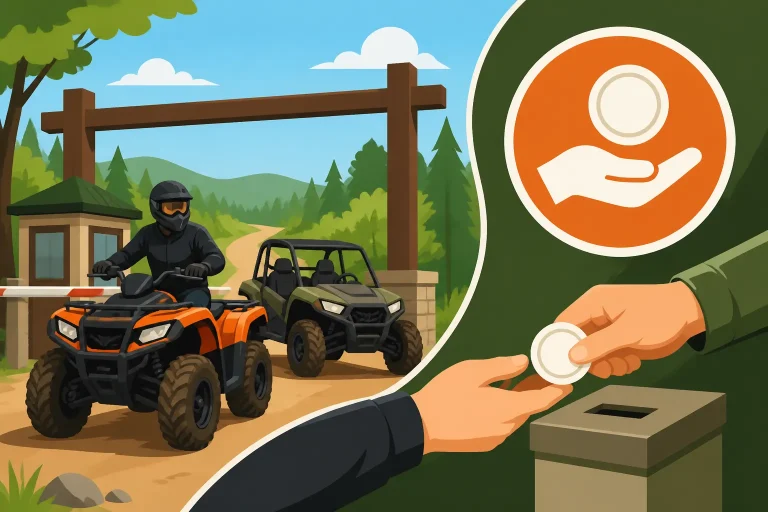
A registration, decal, or trail permit does not by itself create permission to ride on a fish and wildlife area road. These documents serve different purposes. Registration may establish that a machine meets applicable registration requirements; a trail permit may apply to designated riding areas; and a property’s access rules determine whether a route is open to that vehicle.
This means an Indiana registration decal is not a substitute for permission from the property. Likewise, an out-of-state registration does not automatically make a closed road available. Before riding, check both the machine’s legal requirements and the rules for the specific property and route. Indiana ORV Permits Explained covers the role of permits, while Does Indiana Honor Out-of-State Registration? addresses the separate question of registration reciprocity.
Visitors should not treat a permit requirement for an ORV riding area as proof that every public land unit allows ORV riding. A permit may be required at a designated recreation area, but a fish and wildlife area road can have different access rules. Conversely, meeting a registration requirement does not override a gate closure, sign, seasonal restriction, or property-specific prohibition.
| Document or permission | What it may address | What it does not establish by itself |
|---|---|---|
| Indiana ORV registration or decal | Registration requirements for the machine | Permission to ride a particular fish and wildlife area road |
| Out-of-state registration | The machine’s status in its home jurisdiction and possible Indiana reciprocity | That a closed or restricted property road is open |
| ORV trail permit | Access or fee requirements for covered riding areas | General access to every DNR property |
| Hunting, fishing, or other activity authorization | Permission for the activity covered by that authorization | Permission to use an ATV or UTV on a road not open to it |
| Property staff confirmation | Clarification of current access rules for a route | An exemption from other vehicle laws or posted restrictions |
For a nonresident, the time allowed to operate a machine in Indiana without Indiana registration is a separate issue from access to a fish and wildlife area. Do not confuse a visitor registration rule with a land-access permission. Indiana’s Twenty-Day Visitor Rule explains that distinction. Even if your machine may be operated in Indiana under a reciprocity rule, you still need the property to allow that vehicle on the road.
A useful rule of thumb is to ask two questions independently:
- Is the machine properly registered or otherwise permitted for operation in Indiana?
- Is this exact road open to this type of machine for the ride you plan to make?
A “yes” to the first question does not answer the second. If you cannot verify the road’s status, choose a designated riding area rather than testing the restriction on site.
How to check a route before you unload
Rules and access can vary by property, route, season, and purpose. Confirm the current information for the specific fish and wildlife area, rather than relying on a general description of Indiana public land or advice about another property.
- Identify the exact location. Note the fish and wildlife area, entrance, road name, gate, or nearby landmark. If there are multiple access points, make sure you are asking about the route you will actually use.
- Check current signs and property information. Look for vehicle restrictions, closures, seasonal notices, and designated-use instructions. A property map can help orient you, but a line on a map is not sufficient evidence that an ORV may use the route.
- Ask the property office or staff directly. Ask whether an ATV or UTV may be ridden on that particular road, for the purpose you have in mind, on the day you plan to go. Clarify whether the answer applies to recreational riding or only to a specific access need.
- Confirm any conditions. Ask whether the route is seasonal, restricted to certain users, closed during wet conditions, or subject to a gate or permit requirement. Also ask whether you must stay on the road or can continue to a particular parking or access point.
- Check again before departure. Conditions and closures can change. A route that was open on a previous visit may not be open now.
- Keep to the confirmed route. Do not use a side road, field, levee, or trail as a shortcut unless it is also authorized for your machine.
Ask a direct question rather than “Can I ride there?” For example: “May I ride my registered ATV on the gravel road from this entrance to the parking area for recreational access, and is that route open today?” That wording helps distinguish general vehicle access from permission for an ORV to travel on a particular road.
If staff say that access is permitted only for a defined purpose, do not stretch that permission into recreational trail riding. Likewise, permission to reach a parking area does not necessarily authorize riding around the property after you arrive. Follow the stated route and restrictions, and ask again if the answer leaves room for interpretation.
If you are planning to ride on private land instead, get the landowner’s permission for the specific activity and route. Permission to enter for hunting, fishing, or another purpose should not be treated as permission to ride an ORV. Indiana Landowner Permission Rules covers that issue.
What to do if the route is closed
Do not ride around a barrier, pass a closure sign, or follow another machine onto a restricted road. A visible track does not prove that the route is open; it may be an unauthorized path, or it may have been used for a purpose that does not apply to you. Riding off the designated route can create safety problems and damage sensitive land as well as lead to enforcement.
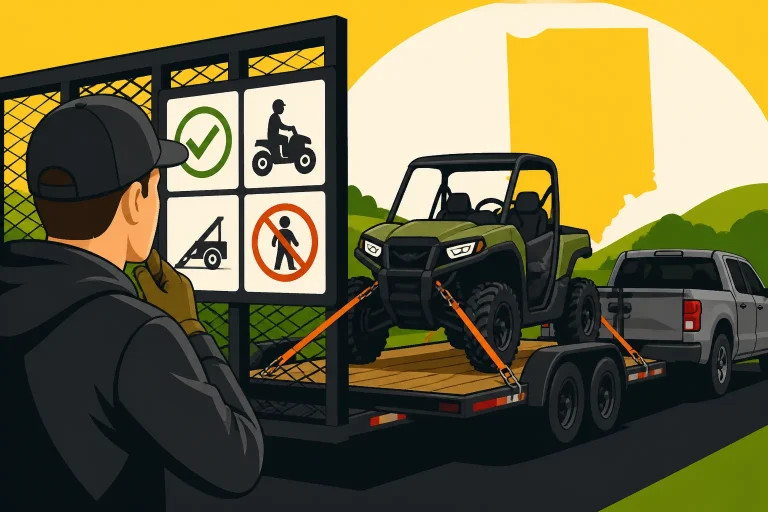
If the property cannot confirm access, use another route or choose a designated ORV riding area. Keep your machine on the trailer until you have a clear answer. That is less frustrating than reaching a gate and discovering that your planned route is not allowed.
A practical pre-ride checklist
Before heading to an Indiana fish and wildlife area with an ATV or UTV, use this short checklist:
- Confirm whether the property allows recreational ORV use at all.
- Verify that the specific road or route is open to your type of machine.
- Check whether access is limited by season, purpose, weather, or a posted closure.
- Make sure the machine’s registration requirements are met independently of property access.
- Carry any documents the property or applicable rules require.
- Stay on the confirmed route and obey signs, gates, and staff instructions.
- If you cannot get a clear answer, do not ride that road.
The central point is simple: a fish and wildlife area road is not automatically an ATV or UTV trail. Registration and permits may address the machine or a designated riding area, but the property’s rules decide whether you may use a particular road. Confirm the exact route before unloading, and treat uncertainty as a reason to stop and ask rather than ride ahead.
Disclaimer
This article is for general informational purposes only and does not constitute professional advice. Laws, prices and regulations vary by location and change over time. Consult a qualified professional for guidance on your specific situation.