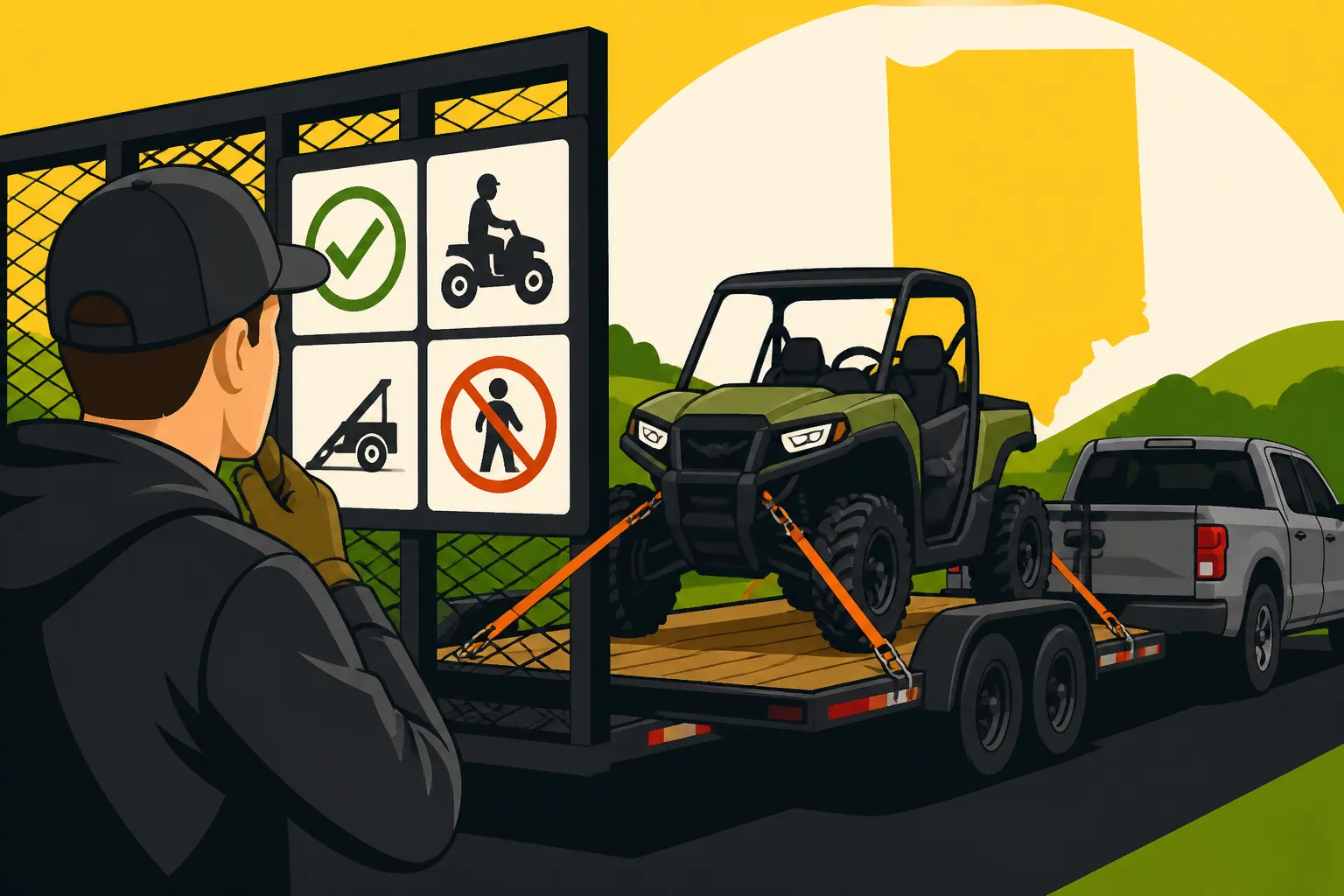
Reading the Gate Board Before You Unload
Before unloading an ATV or UTV at an Indiana riding area, take a few minutes to read the gate board. A trail may be closed, a route may have a special restriction, or a permit reminder may affect your plans. Checking first can save you from unloading for a ride you cannot take—and help you avoid missing a rule that applies to the whole group.
Why the gate board matters
A gate board is a quick snapshot of what riders need to know at that entrance. It can include general park rules, temporary trail closures, route conditions, hours, safety notices and permit information. Some notices apply to the entire property; others concern only a trail, feature or section.
Conditions can change after rain, maintenance work or another event. A map you saved earlier, a sign at a different entrance or a friend’s report from a previous visit may not reflect what is open when you arrive. The board is especially useful when you are visiting an unfamiliar area or returning after a long break.
Do not treat it as a substitute for the full rules. The board may summarize requirements, while detailed restrictions appear on signs farther along a route or in park materials. If the board is unclear, ask park staff before unloading or riding. A quick question at the entrance is easier than turning around after reaching a closed trail.
The notice may also affect the whole group, not just the person driving. A passenger, a young rider or someone bringing a different type of machine may need to follow additional requirements. Review the board together, especially if riders are splitting into separate groups.
What to check before you unload
Read the board from top to bottom, including smaller notices near the main map or entrance. Look for the date or other indication that a notice is current, and check whether the instruction applies to all riders or only a specific area.
| Notice on the board | What to confirm | Practical response |
|---|---|---|
| Trail or area closure | Which route or feature is closed, and whether there is an alternate route | Plan a different loop; do not assume the closure is easy to bypass |
| Hours or access notice | When riding must stop and whether the notice applies to the whole property | Set a return time that leaves room to get back before closing |
| Permit information | Which permit applies to each machine and where it must be displayed or kept | Check that every machine has the required permit before entering |
| Safety reminder | Which riders or machines the rule covers | Check the equipment and riders in your group before departure |
| Trail condition warning | Whether a route is affected by mud, water, maintenance or another hazard | Choose a suitable route or postpone that section |
| Event or traffic notice | Whether an organized activity changes access or creates shared traffic | Ask staff how to avoid conflicts and where riding is permitted |
Closures deserve particular attention. A trail shown on a map is not necessarily open that day, and a closed route is not an invitation to detour around its barrier. Check Indiana Rules for Riding a Closed Trail and [Indiana Rules for Riding Off the Trail] if you need to understand why staying on an open, marked route matters.
Look for whether the notice is temporary or continuing. A temporary closure may affect one part of the day or remain in place until staff reopen the route. If the wording does not say, do not guess. Ask at the gate, and follow the answer you receive.
Then check hours and any instructions about the last ride or when riders must be off the trails. Build your plan around the posted schedule rather than assuming you can return whenever you finish. If your group rides at different speeds, agree on a turnaround time and meeting point before setting out.
Pay attention to safety and equipment notices, too. Requirements may depend on the rider’s age, the machine or the riding area. For example, check Indiana Helmet Rules at an ORV Park if your group includes younger riders or uses an enclosed vehicle. Confirm that any posted rule applies to your planned ride and do not rely on assumptions from a different park.
Permits, out-of-state machines and entrance fees
A gate board may remind you about permits, but it is worth sorting out the permit question before the trip. Indiana’s public riding areas can have trail-use requirements that are separate from a machine’s registration. An out-of-state registration should not automatically be treated as permission to ride every Indiana trail. The distinction is covered in Does Indiana Honor Out-of-State Registration? and Indiana’s Daily and Annual Trail Permits.
A visitor bringing a machine from another state should check both requirements: what applies to the machine’s registration while it is in Indiana, and what the riding area requires for trail use. The rules are not interchangeable. See Indiana’s Twenty-Day Visitor Rule for the registration question, and confirm the current trail-permit instructions for the place you plan to ride.
Also separate the trail permit from any entrance or access charge. Paying one does not necessarily cover the other. Why an Entrance Fee Sits on Top in Indiana explains why those charges can be separate. When you arrive, read the board for the current instructions on permits and payment, and ask staff if the wording leaves you unsure.
A simple pre-unloading check helps avoid a group-wide delay:
- Confirm that each machine has the required trail permit for the riding area.
- Make sure the permit is associated with the correct machine, rather than assuming one permit covers several vehicles.
- Check whether the permit must be displayed, carried or presented at a particular point.
- Verify any separate entrance or access requirement.
- Keep the needed proof accessible so you are not searching through a trailer or vehicle after unloading.
If you still need a permit, check the park’s current process before you unload. Buying an ORV Permit at the Park Gate can help you plan for that step. If you bought a permit in advance, make sure it is with the machine or rider as required. Do not assume a screenshot, receipt or online confirmation is enough unless the park’s instructions say so.
For broader planning, Indiana Trail Closures to Check First is useful before leaving home. Checking in advance can help you choose a different destination if a major closure affects the day, while the gate board remains important for updates once you arrive.
A practical routine for groups
Make the gate board part of the unloading routine, not an afterthought. One person can read the notices while another keeps the group and machines in the staging area. Take a photo of the board if that helps everyone remember the instructions, but do not rely on a photo instead of reading the actual signs or following staff directions. If a notice changes later in the day, your earlier photo may no longer be accurate.
Before heading out, make sure everyone knows:
- Which trails or areas are open and which are off limits.
- What time the group needs to be back.
- Where to meet if riders get separated.
- Which permit and safety requirements apply to each machine and rider.
- Whether a condition warning calls for a different route or a decision not to ride.
If you have children or riders with different experience levels, repeat the most important instructions in plain language. A closure is not a place to explore, and a marked route is not optional just because another track looks easier. Review the park’s requirements for young riders and supervision before the group leaves the staging area.
Keep paperwork and permit evidence where you can reach it during the ride. A phone can be useful for storing photos or copies, but protect it from water and damage, and do not assume a digital copy replaces a required physical document. What Happens If Your Permit Stays in the Truck covers why access to your permit matters once you leave the parking area.
If the board conflicts with a map or an older notice, pause and ask staff which instruction controls for that day. If there is no staff member at the entrance, follow the clear posted restriction and avoid entering a route that appears closed or unsafe. It is better to skip a loop than to cross a barrier or ride into a restricted area.
The key is to check the board before unloading, then keep paying attention as you ride. Follow signs on the trail, stay on open routes and ask when an instruction is ambiguous. That small pause at the entrance gives your group a more predictable start and helps keep the riding area open and safe for everyone.
Disclaimer
This article is for general informational purposes only and does not constitute professional advice. Laws, prices and regulations vary by location and change over time. Consult a qualified professional for guidance on your specific situation.