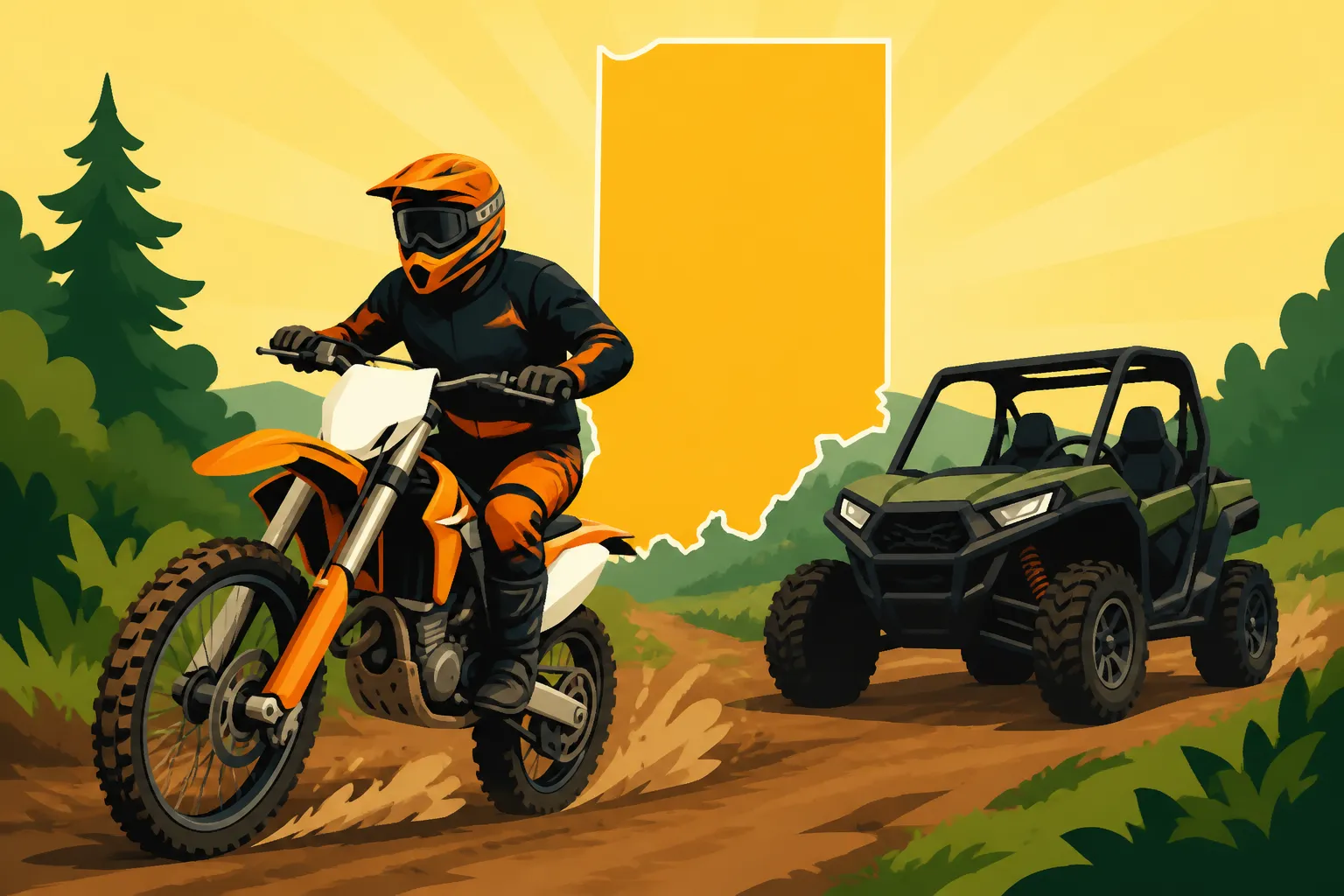
Indiana Rules for a Dirt Bike on an ORV Trail
A dirt bike may fit the definition of an off-road vehicle, but that does not mean any trail is open to it—or that a trail-use permit replaces registration. The key is to sort out where you plan to ride, whether the bike needs Indiana registration, and which rules apply to the rider and machine before you unload.
A dirt bike is an ORV, but access depends on the trail
Indiana treats dirt bikes as off-road vehicles for relevant registration and riding rules. That classification matters because permission to ride a particular trail is separate from having the right paperwork for the machine.
On Indiana’s state ORV properties, a dirt bike must be registered or street legal, and riders must stay in designated areas and on marked trails, according to the Indiana Department of Natural Resources. A state property’s motorized trail-use permit is another requirement: it is not an ORV registration. A permit that gets you through a trail gate does not automatically meet the registration rules that apply elsewhere.
That distinction is especially important for visitors bringing a bike from another state. Indiana recognizes a limited registration exemption for some nonresident machines, but the state’s special out-of-state trail permit is limited to two DNR properties. It is not a substitute for home-state registration when that is required for the ride.
| Situation | What to check |
|---|---|
| Indiana resident riding a dirt bike | Whether the bike must be registered with the Indiana BMV, and whether the riding area requires its own trail-use permit |
| Visitor with a bike registered in another state | Whether the ride falls within Indiana’s visitor exemption, and whether the destination requires a separate permit |
| Visitor with a bike not registered in its home state | Whether the destination is Redbird or Interlake, and whether the special out-of-state permit applies |
| Riding on an Indiana road open to ORVs | Whether the bike is registered in its home state or through the Indiana BMV, and whether local road rules allow that vehicle and rider |
For an Indiana resident, the basic registration rule is broad. Indiana law IC 9-18.1-14 requires ORVs purchased after December 31, 2003, to be registered, according to the Indiana Department of Natural Resources. The Indiana BMV handles ORV registration, and registered vehicles must display valid decals unless exempt, according to the Indiana BMV. A dirt bike’s off-road use does not by itself make it exempt.
Registration is also different from titling. Indiana requires a title for an ORV purchased after December 31, 2009, regardless of model year, according to the Indiana Department of Natural Resources. For the paperwork steps that are specific to this type of machine, see Registering a Dirt Bike in Indiana. If the bike’s ownership papers are incomplete, sort that out before heading to a trail; Indiana ORV Title Requirements covers the related ownership issue.
A state trail permit, registration, and title each serve a different purpose:
- Registration identifies the ORV through the BMV and requires a specific registration number for the vehicle, according to the Indiana Department of Natural Resources.
- A title is proof of ownership for ORVs that fall under Indiana’s titling rule.
- A motorized trail-use permit provides access under the rules of a particular riding property. It is not an ORV registration, according to the Indiana Department of Natural Resources.
Do not treat one document as a replacement for the others. A trail-use permit may be enough for a particular park’s admission rules while leaving registration or title obligations untouched.
Registration and permits for residents and visitors
Indiana residents
If you live in Indiana, check the bike’s registration status before riding. Indiana requires ORVs purchased after December 31, 2003, to be registered, according to the Indiana Department of Natural Resources. The BMV issues a certificate of registration and two decals for an ORV registration, according to the Indiana BMV. The decals must be attached on the forward half of the machine, according to the Indiana BMV.
Indiana ORV registrations must be renewed every three years, according to the Indiana BMV, and vehicle registration renewals can be completed online at mybmv.com, according to the Indiana Department of Natural Resources. New registrants should allow for delivery time: the Indiana BMV says the registration certificate and decal will arrive within 21 days. A new registration is not the same as a trail permit, so check the riding property’s separate entry requirements too.
If you have just bought a dirt bike, a bill of sale can provide a short-term exception. The Indiana BMV exempts an operator from registration when they possess a bill of sale from a dealer or private individual that is no more than 45 days old. The Indiana Department of Natural Resources says the bill of sale must include the purchase date, make, model, and VIN, and allows operation for 45 days after purchase. Do not mistake that temporary window for a permanent registration or a title.
For a broader explanation of trail-use permits, including how they differ from vehicle registration, see Indiana’s Daily and Annual Trail Permits. Check the individual property’s current instructions before riding: having a valid BMV registration does not automatically cover every park’s permit or entrance requirement.
Visitors with an out-of-state registration
A nonresident ORV registered in another state or country may be operated in Indiana for up to 20 days in one calendar year without Indiana registration, according to the Indiana Department of Natural Resources. The Indiana BMV also describes the exemption as applying to nonresidents operating an ORV registered in another state for no more than 20 days in one year. For the details of how this limit works, see Indiana’s Twenty-Day Visitor Rule.
That exemption is not an all-purpose trail pass. It concerns Indiana registration; a riding area may still require a separate permit. The Indiana Department of Natural Resources says visitors to Redbird Off-Road State Recreation Area and Interlake Off-Road State Recreation Area can buy an Out of State Motorized Trail Use permit to ride at those two properties. The permit is only valid at Redbird and Interlake, and a motorized trail-use permit is not an ORV registration.
According to the Indiana Department of Natural Resources, as of November 2026, the Out-of-State ORV Trail Use Permit costs $20 per ORV for non-registered out-of-state ORVs only. That can be relevant if you are visiting one of those two properties with an unregistered bike, but it does not create broad permission to ride on Indiana roads or other trails. Read Indiana’s Out-of-State Annual Permit before relying on it for a visit.
Visitors who want to ride on Indiana roadways that are open to ORV use must have the bike registered in their home state or through the Indiana BMV, according to the Indiana Department of Natural Resources. If the out-of-state owner has not registered the bike in their home state and wants to ride on those Indiana roadways, they must apply in person at an Indiana BMV branch, according to the Indiana Department of Natural Resources. Road access is also subject to local rules; a registration does not make every public road open to dirt bikes.
What state properties charge and require
Redbird and Interlake are DNR ORV properties, but their trail-use requirements should not be confused with general statewide registration. According to the Indiana Department of Natural Resources, as of November 2026, the Daily ORV Trail Use fee is $15 per ORV and includes entrance to the property, while the Annual ORV Trail Use Permit costs $95 per ORV for unlimited trail use. The out-of-state permit is a separate option for qualifying nonregistered out-of-state ORVs at those two properties.
The Indiana DNR also says the valid daily receipt must be in the vehicle operator’s possession at all times. Keep the receipt or permit information accessible rather than assuming that the gate transaction alone will be enough if asked to show it on the property.
Before paying, confirm which kind of permit applies to your machine and trip. An in-state BMV registration, an out-of-state registration, an annual trail-use permit, a daily receipt, and an entrance pass are not interchangeable. If you are unsure whether a specific payment covers trail access or property admission, check the property’s current instructions. For a broader overview of riding options, see Where to Ride an ORV in Indiana.
Rider, bike, and trail rules to check
Helmets and age supervision
Indiana’s ORV helmet law applies to dirt bikes. The Indiana Department of Natural Resources says children under 18 must wear a helmet on or in any ORV, including dirt bikes, and that the rule applies on public and private property. Approved helmets must meet U.S. Department of Transportation standards; helmets meeting FMVSS 218 must have a DOT sticker on the outside back, according to the Indiana Department of Natural Resources.
A helmet listing or product description alone is not a reliable way to confirm that a helmet meets the required standard. Whether you are buying from a local shop or Amazon, check the physical helmet for the required DOT marking. For more detail on who the law covers and what counts as an approved helmet, see Indiana Helmet Law for ORV Riders.
The Indiana Department of Natural Resources says a dirt bike operator under 16 must be directly supervised at all times by a parent or legal guardian on the state ORV properties covered by its rules. Do not assume that being somewhere on the same property is sufficient: the rule calls for direct supervision. Check the destination’s instructions before taking a young rider, and review Indiana Supervision Rules for Young Riders for related requirements.
Passengers and machine condition
A dirt bike is generally a one-rider machine unless the manufacturer designed it for two-up riding. The Indiana Department of Natural Resources says passengers are not allowed on dirt bikes except on models designed by the manufacturer for two-up riding. A seat added later does not establish that a bike was designed for a passenger; check the manufacturer’s specifications.
On state ORV properties, all off-road vehicles must have functioning spark arrestors and mufflers, according to the Indiana Department of Natural Resources. Those requirements make the bike’s condition part of trail preparation, not just a maintenance preference. Check the bike before leaving, especially if the exhaust system has been modified or parts are missing.
The Indiana Department of Natural Resources also says vehicles may only be operated in designated areas and must stay on marked trails at the state ORV properties covered by its rules. Riding beyond the marked route is not made permissible by having a registration or permit. For the practical limits on leaving an established route, see [Indiana Rules for Riding Off the Trail].
Public-road riding is a separate question
A registered dirt bike is not automatically allowed on Indiana roads. The Indiana Department of Natural Resources says off-road vehicles are designed for off-road use, and laws governing ORV use on public roads are made individually by each county. Local restrictions may cover the roads or townships where riding is permitted, as well as factors such as vehicle type, operating hours, age, insurance, helmets, lights, and vehicle width.
That means a trail rule and a county road rule can lead to different answers for the same bike. A trail permit does not open a county road, and a BMV registration does not establish that a county has authorized dirt-bike use on a particular route. Check the relevant county ordinance and the specific road before planning a route that leaves the riding area. The Indiana Department of Natural Resources explains the broader road question in Indiana Counties That Allow ORVs on Roads.
A practical checklist before you ride
Use this order to avoid arriving at a trail with the wrong paperwork or an unsuitable bike:
- Choose the riding property first. Confirm that dirt bikes are allowed there, which trails are designated for them, and whether the property is public or private.
- Check the bike’s registration status. If you are an Indiana resident, confirm whether the bike must be registered with the BMV. If you are visiting, confirm whether the out-of-state exemption applies to your trip.
- Separate registration from trail access. Find out whether you need a daily receipt, annual trail permit, out-of-state permit, or separate property entrance payment. Do not assume one document covers all of them.
- Review ownership paperwork. If the bike was recently purchased, make sure the bill of sale has the details required by the Indiana Department of Natural Resources. If the machine needs a title, do not rely on a trail permit to resolve that separate requirement.
- Inspect the bike and safety gear. Confirm the required helmet for any rider under 18, check the DOT marking, and make sure the bike has a functioning spark arrestor and muffler where those property rules apply.
- Check rider supervision and passenger rules. On the relevant state properties, a dirt-bike operator under 16 must be directly supervised by a parent or legal guardian, and passengers are allowed only on bikes designed for two-up riding, according to the Indiana Department of Natural Resources.
- Stay on the permitted route. Follow marked trails and check current property notices before unloading. If the plan includes a public road, check county rules separately.
The simplest way to think about Indiana dirt-bike riding is that a bike needs the right status for the place where it will be used. Registration covers the machine under state rules, while a trail-use permit covers access under a riding property’s rules. Visitor exemptions and special out-of-state permits are limited, so verify both before setting out.
Sources
- Indiana Department of Natural Resources — State Parks: ORV/Snowmobile Registration FAQs (checked November 3, 2026)
- Indiana Department of Natural Resources — State Parks: Motorized Recreation (checked November 3, 2026)
- Indiana Department of Natural Resources — State Parks: Motorized Recreation (checked November 3, 2026)
- Indiana Bureau of Motor Vehicles — Registrations & Plates: Off-Road Vehicles and Snowmobiles (checked November 3, 2026)
- Indiana Department of Natural Resources — State Parks: Interlake Off-Road State Recreation Area (checked November 3, 2026)
- Indiana Department of Natural Resources — State Parks: Redbird Off-Road State Recreation Area (checked November 3, 2026)
- Indiana Bureau of Motor Vehicles — Registrations & Plates: Off-Road Vehicles and Snowmobiles (checked November 3, 2026)
Disclaimer
This article is for general informational purposes only and does not constitute professional advice. Laws, prices and regulations vary by location and change over time. Consult a qualified professional for guidance on your specific situation.