Why Fish and Wildlife Areas Ban ORV Riding
An Indiana Fish and Wildlife Area may look like a quiet place to ride, especially when a gravel access road or broad field seems open. But public access does not mean motorized recreation is allowed. The key distinction is the land’s purpose and the rules attached to that property: an ORV permit for a designated riding area does not automatically authorize riding on a Fish and Wildlife Area.
Why ORV riding is restricted on Fish and Wildlife Areas
Indiana Fish and Wildlife Areas are managed primarily to protect wildlife habitat and provide activities such as hunting, fishing, and other forms of outdoor recreation compatible with those purposes. Allowing unrestricted ATV and UTV travel would create different demands on the land than walking, fishing, or driving to an authorized parking area.
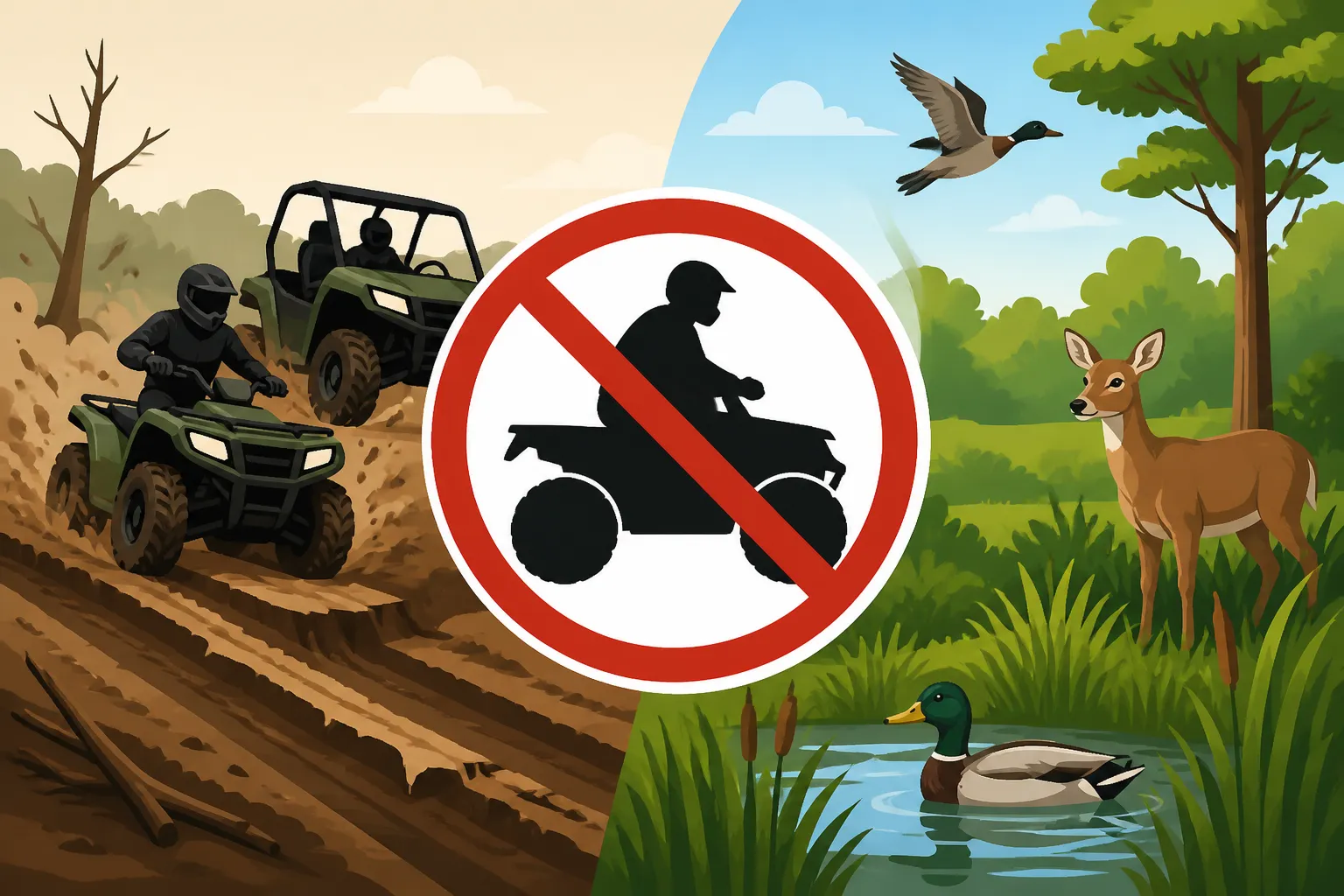
An ORV can cause damage in a short time, especially when several machines use the same informal route. Tires can break through vegetation, widen narrow paths, churn wet soil into ruts, and carry sediment into streams, wetlands, or ponds. A route that looks durable in dry weather may become a channel for runoff after repeated use.
The impacts are not limited to the visible trail. Noise and repeated traffic can disturb wildlife, while machines traveling off established routes can damage nesting, feeding, or resting areas. In places managed for hunting and wildlife observation, keeping motorized traffic in authorized areas also helps reduce conflicts among visitors.
A posted road or parking area can make the rules feel confusing. It may be possible to drive a road to reach a fishing spot or another authorized destination, but that does not mean the road is an ORV trail. Nor does the presence of a vehicle-width path establish permission to ride an ATV or UTV on it. The purpose of the route, property rules, signs, and current directions from the property manager matter.
For a practical overview of rules on these properties, see Indiana Rules on Fish and Wildlife Areas. If you are trying to understand the difference between a road used to access a property and a route open for ORV recreation, Fish and Wildlife Area Roads in Indiana covers that distinction.
Public access is not permission for every activity
“Public land” describes who may access a place under its rules; it does not mean every kind of activity is allowed. A Fish and Wildlife Area may welcome visitors while limiting where they can drive, what equipment they can use, and which activities are permitted in particular locations or seasons.
That distinction matters because an ORV rider might see other vehicles on the property and assume the same access applies to their machine. A truck or passenger car using an authorized access road does not establish that an ATV or UTV may leave that road, use a closed track, or travel cross-country. Likewise, a trail used by walkers or bicycles is not automatically an ORV trail.
Rules may also differ from one property to another, and temporary closures can affect access. Signs at entrances and trailheads are important, but it is sensible to check current property information before unloading. If signs are missing, unclear, or appear inconsistent, ask the property office rather than treating uncertainty as permission.
A state ORV permit does not override property restrictions
Indiana’s ORV permits and a property’s access rules address different questions. A permit may satisfy a requirement for riding in a specific state recreation area or on a designated trail. It does not give the holder a general right to ride anywhere on state-owned land.
This is an important point for riders planning a trip. Buying a permit, carrying a registration decal, or owning a machine that is properly registered does not change a Fish and Wildlife Area’s restrictions. These documents may matter in places where riding is authorized, but they do not create authorization on a property where ORVs are not permitted.
For more on the difference between a permit and permission to use a particular riding area, see Do You Need a Permit for Indiana ORV Trails?. The state’s designated riding areas and property-specific rules are not interchangeable.
How to tell where you may ride
Before making a trip, identify the exact property and the exact route you intend to use. Do not rely only on a map showing public land, a route someone shared online, or a machine’s navigation app. Those tools can help with orientation, but they may not show current closures or distinguish an authorized motor vehicle access road from a trail closed to ORVs.
Use this process before you load:
- Confirm the property name. A nearby state forest, recreation area, private park, or Fish and Wildlife Area may have a different managing agency and different rules.
- Look for current property rules. Check the property’s official information and any posted notices. Rules can change, and seasonal conditions may lead to temporary restrictions.
- Ask about the specific route. If you plan to ride a particular road or trail, ask whether that route is open to your type of machine, not just whether vehicles are allowed on the property.
- Check the machine and activity. A rule for a road-registered vehicle, a mobility accommodation, or a service vehicle may not apply to recreational ORV riding.
- Follow signs on site. A closure sign or barrier takes priority over assumptions based on an old map or a previous visit.
This extra check can prevent a wasted drive and an enforcement problem. It also helps avoid the common mistake of treating an access road as permission to explore surrounding fields or woods. If the route is not clearly identified as open to ORVs, get confirmation before riding.
Look for authorization that names the route or area
A general statement that a property is open to the public is not enough to establish that ORVs may ride there. Look for wording that specifically authorizes the activity and identifies where it is allowed. If the rule only refers to parking, vehicle access, or reaching a designated destination, do not assume it authorizes recreational riding.
Pay attention to boundaries as well. A route may approach or cross several kinds of land, and the rules can change at a boundary. A trail that is open on one property may end where it meets a Fish and Wildlife Area. Riding a few yards farther can still put you outside the authorized area.
For broader comparisons, Where to Ride an ORV in Indiana can help you identify the kinds of riding locations to investigate. Rules for a state forest are not the same as rules for a Fish and Wildlife Area, so check the relevant property guidance rather than carrying one property’s permissions over to another. See Indiana Rules for Riding a State Forest for that separate setting.
Written permission matters on private land
If a route crosses private property, a public road, or a club-managed area, do not assume that permission for one segment covers the next. Obtain the appropriate authorization from the person or organization that controls the land. For private ground, get clear permission before riding and confirm which routes, dates, and machines it covers.
A landowner’s permission cannot authorize riding on neighboring land or on state property. Likewise, a club’s permission to use its own trail does not extend to a nearby Fish and Wildlife Area. The safest plan is to confirm every part of the route and avoid shortcuts that cross land with unclear status. Indiana Landowner Permission Requirements and Indiana Rules for Riding Private Property explain the private-land side of that question.
What can happen if you ride where it is prohibited
Riding on a Fish and Wildlife Area without authorization can result in more than a disappointing conversation at the trailhead. Depending on the circumstances and the applicable rule, an officer may direct you to stop or leave, issue a citation, or require you to address damage. The exact consequences depend on the facts and current rules, so do not rely on a guessed fine or an online account of someone else’s encounter.
The practical costs can add up even without a citation. A machine can become stuck in soft ground, a damaged route can make recovery harder, and riders may need to arrange a trailer or assistance after being told to leave. If damage occurs, getting a machine out can worsen it. Riding around a barrier or through a wet area may also create avoidable conflict with property staff and other visitors.
If an officer or property employee asks you to stop, follow the instruction, keep the conversation calm, and ask what rule or boundary applies. Do not continue riding while arguing about whether a nearby route looks open. If you believe a citation or direction was incorrect, use the formal process available afterward rather than escalating the encounter on the property.
The simple way to avoid these problems is to choose a place that clearly allows ORV use. A private ORV park, an authorized club trail, or a state recreation area with designated routes may be a better fit for a riding day. Each still has its own requirements, including any permits, fees, equipment rules, and closures. A permit for one location should not be treated as a pass for another.
Special events can have additional requirements. An organized ride or other event on state-managed property may need advance authorization, and ordinary trail access does not necessarily cover a group event. Check the property rules before inviting riders or advertising a route. See Indiana Permits for a Race or Event if your plan involves a competition or organized activity.
A practical checklist before you unload
A few minutes of checking can clarify whether a Fish and Wildlife Area belongs in your ride plan. Use this checklist whenever the property status or route is uncertain:
| Check | What to confirm | Why it matters |
|---|---|---|
| Property identity | The exact name and managing agency | Nearby public properties can have different rules |
| ORV authorization | Whether recreational ATV or UTV riding is allowed | Public access alone does not authorize ORV use |
| Route limits | Which roads or trails, if any, are open | Permission may apply only to a specific route |
| Current conditions | Closures, seasonal limits, and posted notices | Old maps and prior visits may not reflect current access |
| Machine requirements | Any registration, permit, or equipment rules | Requirements vary by property and type of use |
| Boundary crossings | Whether the route enters private or differently managed land | Permission on one parcel does not carry over to another |
If you cannot confirm that riding is allowed, choose another location or call the property office before you travel. This is especially worthwhile when a route appears on a third-party map, a social media post, or an older trail description. Those sources can be useful leads, but they are not a substitute for current authorization.
For a club trail, ask the club which trail segments are open to your machine and whether its permission covers the full route. A club map may show nearby public land without granting access to it. Indiana Rules for Riding a Club Trail is a useful related reference, but the club’s current directions still matter.
Keep your documents and directions accessible during the trip, and make sure everyone in the group understands where the authorized riding area ends. If one rider has a permit and another does not, or if the group uses more than one property, confirm the requirements for every machine and each destination.
The basic rule is straightforward: do not infer permission from a road, a public-land boundary, or a permit that applies somewhere else. Fish and Wildlife Areas are managed for purposes that can conflict with unrestricted motorized riding, so their specific property rules control. When in doubt, verify the route before unloading and ride only where ORV use is clearly authorized.
Disclaimer
This article is for general informational purposes only and does not constitute professional advice. Laws, prices and regulations vary by location and change over time. Consult a qualified professional for guidance on your specific situation.