Why a Quad Rider Has No Belt to Wear
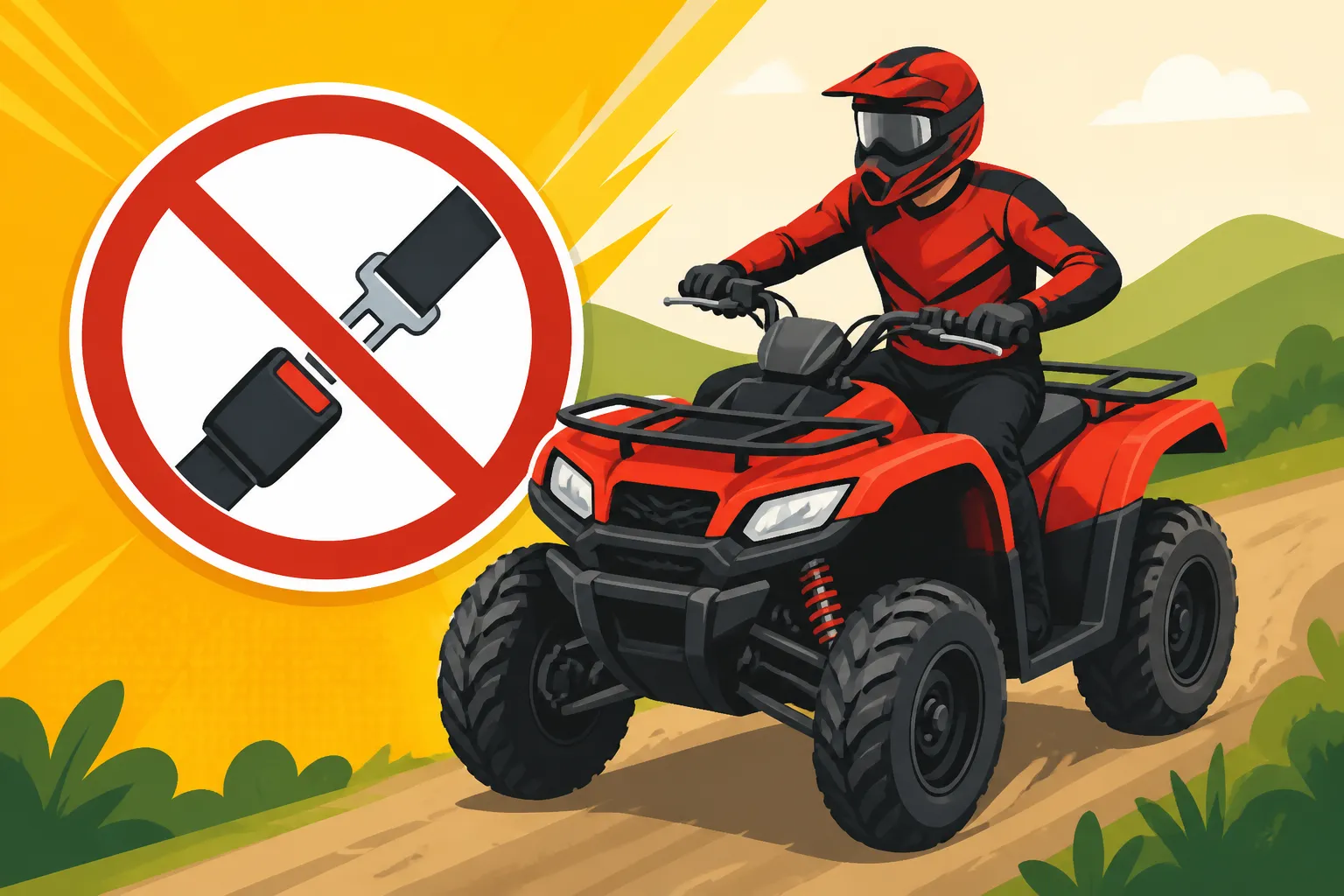
A quad has no seat belt to buckle because an ATV is designed differently from a side-by-side: the rider sits astride an open machine rather than in a seat inside a vehicle. Indiana’s rules reflect that distinction, but the belt exception is not a reason to skip other safety requirements. Here’s what quad riders and UTV occupants should know before riding.
Why a quad and a side-by-side have different belt rules
An ATV, commonly called a quad, is an open vehicle with a straddle seat. The rider sits on top of it, using the handlebars, footrests, and body position to stay in control. Most quads are not built with an occupant seat belt. Dirt bikes share the relevant exception because they are also ridden astride rather than from a seated position inside a cabin.
A side-by-side, or UTV, is arranged more like a small vehicle. Its occupants sit in seats, and it may have a protective structure around them. At Indiana state ORV properties, the Indiana Department of Natural Resources requires seat belts for vehicle operators and occupants except on ATVs and dirt bikes. That means the exception is for the listed vehicle types, not a general option to ride unrestrained in a UTV.
| Machine | Rider position | Seat-belt rule at Indiana state ORV properties |
|---|---|---|
| ATV or quad | Straddling an open machine | The Indiana Department of Natural Resources’ rule exempts ATVs from the seat-belt requirement |
| Dirt bike | Straddling an open machine | The Indiana Department of Natural Resources’ rule exempts dirt bikes from the seat-belt requirement |
| Side-by-side or UTV | Seated inside the vehicle | Seat belts are required under the Indiana Department of Natural Resources’ property rules |
| Other covered vehicle | Seated inside the vehicle | The Indiana Department of Natural Resources requires seat belts for operators and occupants |
The key distinction is the kind of machine, not whether a rider feels more comfortable without a belt. If you are in a side-by-side, use its seat belt. If you are on a quad, the rule does not require you to wear a belt, but that does not make a quad equivalent to a vehicle with occupant restraints.
For a closer look at the property-specific rule, see Indiana Seat Belt Rules at an ORV Park. If you ride more than one type of machine, check the requirements for each one rather than assuming the quad exception carries over to a UTV.
What the belt exception does and does not mean
The exception answers a narrow question: whether an ATV or dirt bike rider must use a seat belt under the cited Indiana state ORV property rule. It does not mean that a quad rider is exempt from every safety rule, or that the same rule applies to every place and situation.
For example, Indiana’s helmet law is a separate requirement. The Indiana Department of Natural Resources says children under 18 must wear a helmet on or in an ORV, including an ATV, UTV, side-by-side, or dirt bike. The rule applies on public and private property, subject to the stated farm-use exception. A quad’s lack of a seat belt does not change the helmet requirement. Read Indiana’s ORV Helmet Rule Explained for more detail.
At state ORV areas, the Indiana Department of Natural Resources also requires DOT-approved safety helmets, with a stated exception for vehicles with fully enclosed metal cabs or roll bar protection. That property rule should not be treated as a blanket replacement for the separate statewide helmet requirement. In particular, the statewide requirement for children under 18 is not erased simply because a machine has a cab or protective structure. If you are unsure how the rules apply to a specific vehicle or setting, check with the property or agency before riding.
The Indiana Department of Natural Resources says approved ORV helmets must meet U.S. Department of Transportation standards, and helmets meeting FMVSS 218 must have a DOT sticker on the outside back. A product description or a decorative sticker alone is not enough to establish that a helmet meets the requirement. If you shop on Amazon or another marketplace, verify the helmet’s certification and the required exterior sticker rather than relying only on a listing title.
The helmet rule also applies to a child riding in a car seat; the Indiana Department of Natural Resources says using a car seat does not remove the helmet requirement for someone under 18. The stated farm-use exception applies when an ORV is being used for farm purposes. If the machine is being used for a non-farm purpose, the Indiana Department of Natural Resources says the helmet law applies.
A few practical takeaways:
- Don’t add a belt to a quad or change how it is used based on assumptions about the exception. Follow the manufacturer’s instructions for that machine.
- If you switch from a quad to a UTV, buckle up. The ATV exception does not cover a side-by-side.
- Treat helmet rules as separate from seat-belt rules. A quad rider may have no belt to wear and still need a helmet.
- Check local and property rules before a ride. The rules for a particular riding area may include requirements beyond the basic distinction between ATVs and UTVs.
Who is responsible for helmet compliance
The person operating the vehicle has a central role in preventing a helmet violation. The Indiana Department of Natural Resources says the operator of any vehicle is ultimately responsible for a violation of the helmet law, and the adult responsible for an ATV can also be cited. Owners who allow children younger than 18 to ride an ORV without a helmet can be charged with a Class C infraction. The maximum penalty listed by the Indiana Department of Natural Resources is $500.
That responsibility matters when an adult lends a quad to a young rider. It is not enough to assume the child knows the rules or has chosen suitable gear. Before handing over the machine, check that the rider has a helmet that meets the stated standard and that the intended ride is allowed. For related age and supervision considerations, see Indiana Supervision Rules for Minors and Indiana Rules for Carrying a Passenger.
Passenger rules are another separate issue. The Indiana Department of Natural Resources says passengers are not allowed on ATVs or dirt bikes unless the machine was designed by its manufacturer for two-up riding. A seat-belt exception does not create permission to carry a second person on a machine that is not designed for a passenger. Check the manufacturer’s specifications and the applicable property rules before taking anyone along.
If a child will be riding in a side-by-side, don’t assume the quad rules apply because both machines are ORVs. Indiana’s helmet rule covers children under 18 in side-by-sides and UTVs, while the state property rule requires seat belts for operators and occupants in vehicles other than ATVs and dirt bikes. The practical checklist for a UTV ride is therefore different: use the available seat belt and follow the helmet rules that apply to the rider and location.
A quick pre-ride check for quad and UTV riders
Before heading out, identify the machine correctly. A quad is an ATV; a side-by-side is a UTV. That classification affects which belt rule applies, and it can also matter for passengers, helmets, and other site requirements. Don’t rely on casual names such as “four-wheeler” to determine whether a machine qualifies for a particular exception.
Then check the rules for the place where you plan to ride. The Indiana Department of Natural Resources says off-road vehicle use on public roads is governed by individual county rules, which may include vehicle-type, age, helmet, insurance, lighting, and operating-hour restrictions. A seat-belt exception at a state ORV property does not establish that a quad can be used on a county road or that county rules will match the property’s rules. See Indiana Local Ordinances on ORV Riding if a route includes public roads.
For a ride at Redbird or Interlake, check the site’s current requirements before unloading. The Indiana Department of Natural Resources lists both as ORV properties and requires riders to stay in designated areas and on marked trails. Its property rules also require functioning spark arrestors and mufflers. Those requirements are separate from the seat-belt distinction, but they are part of planning a compliant ride.
A simple check before departure can prevent confusion at the trailhead:
- Confirm whether the machine is an ATV, dirt bike, UTV, or another vehicle type.
- For a UTV, locate and use the required seat belts; for an ATV or dirt bike, don’t mistake the belt exception for a general safety exemption.
- Check the helmet requirements for every rider, especially anyone under 18.
- Confirm passenger capacity and follow the manufacturer’s design limits.
- Review the rules for the specific property and any county roads on the route.
The short answer is that a quad rider has no belt to wear because an ATV is designed as an open, straddle-ridden machine, and Indiana’s state ORV property rule exempts ATVs and dirt bikes from its seat-belt requirement. A UTV is different: its occupants sit inside the vehicle, and the Indiana Department of Natural Resources requires them to use seat belts at those properties. Keep that distinction clear, and treat helmets, passengers, and location-specific rules as separate questions.
Sources
- Indiana Department of Natural Resources — Law Enforcement: Off-Road Vehicle Child Helmet Law (checked November 3, 2026)
- Indiana Department of Natural Resources — State Parks: Interlake Off-Road State Recreation Area (checked November 3, 2026)
Disclaimer
This article is for general informational purposes only and does not constitute professional advice. Laws, prices and regulations vary by location and change over time. Consult a qualified professional for guidance on your specific situation.