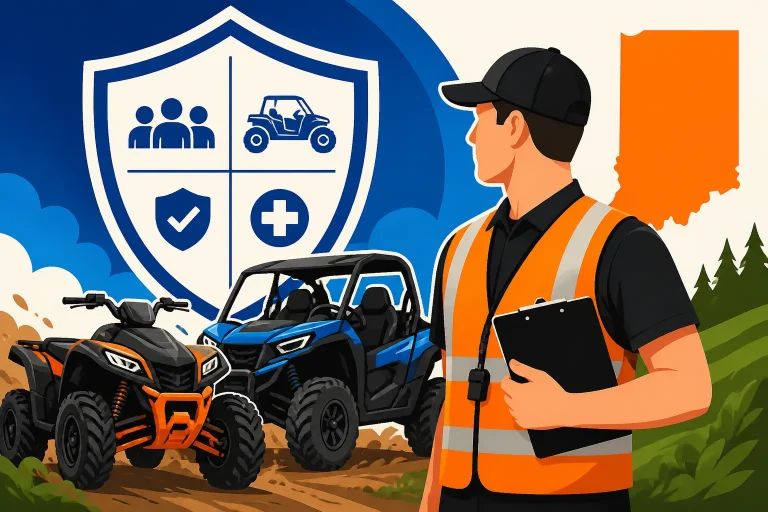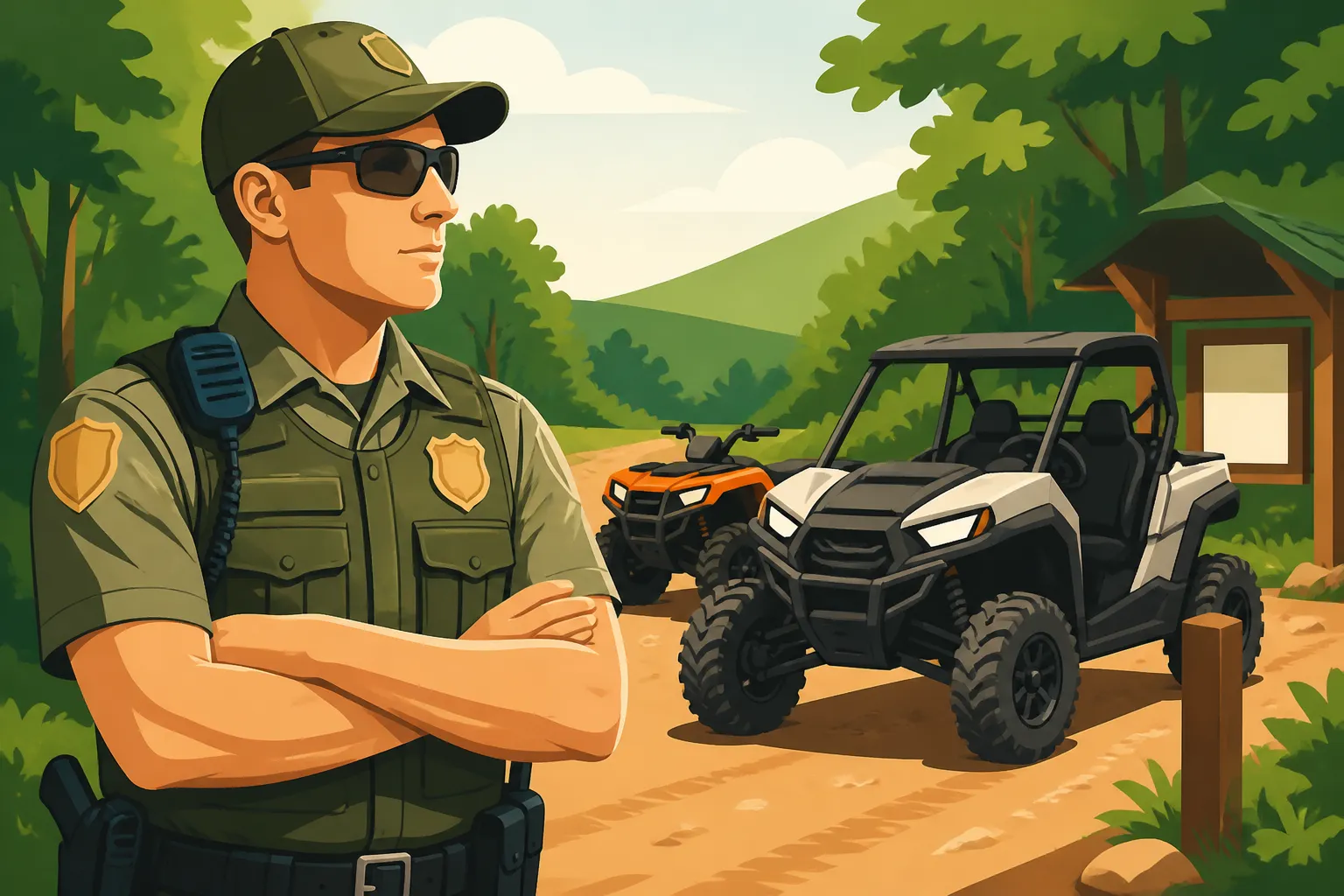
A Warden at an Indiana Trailhead
A warden at an Indiana trailhead may check more than whether you bought a permit. Riders can be unsure which document applies, whether an out-of-state registration is enough, and what happens if something is missing. Knowing the difference between a trail permit and vehicle registration—and having both ready when required—makes the check straightforward.
What a warden may check at an Indiana trailhead
At a state-managed riding area, a conservation officer or other authorized staff member may check that you and your machine are allowed to ride there. The exact checks depend on the location and its rules, but it is sensible to be ready to show your permit, vehicle information and any documents required for your machine.
A quick check can cover several separate things:
- Trail access: Is the machine covered by a required Indiana ORV trail permit?
- Vehicle registration: Does the machine meet applicable registration requirements?
- Location: Are you on a trail or in an area open to that kind of vehicle?
- Rider and machine rules: Are age, supervision, helmet, seat belt or equipment rules being followed?
- Park-specific requirements: Have you followed the property’s entry, operating-hour and trail-use rules?
A permit is not a general pass to ride anywhere in Indiana. It applies to the places and uses set out by the relevant rules. Private parks may have their own admission requirements, and a state permit does not replace a private park’s rules. Before unloading, check the facility’s current information and read any notices at the entrance.
Indiana’s state ORV areas include Redbird and Interlake, but the rules for a given property matter. A permit for a designated area does not make a closed trail open, allow riding off marked routes, or grant permission to cross land where ORVs are not allowed. For location-specific background, see Where to Ride an ORV in Indiana and Indiana Trail Closures to Check.
Permit, registration and entrance fee are different
One of the easiest ways to be caught unprepared is to treat every decal, permit and payment as the same thing. They serve different purposes. A DNR trail permit relates to riding at designated state ORV areas. BMV registration addresses the vehicle’s registration requirements. An entrance fee, where charged, is a separate charge for access to a facility.
| Item | What it generally addresses | What it does not automatically provide |
|---|---|---|
| Indiana ORV trail permit | Permission to use designated state ORV areas under applicable rules | Permission to ride every Indiana trail or public property |
| BMV registration and decal | Registration of a machine when Indiana registration is required | A DNR trail permit or entry to a private park |
| Park entrance fee | Entry to a facility when that property charges one | A trail permit or authority to ride a closed route |
| Out-of-state registration | Registration status under the issuing jurisdiction, subject to Indiana rules | Automatic exemption from Indiana trail-permit requirements |
The distinction matters at a trailhead. A rider may have paid for entry but still need the proper permit. Another rider may have a valid trail permit but still need to meet vehicle-registration requirements. A warden’s check is easier to answer when you know what each item proves.
For a closer explanation of the permit itself, read Indiana ORV Permits Explained. If you are trying to decide between a short visit and repeated trips, Indiana’s Daily and Annual Trail Permits covers the available permit types. Charges and procedures can change, so confirm current details through the official information for the riding area before you travel.
Do not assume one payment covers everything
At some facilities, the permit and the entrance charge are separate. Paying one does not necessarily settle the other. The same goes for a permit covering a machine: do not assume that buying one for a group, tow vehicle or trailer covers every ORV being ridden. Check the permit rules for each machine and keep the proof that applies to it.
A simple pre-trip check is to ask:
- Which riding area are you visiting, and is it open to your machine?
- Does each machine need its own permit?
- Is an entrance fee collected separately?
- Does the property require registration or other documents in addition to the permit?
- How must proof be displayed or presented?
These questions are more reliable than assuming that a previous visit, another rider’s permit or an old receipt covers the current trip.
What out-of-state riders should have ready
Visitors often bring a registration from their home state and assume it settles every Indiana requirement. Registration reciprocity and trail access are related questions, but they are not interchangeable. An out-of-state registration may be relevant to whether a machine is properly registered, while a DNR trail permit may still be needed for a designated state riding area.
Do not rely on a vehicle’s home-state sticker alone as proof that all Indiana requirements are met. Check both the rules for the machine and the permit rules for the location. The Indiana ORV Registration for a Nonresident and Does Indiana Honor Out-of-State Registration? pages can help you sort out the registration question. For a short visit, also check Indiana’s Twenty-Day Visitor Rule; a visitor rule should not be treated as a substitute for a trail permit unless the applicable instructions say that it is.
Before leaving home, keep these items easy to reach:
- Permit confirmation or other proof of purchase, following the provider’s instructions.
- Vehicle registration documents and any required decal.
- Identification for the rider, if required by the facility or relevant rule.
- Any required insurance proof for the particular road or property use.
- A phone with saved copies of documents, as a backup rather than a replacement when physical display is required.
A photo of a document can be useful if the original is lost, but it may not satisfy every requirement. Follow the official directions for displaying or presenting proof. Keep paper documents in a dry, secure place; for more practical tips, see Keeping Paperwork in a Dry Box.
The trailhead check can also involve the machine itself. Be prepared to identify the ORV and show that its permit or registration corresponds to it. If a decal is damaged, missing or hard to read, resolve the issue before riding rather than expecting an officer to accept an unclear number. See Indiana ORV Decal Placement and Replacing a Lost Indiana ORV Decal for related decal questions.
How to handle the check and avoid preventable problems
When an officer or staff member asks to see your documents, stop safely and follow their directions. Have your permit and registration ready, answer questions clearly, and do not continue riding until you understand what is being asked. A calm, organized response helps the check stay focused on the issue.
If you learn that a document is missing, do not assume that buying or locating it later makes the earlier ride compliant. Ask what the property requires before continuing. Depending on the problem, you may need to stop riding, leave the property, or resolve the issue through the appropriate office. If the question is about a rule rather than a missing document, ask which requirement applies and where to confirm it.
Some mistakes are easy to prevent:
- Arriving with proof for the wrong machine: Match the permit and registration to the ORV you are riding.
- Confusing the gate charge with the permit: Check whether each is required and paid separately.
- Assuming an out-of-state decal is enough: Verify both Indiana registration rules and the riding area’s permit rules.
- Riding beyond the permitted area: Stay on open, marked routes and obey closures.
- Leaving documents out of reach: Store them where you can retrieve them without unpacking the trailer or searching through wet gear.
- Relying on old information: Check current park notices and official instructions before departure, especially after weather or seasonal closures.
A permit does not excuse unsafe riding or other rule violations. Operators remain responsible for age and supervision requirements, protective equipment, machine restrictions and trail conduct. Requirements may differ between public riding areas, private parks and roads open to ORVs. If your route includes public roads, review the applicable county and state rules rather than assuming trail access includes road access.
The most useful preparation is a short checklist the evening before a ride: confirm the location is open, verify the permit for each machine, check registration status, set aside any required documents, and review the facility’s latest notices. At the entrance, follow posted directions and keep proof available. That approach reduces confusion without assuming that one permit or sticker answers every question.
Disclaimer
This article is for general informational purposes only and does not constitute professional advice. Laws, prices and regulations vary by location and change over time. Consult a qualified professional for guidance on your specific situation.