What a Seventeen-Year-Old May Drive at a Park
A seventeen-year-old planning to ride at an Indiana off-road park needs to know more than whether they can handle the machine. Age rules depend on the vehicle, while helmets, seat belts, passengers, registration and park permits have separate requirements. Here’s how to tell what a teen may operate at a DNR riding area and what to check before unloading.
What a Seventeen-Year-Old May Operate
At an Indiana DNR off-road property, a seventeen-year-old may operate a dirt bike, ATV or UTV without the parent-or-guardian supervision required for younger riders. The Indiana Department of Natural Resources says operators of those vehicle types who are under sixteen must be directly supervised at all times by a parent or legal guardian. That rule applies to riders below the stated age, not to someone who is seventeen.
That answers the supervision question, but it does not mean a seventeen-year-old can drive every kind of machine at the park. The DNR says an operator of a vehicle, SUV or other vehicle that is not a dirt bike, ATV or UTV must be at least sixteen and have a valid driver’s license. A seventeen-year-old meets the age requirement for that category but still needs the required license.
| Machine at a DNR riding area | What the age rule means for a seventeen-year-old |
|---|---|
| Dirt bike | The under-sixteen direct-supervision rule does not apply at seventeen. |
| ATV | The under-sixteen direct-supervision rule does not apply at seventeen. |
| UTV or side-by-side | The under-sixteen direct-supervision rule does not apply at seventeen. |
| SUV or another vehicle outside those categories | The operator must meet the DNR’s minimum age and valid-driver’s-license requirements. At seventeen, the rider still needs a valid license. |
These rules describe who may operate a machine; they do not guarantee that a particular park will accept every vehicle or allow it on every trail. At DNR properties, off-road vehicles must be registered or street legal, and vehicles may be used only in designated areas and on marked trails, according to the Indiana Department of Natural Resources. Check the property’s current rules and trail information before choosing a vehicle or setting out.
If the rider is still under sixteen, the distinction matters: an adult nearby may not satisfy the supervision requirement. The DNR rule calls for direct supervision by a parent or legal guardian at all times. For details on the broader age rules, see Indiana Minimum Age to Ride Public Land and Indiana Supervision Rules for Young Riders.
The type of machine also matters for passenger plans. The Indiana Department of Natural Resources says passengers are not allowed on ATVs or dirt bikes unless the manufacturer designed the machine for two-up riding. Do not assume that a seat or footrests added after purchase make a single-rider machine suitable for a passenger. Check the manufacturer’s design and the park’s rules. A UTV has a different seating layout, but occupants still need to use the safety equipment required for that vehicle.
A seventeen-year-old riding without a supervising parent must still follow the other rules that apply to the machine and location. A rider who is old enough to operate independently is not automatically exempt from helmet requirements, trail restrictions, registration rules, or a park’s permit and fee requirements. Those are separate questions, and each should be settled before the ride.
Helmets, Seat Belts and Other Park Rules
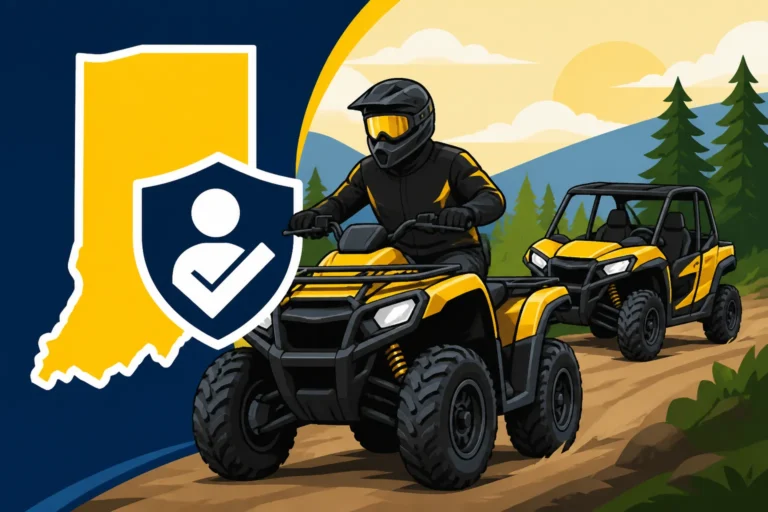
Helmet rules are especially important for a seventeen-year-old because age, vehicle type and location all matter. The Indiana Department of Natural Resources says children under eighteen must wear a helmet on or in any ORV in Indiana, including ATVs, UTVs, side-by-sides and dirt bikes. The DNR says the rule applies on public and private property, so riding at a private off-road park does not by itself remove the requirement.
The DNR identifies helmets meeting U.S. Department of Transportation standards as approved for ORV use. It also says a helmet meeting FMVSS 218 must have a DOT sticker on the outside back of the helmet. If buying gear through Amazon or another retailer, check the actual helmet and its labeling rather than relying only on a product title or a seller’s description. A novelty helmet or one that merely looks like a motorcycle helmet may not meet the stated standard.
Some DNR park operating information describes a helmet exception for vehicles with a fully enclosed metal cab or roll bar protection. That should not be treated as a blanket permission for a rider under eighteen to go without a helmet: the DNR’s under-eighteen helmet rule is broad. For a seventeen-year-old, wearing a properly approved helmet in every ORV is the clear, low-uncertainty choice. If a particular vehicle appears to qualify for an exception, confirm the rule with the park before riding. More detail is available in Indiana Helmets at Redbird and Interlake and Do You Need a Helmet Inside a Roll Cage?.
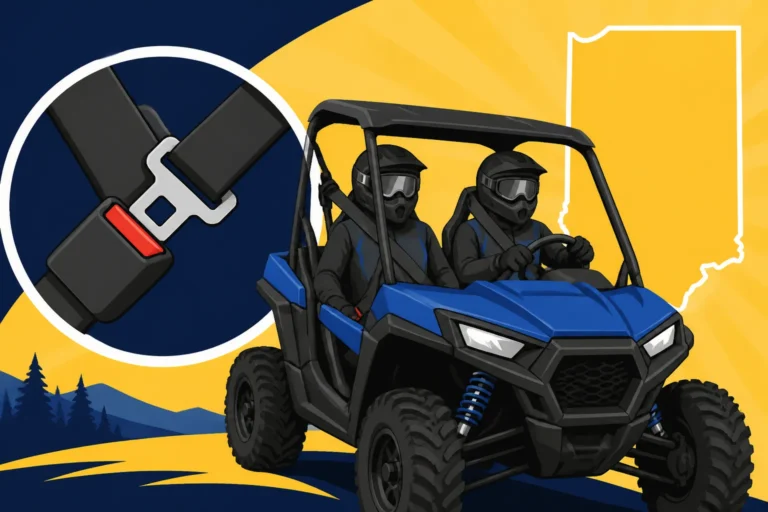
Seat belts depend on the vehicle. The Indiana Department of Natural Resources says seat belts are required for vehicle operators and occupants except on ATVs and dirt bikes. A seventeen-year-old in a UTV or other covered vehicle should use the available seat belt as required; being a passenger rather than the driver does not remove the occupant requirement. The DNR’s overview of this distinction is covered in Indiana Seat Belt Rules at an ORV Park.
Other operating requirements apply regardless of the rider’s age. The Indiana Department of Natural Resources says ORVs must have functioning spark arrestors and mufflers, and tire chains and studded tires are prohibited. The DNR also says vehicles must remain in designated areas and on marked trails. A machine that is allowed on the property is not necessarily permitted on every route, so look at the trail map and any posted closures.
For UTVs and other vehicles with multiple seats, confirm that the machine is configured for the occupants and that everyone follows the relevant safety rules. For ATVs and dirt bikes, the passenger restriction is particularly easy to overlook when a teen is riding with a friend or sibling. A passenger should not climb aboard unless the vehicle was designed by its manufacturer for two-up use, as specified by the Indiana Department of Natural Resources.
The rider’s parent or guardian should also understand who may be responsible if the helmet rule is ignored. The DNR says the operator is ultimately responsible for a helmet-law violation and that the adult responsible for the ATV can also be cited. It identifies allowing a child under eighteen to ride an ORV without a helmet as a Class C infraction, with a maximum penalty listed by the DNR. Rather than rely on assumptions about who might be cited, make helmet use a condition of the ride.
Registration, Trail Permits and a Pre-Ride Check
Vehicle registration and a park’s trail-use permit are not interchangeable. The Indiana Department of Natural Resources says ORVs used in Indiana must be registered unless exempt, and the Indiana BMV issues the registration. The DNR also explains that a motorized trail-use permit is not an ORV registration. A park permit can authorize trail use under the park’s rules, but it does not replace vehicle registration where registration is required.
Redbird and Interlake have a specific option for out-of-state visitors: the Indiana Department of Natural Resources says they may purchase an Out of State Motorized Trail Use permit for use at those two DNR properties. That permit is valid only at Redbird and Interlake, and the DNR says it is not an ORV registration. A visitor planning to use an ORV on Indiana roadways open to ORVs needs to meet the separate registration requirements for that use. For a trip focused only on a riding area, check the property’s current permit instructions and do not assume a trail permit authorizes road use.
A riding plan should account for the vehicle as well as the seventeen-year-old’s age. Before leaving, check that the machine is registered or otherwise qualifies for the applicable exception, that its decal and paperwork are in order, and that the required trail-use permit or daily receipt is available. The Indiana Department of Natural Resources says the valid daily receipt must be in the vehicle operator’s possession at DNR off-road properties. Make sure the teen knows where the documents are and can show them if needed.
Use this pre-ride sequence to avoid sorting out eligibility at the gate:
- Identify the vehicle category. Confirm whether it is a dirt bike, ATV, UTV, SUV or another type of vehicle. The category determines which age and license rule applies.
- Check the operator rule. For a seventeen-year-old on a dirt bike, ATV or UTV, the DNR’s under-sixteen supervision requirement does not apply. For an SUV or another vehicle outside those categories, confirm the valid-driver’s-license requirement.
- Confirm the park and trail. Check that the property accepts the machine and that the chosen route is designated for it. Stay on marked trails and follow posted closures.
- Prepare required safety gear. A seventeen-year-old should have a DOT-approved helmet. Use seat belts where required, and confirm the machine’s passenger capacity and intended use.
- Separate registration from trail access. Verify that the ORV’s registration status is correct and arrange any park permit or daily receipt separately.
- Review the final details with the park. If the vehicle type, helmet exception, trail access or permit status is unclear, contact the property before the trip.
The key distinction is straightforward: at a DNR riding area, a seventeen-year-old is beyond the age range for the stated direct-supervision rule on dirt bikes, ATVs and UTVs, but that does not make the ride unrestricted. A different age-and-license rule applies to other vehicles. Helmet use, seat belts, passengers, registration, permits and marked-trail rules remain separate checks. Sorting them out before the trip is easier than discovering a problem after the machine is unloaded.
Disclaimer
This article is for general informational purposes only and does not constitute professional advice. Laws, prices and regulations vary by location and change over time. Consult a qualified professional for guidance on your specific situation.