Indiana Rules for a Full-Size Vehicle Operator
Indiana’s full-size vehicle rules are easy to confuse with the rules for ATVs and side-by-sides. The key distinction is the operator: at Indiana’s state off-road riding areas, a full-size vehicle operator generally must be at least 16 and hold a valid driver’s license. That requirement does not replace the vehicle’s permits, safety rules or trail restrictions.
What Counts as a Full-Size Vehicle
The phrase “full-size vehicle” generally means a road-sized four-wheel-drive vehicle, such as a Jeep, truck or similar 4×4 used off road. It is different from an ATV and may also be treated differently from a side-by-side or other recreational off-highway vehicle. The distinction matters because the rules for who can drive, what safety equipment occupants need, and where the vehicle can go may not be the same.
Before a trip, check the particular riding area’s current definition and vehicle rules. A machine that looks like a small off-road vehicle may still be treated as a full-size vehicle based on its design, size or class. Don’t assume that a rule for an ATV automatically applies to a UTV, or that a UTV rule covers a full-size 4×4.
The operator’s age and license
At Indiana’s state off-road riding areas, a full-size vehicle operator generally must be at least 16 years old and have a valid driver’s license. A parent riding along does not turn an underage passenger into an eligible driver. If the person behind the wheel does not meet the age and license requirement, plan for a qualified driver to operate the vehicle instead.
A learner’s permit, temporary credential or out-of-state license can raise questions about whether the driver meets the area’s rule. If the operator has anything other than a standard current license, confirm directly with the park before unloading. Don’t treat a driver’s ability to operate a vehicle on public roads as automatic approval to drive it on an off-road trail, or the reverse.
A driver’s license is also not a blanket authorization to ride anywhere. It qualifies the operator for a particular kind of vehicle under applicable rules; it does not open closed roads, private land or trails that exclude full-size vehicles. For a broader overview of age-based requirements, see Indiana State Park Rules for Riders Under 16 and Indiana Rules for a Full-Size Vehicle Operator.
A full-size vehicle is not just a larger ATV
An ATV operator may be subject to a different age and supervision standard than a full-size vehicle operator. A rider who is old enough to operate one type of machine may not be old enough to drive another. The same caution applies when a machine has a roll cage, doors, a steering wheel or seat belts: those features may affect the equipment rules, but they do not necessarily make the vehicle’s age or license requirements identical to an ATV’s.
Use this quick comparison as a starting point, then verify the specific machine and property rules before you go:
| Question | Full-size vehicle | ATV or smaller ORV |
|---|---|---|
| Who may operate it? | Generally, an operator at least 16 with a valid driver’s license at Indiana state riding areas | Age and supervision rules may differ by machine and rider |
| Does a driver’s license allow riding on every trail? | No. The trail must allow that vehicle class | No. The trail must allow that machine class |
| Does the operator’s license replace an ORV permit? | No | No |
| Are occupants subject to safety rules? | Yes. Follow posted seat-belt and helmet requirements | Yes. Helmet and passenger rules may apply |
| Does an out-of-state registration settle every requirement? | No. Trail access and permits are separate questions | No. Registration reciprocity does not necessarily cover trail permits |
If you’re not sure how a particular machine is classified, describe it to the park rather than relying on a casual label such as “side-by-side” or “off-road truck.” Give the make, model and seating configuration if you have them. A clear answer before travel is better than discovering at the gate that your group brought a vehicle the route does not allow.
The license does not make a closed route legal
Indiana’s public-road rules, local ordinances and off-road park rules are separate layers. Being licensed to drive a full-size vehicle does not by itself authorize you to use an ATV trail, travel on a county road that is closed to ORVs or cross land without permission. Likewise, trail access at a managed riding area does not mean the vehicle may be driven on nearby public roads.
Check the rules for your actual route, not just the rules for the operator. If your plan involves leaving a park or crossing a road, look up the road-use requirements as well. Indiana Rules for Riding a County Road explains why a county road may be open to some vehicles or uses but not others.
Permits, Registration and Reciprocity
The operator’s license and the machine’s paperwork answer different questions. A license addresses who may drive. Registration, a trail permit and an entrance fee address other requirements. Showing one does not automatically satisfy the others.
The trail permit is tied to the machine
When a state off-road recreation area requires a trail permit, expect the requirement to apply to each machine that will ride—not simply to the driver or the truck carrying the group. If several vehicles are coming off one trailer or arriving together, check whether each needs its own permit and what kind of permit is accepted for the visit.
This is easy to overlook when one person handles the group’s payment. A driver may have a valid license and the vehicle may have registration, yet the machine can still be missing a required trail permit. For an explanation of the permit types and who generally needs them, see Indiana’s Daily and Annual Trail Permits and Do You Need a Permit for Indiana ORV Trails?.
A trail permit is also distinct from an entrance charge. Where both apply, budgeting for one does not necessarily cover the other. Confirm the current requirements and payment options with the riding area before you leave home. If the site sells permits at the gate, check whether that process is practical for your arrival time and group size. Why an Entrance Fee Sits on Top in Indiana explains the difference between those charges.
Out-of-state paperwork is a separate issue
Visitors often ask whether an out-of-state registration or decal is accepted in Indiana. The answer depends on which requirement they mean. Rules that recognize or provide a limited period for an out-of-state machine to operate in Indiana do not necessarily waive a state riding area’s trail permit, entrance charge or vehicle-specific restrictions.
In other words, reciprocity is not one universal pass. It may address the machine’s registration status while leaving park access requirements unchanged. A visitor should check both questions:
- Is the machine’s out-of-state registration or decal acceptable for its use in Indiana?
- Does the riding area require a separate permit for this vehicle?
- Is this vehicle class allowed on the trails the group intends to ride?
- Does the operator meet the age and license requirements?
For the registration side, see Indiana’s Twenty-Day Visitor Rule and Does Indiana Honor Out-of-State Registration?. For a practical visitor checklist, Indiana Rules for a Visiting Rider covers the separate issues to verify before arriving.
Keep vehicle documents distinct from operator credentials
Carry the driver’s license required for the operator and keep the machine’s paperwork accessible. If the vehicle is registered in another state, bring the registration document or other proof that makes its status clear. If you have purchased a permit, make sure you know how the park expects it to be displayed or shown.
A phone photo can help as a backup, but it is not a substitute for a document or credential that the park or an officer requires you to produce. Keep originals protected from water and mud. A small dry pouch bought from Amazon can be useful for paper registration documents, permits and emergency contact information; store it where the driver can reach it without climbing around a loaded vehicle.
If your group is carrying multiple machines, label documents or keep them in separate sleeves. It is much easier to match each permit to its vehicle at the gate than to sort through a wet pile of papers after unloading.
Safety Rules for Drivers and Passengers
A qualified driver is only one part of a safe trip. Full-size vehicles have their own occupant protection requirements, and riders should follow posted park rules as well as the vehicle manufacturer’s instructions. A road-sized vehicle can still roll, slide or strike an obstacle on an off-road trail.
Use the seat belts provided
If the vehicle is equipped with seat belts, occupants should use them as required by the park’s rules and the vehicle’s design. A roll cage or enclosed cab does not make seat belts optional. Keep passengers in designated seats and do not let anyone ride on a cargo rack, tailgate, hood or other place not designed for passengers.
Seat belts are especially important when the trail has side slopes, ruts, steep climbs or sudden changes in traction. A passenger who is not belted can be thrown against the cabin or out of the vehicle during a hard turn or rollover. The driver should check that everyone is seated and buckled before moving, not after the vehicle reaches the trail.
Do not exceed the vehicle’s stated seating capacity. A rear bench or cargo area may look like a convenient place to squeeze in one more person, but it may not be designed or approved for passengers. If there are more people than legal seats, make a second trip or bring another vehicle.
Follow helmet requirements for the vehicle and occupant
Helmet rules may depend on the rider’s age, the vehicle’s design and the location. An enclosed cab can affect whether a helmet exception applies under a particular rule, but it is not safe to assume that any roof, windshield or roll cage counts as an enclosed cab. Check the current park guidance, especially when a passenger is under 18.
Even when a helmet is not required for a particular occupant in a particular vehicle, it may still be sensible protective equipment. A cab can have open windows, and an off-road impact can cause a passenger’s head to strike an interior surface. Choose properly fitted protective gear and make sure it is in good condition. A helmet purchase through Amazon, for example, should be checked carefully for the required safety certification and fit rather than chosen by appearance alone.
For the age-related helmet requirements at managed riding areas, see Indiana Helmets at Redbird and Interlake and Why Under-18 Riders Wear Helmets in a UTV. Confirm any exception with the park before relying on it.
Drive to the trail, not past your skill level
A driver’s license shows that the operator meets a legal qualification; it does not prove off-road experience. A large 4×4 behaves differently on loose clay, wet ground, steep side slopes and uneven mine spoil than it does on pavement. The vehicle’s weight and wheelbase can make narrow turns or soft shoulders more challenging than they appear from the driver’s seat.
Before setting out:
- Pick trails that fit the driver’s experience and the vehicle’s size.
- Read signs and posted trail ratings at the entrance.
- Leave room between vehicles so dust and sudden stops do not cause a collision.
- Reduce speed before blind turns, hill crests and trail intersections.
- Avoid climbing an obstacle if you cannot see what lies beyond it.
- Do not drive around a closure or bypass a difficult section off trail.
- Stop in a safe place if visibility, weather or vehicle condition changes.
If the route is too tight or steep for the vehicle, turn around where it is safe to do so. Scraping through a narrow trail can damage the vehicle, harm the trail and block other riders. Ask park staff about full-size routes rather than trying to infer access from a map symbol you do not understand.
Do not let passengers distract the driver
A passenger can help with navigation, but the driver remains responsible for controlling the vehicle. Agree on simple signals before entering a noisy or dusty section. If the group needs to consult a map or phone, stop somewhere safe and out of the travel lane.
A mounted phone is not a reason to look away from the trail. Download or save useful maps before losing service, and keep the device secured. Amazon sells vehicle mounts and protective cases, but any mount should hold the device firmly without blocking the driver’s view or interfering with controls. A paper trail map can be a useful backup if the phone battery dies or the signal disappears.
Where and How a Full-Size Vehicle May Ride
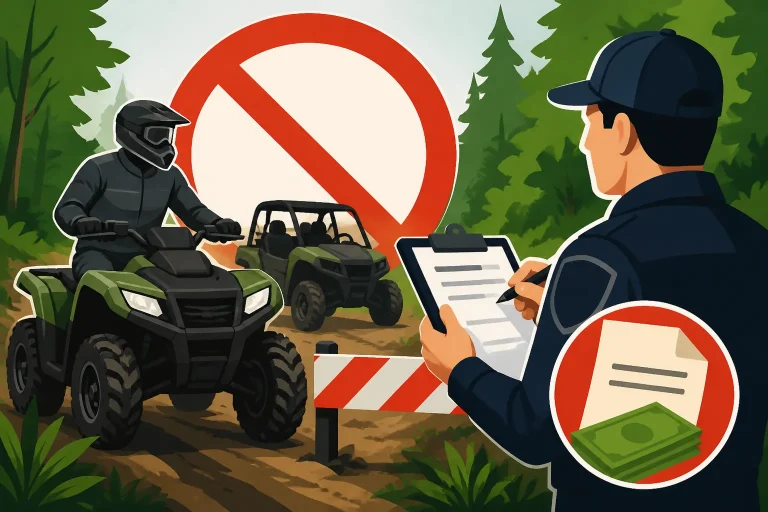
A license and permit do not mean every marked ORV trail is open to every machine. Trails can be limited by vehicle type, width, use or current condition. The park’s signs and official map control your route.
Check access for the exact vehicle class
Before traveling, look for the riding area’s rules on full-size vehicles, not simply a general statement that ORVs are allowed. Check whether there are designated routes, any size or equipment limits, and whether the particular area is open to that vehicle class on the day you plan to ride.
This matters at parks with mixed-use trail systems. An ATV route may be too narrow for a truck or Jeep, even if both are considered off-road vehicles in everyday conversation. A full-size vehicle should not enter a route marked for smaller machines unless the park explicitly allows it.
Use the current map and signs together. If a map is unclear, ask staff at the entrance. Don’t use a trail because another vehicle has driven there; it may have been authorized for an event, may be a service vehicle or may simply be in the wrong place. [Indiana Rules for Riding Off the Trail] explains why leaving a marked route can create both safety and access problems.
Stay on open, designated routes
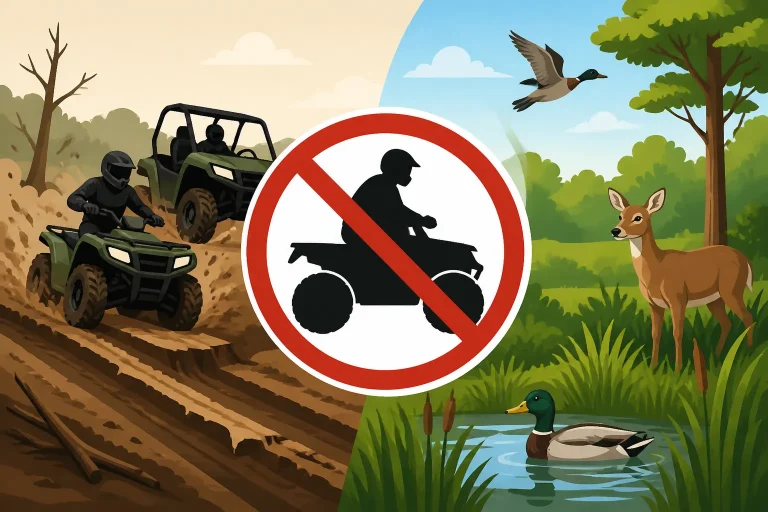
Stay on trails that are open to your vehicle. Do not widen a route by driving around a muddy spot, cut across a field to rejoin a trail, or use an unmarked path as a shortcut. Off-trail driving can damage vegetation and soil and may create new ruts that remain long after the ride.
Closures can change with weather, maintenance and land conditions. Check the park’s notices before loading, then read the gate board when you arrive. A route that was open on a previous visit may be closed today. After heavy rain, clay and reclaimed ground can become slippery and may be damaged by heavy vehicles. If staff close a trail, take the alternate route rather than trying to judge whether your vehicle can get through.
When you encounter another vehicle, slow down and make room where the trail allows. On a narrow incline, avoid stopping in a place where either vehicle could slide backward or lose traction. Communicate clearly, give the other driver time to maneuver and never assume that a larger vehicle has the right to force its way through.
Public roads are not a park trail
A road-legal vehicle may be allowed on public roads under ordinary traffic laws, but that does not grant it a right to use an off-road trail. Conversely, a park permit does not make an off-road vehicle street legal. Treat every transition between a park, a county road and private property as a separate legal question.
If a trip involves driving from a staging area along a public road, verify the road-use rules for that place and vehicle. County rules can differ, and the route may pass into a town or onto a state road with different restrictions. A driver’s license alone does not settle those questions. Where Indiana Allows ORVs on Public Roads provides a broader overview of road access.
Also confirm land access. A trail or road that appears to connect two riding areas may cross private property or a closed section. Get permission where required, and do not rely on a map app’s suggested route as proof that riding is allowed.
A Pre-Trip Checklist for the Driver
A short check before leaving can prevent a wasted trip and reduce confusion at the entrance. The person driving should confirm the operator, vehicle and route requirements separately.
- Confirm the driver qualifies. Make sure the operator meets the age requirement and has a valid driver’s license. If the credential is unusual or its status is uncertain, ask the park before traveling.
- Identify the vehicle class. Describe the vehicle accurately when checking rules. Include its make, model and seating arrangement rather than assuming that “UTV,” “Jeep” or “4×4” is enough.
- Check trail access. Verify that the riding area allows full-size vehicles and identify routes open to that class. Review current closures and any size restrictions.
- Review permits and fees. Determine whether each machine needs its own trail permit and whether a separate entrance charge applies. Do not assume an out-of-state registration covers park access.
- Pack documents. Bring the operator’s license and the machine’s applicable registration and permit information. Protect papers from water and dirt.
- Inspect the vehicle. Check tires, brakes, steering, lights, fuel and visible damage. Confirm the seat belts work and that passenger seats are within the vehicle’s rated capacity.
- Brief every occupant. Explain seat-belt use, helmet requirements, where passengers may sit, how to communicate and what to do if the group gets separated.
- Set a conservative route. Choose a trail that suits the least experienced driver and the vehicle, not just the most capable machine in the group.
- Recheck conditions at the gate. Read signs and closure notices, and ask staff if anything is unclear before entering the trail system.
A phone can be helpful for storing a map or making a backup copy of a permit, but keep the official document available if the park requires it. If using Amazon for a weather-resistant phone pouch or document holder, test that it closes securely and does not interfere with seat belts or vehicle controls.
If the driver does not qualify, the vehicle is not allowed on the selected trail, or the permit situation is unclear, resolve that before unloading. Having the right operator does not cure a missing permit, and having the correct permit does not make an unqualified person eligible to drive.
The practical rule is simple: confirm the driver’s age and license, then check the vehicle’s permit, safety requirements and route access independently. That gives your group the best chance of arriving ready to ride—and avoids assuming one credential covers every requirement.
Disclaimer
This article is for general informational purposes only and does not constitute professional advice. Laws, prices and regulations vary by location and change over time. Consult a qualified professional for guidance on your specific situation.