Vanderburgh’s $75 First Fine
It's incredibly frustrating when you just want to take your ATV or UTV a short distance down a public road to get to a trailhead, a friend's house, or even just another field, only to find yourself facing a ticket. Indiana's rules for off-road vehicles (ORVs) on public roads are notoriously complex and often lead to confusion, and local ordinances, like the one in Vanderburgh County, add another layer of specific requirements and potential penalties. This guide will meticulously break down why riding on roads in Indiana is generally restricted, how some counties offer exceptions, and what to expect if you find yourself on the wrong side of the law, especially focusing on Vanderburgh's initial fine.
The Strict Reality of ORVs on Indiana Roads
Let's face it: many of us dream of a world where we can hop on our quad or side-by-side and cruise down a country road to our favorite fishing spot or just enjoy the scenery. Unfortunately, in Indiana, the default stance on ORVs on public roads is a firm "no." This isn't just a suggestion; it's a legal framework designed to keep different types of vehicles, with different safety standards and operational characteristics, separated for everyone's safety. Understanding this baseline is crucial before you ever consider turning your tires onto asphalt.
Why Indiana Roads Are Closed by Default
Indiana law considers ATVs, UTVs, and other ORVs fundamentally different from cars, trucks, or motorcycles. These machines are engineered for off-road performance, excelling in dirt, mud, and uneven terrain. Their design often means they lack certain safety features mandated for on-road vehicles, such as specific lighting, turn signals, mirrors, or even top speeds suitable for highway traffic. Because of these differences, the state legislature has largely prohibited their use on public roads. The general rule is that if it's a public highway, street, or even a maintained county road, your ORV doesn't belong there unless a specific, local exception has been carved out. This blanket prohibition aims to prevent accidents between vehicles operating under different rules and expectations, and it's why you can't just assume your machine is good to go on any paved surface. This foundational principle is well-articulated in posts like [Why Indiana Roads Are Closed by Default].
The Shoulder and Ditch Exception in Indiana
Now, there are some very narrow exceptions, and it's easy to misunderstand them, leading to costly mistakes. Indiana law does allow ORVs to ride on the shoulder or in the ditch of a public highway. However, this isn't a free pass to cruise parallel to traffic. This exception is primarily intended for short distances, often when moving from one private property to another or to access a specific trail. Crucially, this can only be done where the shoulder or ditch has "sufficient width" to permit the safe operation of the ORV completely off the traveled portion of the highway, and without interfering with pedestrian or vehicular traffic. It's not about riding alongside traffic; it's about being entirely separate. Furthermore, this exception almost never applies to limited-access highways, like interstates or major four-lane state routes, where shoulders are often too narrow or dangerous for such use. If you're not sure, always assume it's better to trailer your machine than to risk a fine by misinterpreting this narrow allowance.
When Counties Open Their Roads: The Local Ordinance Approach
While the state generally says "no," Indiana law does grant counties and municipalities the power to create their own ordinances to allow ORV use on certain public roads within their jurisdiction. This is where things get interesting, and also complicated, as each county can set its own rules. This localized approach means that what's legal in one county might get you a ticket just across the county line. It places the burden squarely on the rider to know the specific regulations for every area they plan to ride in.
How an Indiana County Opens Its Roads
For an Indiana county to allow ORVs on its roads, the county commissioners typically need to pass a specific ordinance. This isn't a quick decision; it usually involves public hearings, input from law enforcement, and careful consideration of local traffic patterns and safety concerns. When an ordinance is passed, it often designates specific roads or areas where ORVs are permitted, often limiting them to county roads (not state highways within the county) and sometimes excluding roads within incorporated cities or towns. These ordinances might specify speed limits, hours of operation, and even types of ORVs allowed. The goal is to provide recreational access while maintaining public safety. For a deeper dive into this process, check out [How an Indiana County Opens Its Roads]. Always remember that just because a county can open its roads doesn't mean it has, so always verify before you ride.
What a Local ORV Ordinance Is Not Allowed to Require
While counties have the power to open roads, their ordinances aren't a blank check. State law sets some limitations on what a county can demand from ORV operators. For example, a county ordinance generally cannot require an ORV operator to have a specific driver's license (though state law does dictate minimum age requirements for operation, especially on public lands). Counties also cannot cap the weight of an ORV below 2,000 pounds, ensuring that larger side-by-sides aren't arbitrarily banned. These state-imposed guardrails are there to create some consistency and prevent counties from imposing overly burdensome or contradictory regulations. This protection is important for riders, as detailed in [What a Local ORV Ordinance Is Not Allowed to Require], but it doesn't negate the need to follow all other valid local rules. Riders still need to be aware that while a county can't make any rule, they certainly can make many rules that you must follow.
Vanderburgh County's Approach to ORV Road Use
Vanderburgh County, home to Evansville, is one of those areas that has tackled the ORV road use question with a specific ordinance. They've recognized the desire for riders to access county roads, but they've done so with a detailed set of rules designed to integrate ORVs as safely as possible into their rural road network. It's a prime example of a local government attempting to balance recreation with public safety, and it comes with specific requirements that differ from simply riding on designated trails.
Reading Vanderburgh's Color-Coded Map
One of the most helpful tools Vanderburgh County provides is a color-coded map that clearly designates which roads are open, which are closed, and which might have specific restrictions. This map is an invaluable resource for anyone planning to ride in the county, as it eliminates much of the guesswork. Typically, roads marked with one color might be fully open, while others might be entirely off-limits, perhaps due to heavy traffic or proximity to urban areas like Evansville itself. It’s absolutely essential to consult this map before you even load your machine, let alone hit the road. Trying to navigate by memory or assumption is a recipe for a ticket. If you're planning a ride, pull up the map, understand the routes, and maybe even print a copy or save it to your phone for reference. [Reading Vanderburgh's Color-Coded Map] can give you more insights into how to interpret this visual guide.
Vanderburgh's Eighteen-Year-Old Operator Rule
Vanderburgh County's ordinance includes a specific age requirement for operating an ORV on its designated roads: operators must be at least 18 years old. This is a common local modification, as many counties feel that the maturity and driving experience of an adult are necessary when sharing public roads with other vehicles, even if the ORV is technically legal there. It means that even if a younger rider might be legally permitted to operate an ORV on private land or certain state trails with supervision, they are prohibited from doing so on Vanderburgh's open county roads. This rule places the responsibility squarely on the shoulders of adult riders and parents alike to ensure compliance, as violating it could lead to significant penalties. This particular rule is a good example of local control, as explained in [Vanderburgh's Eighteen-Year-Old Operator Rule].
Vanderburgh's Insurance Certificate Requirement
Another critical aspect of Vanderburgh's ordinance is the requirement for ORV operators to carry proof of insurance. While Indiana state law doesn't universally mandate ORV insurance for all types of riding, many counties, like Vanderburgh, choose to make it a condition for riding on their public roads. This makes sense from a liability standpoint; if an accident occurs on a public road, insurance helps protect all parties involved. It's not enough to just have insurance; you must carry a physical or digital copy of your insurance certificate while riding. A quick stop by a law enforcement officer will almost certainly include a request for this documentation, and being unprepared can lead to a fine. Make sure your policy covers ORV operation, especially on public roads, and always have that proof readily accessible. For anyone looking for robust protection, exploring options for heavy-duty skid plates or robust A-arm guards from a brand like SuperATV can also be a smart move, protecting your machine in case of an unforeseen incident, even on designated roads. More on this requirement can be found in [Vanderburgh's Insurance Certificate Requirement].
Vanderburgh's Dual Light Rule at Night
Riding after dark introduces a whole new set of challenges and safety considerations, and Vanderburgh County addresses this with a dual light rule. Their ordinance mandates that any ORV operating on designated county roads at night must be equipped with two headlights and two taillights. This is a significant departure from some basic ORV setups, which might only have a single headlight. The purpose is clear: to enhance visibility for both the ORV operator and other motorists. It ensures that your machine is clearly seen from both the front and the rear, reducing the risk of collisions. Before you even think about night riding in Vanderburgh, check your lighting system. If your machine only has one headlight, you'll need to install an auxiliary light to comply. This is a crucial safety measure, and information about it can be found in [Vanderburgh's Dual Light Rule at Night]. Many riders upgrade their lighting anyway for better visibility on trails, and these upgrades often mean they're already compliant with such rules.
Understanding the Fines and Penalties
So, what happens if you don't follow all these rules? This is where the rubber meets the road, or rather, where the ORV meets the citation. Local ordinances like Vanderburgh's are not mere suggestions; they are legally binding rules with real financial consequences. It’s important to understand the structure of these penalties, especially how they can escalate if violations become a pattern.
Vanderburgh's $75 First Fine
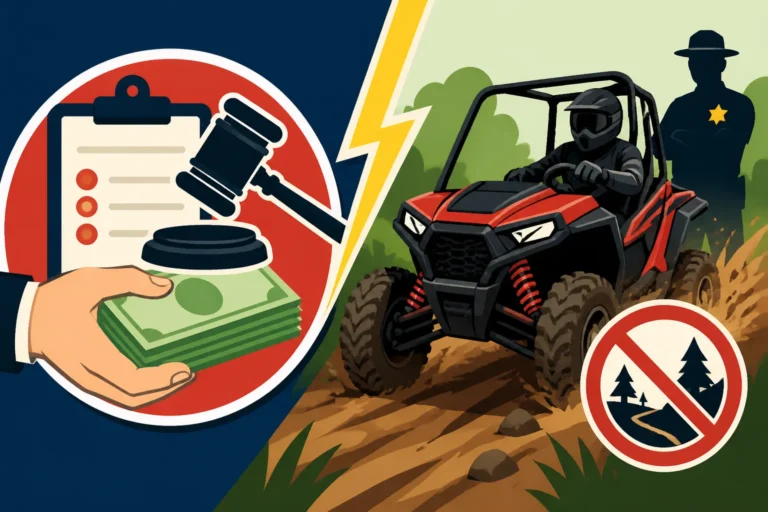
If you're caught violating Vanderburgh County's ORV ordinance for the first time, you can expect a civil penalty of $75. While $75 might not seem like a massive sum, it's a direct financial hit that could have been easily avoided by simply understanding and adhering to the rules. This initial fine serves as a warning, a clear signal that the county takes its ordinance seriously and expects compliance. It's a reminder that riding without proper registration, operating outside designated areas, or failing to meet age or insurance requirements carries a tangible cost. Think of it as an expensive lesson, but one that can escalate quickly if the lesson isn't learned. It's crucial to understand that this is the first fine, implying that subsequent offenses will likely be more severe.
What Happens After a First Vanderburgh ORV Ticket
That $75 fine is just the beginning if you're a repeat offender. Vanderburgh County's ordinance, like many others, includes escalating penalties for subsequent violations. A second offense will likely result in a significantly higher civil penalty, and a third offense can jump to an even steeper fine. For instance, some ordinances might impose a fine of up to $750 for a third or subsequent violation. This escalation is designed to deter habitual non-compliance. Beyond the monetary fines, repeated violations can also lead to more serious legal consequences, potentially even impacting your ability to operate vehicles in the future. It's a stark reminder that ignoring local regulations is not a sustainable or advisable approach to enjoying your ORV. For more details on this progression, you can refer to [What Happens After a First Vanderburgh ORV Ticket].
Indiana Fines for an Unregistered ORV
Beyond county-specific ordinances for road use, there are state-level regulations that can lead to fines, particularly regarding registration. In Indiana, most ORVs require registration with the Bureau of Motor Vehicles (BMV), signified by a decal you display on your machine. Operating an ORV that isn't properly registered, whether on public land, designated trails, or even—if a county allows it—on a county road, can lead to a fine. This isn't tied to a specific county's road use ordinance but rather to the state's ORV registration laws. The fines for an unregistered ORV can be substantial, often falling under the umbrella of a Class C ORV infraction. This means you could be looking at fines that easily exceed the initial $75 Vanderburgh penalty. Always make sure your machine has its current [Indiana ORV Decal Explained], and that it's correctly placed as outlined in [Indiana ORV Decal Placement]. These state-level requirements are mandatory for almost all ORVs operating anywhere in Indiana, making [Indiana Fines for an Unregistered ORV] a critical piece of information for any rider. This state-level requirement is distinct from the county-level road use rules but often checked concurrently by law enforcement.
Avoiding Fines and Riding Responsibly
Nobody wants to get a ticket when they're out trying to have fun. The key to avoiding fines, especially when navigating the nuances of road use in Indiana, is thorough preparation and a commitment to responsible riding. It's not just about knowing the rules; it's about making sure your machine and your paperwork are always in order. This proactive approach ensures that your adventures remain enjoyable and stress-free.
Checking Local Ordinances Before You Ride
This cannot be stressed enough: always check the specific local ordinances for any county or municipality you plan to ride in. As we've seen with Vanderburgh County, rules can vary significantly from one area to another. What's perfectly legal in Hancock County might be a serious violation in Dearborn County, or even a section of the very next township. Most counties that have opened roads will have their ordinances posted on their county government websites, often within the county commissioner or highway department sections. Look for "off-road vehicle ordinance" or "ATV/UTV road use." If you can't find clear information, contact the county highway department or sheriff's office. A quick phone call or website search before you leave home is infinitely less expensive and less aggravating than dealing with a roadside stop and a citation. This due diligence is the best way to ensure compliance and avoid unexpected fines, as outlined in guides like [Indiana Rules for Riding a County Road].
Essential Gear and Documentation for Road Use
If you plan to ride your ORV on any designated county roads in Indiana, beyond just checking the ordinance, you need to ensure both your machine and your person are properly equipped. This often includes:
- Current Indiana ORV Registration Decal: Affixed to the forward half of your machine. This is a state requirement, regardless of where you ride. [Registering an ORV in Indiana] is a good resource for this.
- Proof of Insurance: If the local ordinance requires it, have your insurance card or certificate readily available.
- Driver's License/Identification: Even if the county doesn't require a specific ORV license, you'll need identification.
- Proper Lighting: Especially for night riding, ensure you meet the local ordinance's requirements (e.g., Vanderburgh's dual lights). Upgrading to high-quality LED lights from a brand like SuperATV can provide superior visibility and help you meet these requirements.
- Helmets: While not always required for adults in an enclosed UTV, they are generally mandated for riders under 18 and highly recommended for all ATV and dirt bike riders on trails and roads for safety.
- Working Brake Lights and Horn: Many ordinances will require these basic safety features.
Beyond just the essentials, consider what else makes your ride safer. Things like a sturdy winch, especially if you plan to venture onto shoulders that might be soft, or robust skid plates from a company like SuperATV, can protect your machine in unexpected situations, even on what seems like a simple county road. Carrying a copy of the county's ordinance (even on your phone) can also be helpful in case of a misunderstanding. Being prepared with all necessary documentation and safety gear is your best defense against fines and ensures a much more enjoyable and legal ride.
Disclaimer
This article is for general informational purposes only and does not constitute professional advice. Laws, prices and regulations vary by location and change over time. Consult a qualified professional for guidance on your specific situation.