Registering a Quad Kept at a Brown County Cabin
It's a common scenario in Indiana: you've got a fantastic cabin nestled in the picturesque hills of Brown County, a true escape from the daily grind. And, of course, what's a cabin without an ATV or UTV to explore the surrounding woods, tackle chores, or simply enjoy the freedom of the open air? But then a nagging question pops up – do I really need to register that quad or side-by-side that mostly stays on my property or nearby private trails? This guide is here to clear up that confusion, specifically for those of you with a machine living its best life in a Brown County cabin, and walk you through the precise steps to ensure you're riding legally and without a worry.
Understanding Indiana's ORV Registration Essentials for Your Cabin Quad
When you own an off-road vehicle (ORV) in Indiana, whether it's a quad, dirt bike, or side-by-side, the rules for registration apply broadly across the state. It doesn't matter if your machine is a dedicated trail beast or primarily used for puttering around your Brown County cabin property; Indiana law generally requires it to be registered. This can be a point of frustration for many cabin owners who feel their machine is "private use only," but understanding the state's perspective is key to avoiding penalties.
Why Registration Matters, Even for a Cabin Machine
Let's be honest, it's easy to think, "My ATV never leaves the property, why bother?" But the reality is that the lines blur very quickly. Even if you swear your machine will only touch your cabin's land, there are countless scenarios where it could legally be considered on public land, or at least public-facing. For instance, you might trailer your ORV to your Brown County cabin using public roads, even if only for a short stretch. That alone requires it to be properly registered. Imagine you're trailering it down State Road 135 to get to your secluded spot, and you get pulled over. An unregistered ORV on a trailer is still considered an ORV that could be operated on public land, and thus, needs its registration.
Beyond trailering, think about the edges of your property. Does a county road run alongside it? Even if you're just dipping a tire onto a shoulder or crossing a drainage ditch, you're interacting with public property. What if you decide to ride with a neighbor and briefly cross a gravel county road to get from your property to theirs? Without proper registration, you're instantly in violation. Furthermore, if you ever decide to take your machine to one of Indiana's fantastic public riding areas like Redbird or Interlake, registration is absolutely non-negotiable. Skipping registration might save a few dollars now, but the potential fines and headaches down the road, especially if an incident occurs, far outweigh that initial saving. [Indiana Fines for an Unregistered ORV] can be quite a shock, and trust me, nobody wants that kind of souvenir from their peaceful cabin weekend.
The Brown County Angle: What Makes It Unique?
Brown County, with its rolling hills, abundant forests, and reputation as an outdoor haven, is a prime location for cabin ownership and, naturally, ORV use. However, the scenic beauty doesn't exempt residents or visitors from state laws. While some counties in Indiana might have specific ordinances regarding ORV road use (which is a whole different topic!), the fundamental state requirement for ORV registration doesn't change based on your county. Your Brown County cabin might feel remote and secluded, but the Indiana Bureau of Motor Vehicles (BMV) sees all ORVs in the state under the same lens for registration purposes.
The "Brown County angle" really comes down to the prevalence of private land and the assumption by many owners that their machine is exclusively for that private use. It's easy to fall into the trap of thinking "out of sight, out of mind." However, this mindset often leads to owners being caught off guard when a situation arises that requires their ORV to be legally compliant. Whether you're on your own land, riding a friend's adjacent parcel with permission, or just hauling your machine to a repair shop in Nashville, Indiana, having it properly registered ensures peace of mind. While Brown County might not have specific ORV road-riding ordinances that directly impact registration, the fact that you're in a popular recreational area means there's a higher chance of enforcement if you're seen operating an unregistered machine, even on what appears to be private property but is accessible or visible from public ways.
The Step-by-Step Process for Registering Your Indiana Cabin Quad
Registering your ORV in Indiana isn't overly complicated, but it does require attention to detail and the right paperwork. Think of it as a small investment in ensuring your Brown County cabin retreats remain hassle-free and enjoyable. The process largely mirrors registering any vehicle, with a few ORV-specific considerations.
Gathering Your Paperwork: What You'll Absolutely Need
Before you even think about heading to the BMV, the most crucial step is to gather all the necessary documents. Missing even one piece of paper can mean a wasted trip and unnecessary delays. The core documents you'll need include:
- Proof of Ownership: This is paramount. For machines purchased after December 31, 2009, an Indiana title is generally required. If you bought your quad new from a dealer, they should have handled the title application. If you bought it used, you should have received a properly assigned title from the previous owner. For older machines (purchased on or before December 31, 2009) or certain other exemptions, a title might not be strictly necessary, but you'll still need clear proof of ownership like a bill of sale or an Ownership Affidavit. [Why Indiana Titles Machines Bought After 2009] is a key piece of legislation to understand here.
- Bill of Sale: This document is vital, especially for private sales. It needs to include the buyer's and seller's names and addresses, a description of the ORV (make, model, year, VIN), the purchase price, and the date of sale. A well-drafted [An Indiana Bill of Sale for an ORV] protects both parties. If you need a solid template, resources like LawDepot offer excellent, legally sound bill of sale forms that you can customize for your specific transaction. This ensures all the necessary information is present and accounted for when you go to the BMV.
- Manufacturer's Statement of Origin (MSO) or Certificate of Origin (MCO): If you purchased your ORV brand new from a dealer, this document acts as the initial proof of ownership before a title is issued.
- Indiana ORV Registration Application: This form is available at the BMV branch or can sometimes be downloaded online.
- Proof of Identity: Your valid Indiana driver's license or state ID card.
Make sure all names and identifying numbers (like the Vehicle Identification Number or VIN) match across all documents. Any discrepancies can flag your application for further review and significantly slow down the process. For a comprehensive list, you'll want to review [Indiana ORV Registration Paperwork].
Where to Go and What to Expect at the BMV
Once your paperwork is in order, your next stop is a local Indiana BMV license branch. While the internet is great for information, ORV registrations must be handled in person or, in some cases, by mail for renewals. For initial registrations, an in-person visit is usually the easiest way to ensure everything is correct and address any questions on the spot. [Where to Register an ORV in Indiana] is always a local BMV branch.
Here's what you can generally expect:
- Present Your Documents: Hand over all your gathered paperwork to the BMV clerk. They will review everything to ensure it's complete and correct.
- Complete the Application: If you haven't already, you'll fill out the specific Indiana ORV registration application form. The clerk can assist you if you have questions about any section.
- Pay the Fees: You'll pay the applicable registration fee. The [Indiana ORV Registration Cost] is a flat fee, and remember that Indiana ORV registrations are typically valid for three years. There might also be a small service fee. If your machine requires a title and you're applying for that simultaneously, there will be an [Indiana ORV Title Cost] as well.
- Receive Your Decal and Certificate: Once processed, you'll receive a temporary registration certificate, and your permanent ORV decal will be mailed to you, usually within a few weeks. It's important to remember that you typically won't walk out with the physical decal on the same day.
Be prepared for a wait, especially during peak hours. Bringing a book or having some podcasts downloaded can make the experience more pleasant.
Titling vs. Registration: A Common Point of Confusion
This is perhaps the most common area of misunderstanding for ORV owners. Many people use "title" and "registration" interchangeably, but in Indiana, they are distinct processes, though often linked.
- Titling refers to the document that proves legal ownership of your ORV. It's like the deed to a house or the title to your car. In Indiana, ORVs purchased after December 31, 2009, must be titled. This means if you bought your quad in 2010 or later, it needs a title. If you bought an ORV on or before that date, it is generally considered "title-optional" unless it was specifically titled at some point.
- Registration is the process of putting your ORV into the state's system, allowing you to legally operate it on public lands (where permitted) and to transport it on public roads. When you register, you receive a registration certificate and a decal to affix to your machine.
So, for your Brown County cabin quad, if it was purchased in 2010 or later, you'll likely need both a title and registration. If it's an older machine, you'll still need to register it, but titling might be optional depending on its history. However, having a title, even if optional, is always good practice for proving ownership, especially if you ever decide to sell the machine. For a deep dive into this, check out [Do You Need a Title for an ATV in Indiana?]. If you find yourself in a situation where you have no title for a machine that should have one, or you've only got a sketchy bill of sale from a private seller, you might need to file an Ownership Affidavit. LawDepot is a useful resource for generating a proper Ownership Affidavit form, which can sometimes help establish a clear chain of ownership when traditional titling documents are absent.
Displaying Your Decal and Staying Compliant in Brown County
Once you've navigated the BMV and your registration is complete, the next step is ensuring your ORV is visibly compliant and that you maintain good habits while riding, especially around your Brown County cabin. This includes knowing where to put your decal and what paperwork to keep with you.
Proper Decal Placement and What It Means
Receiving your official Indiana ORV decal in the mail is the final step in the registration process. This decal is more than just a sticker; it's your visual proof that your machine is legally registered with the state.
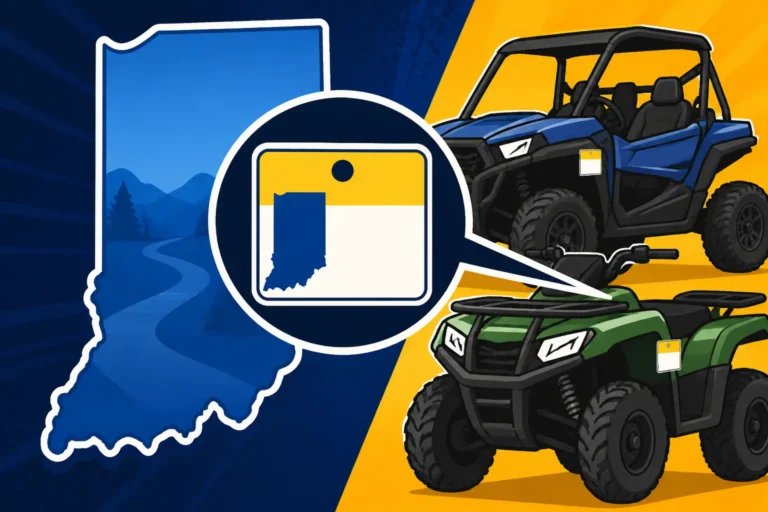
The rules for decal placement are quite specific to ensure easy visibility for law enforcement or park rangers. Your decal must be mounted on the "forward half" of the machine, typically on the front fender or a visible portion of the frame. It needs to be clearly visible and not obstructed by mud, accessories, or other modifications. For clarity, the specific location is usually the front fork tube for dirt bikes, and the left or right front fender for quads and side-by-sides. Make sure it's facing forward. [Where the Indiana Decal Mounts] provides more detail on this.
Each decal has a unique number and expiration date. Remember, Indiana ORV registrations are valid for three years, so keep an eye on that expiration date to ensure timely renewal. [Indiana's Three-Year ORV Registration] means you won't have to worry about it annually, but setting a reminder is still a good idea. The decal itself, often made of a durable material, is designed to withstand the elements, but consistent exposure to extreme mud or power washing can cause it to fade or peel over time. Should that happen, you'll need to look into a replacement. This decal is essentially your ORV's license plate for off-road use, and understanding [The Indiana ORV Decal Explained] can help you avoid simple mistakes.
Keeping Your Paperwork Handy and Avoiding Fines
Just as you wouldn't drive your car without your driver's license and proof of insurance, you shouldn't ride your ORV without proper documentation. While you don't necessarily need to carry the title with you every time you ride (it's best kept in a safe place at home), you absolutely should have your ORV registration certificate on your person or securely stored on the machine.
Think about it: a conservation officer or local sheriff's deputy patrolling the roads around your Brown County cabin spots you on an ORV. If they stop you, one of the first things they'll ask for is proof of registration. If you can't produce it, even if the decal is perfectly affixed, you could face a citation. Many riders keep their registration certificate laminated or in a waterproof pouch in a glove box, under the seat, or even in a wallet. It's also a good idea to have your personal identification readily available.
Failing to register your ORV or not having proof of registration with you can lead to fines. While the exact cost can vary, it's never a pleasant surprise. [Indiana Fines for an Unregistered ORV] are designed to encourage compliance, not just collect revenue. It's far easier and cheaper to do it right the first time.
Here's a quick look at some common pitfalls and how to avoid them:
| Pitfall | Description | Solution |
|---|---|---|
| "Private Property Only" Excuse | Believing your ORV doesn't need registration if it stays on private land. | Registration is required even if you only transport it on public roads to get to your Brown County cabin, or if you ever cross a public road, shoulder, or ditch. |
| Missing Bill of Sale | Buying a used machine without a proper, detailed bill of sale. | Always insist on a comprehensive bill of sale, especially when buying privately. If needed, use a template from a reputable source like LawDepot to ensure all legal requirements are met, including VIN, date, and buyer/seller details. |
| Expired Registration | Forgetting to renew your three-year registration. | Mark your calendar for renewal well in advance. Check the expiration date on your decal and certificate periodically. |
| Decal Issues | Decal faded, peeled, or improperly placed/missing. | Regularly check your decal. If it's unreadable or missing, order a replacement. Ensure it's mounted correctly on the forward half of the machine, as specified by Indiana law. |
| No Proof of Registration | Having the decal, but not carrying the actual registration certificate. | Always carry your physical registration certificate (and potentially insurance card) with you or on the machine in a secure, waterproof location. Photos on your phone might not always be accepted by enforcement officers. |
| Titling Confusion | Not knowing if your specific ORV requires a title in Indiana. | For ORVs purchased after 2009, a title is mandatory. For older machines, while sometimes optional, having one is always recommended for clear proof of ownership. Clarify with the BMV if unsure. |
Brown County Specifics for Cabin Owners
While Indiana's ORV registration laws are uniform across the state, the context of owning a machine at a Brown County cabin does bring up specific practical considerations. First and foremost, reiterate that registration is a statewide requirement. It doesn't matter if your cabin is in a bustling area of Nashville or deep in the woods near Story; the ORV needs to be registered.
One crucial point for cabin owners to remember is the issue of transportation. Even if you intend to ride your quad only on your Brown County property, you almost certainly transport it to your property using public roads. This act alone triggers the registration requirement. If you're hauling your machine on a trailer down any state highway or county road, it must be registered. You'll want to ensure you always have your [Registering a Quad Kept at a Brown County Cabin] paperwork in order whenever you are trailering it.
Secondly, many cabin owners have access to vast stretches of private land, sometimes through agreements with neighbors or larger hunting clubs. While riding on private land with permission does not inherently require state registration for the act of riding itself, the moment your tires touch a public road, shoulder, or even a public easement (like a utility corridor), you are subject to state laws. If you're riding a farm lane that crosses a county road, or if you plan to access a trail system that requires a short jaunt on a designated county ORV road (if Brown County ever designates any), then registration is critical.
Finally, while the focus here is on registration, remember that basic landowner permission is also paramount. Always ensure you have explicit permission to ride on any land that isn't yours. This isn't a state registration issue, but it's a common sense rule that keeps you in good standing with your neighbors and the local community in Brown County.
Disclaimer
This article is for general informational purposes only and does not constitute professional advice. Laws, prices and regulations vary by location and change over time. Consult a qualified professional for guidance on your specific situation.