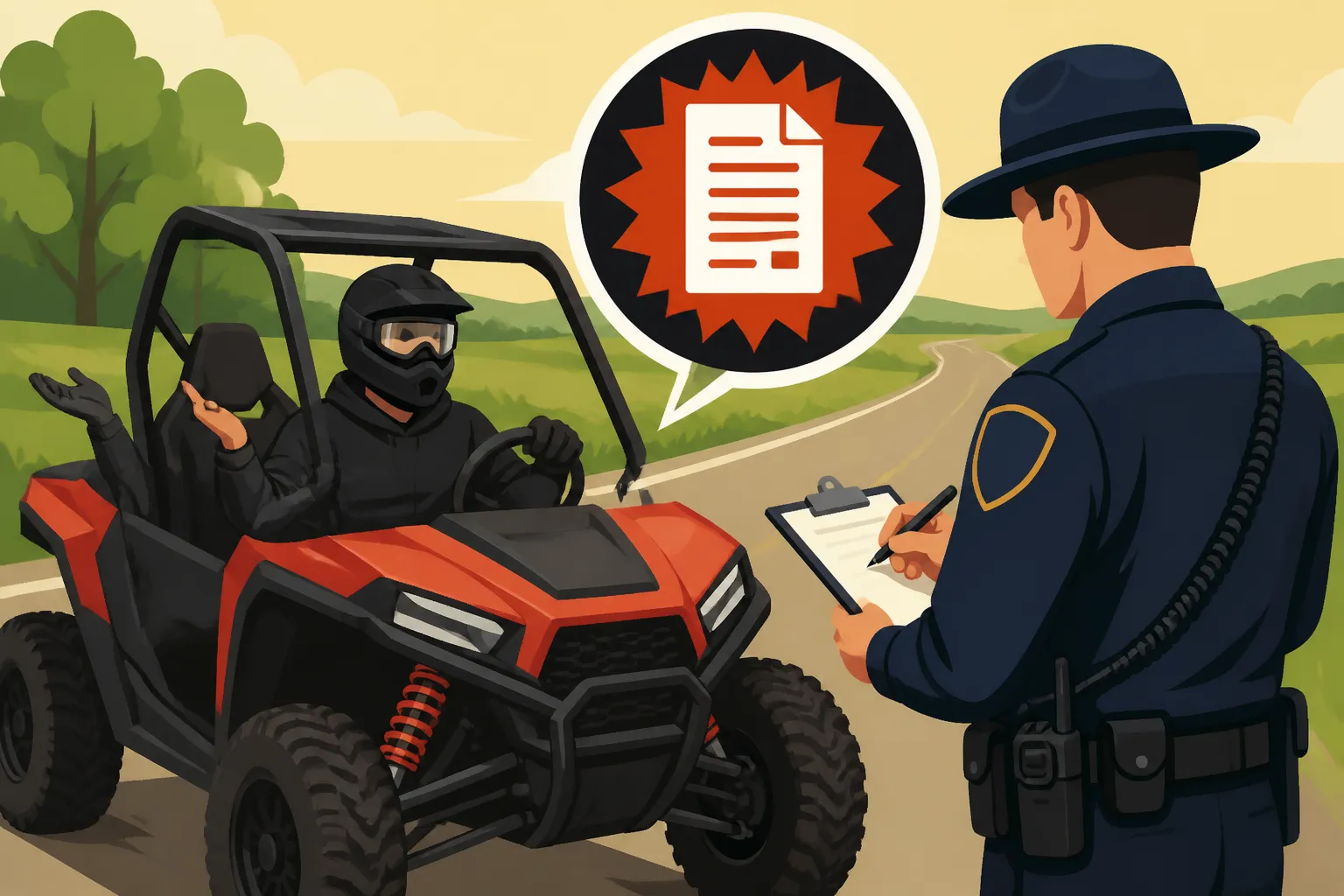
Getting Ticketed While Riding a County Road
There’s nothing quite like the feeling of hitting the open road on your ATV or UTV, especially when you’re just trying to get to a trail or connect two pieces of private property. But if you’ve ever seen those flashing blue lights in your rearview mirror while cruising an Indiana county road, you know that pit-in-your-stomach feeling. This guide is here to walk you through exactly why those tickets happen, what to expect if you find yourself in that situation, and how to navigate the complex world of Indiana’s ORV road rules.
Why Riding County Roads in Indiana is Tricky
Indiana's approach to Off-Road Vehicles (ORVs) on public roads can feel like a maze, and honestly, it’s a source of frustration for many riders. You might have friends in other states where a quick trip down a county road is no big deal, but here in the Hoosier State, things are different. The default position of the law is that county roads are closed to ORV traffic, and that’s a critical starting point for understanding why tickets are issued. It's not always about outright prohibition, but rather about very specific, often localized, permissions and exceptions.
The Default Closed Road Rule
Imagine pulling out of your driveway, eager to take a spin around the block or head down to a neighbor's house a few miles away. Many riders assume that if a road isn't a major highway, it must be fair game. However, Indiana law operates on an "opt-in" system for ORVs on public roads. This means that unless a specific county or municipality has passed an ordinance explicitly opening its roads, they are considered closed to ORV use. This can be a huge headache, especially if you live near a county line where the rules might change just by crossing the street. It’s this fundamental rule that catches many unsuspecting riders off guard and often leads to an unexpected roadside encounter with law enforcement. The burden is on you, the rider, to know the local regulations.
County-Designated Open Roads
Thankfully, not all hope is lost. Some Indiana counties have taken the initiative to pass ordinances that allow ORVs on certain county roads. This is fantastic news for riders in those areas, but it's not a blanket free-for-all. These ordinances typically come with a host of stipulations: designated roads might be marked with specific signage, or there might be age restrictions, insurance requirements, or specific operating hours. For example, some counties might only allow ORVs on roads that fall outside of municipal limits, while others might restrict them to certain days or seasons. To find out if your local county has opened its roads, you'll need to do your homework. Checking with the county highway department or the sheriff's office is a good start. Familiarize yourself with articles like [Indiana Counties That Allow ORVs on Roads] and [How a County Highway Department Designates ORV Roads] to understand the nuances of these local rules. Just because you see one local rider taking advantage of open roads, it doesn't mean you're compliant unless you understand the local ordinance for yourself.
Exceptions: Shoulders, Ditches, and Crossings
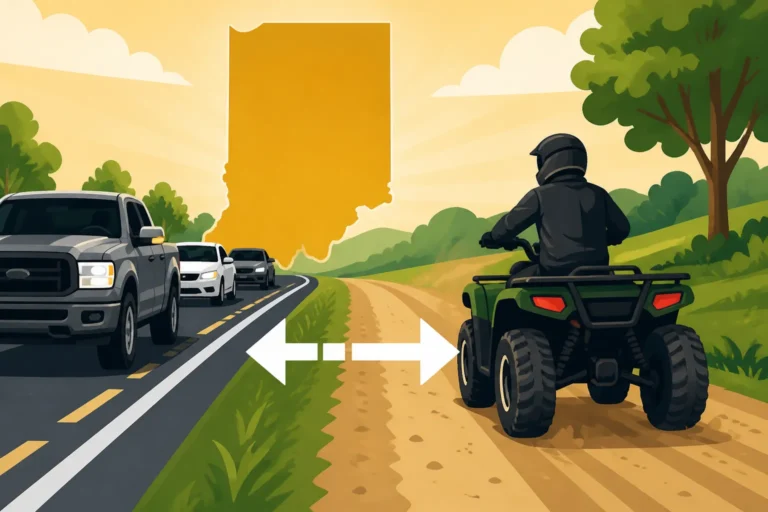
Even in counties where roads are generally closed to ORVs, Indiana law does provide a few very specific exceptions that are often misunderstood. These exceptions are not permissions for recreational riding but are instead narrowly defined scenarios to allow for necessary movement or access. One common point of confusion revolves around riding on the shoulder or in the ditch. The law generally allows for ORVs to operate on the extreme right of the improved portion of a highway or on the shoulder or ditch, but only if it's necessary to gain access to private property or to cross a highway safely. This isn’t a license to cruise down the shoulder for miles.
When it comes to crossing a highway, the rules are even stricter. You must come to a complete stop, yield to all traffic, and cross at a right angle to the highway, as directly and quickly as possible. This means no casual diagonal drifts across the road, and certainly no U-turns in traffic. It's a quick, decisive maneuver designed to minimize your time in harm's way. Understanding these specific rules, like those outlined in [Indiana Rules for Riding a Highway Shoulder], [Indiana Rules for Riding a Ditch], and [Indiana Rules for Crossing a Highway], is crucial because misinterpreting them is a prime reason for getting a ticket.
What an Indiana Officer Checks Roadside
When a law enforcement officer pulls you over on a county road in Indiana, they’re not just making a snap judgment. They're typically checking for a specific set of compliance points to ensure you’re operating your ORV legally and safely. It's important to remember that they are enforcing state law first, and then any local ordinances. Being prepared for what they’ll look for can save you a lot of hassle, or at least help you understand the situation if a ticket is issued.
Registration and Decal Proof
One of the first things an officer will check is whether your ORV is properly registered with the Indiana Bureau of Motor Vehicles (BMV) and if you have the current registration decal displayed correctly. Indiana requires all ORVs operated off private property to be registered, even if you’re just crossing a county road. This means having a valid decal on the forward half of your machine – typically on the front fender, fairing, or a visible part of the frame. An officer will look for that decal and may ask to see your registration certificate. If you don't have it, or if it's expired, that's an immediate red flag. Think of it like a license plate for your ORV. It's essential to understand the importance of [The Indiana ORV Decal Explained] and what can happen if you're caught without it, as detailed in [Indiana Fines for an Unregistered ORV]. Always keep your [Keeping Paperwork in a Dry Box] to ensure it's protected and accessible.
Operator Age and Supervision Requirements
Indiana takes the age of ORV operators seriously, especially when they're on public access points like county roads. An officer will certainly inquire about the age of the rider, and if it's a minor, they'll check for proper adult supervision. Generally, riders under a certain age have specific restrictions, and those under 14 almost always require direct adult supervision. If a minor is operating the machine without meeting these age or supervision requirements, not only could they be ticketed, but the owner of the ORV could also face liability. This is an area where empathy for wanting kids to enjoy the ride clashes directly with the letter of the law. You’ll want to review [Indiana Minimum Age to Ride an ORV] and [Indiana Supervision Rules for Minors] to ensure everyone in your riding group is compliant.
Helmet and Safety Gear Compliance
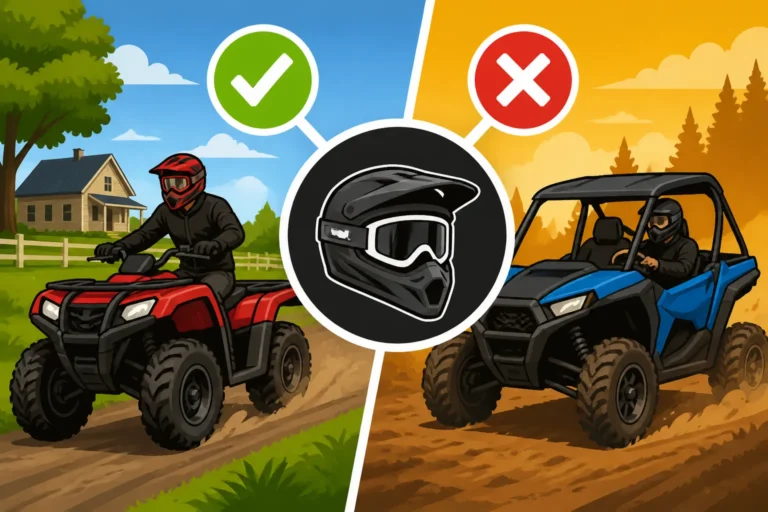
Safety is paramount, and Indiana law reflects this, particularly concerning helmets. For ORV riders under the age of 18, wearing a Department of Transportation (DOT) approved helmet is mandatory, regardless of where they are riding – including private property. While adults generally aren't required to wear a helmet on private land, if you're on a public road or designated ORV area, this rule may extend. An officer will check to see if all minor riders are wearing their helmets. For UTVs, they’ll also be looking for seat belt use. While not explicitly part of road compliance, having proper lighting for visibility, especially if riding near dusk or dawn, is also something an officer might note. Ensuring your machine is equipped with robust aftermarket lighting or mirrors from a reputable brand like SuperATV can make a difference in visibility and compliance, as it helps your machine meet any general safety requirements an officer might consider for road travel. Remember to check [Indiana Helmet Law for ORV Riders] to stay informed.
Machine Condition and Equipment
Beyond the basics, an officer might also glance over the general condition of your ORV. While they aren't looking for trail wear and tear, they are checking for things that could pose a safety hazard on a public thoroughfare. This includes working headlights and taillights, especially if you're riding after dark. You’d be surprised how many riders forget that [Indiana Lighting Requirements for ORVs] apply even for brief road crossings. They might also check for spark arrestors, which are generally required for any ORV operated on public land to prevent wildfires. If your machine is excessively loud, that could also draw attention and potentially lead to a noise violation, though these are less common for a simple roadside stop. Before you even think about putting a wheel on a county road, take a moment to double-check your rig. Are your lights working? Do you have mirrors? Products from companies like SuperATV offer a range of solutions to help ensure your machine is up to snuff for various riding conditions, potentially aiding in meeting safety standards.
Common Violations and Their Consequences
Facing a ticket can be a frustrating and often costly experience. Understanding the most common violations associated with riding an ORV on an Indiana county road can help you avoid them, or at least understand the legal landscape if you do get cited. These aren't just minor inconveniences; they can carry substantial fines and, in some cases, even lead to confiscation of your machine.
Riding in Undesignated Areas
This is arguably the most frequent reason riders get ticketed. As we've discussed, Indiana county roads are closed by default, and only specifically designated roads are open. If you're caught riding on a county road that hasn't been officially opened to ORVs, you're almost certainly looking at a ticket. The "I didn't know" defense, while understandable from a rider's perspective, rarely holds up in court. The responsibility to know where you can and cannot ride rests squarely on the operator. This often results in a Class C infraction, which can carry a fine. Ignorance of the local ordinance, even if you were just trying to get to a nearby trail or private property, is not usually a valid excuse. This is where researching local ordinances, perhaps consulting maps like [Reading Vanderburgh's Color-Coded Map], becomes absolutely vital.
Operating Without Proper Registration
Just as critical as knowing where to ride is ensuring your machine is legally registered to be ridden at all. Operating an ORV on any public land, which includes crossing or riding on county roads (even if permitted), without a current and properly displayed Indiana ORV registration decal is a ticket waiting to happen. This offense directly relates to compliance with state law, and officers are well-versed in checking for it. An expired decal or no decal at all will almost guarantee you a citation. The state takes registration seriously because the fees collected help fund ORV trails and programs. For more information on registration, check out [Registering an ORV in Indiana] and understand the implications of [Indiana Fines for an Unregistered ORV].
Age and Supervision Infractions
When minors are involved, the stakes get higher. If a rider under the age of 14 is caught operating an ORV on a county road without direct supervision by an adult (as per [Indiana Rules for a Rider Under 14]), both the minor and the supervising adult (or even the owner of the ORV, as discussed in [Why an Indiana Owner Is Liable]) could be cited. The definition of "direct supervision" is important here – it often means being close enough to immediately intervene, not just being somewhere in the vicinity. Similarly, if a rider who is too young for a particular type of ORV or for operating on public roads is found to be in violation, the consequences can be severe. These infractions are seen as serious safety matters, and officers will enforce them rigorously to protect young riders.
Equipment and Safety Violations
While often secondary to being on a closed road or lacking registration, equipment and safety violations can add to your list of offenses. This includes not wearing a helmet if required (for riders under 18, for example, as per [Indiana Helmet Law for Riders Under 18]), or having insufficient lighting if you’re riding at night. If you’re riding a side-by-side on a permitted county road and occupants aren’t wearing seat belts, that could also lead to a ticket. Even something like an excessively loud exhaust that exceeds sound limits, or lacking a spark arrestor, could theoretically draw a citation, especially if other more primary violations are present. Ensuring your machine is equipped correctly, perhaps with compliant aftermarket parts from SuperATV like DOT-approved mirrors, turn signals, or headlights, is key to avoiding these types of tickets.
Here’s a quick overview of common violations and their implications:
| Violation Type | Common Scenario | Typical Indiana Legal Class | Potential Consequences |
|---|---|---|---|
| Riding in Undesignated Area | Operating ORV on a county road not opened by ordinance | Class C Infraction | Fines (often in the range of hundreds of dollars for a first offense), potential court costs. Increased fines for repeat offenses, up to $750 for a third offense ([What a Class C ORV Infraction Costs in Indiana]). |
| No ORV Registration/Decal | Riding without a valid, current BMV decal displayed | Class C Infraction | Fines, potential impoundment of the vehicle in severe cases or for repeat offenders. |
| Underage/Unsupervised Operation | Minor operating ORV without proper age or adult supervision | Class C Infraction | Fines for the minor, supervising adult, and/or ORV owner. Potential liability in case of an accident. |
| No Required Helmet | Rider under 18 not wearing a DOT-approved helmet | Class C Infraction | Fines for the operator and/or owner. Safety concern, especially for youth riders. |
| Insufficient Lighting (at night) | Riding after dark without adequate headlights/taillights | Class C Infraction or similar | Fines, safety hazard. |
| Trespassing | Riding on private land adjacent to county road without permission | Class B Misdemeanor or higher | Significantly higher fines, potential jail time, criminal record. Not specifically a "county road" offense but often occurs in conjunction. |
Appealing an Indiana ORV Citation
Getting a ticket is never fun, but it's important to remember that it's not always the final word. You have the right to challenge a citation, and sometimes, with a clear understanding of the law and a well-prepared defense, you can get a favorable outcome. It might seem daunting to go up against the legal system, but taking the right steps can make a difference.
Understanding Your Rights
First things first: when an officer hands you a citation, read it carefully. It will state the specific offense you're being charged with, the relevant statute or ordinance number, and your court date or instructions for payment. Don't admit guilt or make any statements beyond what's absolutely necessary at the scene. You have the right to remain silent and consult with an attorney. Your initial court appearance is often an arraignment where you simply enter a plea. If you plead "not guilty," you'll typically be given a date for a pre-trial conference or a trial. This is your chance to gather information and build your case. It’s also wise to get a copy of the specific county ordinance you are accused of violating, as well as the relevant state ORV laws.
Gathering Evidence
This step is crucial. If you decide to appeal, you’ll need to present evidence to support your case. Immediately after the incident, or as soon as safely possible, document everything. Take photos or videos of the exact location where you were cited, including any signage (or lack thereof), road conditions, and how your ORV was parked or positioned. If the ticket was for an equipment issue, take photos of your machine, highlighting that the equipment was indeed present and functional (e.g., your SuperATV LED lights were on, or your mirrors were properly installed). Measure distances, note the time of day, and jot down any relevant details you remember from your interaction with the officer. If your defense hinges on a specific local ordinance, bring a printed copy of that ordinance to court. Having clear, tangible evidence can significantly strengthen your position and show the court you’ve done your homework.
Navigating the Appeals Process
The appeals process typically begins with your plea in court. If you plead not guilty, you may be offered a plea bargain at a pre-trial conference, where the prosecutor might offer to reduce the charge or fine in exchange for a guilty plea. This is a decision you’ll need to weigh carefully, perhaps with legal counsel. If you proceed to trial, you will have the opportunity to present your evidence and arguments to a judge or, in some cases, a jury.
Your defense might involve arguing that the road was designated for ORV use, that you were legally utilizing one of the exceptions (like a shoulder or crossing at a right angle), or that the officer misinterpreted the law or the facts of the situation. For instance, if you were cited for no helmet, but you were on private property that day, you could argue that the helmet law didn't apply. Or, if you were cited for an equipment issue, you could show evidence that your SuperATV accessories met all necessary requirements. Be respectful, articulate, and focus on the facts. The goal is to demonstrate that you were operating within the bounds of the law, or that there was a reasonable misunderstanding that should lead to a dismissal or reduction of the charges. Remember, getting [Getting Ticketed While Riding a County Road] is frustrating, but knowing your rights and preparing for your day in court is your best path forward.
Disclaimer
This article is for general informational purposes only and does not constitute professional advice. Laws, prices and regulations vary by location and change over time. Consult a qualified professional for guidance on your specific situation.