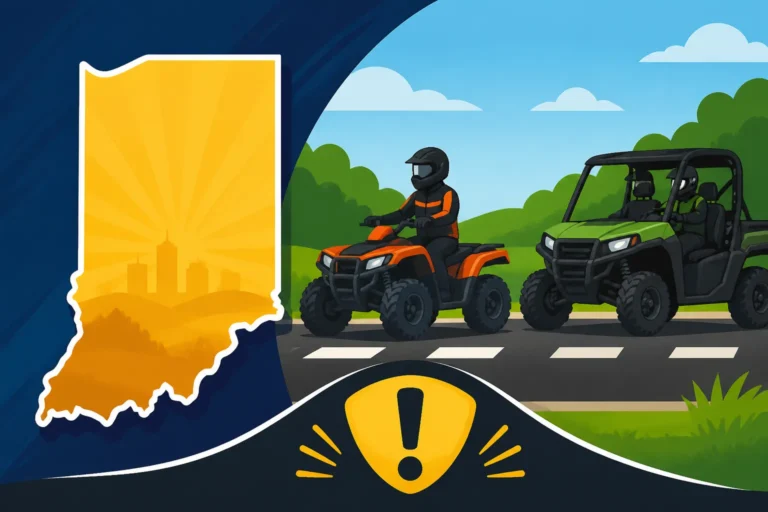
Crossing at Right Angles in Indiana
It's a familiar scenario for many of us who love hitting the trails or simply needing to get our machine from one section of private property to another: you're cruising along, having a great time, and then you hit a public road. That moment of hesitation, wondering if you can cross, and more importantly, how you can cross safely and legally, is a common frustration. This guide is all about navigating those road crossings in Indiana, focusing specifically on the "right angle" rule, along with all the other critical steps you need to take to keep yourself, your passengers, and other motorists safe and compliant with Hoosier state law.
The Imperative of Safety: Why Indiana Regulates ORV Road Crossings
When you're out on your ATV or UTV, whether it's a nimble dirt bike or a robust side-by-side, you're experiencing a freedom that's hard to match. However, that freedom comes with a significant responsibility, especially when your path intersects with public roadways. Indiana's regulations around ORV road crossings aren't there to dampen your fun; they're fundamentally about keeping everyone safe. Public roads are designed for vehicles with different characteristics, speeds, and operator expectations than most off-road machines, and mixing them without clear rules would be a recipe for disaster.
Understanding the Risk: Speed Differentials and Blind Spots
Think about the typical environment where you ride your ORV: trails, fields, forests, maybe even reclaimed mine land. These are places where you might encounter uneven terrain, varying speeds, and minimal traffic. Now, picture a busy two-lane county road. Cars are traveling at 45-55 MPH, drivers are often focused straight ahead, and your ORV, while certainly capable, likely has a lower top speed, different braking characteristics, and a profile that might make it less visible than a full-sized car or truck. The speed differential alone creates an enormous risk. A driver expecting to see another car might not register your ATV in time, especially if you're popping out from behind a line of trees or a rise in the land. Then there are the blind spots—for you and for the motorists. Trying to turn onto a road, or even cross it, can place your machine directly in the path of oncoming traffic before anyone has a chance to react.
The historical context of these rules often stems from unfortunate incidents where ORVs and on-road vehicles collided. Legislators, emergency responders, and community members recognized the need for clear guidelines to prevent injuries and fatalities. These rules create a standardized expectation for ORV operators, ensuring a predictable pattern of behavior that other road users can anticipate, even if they don't regularly encounter ORVs. It's a pragmatic approach to integrate ORV use into a state with extensive public roadways, acknowledging that while ORVs are essential for recreation and work, they also pose unique challenges on asphalt.
Balancing Access and Public Safety: The Legislative Intent
Indiana's approach to ORV use on public roads is often seen as a balancing act. On one hand, the state recognizes the popularity of off-road riding and the need for riders to access different areas, sometimes requiring them to traverse public thoroughfares. On the other hand, the paramount concern is public safety. This is why, by default, ORVs are not permitted on most public roads in Indiana. The state effectively says, "Roads are for cars, unless we specifically make an exception for ORVs, and then only under very strict conditions."
The existence of specific rules for crossing roads, or even for riding shoulders and ditches in certain counties, represents these carefully crafted exceptions. These exceptions are never carte blanche; they come with caveats and specific operational requirements designed to minimize risk. For instance, the detailed guidelines for stopping, yielding, and crossing at a specific angle are all part of this legislative intent to provide limited, controlled access without compromising the safety of the general public. It's crucial for every ORV operator to understand that these rules are not suggestions; they are legal mandates aimed at preventing accidents. Familiarity with [Indiana Rules for Riding a County Road] is key to understanding the full scope of these regulations, as county ordinances can further define where and how ORVs may operate or cross.
Deconstructing the "Right Angle" Rule for ORV Crossings
The requirement to cross a public road "at right angles" is one of the foundational tenets of safe and legal ORV operation in Indiana. It might sound like a geometry lesson, but in practice, it's a critical safety measure. This rule isn't just about drawing a straight line; it's about minimizing your time in the lanes of traffic and maximizing your visibility to other road users, ensuring the quickest and most predictable path from one side to the other.
What "Right Angle" Truly Means on an Indiana Road
When the law specifies "at right angles," it means you should approach the road, stop, and then proceed directly across the travel lanes so that your path forms a 90-degree angle with the road's centerline. Imagine the road stretching infinitely in both directions; your goal is to make your machine's trajectory perpendicular to that line. This is fundamentally different from turning onto the road, traveling a short distance, and then turning off, or trying to cross diagonally.
For instance, if you're approaching a two-lane road from a trail that comes in at an acute angle, you don't simply follow the trail's curve onto the road. Instead, you'd bring your machine to a complete stop, reposition it so it's facing directly across the road (imagine a giant "T" with your machine forming the horizontal bar and the road being the vertical one), and then proceed straight. This minimizes the distance you travel within the traffic lanes and reduces the chances of drivers misinterpreting your intentions. A diagonal crossing, by contrast, would keep you in the lane for a longer time, expose you to traffic for a greater duration, and could lead drivers to believe you're attempting to travel on the road rather than merely crossing it. Always visualize that perfect perpendicular line. Think of it like a train on a track: it's designed to go straight across, not to merge into traffic. This practice is often referred to as [Crossing Square to the Lanes] and is a simple yet powerful safety principle.
Practical Application: Visualizing the Crossing Point
Putting the "right angle" rule into practice requires a bit of foresight and awareness, even before you reach the edge of the pavement. As you approach a road you intend to cross, start scanning for approaching traffic well in advance. Then, identify a clear, safe spot where you can pause, if necessary, and reposition your machine to achieve that 90-degree angle. This might mean pulling slightly off the trail or path you're on, or even backing up a few feet if your initial approach angle isn't ideal. The key is to be deliberate.
Once you've stopped at the edge of the road, and you've confirmed your path is square to the lanes, you'll need to double-check for traffic. Look left, look right, and then look left again. Your machine should be aimed directly at the opposite side, minimizing any deviation in your trajectory. This straight-shot approach ensures that your movement is predictable to any approaching vehicles. Don't start your crossing until you have a clear and safe window of opportunity, allowing ample time for you to traverse all lanes of travel without rushing or having to stop in the middle. Remember, the goal is to be a temporary, predictable, and quickly disappearing presence on that roadway, not an unexpected obstacle.
Beyond the Angle: Other Critical Rules for Safe Indiana Crossings
While crossing at a right angle is paramount, it's just one piece of the puzzle for legal and safe ORV road crossings in Indiana. The state's regulations are comprehensive, encompassing several other crucial steps that every rider must internalize before venturing onto any public thoroughfare. These additional rules are designed to compound safety, ensuring that not only is your path predictable, but your intentions are clear and your presence is acknowledged by all other road users.
The Mandatory Full Stop and Yielding Requirement
Before your tires even touch the asphalt of a public road, a complete stop is non-negotiable. This isn't a "rolling stop" or a quick pause; it means coming to a full, absolute halt. Imagine you're at a stop sign in your car – the same standard applies. This full stop serves multiple purposes. First, it gives you a crucial moment to properly assess the traffic situation in both directions. You can't adequately scan for fast-moving vehicles if you're still in motion. Second, it clearly communicates your intention to yield. Other drivers will see you stopped at the roadside, signaling that you are not attempting to merge or proceed without caution.
Once stopped, the next critical step is to yield to all traffic. This means any vehicle, pedestrian, or even cyclist approaching on the public road has the right-of-way. You must wait until the road is completely clear, or until there's a sufficiently large gap in traffic, to safely execute your crossing without forcing any other road user to slow down, swerve, or take evasive action. This often means being patient, especially on busier roads. It's far better to wait an extra minute for a safe opening than to rush and put yourself and others in jeopardy. For a deeper understanding of this fundamental requirement, refer to [A Complete Stop Before an Indiana Crossing].
Minimizing Roadway Exposure: The Quickest Path Across
After coming to a complete stop and ensuring the way is clear, your next objective is to cross the road as quickly and directly as possible. This reinforces the "right angle" rule – a straight line is the shortest distance between two points, and in this case, it means less time spent in the direct path of vehicular traffic. You're not meant to dawdle, explore, or hesitate once you've committed to the crossing. The intent is to be a transient presence, getting from one side to the other with maximum efficiency and minimal disruption.
This means you should select a gear that allows for immediate acceleration across the pavement, without being so fast that you lose control. If you're coming out of a muddy ditch or an uneven shoulder, ensuring your machine has the traction and power to get onto the pavement smoothly is important. Sometimes, getting your ORV into an optimal position before the crossing can be tricky, especially if the approach is steep or slick. Having the right recovery gear, perhaps even an integrated winch system from a brand like SuperATV, can make a huge difference in ensuring you can navigate challenging approaches and then execute a swift, clean crossing without getting hung up or losing momentum right at the roadside. Your machine should be ready to traverse the entire width of the road in one continuous, controlled motion.
Day and Night Considerations: Visibility and Lighting
Visibility is always a concern when operating an ORV, and it becomes even more critical when interacting with public roads. During daylight hours, bright clothing and, where permitted, safety flags can significantly enhance your presence. However, if your crossing occurs during dusk, dawn, or actual nighttime, your machine's lighting becomes absolutely vital. Indiana law has specific requirements for ORV lighting when operating in situations that put them in proximity to public roads, even if it's just for a quick crossing.
Your ORV must be equipped with at least one headlight and one taillight, both visible from appropriate distances. These lights aren't just for you to see; they're for others to see you. Before attempting any crossing in low-light conditions, ensure all your lights are functional, clean, and properly aimed. If you've invested in aftermarket lighting upgrades, perhaps from a reputable brand like SuperATV, ensure they meet all legal requirements for brightness and beam pattern, enhancing your ability to be seen by oncoming traffic. An unlit or poorly lit ORV crossing a road in the dark is an extreme hazard, inviting serious consequences. Always be proactive about making yourself as visible as possible, understanding that other drivers may not be looking for an ORV. Further details on required illumination can be found under [Indiana Lighting Requirements for ORVs].
The Prohibited Zones: Where ORV Road Crossings Are Strictly Forbidden
While Indiana provides specific conditions for ORV road crossings, it's equally important to understand where these crossings are absolutely prohibited. Not all roads are created equal in the eyes of the law, and attempting to cross certain types of highways or within specific municipal boundaries can lead to severe penalties and, more importantly, put your life and the lives of others at extreme risk. Knowing these no-go zones is as crucial as knowing the rules for permissible crossings.
Understanding Limited-Access Highways and ORV Restrictions
Limited-access highways are the most prominent category of roads where ORVs are universally prohibited, even for crossing. Think of interstates, freeways, and certain state routes designed for high-speed, unimpeded travel over long distances. These roads are characterized by their lack of at-grade intersections, driveways, or direct property access; entry and exit are typically via ramps. The very design of these highways makes them inherently incompatible with ORV operation or crossing.
The speeds on limited-access highways are much higher than those on county roads, often 65-70 MPH or more. An ORV, even one designed for speed off-road, is simply not built to withstand the force or keep pace with traffic moving at these velocities. Furthermore, the limited access design means there are no designated crossing points or safe shoulders for an ORV to stage a crossing. Attempting to cross an interstate, for example, would involve entering multiple lanes of high-speed traffic, which is an extremely dangerous and illegal maneuver. This is why [Why You Cannot Cross a Limited-Access Highway] is a fundamental safety principle ingrained in Indiana's ORV laws. There are no exceptions for these types of roads; if you encounter one, you must find an alternative route that does not involve your ORV touching its pavement.
Navigating City Limits and Non-Designated Roads
Beyond limited-access highways, another significant area of restriction comes from local ordinances, particularly within incorporated cities and towns. While some Indiana counties have begun to open certain county roads to ORV use or crossing, these ordinances often apply only to roads outside city limits. Inside city boundaries, ORV use, including crossing, is almost universally prohibited unless a specific municipal ordinance explicitly allows it, which is rare. Cities have different traffic patterns, population densities, and infrastructure, making ORV integration far more complex and risky.
It's critical not to assume that just because you can ride or cross a county road outside a town, you can do the same once you enter its corporate limits. Always check local ordinances. What's permissible on a rural gravel road in one part of a county might be strictly forbidden on a paved subdivision street just a few miles away. Riding on [Indiana Rules for Riding a Subdivision Street] is a quick way to find yourself in violation of local law. If you're unsure, err on the side of caution and avoid crossing or riding within populated areas. Ignorance of local law is not a valid defense, and city police departments often have zero tolerance for ORV violations due to the inherent safety risks in congested areas.
Consequences and Compliance: Why Following Indiana's Crossing Laws Matters
It might seem like a hassle to stop, look, and angle yourself perfectly every time you need to cross a road on your ORV. You might think, "It's just a quick hop across, what's the big deal?" But the "big deal" can range from a hefty fine to a devastating accident. Indiana's ORV laws, particularly those concerning road interactions, are serious, and the consequences for non-compliance can be significant, impacting your wallet, your machine, and potentially your freedom or even your life. Understanding these implications is a powerful motivator for strict adherence.
Penalties for Non-Compliance: Fines and Legal Repercussions
Operating an ORV in a manner that violates Indiana's road crossing laws can result in more than just a stern talking-to. Most violations are classified as Class C ORV infractions, which carry a significant administrative penalty. While specific amounts can vary and you should always check the most current regulations, these fines are not trivial. A single ticket can easily set you back hundreds of dollars, and repeated offenses can escalate the penalties dramatically. For example, a third offense might carry a much higher fine, possibly closer to the maximum for an infraction. The state is serious about road safety, and they don't treat ORV violations lightly. You can find more detail on the costs and implications by looking into [Indiana Fines for Illegal ORV Road Use].
Beyond the immediate financial hit, there are other potential legal repercussions. If an improper crossing leads to an accident, even a minor one, you could be held liable for damages, injuries, and potentially face more severe charges depending on the circumstances. Your machine could be impounded, and your insurance rates could skyrocket or even be canceled. Law enforcement officers, whether DNR conservation officers or county sheriffs, are trained to spot these violations, and they patrol areas where ORV riders are known to frequent. Thinking you can just "get away with it" is a dangerous gamble that carries substantial risks.
Mitigating Risks: Ensuring Your Machine and Gear are Ready
Compliance with the law is only one side of the coin; personal safety is the other, and the two are inextricably linked. Ensuring your ORV is in peak operating condition is paramount for safe road crossings. This means regularly checking your brakes, steering, and tires. Can your brakes bring you to a quick, controlled stop at the edge of the pavement? Is your steering precise enough to guide you directly across at a right angle without wandering? Are your tires appropriate for both the off-road conditions and the brief on-road traverse, offering sufficient grip on varied surfaces?
Beyond the machine itself, your gear plays a role. While Indiana doesn't always mandate specific reflective gear for ORV riders, making yourself as visible as possible is just plain smart. High-visibility helmets, bright jackets, and even a safety flag can make a difference, especially when you're momentarily sharing space with faster-moving traffic. Consider how accessories might contribute to safer operations. For instance, robust skid plates, perhaps from SuperATV, can protect the undercarriage of your machine if the approach to a road is rocky or uneven, preventing damage that could cause a breakdown at a critical moment. Similarly, dependable suspension systems, also available from SuperATV, ensure your machine handles predictably and stays stable when transitioning from soft dirt to hard pavement, especially when navigating ditches or embankments at the roadside. Investing in quality parts and maintaining your machine properly isn't just about performance on the trail; it's a vital part of preparing for those unavoidable interactions with public roads.
| Aspect of Crossing | Safe Practice | Unsafe Practice | Rationale |
|---|---|---|---|
| Angle of Approach | Straight, 90-degree angle to roadway | Diagonal, curving onto or off the road | Minimizes time in traffic, increases predictability for others. |
| Stopping | Complete, absolute stop before pavement | Rolling stop, slow roll onto pavement | Allows full assessment of traffic, signals yielding. |
| Yielding | Yield to ALL traffic (cars, pedestrians) | Assumes right-of-way, rushes into traffic | Prevents collisions, respects flow of public road. |
| Speed | Quick, controlled acceleration across | Hesitant, slow crawl, or excessive speed | Reduces exposure time, maintains control. |
| Visibility | Day: Bright clothing, flags. Night: Working lights | Dark clothing, non-functional/dim lights | Ensures other drivers see you, especially in low light. |
| Location | Designated crossing, county roads (if allowed) | Limited-access highways, city streets (unless specified) | Legality and safety based on road design and local ordinances. |
| Awareness | Constant scanning for traffic, planning | Distracted, assuming road is clear, no plan | Proactive safety measure, reduces surprise encounters. |
Navigating Indiana's roads on your ATV or UTV requires not just skill, but a thorough understanding and strict adherence to the laws in place. The "right angle" rule, combined with mandatory stops, yielding, and proper lighting, forms a critical framework designed to keep you and everyone else safe. It might feel like a lot to remember, but each rule is a building block in creating a safer environment for off-road enthusiasts and the general public alike. Ride smart, stay safe, and always be prepared to follow the rules of the road, even when you're just passing through.
Disclaimer
This article is for general informational purposes only and does not constitute professional advice. Laws, prices and regulations vary by location and change over time. Consult a qualified professional for guidance on your specific situation.