Counting Days Across a Calendar Year
If you bring an out-of-state ATV, UTV, or snowmobile to Indiana, it can be hard to tell how long you may ride before Indiana registration becomes necessary. The key is that the visitor exemption is limited to days accumulated within a calendar year, not a fresh allowance for every trip. Here’s how to track that limit and avoid confusing trail permits with registration.
How Indiana’s 20-day visitor limit works
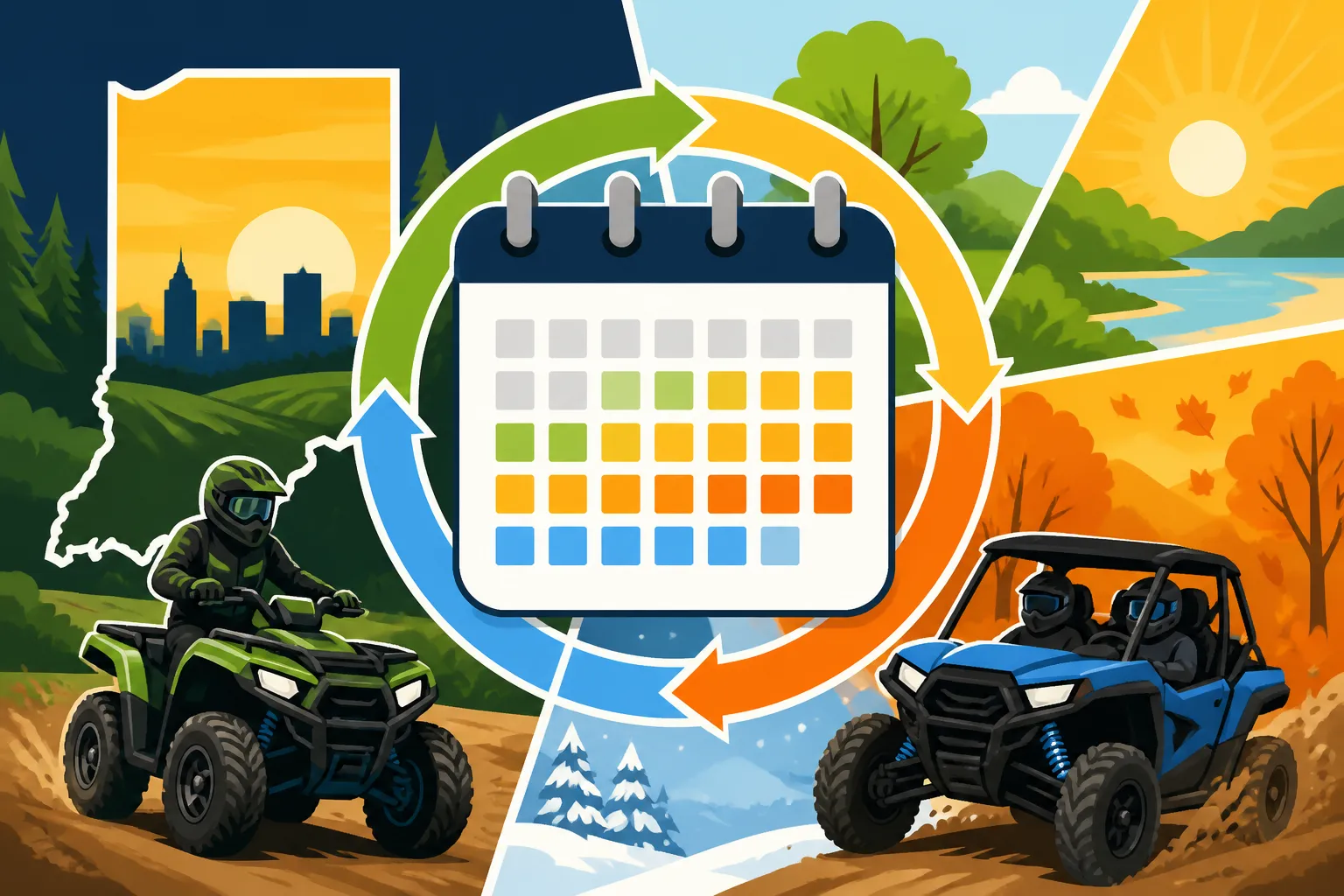
According to the Indiana Bureau of Motor Vehicles, a nonresident operating an ORV or snowmobile registered in another state is exempt from Indiana registration for up to 20 days in one year. The State of Indiana describes the allowance as 20 days accumulated across a single calendar year.
That wording matters. The allowance is not described as 20 consecutive days, and it is not a new allowance every time you cross the state line. Separate visits add to the same annual total. If your machine has already been used in Indiana during the calendar year, account for those days before planning another visit.
A calendar-year limit also differs from a rolling twelve-month window. You should not assume that the count starts over on the anniversary of your first visit or after a full year has passed since that visit. The relevant period is the calendar year. For more on the basis of the rule, see Indiana’s Twenty-Day Visitor Rule and Why Indiana Counts Days per Year.
The official facts describe a limit of 20 days accumulated in one calendar year, but they do not specify how to count a partial day, a day when a machine is transported but not ridden, or a day when it is present in Indiana but not operated. Don’t rely on a guess for those situations. Ask the Indiana BMV or Indiana Department of Natural Resources how the rule applies to your circumstances, and keep their guidance with your trip paperwork.
A simple way to think about the limit
Treat every day you operate the out-of-state machine in Indiana as part of one shared annual allowance. Keep a record for the machine, rather than tracking each trip as if it were unrelated. When you plan a return visit, add it to your previous Indiana use for that calendar year.
This approach is deliberately cautious. It avoids interpreting the exemption as a per-trip allowance or counting only days that involve a particular trail. If you have questions about what counts as operation, confirm the answer with the relevant agency before you ride.
The rule applies to an ORV or snowmobile that is registered in another state. If your machine is not registered in its home state, do not assume that the visitor exemption covers it. According to the Indiana Department of Natural Resources, an out-of-state owner whose ORV is not registered in the home state and who wants to drive on Indiana roadways open to ORV use must register through the Indiana BMV. The owner must apply in person at a BMV branch.
If you are unsure whether the home-state paperwork is valid or whether Indiana recognizes it for your intended use, Does Indiana Honor Out-of-State Registration? and Indiana Rules for a Visiting Rider address related questions. The 20-day allowance is an exemption from Indiana registration for qualifying nonresidents, not a substitute for having valid registration in the state or country where the machine is registered.
Keep a running record instead of relying on memory
Because the allowance accumulates across visits, a small record can prevent an avoidable mistake. Record each Indiana operating day as it happens, then check the total before making plans for another trip. Do not wait until the end of the year to reconstruct the count from memory, especially if the machine travels with different family members or is used on more than one trip.
A useful record can include:
| Record item | What to note |
|---|---|
| Date of Indiana operation | Write down the date the ORV or snowmobile was operated in Indiana |
| Machine identification | Note the make and model, and the VIN if available |
| Home-state registration | Record the registration state and keep the registration document accessible |
| Trip or riding location | Note where the machine was used, particularly if visiting an Indiana DNR property |
| Running annual count | Add the day to the same calendar-year total for that machine |
| Agency guidance | Keep a note of any answer you receive about an unclear counting situation |
This is a practical tracking method, not an official form or a separate legal requirement. Its purpose is to make it easier to see whether you are approaching the limit and to show that you have considered earlier visits. Keep the machine’s registration information available too. The Indiana Department of Natural Resources says ORV registration includes a registration number specific to the machine, along with owner and vehicle details.
If more than one person uses the machine, agree on who maintains the record. A shared note or paper log can work; the important part is that everyone updates the same count. If you keep documents digitally, make sure the registration details are still accessible when needed. A paper copy can be a useful backup if your phone is unavailable.
Do not treat the log as a way to change the rule. A record cannot extend the visitor exemption, and an entry does not make an unregistered machine eligible for it. If your machine’s registration has expired, is missing, or does not clearly identify the vehicle, resolve that issue before relying on the exemption. For related paperwork questions, see Indiana ORV Registration for a Nonresident and Indiana ORV Registration Paperwork.
Questions to settle before a trip
Before loading the machine, check the issues most likely to affect whether the visitor rule fits your plans:
- Is the machine registered in another state or country?
- Has it already been operated in Indiana during this calendar year?
- Are you planning to ride on a public road, at a DNR property, or somewhere else?
- Does the machine need Indiana registration for the use you have in mind?
- Are you relying on a trail-use permit, and do you understand what that permit does and does not cover?
If the answer to any of these is unclear, ask the BMV or DNR rather than assuming that the 20-day limit resolves every registration question. Rules for a particular location or kind of use may matter separately.
Registration and trail permits are not the same thing
A common source of confusion is assuming that a pass to ride at a particular property is the same as registration. It is not. The Indiana Department of Natural Resources states that a motorized trail use permit is not an ORV registration.
Out-of-state visitors can purchase an Out of State Motorized Trail Use permit to ride at Redbird Off-Road State Recreation Area and Interlake Off-Road State Recreation Area. According to the Indiana Department of Natural Resources, that permit is valid only at those two DNR properties. It does not turn into a general Indiana registration or provide permission to operate on other roads or riding areas.
The distinction is worth keeping clear:
| What you have | What it addresses | What not to assume |
|---|---|---|
| Valid registration from another state | The machine’s registration in its home jurisdiction and possible eligibility for the Indiana visitor exemption | That the registration removes every Indiana trail or local requirement |
| Indiana ORV registration | Indiana registration for a qualifying ORV | That it automatically grants access to every riding property |
| Out of State Motorized Trail Use permit | Riding at Redbird SRA and Interlake SRA, under the permit’s terms | That it is an ORV registration or authorizes roadway use |
| Bill of sale for a newly purchased machine | A limited registration exemption after purchase | That it applies indefinitely or replaces other required paperwork |
According to the Indiana BMV, an operator with a bill of sale from a dealer or private individual that is no more than 45 days old is exempt from registration. The Indiana Department of Natural Resources says the bill of sale must include the purchase date, make, model, and VIN. This is a separate, limited exemption; it does not add days to a nonresident’s annual allowance.
For details about the state property permit, see Indiana’s Out-of-State Annual Permit and The Out of State Motorized Trail Use Permit. If your plan includes riding beyond Redbird or Interlake, confirm the requirements for each location rather than assuming the DNR property permit covers the rest of the trip.
Road use needs separate attention as well. According to the Indiana Department of Natural Resources, nonresident visitors who want to drive an ORV on Indiana roadways open to ORV use must have it registered in their home state or through the Indiana BMV. County rules can also affect where and how ORVs may be operated on roads. A visitor exemption from Indiana registration does not mean every county road is open to ORVs. See How to Find an Indiana County ORV Ordinance before planning a road route.
What to do when you are close to the limit
If you are approaching the 20-day allowance, make the registration decision before the next ride, not after it. The right next step depends on whether your home-state registration is current, where you intend to operate, and whether you are visiting a DNR riding area or using a road open to ORVs.
For a machine properly registered in another state, keep the registration current and keep track of Indiana operating days. If you expect to exceed the limit, contact the BMV about Indiana registration before riding beyond the exemption. The Indiana Department of Natural Resources says an out-of-state owner who is not registered in the home state and wants to drive on an Indiana roadway open to ORV use must apply in person at a BMV branch. Check directly with the BMV about the paperwork that applies to your machine and situation.
Indiana requires registration for ORVs and snowmobiles purchased after the applicable statutory date, unless an exemption applies. The Indiana Department of Natural Resources says ORVs and snowmobiles purchased after December 31, 2003 must be registered, while the Indiana BMV describes exemptions including the nonresident rule and the limited bill-of-sale period. These registration requirements are separate from whether a machine needs a title. For example, according to the Indiana BMV, ORVs purchased after December 31, 2009 must be titled. Review Registering an Out-of-State Machine in Indiana and Indiana ORV Title Requirements if your situation involves both registration and title paperwork.
A practical pre-ride process is:
- Check the home-state registration. Confirm that it is current and belongs to the machine you plan to bring.
- Review the calendar-year record. Add the planned use to the days already recorded for Indiana.
- Identify where you will ride. Separate roadway use from riding at Redbird or Interlake, since each may involve different requirements.
- Check any permit’s limits. A trail-use permit for a DNR property is not Indiana registration.
- Contact the BMV or DNR about uncertain details. In particular, verify how they treat partial days or other situations not clearly covered by the rule.
- Complete any required registration before operating. Do not assume that applying, carrying a bill of sale, or buying a trail permit extends the visitor limit.
The important point is simple: do not count the 20 days as a fresh allowance for every trip. According to the State of Indiana, the nonresident registration exemption is limited to 20 days accumulated across a single calendar year. Track the days for that year, confirm how the rule applies to any unusual circumstances, and keep registration and trail-use documents separate. That makes it easier to plan a visit without relying on a mistaken count or a permit that does not cover the use you have in mind.
Sources
- Indiana Department of Natural Resources — State Parks: ORV/Snowmobile Registration FAQs (checked November 3, 2026)
- Indiana Department of Natural Resources — State Parks: Motorized Recreation (checked November 3, 2026)
- Indiana Department of Natural Resources — State Parks: Motorized Recreation (checked November 3, 2026)
- Indiana Bureau of Motor Vehicles — Registrations & Plates: Off-Road Vehicles and Snowmobiles (checked November 3, 2026)
- Indiana Department of Natural Resources — State Parks: Interlake Off-Road State Recreation Area (checked November 3, 2026)
- Indiana Bureau of Motor Vehicles — Registrations & Plates: Off-Road Vehicles and Snowmobiles (checked November 3, 2026)
Disclaimer
This article is for general informational purposes only and does not constitute professional advice. Laws, prices and regulations vary by location and change over time. Consult a qualified professional for guidance on your specific situation.