What Indiana Charges Visitors to Ride
Visitors often arrive at an Indiana trailhead thinking their home-state registration covers every riding cost, then discover that trail permits and entrance fees may be separate. This guide explains what out-of-state riders may need, how Indiana’s visitor rule fits in, and how to budget for a day at places such as Redbird or Interlake.
The three charges visitors should separate
A useful way to plan an Indiana off-road trip is to treat machine registration, a trail-use permit, and park admission as separate questions. They can apply to the same ride, but they serve different purposes. Having one does not automatically mean you have the others.
This distinction matters most when you are coming from Ohio, Illinois, Michigan, or Kentucky. You might have a valid registration decal from home and still need a permit to use a particular Indiana riding area. You might also need to pay an entrance fee even after arranging the trail permit.
Registration is about the machine
Registration or similar authorization concerns whether the machine is legally identified for operation under the rules that apply to it. The details can depend on where the machine is registered, the kind of vehicle, and how long it is being used in Indiana. A visitor’s out-of-state registration is not the same thing as an Indiana DNR trail permit.
The practical question is not simply, “Is my quad registered?” It is also, “Does Indiana recognize the paperwork I have, and does the place where I plan to ride require something else?” Keep the machine’s registration information available, and check the requirements for your specific vehicle and destination before leaving home.
Visitors often get caught by assuming an out-of-state plate, decal, or registration card works as a universal pass. It may help establish that the machine is registered elsewhere, but it does not necessarily cover state recreation area access, park admission, or every Indiana riding requirement.
A trail permit is for riding access
A trail-use permit is an authorization tied to riding on a particular public riding system or property. Indiana’s DNR permit rules are relevant for state off-road riding areas such as Redbird Off-Road State Recreation Area and Interlake Off-Road State Recreation Area. A vehicle’s home-state registration and an Indiana trail permit answer different questions.
In practical terms, think of registration as paperwork for the machine and the trail permit as permission to use a designated riding area. If your group has several machines, check whether each one needs its own permit. Do not assume a single permit for the truck, trailer, or group leader covers every ATV or UTV being unloaded.
The permit also does not grant permission to ride anywhere you can physically reach. It applies within the rules of the relevant property. A permit cannot turn a closed road, private field, or unmarked trail into an authorized route.
Park admission may be a separate charge
Admission or entrance charges are another part of the budget. A visitor may need to account for both the trail-use permit and the fee to enter a recreation area. That is why a single advertised or remembered figure can be misleading: it may cover only one piece of the day’s cost.
Before travelling, check the official information for the particular site and identify each charge separately. Ask whether a fee is per person, vehicle, machine, or visit; whether it is collected at the entrance; and whether an annual option covers only trail access or also park admission. Those details affect the total more than the word “permit” alone.
| Item | What it generally addresses | What it does not automatically cover |
|---|---|---|
| Home-state registration or authorization | The machine’s registration status under applicable rules | Indiana trail access or park admission |
| Indiana trail-use permit | Use of a designated riding area where required | Registration paperwork or every park entrance charge |
| Park entrance fee | Admission to a particular recreation area | The trail-use permit or registration |
| Private park fee or waiver | Access to that private facility under its rules | Public-land permits or admission elsewhere |
If you are planning a weekend rather than a single ride, make a small checklist for each property. A permit that works for one DNR site should not be treated as a pass for every public or private riding area in Indiana. For more detail on the types of state permits, see Indiana’s Daily and Annual Trail Permits.
Indiana’s visitor rule and out-of-state machines
The visitor rule is one of the easiest parts of Indiana riding requirements to misunderstand. A visitor may hear that an out-of-state machine can be used for a limited period and interpret that as a blanket exemption from all permits. It is safer to treat the visitor allowance and trail-use requirements as separate checks.
What the twenty-day rule means in practice
Indiana has a limited visitor period associated with out-of-state machines. The important planning point is that the allowance is not a substitute for checking the specific site’s access rules. It also should not be treated as permission to ignore other requirements that apply to the machine or the rider.
If you are visiting for a weekend from Louisville, Cincinnati, or the Chicago area, the limited period may be relevant to whether your out-of-state machine needs Indiana registration. But you should still check whether the riding destination requires a DNR permit, whether the park collects an entrance fee, and whether your machine’s home-state paperwork is valid and available.
The rule matters more for people who return repeatedly or keep a machine in Indiana for extended periods. A visitor who rides a few days during one trip has a different situation from someone who visits every month, leaves a quad at a cabin, or regularly uses an Indiana property. Track your trips rather than relying on a rough memory of how often you have ridden.
Count days carefully and keep a record
When a rule is expressed as a number of days, the details of what counts can matter. Do not assume that only full days count, that the count resets when you cross a county line, or that a new trip automatically starts a fresh allowance. Confirm how the rule applies to your machine and travel pattern before relying on it.
A simple trip log can prevent confusion. Record the date, the machine, where it was used, and whether it was operating in Indiana. If you own more than one out-of-state machine or travel with a group, keep the records separate. A note in your phone or a paper log in the tow vehicle is better than trying to reconstruct several months of weekend rides later.
For a one-time visitor, this may feel overly careful. It becomes useful, though, when a machine stays at a southern Indiana cabin or when a family takes multiple trips to Redbird and Interlake across a season. The visitor allowance is easier to manage when you know how many days have already been used.
When a visitor may need to do more
A longer stay, repeated use, a move to Indiana, or a machine kept in the state can change the paperwork question. At that point, do not assume the visitor rule still fits. Check the registration and title obligations that apply to your circumstances, separately from the DNR riding permit.
A machine that has recently arrived from another state may also have an ownership or title issue. That is especially worth sorting out before a trip if the seller gave you only a bill of sale, the machine has a lien, or the serial number is difficult to read. Trail access and legal ownership are not interchangeable: having a riding permit does not repair missing ownership documents.
For a visitor who is unsure whether a machine’s home-state status is enough, the useful next step is to identify the exact machine type, the state where it is registered, how long it will be used in Indiana, and the places where it will be ridden. Then ask the appropriate agency or park about those facts. The overview at Indiana’s Twenty-Day Visitor Rule can help you focus on the visitor-period question.
Permits at Redbird and Interlake
Redbird and Interlake are popular destinations, but they are not interchangeable with every trail, private park, or county road in Indiana. Their own access procedures matter. Check the details for the site you are visiting rather than relying on a friend’s experience at a different property.
Redbird in Sullivan County
Redbird Off-Road State Recreation Area is near Dugger in Sullivan County. A visitor should plan for the site’s trail-use requirements and entrance arrangements, not just the drive to the gate. Check the official site information before loading because access rules, operating conditions, or closures can affect whether a planned ride is possible.
Think through the day from arrival to departure. Will each ATV or UTV need its own permit? Is the entrance charge separate? What proof should the driver have ready? Are there rules for youth riders, helmets, passenger seating, or machine types that affect your group? Answering those questions before reaching the staging area makes check-in easier and reduces the chance that one missing item delays everyone.
Conditions are part of the practical cost, too. A wet weekend can change the experience on reclaimed ground, and a trail closure may require a different plan. Bring equipment that helps you manage the day safely, but do not confuse gear with authorization. A phone mount or waterproof document pouch bought through Amazon, for example, may help keep directions and paperwork organized; it does not replace a required permit or the rules posted at the park.
Interlake across Pike and Warrick counties
Interlake Off-Road State Recreation Area is another major destination, near Lynnville and spanning areas associated with Pike and Warrick counties. Its large trail network can make a single visit feel very different from a short, familiar loop. That is one reason it pays to know the site’s current entry and permit process before arriving.
For a first visit, make sure the group understands where the permitted riding area begins and ends. A map, gate instructions, and posted notices are more useful than relying on a route someone remembers from a previous season. A trail-use permit is not permission to ride off designated routes or to ignore a temporary closure.
Longer rides also make basic preparation more important. Carry water, a charged phone, and a way to keep essential paperwork readable. Some riders use a small weather-resistant pouch or a phone case from Amazon for trail maps and confirmation details. These are convenience items, not safety guarantees; cell coverage can be limited, so save useful information before leaving a reliable signal.
Do not assume one site’s permit covers every destination
Visitors often build a weekend around multiple riding locations. Before doing that, verify whether the permit or admission arrangement for one property applies anywhere else. A state recreation area permit should not be assumed to cover a private off-road park, and a private park’s entry payment should not be assumed to meet a public-area requirement.
This is also true when two destinations are close enough to visit on the same trip. Redbird and Interlake are both DNR off-road areas, but that does not mean every fee, permit detail, gate procedure, or schedule is identical. Check each site’s own instructions rather than taking a shortcut based on the general similarity.
For trip planning, keep a separate note for each stop: its address, gate hours, permit process, entrance charge, machine rules, and closure information. The guide Indiana’s Two State ORV Areas Compared can help you think through how the two areas differ, while Where to Buy an Indiana ORV Permit is useful when you are deciding how to obtain the permit before you set out.
How to estimate the total cost of a visitor ride
The easiest way to avoid a surprise at the entrance is to budget by machine and by stop, not just by rider. Some expenses attach to each machine, while others may be charged for entry or access. The exact arrangement depends on the place and the permit option available.
Start with one machine and one riding day
Make a list of the vehicles you plan to unload. For each one, check whether it needs its own trail permit and whether its registration paperwork is acceptable for the planned use. Then add the entrance charge for the destination and any separate costs the park lists.
This matters even for a small family group. One pickup might be towing two ATVs, while another family brings a side-by-side and a youth machine. Counting only the adults or only the tow vehicles can leave the group short if the riding authorization is tied to the machine.
A useful starting formula is:
- Identify every ATV, UTV, or other machine that will be ridden.
- Confirm the registration or visitor-period requirements for each machine.
- Check the trail-permit requirement and how it is counted.
- Add the entrance or admission charge for the destination.
- Check for separate requirements such as waivers, youth rules, or special-event permissions.
This is a planning method, not a universal fee schedule. The details can differ by site, so confirm the actual charges and eligibility rules before payment.
Compare daily and annual options realistically
A daily permit can make sense for a one-off visit, especially if you are travelling a long distance to ride for a single day. An annual option may be worth comparing if you expect to return. Do the comparison using the machines and locations you actually plan to use, and verify what the annual authorization includes.
Do not compare only the permit price. An annual trail permit may not cover park admission, and an entrance pass may not replace a trail permit. A frequent rider can overestimate the savings if they assume one annual purchase covers every layer of the trip. Conversely, a rider who makes several trips may find that buying separate daily authorizations each time is less convenient.
Write down your expected trips and machines. If you visit once with one quad, your calculation is simple. If you ride repeatedly with a UTV and two ATVs, and sometimes bring a youth machine, the per-machine rules become important. For an overview of the visitor-specific annual option, see Indiana’s Out-of-State Annual Permit.
Account for group plans and additional machines
A group ride can look inexpensive when the organizer quotes a single total, but confirm what that total includes. Ask whether the cost covers each machine, each rider, or only admission. If some people are arriving in their own vehicles, do not assume the group leader’s purchase applies to them.
Also consider a machine that is present but not intended to ride. If you are transporting a spare, a youth ATV, or a UTV that may be used later in the day, clarify whether it needs authorization before it is unloaded or operated. It is much easier to settle the question at home than at a busy gate.
The same care applies to an annual permit shared among household members or machines. Do not assume an authorization can move from one vehicle to another simply because the same person owns both. Read the permit conditions and keep a record of which machine it applies to. The topic Does Every Machine in the Truck Need Its Own Permit? addresses the kind of group-planning question worth resolving before the trailer leaves the driveway.
What to check before crossing the state line
A little preparation can prevent a frustrating start to the ride. The goal is to have the right paperwork, know where you are allowed to ride, and avoid discovering at the gate that a key detail was overlooked.
Verify the machine’s paperwork
Check the registration card or other home-state documentation and make sure the machine’s identifying information is legible. If the paperwork lists a VIN or serial number, compare it with the number on the vehicle. If ownership changed recently, bring the documents that show the transfer, not only a phone photo of an old listing.
A used machine can complicate a trip if the previous owner never completed the paperwork. A bill of sale may show that you bought it, but it does not necessarily resolve every title or registration issue. Before travelling, clarify whether the machine can be operated under the documents you have and what additional steps are needed.
Keep the original documents in a dry, secure place and consider having a backup copy stored separately. Do not leave important papers loose on a truck seat where rain, spilled drinks, or trail dust can ruin them. For a document checklist, see Indiana ORV Registration Paperwork and Indiana ORV Registration for a Nonresident.
Confirm the destination’s rules and conditions
Check the exact riding location, not merely the town or county name. Indiana has state recreation areas, private parks, public roads, and private property, each with different permissions and restrictions. A route that looks close on a map may cross land where riding is not allowed.
Look for current notices about hours, closures, weather-related conditions, and what the gate expects you to show. If the website or posted material leaves an important question unanswered, contact the park office before driving several hours. A short call can settle whether you need a permit in advance, can buy it at the gate, or must take another step.
Ask specifically about your machine type. A side-by-side may have different equipment or passenger considerations from a quad, and a youth machine may bring age and supervision rules into the picture. A permit answers only the question it is designed to answer; it does not exempt a rider from site safety rules.
Prepare the people as well as the vehicles
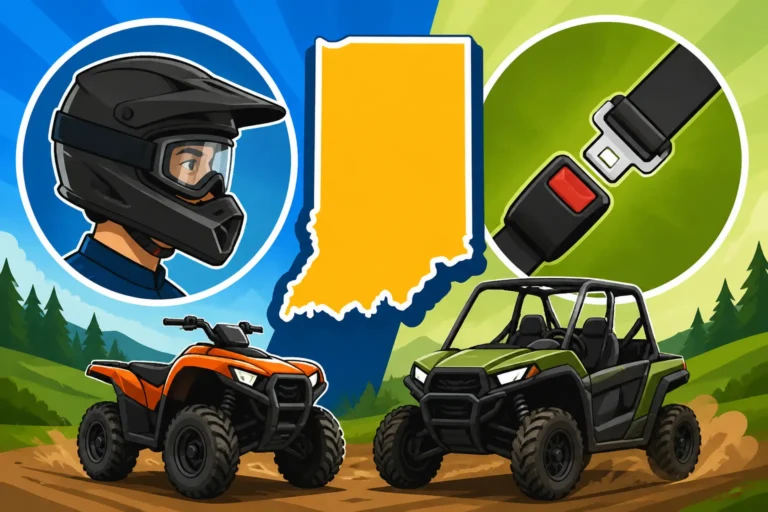
A good paperwork plan will not help much if the group arrives without required safety equipment or has an underage rider who does not meet the site’s conditions. Check rules for helmets, supervision, passengers, and seat belts where applicable. Make sure every rider knows which trails are within their ability and what to do if the group gets separated.
For children, avoid treating a permit purchase as the whole preparation. Confirm that the machine is appropriate for the rider, that the rider understands basic controls, and that the supervising adult can remain close enough to help. A parent who plans to supervise from a different trail loop may not satisfy the practical intent of direct supervision.
Pack food, water, first-aid supplies, and a way to communicate. Save maps or directions in advance, especially when travelling through areas with patchy service. Amazon can be a place riders look for basic storage items such as a document pouch or compact first-aid kit, but select gear that fits the trip and inspect it before relying on it. A purchase is not a substitute for learning the park’s rules or carrying appropriate safety equipment.
Common visitor mistakes that lead to extra hassle
Most problems are not caused by a complicated legal puzzle. They happen because someone makes a reasonable assumption without checking whether it applies to that specific machine, site, or trip.
Treating a home-state registration as a park pass
A valid registration can be important, but it should not be mistaken for park access. Visitors sometimes arrive with a registration card and expect it to cover the trail permit and entrance charge as well. The distinction between those requirements is small on paper and very noticeable when the group is waiting at the gate.
Before leaving, write down what each document or payment is meant to cover. If your machine is registered in another state, confirm whether it satisfies the applicable visitor requirement. Then check the DNR permit and destination admission separately.
Keep proof accessible. If an attendant asks for a permit or registration document, searching through a packed trailer or a phone gallery with poor reception turns a simple check into a delay. Store confirmation details where the driver can retrieve them promptly, and carry any required physical item.
Assuming an old fee or a friend’s advice still applies
A rider may remember what they paid on a previous trip and assume the same amount and process will apply next time. Someone else may say, “We just bought one pass at the gate,” without mentioning the property, machine count, date, or permit type. Those details change the meaning of the advice.
Use firsthand information from the specific destination when planning. Confirm the fee schedule and what it includes, then compare it with your group’s situation. Avoid building a trip budget around an old receipt or a social media comment that does not describe the same machines and access option.
A simple screenshot of the official requirements can be helpful for trip planning, but check that it refers to the correct location and permit type. Keep the source information available so you can resolve questions without relying on a secondhand summary.
Forgetting separate rules for roads and private property
A DNR trail permit does not authorize riding on every road in Indiana. Road access depends on the applicable state and local rules, including whether a county has designated roads for ORV use. Likewise, the fact that a field appears open does not mean you have the landowner’s permission to ride there.
Visitors unfamiliar with Indiana can be especially vulnerable to this mistake. A route recommended by a friend may cross a road or parcel with different rules than the trail system itself. Plan a legal route between parking, staging, and the trail, and do not ride along a road unless the rules allow it.
If your ride includes roads, check the local requirements separately, including any county ordinance, equipment, insurance, or age conditions. The trail permit and the road-use question are distinct. For general background, see Indiana Rules for Riding a County Road and Indiana Landowner Permission Rules.
A practical checklist for visitors
The point of planning is not to turn a fun weekend into a paperwork exercise. It is to catch the few details that can prevent a long drive from ending in a confusing gate conversation or an avoidable violation.
Before you leave home
Start with the destination and the machines. Confirm the park’s permit process, entrance charge, hours, and any closure notices. Check whether the permit is per machine, and verify whether an annual option fits your expected visits. Make sure each vehicle has the registration or ownership documents relevant to its circumstances.
Next, check the people. Review age, supervision, passenger, helmet, and seat-belt rules that apply at the destination. Confirm that everyone has suitable protective equipment and understands the plan. If a child is riding, make sure the selected machine and route are appropriate rather than assuming the youth permit or adult presence resolves every issue.
Finally, organize the day’s information. Save the address, gate instructions, map, permit confirmation, and contact details. Bring a charged phone and a backup way to navigate if cell service is unreliable. Put documents somewhere protected but easy to reach.
At the gate and on the trail
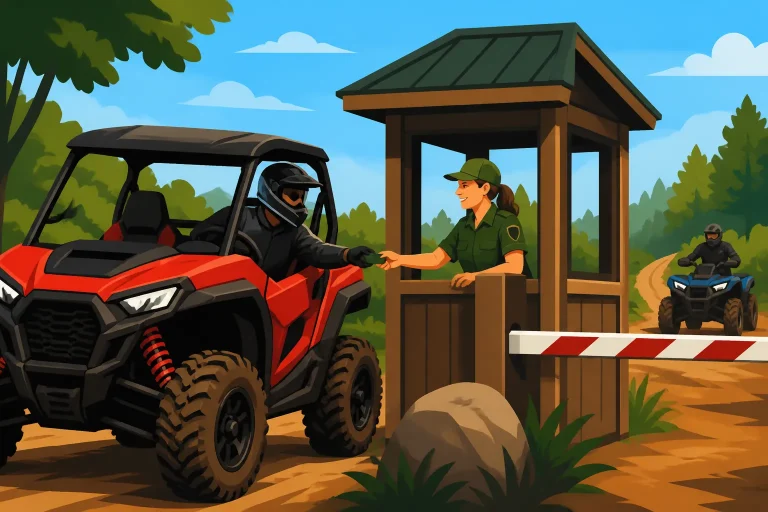
Follow the posted check-in process and present the requested information clearly. If you are unsure whether an authorization applies to a particular machine, ask before unloading or riding. A quick question at check-in is far easier than explaining later why a group assumed one purchase covered multiple vehicles.
Once on the property, remain on authorized routes and follow closure notices. A trail that looks passable may still be closed because of damage, maintenance, or safety concerns. Avoid riding around a barrier or following tracks off the marked trail.
Stay with your group and plan for the possibility of separation. Agree on a meeting point, carry basic supplies, and give newer riders an easier route. Permits and fees get you through the administrative part of the visit; good judgment is what helps the ride go smoothly.
Before planning the next visit
After the trip, note what you paid, what the purchase covered, and which machines were included. Record any entry procedure that was different from what you expected. That information makes the next trip easier, but treat it as a reminder rather than a guarantee that future rules or charges will be identical.
If you expect to ride again, compare the daily and annual options using your actual plans. Include the number of machines, expected visits, and whether you will return to the same facility. Keep the entrance charge separate in your calculation so you do not mistake a trail-permit option for an all-in visit pass.
For a visitor, the safest budgeting habit is simple: verify registration status, confirm the site’s trail permit, add entrance charges, and check the rules for the people and machines in your group. That approach works whether you are planning one day at Redbird, a weekend near Interlake, or several Indiana rides during the season.
Disclaimer
This article is for general informational purposes only and does not constitute professional advice. Laws, prices and regulations vary by location and change over time. Consult a qualified professional for guidance on your specific situation.