Why Indiana Roads Are Closed by Default
It's incredibly frustrating, isn't it? You've got this amazing ATV or UTV, built for adventure, ready to tackle any terrain, and yet, the moment you want to take it down the county road for a quick trip to a friend's house or to access a nearby trail, you're met with a wall of confusion and regulations. Indiana, like many states, has a default position that can feel like a constant battle for off-road enthusiasts: most public roads are closed to your machine. This guide aims to peel back the layers of this default closure, explaining the "why" behind Indiana's ORV road laws, the specific safety and regulatory concerns, and the very limited ways you might legally navigate this landscape.
The Foundation of Indiana's ORV Road Laws
When it comes to motor vehicles on public roads, Indiana operates on a fundamental principle: if it's not specifically designed, equipped, and registered for highway use, it generally doesn't belong there. This isn't an arbitrary decision made to inconvenience riders; it's deeply rooted in the state's legal framework for public safety and infrastructure management.
The Core Principle: Roads are for Registered Motor Vehicles
Think about the cars, trucks, and motorcycles you see on Indiana's roads every day. They all share common characteristics: turn signals, headlights, taillights, mirrors, seat belts, windshields, specific tire types, and a host of other safety features mandated by federal and state regulations. These vehicles are engineered to perform safely at higher speeds, interact predictably with other traffic, and withstand the rigors of paved road conditions. They also carry specific registrations and titles that tie them directly to their owners and ensure they meet certain standards.
Off-road vehicles, or ORVs, are fundamentally different. They are designed for rugged, unpaved terrain – mud, rocks, sand, and dirt. Their construction prioritizes ground clearance, suspension travel, and traction in challenging environments, not smooth highway performance. Because of these inherent design differences, the state views them as distinct categories of vehicles with different operational requirements. The legal framework defaults to keeping ORVs off public roads to prevent accidents, minimize wear and tear on infrastructure not built for them, and maintain order in traffic flow. It's about protecting both ORV riders and the general motoring public, even if it sometimes feels like an overreach when you just want to cross a small section of blacktop.
How Indiana Defines an Off-Road Vehicle
To truly understand why Indiana's roads are closed by default, you need to grasp how the state legally defines an Off-Road Vehicle. The Indiana Code is quite specific on this. An ORV is generally described as a motorized vehicle, other than a snowmobile, that is designed for off-road use and not for use on public highways. This includes common machines like ATVs (All-Terrain Vehicles), often called quads, and UTVs (Utility Terrain Vehicles), also known as side-by-sides.
The critical phrase here is "not for use on public highways." This isn't just a suggestion; it's a legal classification that sets ORVs apart from cars, trucks, and motorcycles. The definition hinges on the intended design of the machine, not necessarily how an individual owner might want to use it. This legal distinction is precisely why your machine, despite its powerful engine and sturdy build, doesn't get the same road privileges as your family sedan. You can dive deeper into this topic by looking at [How Indiana Defines an Off-Road Vehicle], which details the specific criteria that categorize a machine as an ORV in the eyes of the law, solidifying its separation from highway-legal vehicles. The lack of standard road-safety equipment like DOT-approved tires, seatbelts (for ATVs), full lighting packages, and standard automotive braking systems further reinforces this separation.
Safety Concerns Driving the Default Closure
The primary driver behind Indiana's default closure of roads to ORVs is, unequivocally, safety. While your machine might feel robust and capable on the trail, public roads present a completely different set of hazards that ORVs, by their very design, are ill-equipped to handle safely.
Designed for Different Terrains
Let's talk about the physical characteristics of your ATV or UTV. Those knobby, low-pressure tires that grip so well in mud, sand, and loose dirt? They behave very differently on asphalt or concrete. On hard, paved surfaces, they can provide less traction for braking and turning, leading to unpredictable handling, especially at higher speeds or during emergency maneuvers. The aggressive tread can also wear down quickly on pavement, reducing their effectiveness where they're truly needed – off-road.
Similarly, the suspension systems on ORVs are built to absorb bumps, jumps, and uneven terrain. This translates to a softer, more forgiving ride off-road, but on a smooth highway, it can lead to excessive body roll and instability, making quick evasive actions dangerous. The ground clearance, so vital for clearing obstacles on a trail, also contributes to a higher center of gravity, increasing the risk of rollovers on cambered roads or during sharp turns, particularly with UTVs. While brands like SuperATV offer excellent lift kits and suspension upgrades for trail performance, these are generally designed for improving off-road capability, not for making a machine safer for on-road use. This fundamental mismatch between design and environment is a major reason why the state keeps them off the blacktop.
Rider Visibility and Vehicle Protection
Another critical safety aspect is the vulnerability of ORV riders and the machines themselves in a mixed-traffic environment. ATVs place their riders directly in the open, with no enclosure or significant crash protection beyond a helmet and riding gear. Even UTVs, while offering roll cages and seatbelts, still lack the crumple zones, airbags, and substantial steel frames that protect occupants in a car or truck. A collision between an ORV and a standard automobile, even at moderate speeds, is almost always devastating for the ORV operator and machine.
Furthermore, ORVs are often lower to the ground and less conspicuous than typical road vehicles. This makes them harder for other motorists to see, especially in heavy traffic, at dusk, or in adverse weather conditions. Their lighting systems, while adequate for trails, might not meet the intensity or spread requirements for highway use, particularly for taillights and turn signals. The lack of turn signals on many ATVs, for instance, requires hand signals, which can be easily missed by other drivers, creating dangerous ambiguities on a busy road. The state recognizes these inherent visibility and protection deficits as significant risks, reinforcing the default closure of roads to off-road vehicles.
Infrastructure and Regulatory Considerations
Beyond immediate safety, Indiana's stance on ORVs on public roads also takes into account the long-term impact on infrastructure and the practical challenges of regulation and enforcement. It's not just about what happens in an accident, but what happens to the roads themselves and how effectively laws can be managed.
Wear and Tear on Public Roads
Those aggressive, knobby tires that give your ORV superior traction on dirt and gravel also act like miniature chisels on paved roads. Designed to dig in and move material, they can chew up asphalt and contribute significantly to rutting, especially on softer shoulders or less-trafficked county roads. The sheer weight of some larger UTVs, combined with the concentrated pressure of their tire treads, can also accelerate the deterioration of road surfaces not built to withstand such forces.
Moreover, ORVs often track mud, dirt, and gravel onto paved surfaces from trails or unpaved property. This debris can create hazards for other motorists, especially motorcycles, by reducing traction and increasing the risk of skidding. This isn't just an inconvenience; it's a maintenance issue for local highway departments, leading to increased costs for sweeping, patching, and resurfacing. The state has a vested interest in preserving its vast network of roads, and unrestricted ORV use would undeniably contribute to premature wear and higher taxpayer expenses.
Enforcement Challenges and Uniformity
Imagine if ORVs were simply allowed on all public roads without specific regulations. The complexities for law enforcement would be immense. How would officers verify insurance, operator age, or even basic vehicle safety standards if these machines aren't held to the same highway-legal requirements as cars? The lack of standardized equipment, such as turn signals or proper mirrors on many models, would make it nearly impossible to enforce traffic laws consistently.
Maintaining uniformity in road laws across Indiana is also a significant consideration. If every county, city, or even township had completely different rules for ORV road access, it would create an impossible maze for riders to navigate and an administrative nightmare for the state. By maintaining a default closure, with limited exceptions granted at the local level, Indiana aims to provide a clear, understandable baseline for everyone. This minimizes confusion, simplifies enforcement, and ensures a more consistent level of public safety statewide, even if it means more restrictive access for ORV owners.
Limited Exceptions and Local Control
While Indiana's default position is that ORVs are generally not permitted on public roads, the state does recognize that there are practical circumstances where some limited access is necessary or desirable. These exceptions are highly specific and often contingent on local decision-making.
The Shoulder and Ditch Exception in Indiana
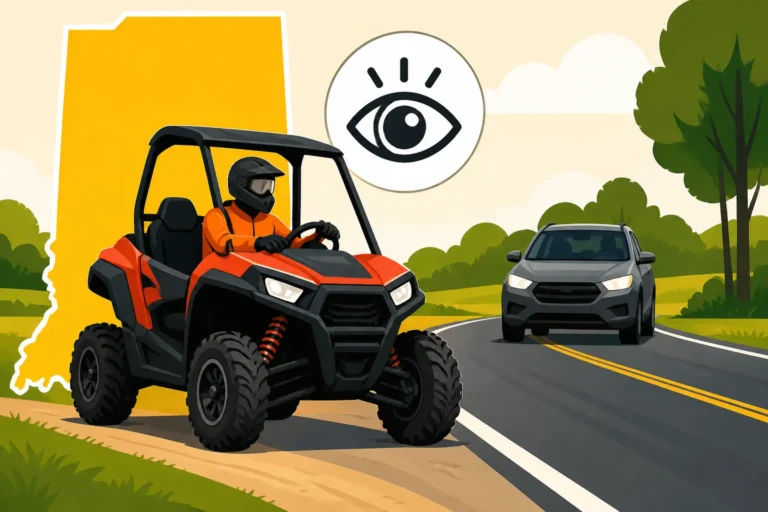
This is perhaps the most well-known, albeit often misunderstood, exception to the general rule. Indiana law allows an ORV to be operated on the shoulder or in the ditch of a highway, provided there is "sufficient width to ride away from traffic." This is a crucial distinction. It doesn't mean you can cruise down the shoulder of I-65; it's primarily intended for county roads or rural state routes where there's ample, clear space to operate entirely separate from the main flow of vehicular traffic.
Even with this exception, there are strict caveats. You absolutely cannot operate an ORV on a limited-access highway (like interstates or major parkways). Furthermore, any operation under this exception still carries the responsibility to yield to all traffic, maintain a safe speed, and operate with due regard for conditions. It’s important to understand [How Wide a Shoulder Must Be to Ride] to determine if a specific area meets the legal standard for this exception. This is not an open invitation to ride freely but a very narrow allowance for specific, low-risk situations, often to access private property or a legal trail system. You can learn more about these limitations and specific conditions in [The Shoulder and Ditch Exception in Indiana] and [Indiana Rules for Riding a Ditch] or [Indiana Rules for Riding a Highway Shoulder].
How a County Opens Its Roads to ORVs
Perhaps the most significant avenue for legal ORV road use in Indiana comes through local control. While the state maintains its default closure, it empowers individual counties (and, in some cases, cities or towns) to pass ordinances that specifically open certain roads or classes of roads to ORV traffic. This is a critical distinction: the roads aren't open by default; they are opened by exception through local legislative action.
This process typically involves county commissioners or a similar governing body holding public meetings, assessing local needs, and then enacting a specific ordinance. These local ordinances often come with their own set of additional requirements beyond state law, such as mandatory insurance, specific lighting requirements, age restrictions (e.g., riders must be 18 or older), or specific hours of operation. For example, some counties might require all UTVs to have a rearview mirror or even a windshield for road use. It's a way for local communities to balance the desires of their residents with their unique safety and infrastructure concerns. To understand the process, you might explore [How an Indiana County Opens Its Roads] and [Indiana Local Ordinances on ORV Riding], as well as [Indiana Counties That Allow ORVs on Roads] to see examples of where this has happened.
Navigating the Complexities for Indiana Riders
For Indiana ORV owners, the fragmented nature of road access can be incredibly confusing. It requires diligent research and a clear understanding of where you are and what the local rules entail. Ignorance of the law is never an excuse, and violations can lead to significant fines.
Understanding Local Ordinances and Their Limits
The first, and most crucial, step for any ORV rider considering road access is to do your homework. Just because one county has an ordinance opening its roads doesn't mean the neighboring county does. You absolutely must check the specific ordinances for the county (and any city or town within it) where you plan to ride. These ordinances are usually available on the county's website or by contacting the county clerk or highway department. It's an important step, as even if a county opens its roads, it doesn't automatically override all state laws. For instance, state helmet laws for riders under 18 still apply, as do rules for crossing state highways.
These local ordinances are highly varied. Some counties might open all county roads, while others designate only specific routes. Some might have time-of-day restrictions or specific speed limits for ORVs. Failure to comply with these specific local rules, in addition to general state laws, can result in citations. It's truly a patchwork system, so treating every stretch of pavement the same is a recipe for trouble. For specific guidance, you'll want to review resources like [Indiana Local Ordinances on ORV Riding] and [Indiana Rules for Crossing a Highway].
What an Indiana Officer Checks Roadside
If you find yourself riding your ORV on a county road that has been designated open by a local ordinance, or even utilizing the shoulder/ditch exception, it's highly likely you'll eventually encounter law enforcement. Conservation officers, sheriff's deputies, and state police are all tasked with enforcing ORV laws. They won't just wave you on; they'll want to verify your compliance.
Typically, an officer will check for a few key things:
- Indiana ORV Registration Decal: Your machine must be properly registered with the Indiana BMV and display the current decal. You can learn more about this in [Registering an ORV in Indiana].
- Proof of Insurance: If the local ordinance requires insurance for road use, you'll need to provide proof.
- Operator Age and License: Most local ordinances set minimum age requirements (often 18) for road operation, and while a driver's license isn't universally required for ORV operation off-road, it often is for road use where permitted.
- Helmet Use: If the rider (or a passenger) is under 18, Indiana's helmet law requires them to wear a DOT-approved helmet, regardless of where they are riding. This applies even on your own land or on a designated county road. You can review [Indiana's Helmet Law for Riders Under 18].
- Required Equipment: Local ordinances often specify lighting (headlights, taillights, brake lights, sometimes turn signals), mirrors, and sometimes a windshield or horn.
An officer's stop is not just an inconvenience; it's a verification process. Having all your paperwork in order and your machine properly equipped for the specific rules of that locality is paramount. Being unable to provide this information can quickly lead to a citation and potentially fines. You can prepare by understanding [What an Indiana Officer Checks Roadside].
The Path Forward for Road Riding Advocates
Despite the restrictive default, there is a path for change and responsible enjoyment of ORVs, even on a limited number of public roads. This involves active participation and a commitment to safe practices.
Advocating for Change
If you're an ORV enthusiast in a county where roads remain closed, you don't have to simply accept the status quo. Local governance offers an avenue for change. Riders and ORV clubs can engage directly with their county commissioners, council members, and highway departments to advocate for opening roads. This isn't about demanding unrestricted access, but rather presenting a well-reasoned case that addresses local concerns.
Successful advocacy often involves:
- Data and examples: Showing how other Indiana counties have successfully implemented ORV road ordinances.
- Safety plans: Proposing specific safety requirements, such as enhanced lighting, speed limits, and mandatory insurance, perhaps even a requirement for a safety course.
- Economic impact: Highlighting the potential for increased tourism and local business revenue from ORV riders.
- Community involvement: Demonstrating that riders are responsible members of the community, willing to maintain trails and respect local rules.
By working constructively with local officials and addressing their concerns about safety, enforcement, and infrastructure, ORV advocates can gradually expand access where it makes sense.
Considering Aftermarket Upgrades for Safety
While no aftermarket upgrade can magically make an ORV street legal if it's not designed for it, certain accessories can significantly improve safety and compliance for those limited situations where road use is permitted by local ordinance. For riders in counties that have opened their roads, investing in these enhancements is a smart move.
Brands like SuperATV offer a wide range of products that can bridge some of the safety gaps between off-road design and on-road needs. For instance, adding proper turn signal kits, often including horn kits, can drastically improve your visibility and communication with other drivers. Enhanced LED headlights and taillights from companies like SuperATV can provide brighter, more effective illumination for night riding on designated roads, surpassing standard trail lighting. While not all local ordinances require these, having them can provide a significant safety advantage and demonstrate a commitment to responsible riding. Remember, these upgrades enhance safety and compliance for specific, legally permitted road use; they do not circumvent Indiana's fundamental classification of an ORV as a non-highway vehicle. Always check your specific county's ordinance to ensure you meet all mandated equipment requirements.
| Feature | Typical Off-Road Vehicle (ORV) | Typical Street-Legal Vehicle (Car/Truck) | Why it Matters for Road Safety |
|---|---|---|---|
| Tires | Knobby, low-pressure, aggressive tread | Smooth, higher-pressure, all-season | ORV tires have poor grip, wear quickly, and are unstable on pavement; can damage road surface. |
| Suspension | Long travel, soft, high ground clearance | Shorter travel, stiffer, lower center of gravity | ORV suspension leads to excessive body roll, instability, and higher rollover risk on paved roads. |
| Lighting | Basic headlights/taillights (for trail) | DOT-compliant headlights, taillights, brake lights, turn signals, reflectors | ORV lighting is often inadequate for visibility in traffic, especially for signaling turns. |
| Braking System | Designed for low-speed, off-road stops | ABS, larger rotors, designed for high-speed stops | ORV brakes may be less effective for emergency stops on high-traction paved surfaces. |
| Enclosure/Protection | Open cockpit (ATV), roll cage (UTV) | Fully enclosed cabin, airbags, crumple zones | Significantly less occupant protection in a collision with a street-legal vehicle. |
| Mirrors | Often none or minimal | Rearview, side mirrors | Critical for situational awareness in traffic, changing lanes, and seeing other vehicles. |
| Turn Signals/Horn | Hand signals (ATV), sometimes optional | Mandatory | Essential for communicating intentions to other drivers safely. |
| Windshield/Wipers | Optional, minimal protection | Standard, with wipers | Protects from debris, provides clear visibility in all weather conditions. |
| Registration/Titling | ORV registration/decal; title required for machines bought after 2009 | Standard vehicle registration, title, license plates | Identifies vehicle for road use, ensures compliance with highway regulations. |
| Speed Capability | Varies widely, often lower top speeds | Designed for highway speeds | ORVs can be a hazard if unable to keep pace with traffic flow. |
Disclaimer
This article is for general informational purposes only and does not constitute professional advice. Laws, prices and regulations vary by location and change over time. Consult a qualified professional for guidance on your specific situation.