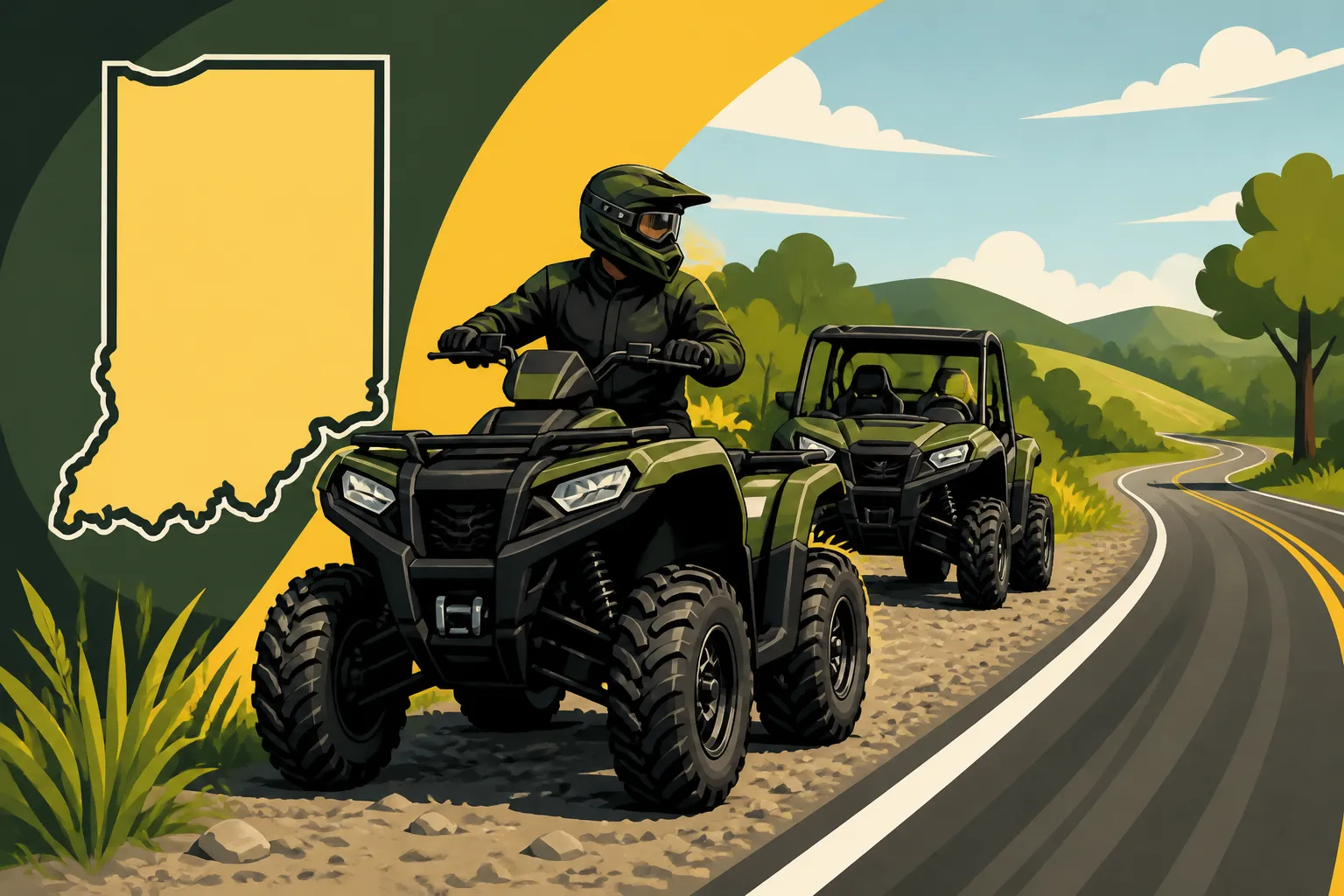
Riding a Sullivan County Shoulder
Let's be honest, trying to figure out where you can actually ride your ATV or UTV in Indiana can feel like navigating a legal minefield. You look at a long, quiet stretch of road, maybe even a wide shoulder in a rural area like Sullivan County, and wonder, "Can I just use that to get from point A to point B, or am I asking for a ticket?" It's a common frustration, especially when the alternative is trailering your machine for every short hop. This guide is here to clear up the confusion about riding ORVs on road shoulders in Indiana, focusing on what the law actually says and what it means for you, particularly if you're exploring areas like Sullivan County.
The General Rule: Why Roads Are Closed by Default
Indiana's approach to off-road vehicles (ORVs) on public roads is pretty straightforward: they are generally not allowed. This isn't just some arbitrary rule; it stems from a fundamental difference in how ORVs are designed compared to street-legal vehicles. Your ATV or UTV is built for rugged terrain, for mud, rocks, and uneven surfaces, not for the smooth, high-speed environment of asphalt and other traffic. This default "no" can be a real headache for owners who just want to connect trails or get to a friend's property.
The Rationale Behind the Default Ban
Think about it: ORVs often lack the specific safety features and certifications required for highway use. They might not have turn signals, rearview mirrors, or brake lights that meet road vehicle standards. Their tires are aggressive, great for traction off-road but not ideal for pavement, affecting handling and braking. Plus, they can be much narrower or wider than typical cars, creating visibility issues for other drivers. The state's primary concern is safety – both for the ORV operator and for everyone else on the road. It’s a bitter pill to swallow when you’re driving a [Registering an ORV in Indiana] machine that feels perfectly capable, but the law looks at the design specifications.
What "Public Road" Actually Means
When the law talks about "public roads," it's cast a pretty wide net. This includes everything from interstate highways (which are definitely off-limits for ORVs, no exceptions) down to your quietest township roads. It covers state routes, county roads, and city streets. Essentially, if it's maintained by a governmental entity and open for public vehicular travel, it's considered a public road. This comprehensive definition means that unless there's a specific exception carved out by state law or a local ordinance, your ORV isn't permitted on any part of that road, including the paved surface itself. It's the reason why you often see signs for "no ORVs" even on what seem like deserted backroads; the default applies unless explicitly stated otherwise.
Understanding Indiana's Shoulder and Ditch Exception
Now, here's where things get a little nuanced, and it's often the source of confusion for many riders. While ORVs are generally banned from the traveled portion of public roads, Indiana law does provide specific exceptions that allow ORVs to operate on the shoulder or in the ditch of certain public roads. This isn't a carte blanche to ride anywhere, but it offers some flexibility, especially in rural areas where designated ORV trails might be few and far between.
Distinguishing Between a Shoulder and a Ditch
Before we dive into the rules, let's make sure we're all on the same page about what a "shoulder" and a "ditch" actually are in the eyes of the law.
- Shoulder: This is the portion of the roadway immediately adjacent to the traveled lane, typically paved or graveled, and designed to accommodate stopped vehicles, emergency use, or lateral support for the pavement. It's usually distinguishable from the main driving lanes, even if it's not a different color.
- Ditch: Beyond the shoulder, you often find the ditch, which is typically a sloped or excavated area designed for drainage. It's usually unpaved, grassy, or muddy, reflecting the natural terrain.
The distinction is important because while the law often groups them together for ORV access, the practicalities of riding a ditch versus a paved shoulder are quite different. Riding in a ditch can be much more challenging and potentially damaging to your machine, even for something as robust as a SuperATV equipped with heavy-duty suspension.
Conditions for Legal Shoulder Riding
Indiana law states that an ORV may be operated on the shoulder, berm, or ditch of a public highway if the operation is not otherwise prohibited and if certain conditions are met. The key conditions are:
- Sufficient Width: The shoulder or ditch must be wide enough to allow the ORV to operate safely and away from the traveled portion of the highway. This is crucial. It's not enough to simply be on the shoulder; you must be far enough over that you're not posing a hazard to vehicles on the main road. What constitutes "sufficient width" can be subjective, but generally, it means you're not riding right on the edge of the white line or kicking up dust onto passing cars.
- Away from Traffic: You must operate your ORV in a manner that does not interfere with, impede, or endanger the operation of regular vehicular traffic. This means being mindful of your speed, visibility, and how your presence affects other drivers. If cars are having to swerve or slow down significantly because of your ORV on the shoulder, you're likely in violation.
- No Local Prohibitions: Even if the state law allows for shoulder riding under these conditions, a county or municipality can enact an ordinance that further restricts or even prohibits ORV use on its roads and shoulders. This is why checking local rules, like [How to Find an Indiana County ORV Ordinance], is so vital.
It's a delicate balance. You're given a narrow window of opportunity, but it comes with significant responsibility to ensure safety and minimize disruption.
Crossing Roads vs. Riding Along Them
It's vital to differentiate between using the shoulder or ditch to travel along a road and using it to cross a road. Indiana law has specific provisions for crossing highways:
- Crossing at Right Angles: An ORV may cross a public highway at right angles to the highway, but only at a place where the operation can be done safely.
- Complete Stop: Before crossing, the operator must bring the ORV to a complete stop.
- Yield to Traffic: The operator must yield the right-of-way to all oncoming traffic that constitutes an immediate hazard.
- Not a Limited-Access Highway: You can never cross a limited-access highway (like an interstate) or any road where signs prohibit crossing.
So, while you might be able to ride a designated shoulder for a short distance, the rules for simply traversing a road are much stricter. This means you can’t just ride the shoulder for miles on end if it’s not wide enough or if a local ordinance prevents it. Understanding [Crossing a Road on an ORV in Indiana] is key to staying legal.
Sullivan County Specifics: Local Ordinances and Reality
When it comes to ORV riding on roads or shoulders, what's true for the state might not be entirely true for every county. While Indiana law provides the baseline, individual counties have the authority to create their own ordinances that either open or close their roads and related areas (like shoulders) to ORVs. This means that Riding a Sullivan County Shoulder depends heavily on whether Sullivan County Commissioners have taken specific action.
Absence of a Specific Sullivan County Ordinance
As of now, Sullivan County does not have a widely publicized, specific ordinance opening its county roads or shoulders for general ORV use beyond what state law allows. This is crucial because if a county hasn't explicitly passed an ordinance to permit ORV road use (or specific shoulder use), then the default state law prohibiting ORVs on the traveled portion of the highway remains in full effect.
This means that in Sullivan County, your primary legal avenue for riding an ORV on a road-related surface will be through the "shoulder and ditch exception" as outlined in state law. You'd need to ensure the shoulder is "sufficiently wide" and you are operating "away from the traveled portion" of the highway, without impeding traffic. If the shoulder narrows, or if traffic is heavy, you'd be expected to cease ORV operation on that shoulder and find another route. It’s a bit of a gray area, and it puts the onus on the rider to constantly assess the conditions.
Practical Considerations for Riding a Shoulder in Sullivan County
Sullivan County, being a largely rural area with numerous backroads, gravel roads, and agricultural lanes, might seem like a perfect place for some casual ORV shoulder riding. However, even on these less-trafficked roads, the legal considerations are paramount.
- Road Types and Conditions: Many roads in Sullivan County are gravel or narrow paved roads. While these often have wider, less-defined shoulders, or even ditches that function as shoulders, the "sufficient width" and "away from traffic" rules still apply. Muddy conditions, common after rain, can make even a wide ditch unsafe or lead to environmental damage if you stray too far. If you're running aggressive mud tires from a company like SuperATV, you might feel confident in any conditions, but the legal framework doesn't change with your machine's capabilities.
- Traffic Variability: Even quiet rural roads can have sudden bursts of traffic, especially during harvest seasons or commuting times. A shoulder that felt safe and wide at noon on a Tuesday might feel entirely different at 5 PM on a Friday. Always be prepared to pull off completely or turn around if conditions change.
- Enforcement: Local law enforcement in Sullivan County, including sheriff's deputies and Indiana Conservation Officers, are familiar with state ORV laws. While they might exercise discretion on quiet backroads, if they observe unsafe operation, interference with traffic, or blatant disregard for the "away from traffic" rule, you could face consequences. An officer pulling you over will typically be looking for your [Indiana ORV Decal Explained] and ensuring your operation is safe and legal. It’s always best to err on the side of caution.
If you're using your ORV for legitimate agricultural purposes, such as moving between fields, the rules can be a bit different, but this generally applies to active farming operations and not recreational riding. [Does a Farm-Only Quad Need a BMV Decal?] is a common question that highlights these distinctions.
Safety, Gear, and What to Expect from Law Enforcement
Even when you're legally riding a shoulder or ditch, safety should always be your top priority. ORVs can be inherently unstable on hard surfaces, and interacting with other vehicles on a public right-of-way demands extra vigilance. Understanding what to carry and how to act can make all the difference.
Essential Safety Gear and Practices
Riding on or near public roads, even just on the shoulder, carries a higher risk than riding on a dedicated trail.
- Helmets: Indiana law requires all ORV operators and passengers under 18 to wear a helmet when riding on public property or public lands. While a private field might not enforce it, riding a public shoulder absolutely means [Indiana's Helmet Law for Riders Under 18] applies. Even if you're over 18, wearing a DOT-approved helmet is just smart practice.
- Visibility: Make yourself as visible as possible. Wear bright colors, use your headlights and taillights, especially if there's any dust or low light. A tall flag can also increase your visibility to other drivers, particularly those in larger trucks who might not see a lower-profile ORV over hills or around bends. Consider adding aftermarket lighting, perhaps from a brand like SuperATV, to enhance your visibility to others, even in daylight.
- Machine Maintenance: Ensure your ORV is in good working order. Brakes, tires, and lights should be fully functional. A breakdown on a road shoulder, even a quiet one, can be dangerous.
- Cautious Riding: Reduce your speed significantly when on a shoulder. Be prepared for sudden changes in terrain (like ditches, culverts, or soft spots) and for unexpected traffic. Assume other drivers don't see you.
- Stay Sober: Operating an ORV under the influence of alcohol or drugs is illegal and incredibly dangerous, just like operating any other vehicle. [Indiana DUI Rules for ORV Riders] are strict and apply to all forms of ORV operation.
Interacting with Law Enforcement
If you find yourself pulled over while riding a Sullivan County shoulder, remain calm and respectful. Officers are primarily concerned with safety and compliance with the law.
- Be Prepared: Always carry your [Indiana ORV Registration Paperwork] or proof of registration, and an insurance card if your county (or specific area) requires it. Even if not strictly required statewide for all ORV operation, having proof of insurance is good practice and might be necessary if your machine is involved in an incident.
- Keep Your Hands Visible: When an officer approaches, keep your hands on the handlebars or steering wheel where they can be seen.
- Answer Honestly: Be truthful and concise in your answers. If you're unsure about a specific rule, it's better to say so than to guess.
- Understand Their Perspective: Officers are enforcing laws designed to protect everyone. Even if you believe you're riding safely, they might see a potential hazard or a violation of the "away from traffic" rule. They are also often checking for proper [Indiana ORV Decal Placement].
It’s always a good idea to know the rules, but also to understand that interpretation can vary. The safest bet is to minimize your time on public road shoulders and prioritize dedicated [Where to Ride an ORV in Indiana] areas like Redbird SRA or Interlake SRA whenever possible.
Comparing Legal and Illegal Shoulder Riding Scenarios
To help illustrate the differences between compliant and non-compliant shoulder riding, here's a quick comparison:
| Scenario Description | Legal Status (Sullivan County) | Rationale |
|---|---|---|
| Riding a wide, gravel shoulder of a rural county road (no local ordinance) for 100 yards to reach a field, staying far from the paved lane. | Likely Legal | Meets state's "sufficient width" and "away from traffic" criteria. Short distance and specific purpose helps. |
| Riding a narrow, paved shoulder of a state highway (even if rural) for 2 miles, close to the white line. | Likely Illegal | Shoulder is likely not "sufficiently wide" to be truly "away from traffic" on a higher-speed highway. Sustained travel is generally restricted. |
| Crossing a paved county road from one field to another, stopping, looking both ways, and yielding to an approaching car. | Likely Legal | Follows state's rules for crossing at right angles, complete stop, and yielding. |
| Riding through a ditch that is clearly separated from the road, does not impede traffic, and poses no hazard. | Likely Legal | Ditch is often included in the "shoulder, berm, or ditch" exception, provided conditions for safety and separation from traffic are met. |
| Riding on any part of a highway shoulder within town limits, where a town ordinance specifically bans ORVs on all town roads. | Definitely Illegal | Local ordinances can override state permissions for shoulder use and often prohibit ORVs within corporate limits. Check [Indiana Local Ordinances on ORV Riding]. |
| Operating on a shoulder without an Indiana ORV decal. | Definitely Illegal | All ORVs operating on public land, including shoulders, must be registered and display a current decal. You'd face [Indiana Fines for an Unregistered ORV]. |
Remember, this table provides general guidance. Each situation is unique, and local law enforcement will make the final determination based on their assessment of the specific circumstances. Always exercise caution and prioritize safety above all else.
Disclaimer
This article is for general informational purposes only and does not constitute professional advice. Laws, prices and regulations vary by location and change over time. Consult a qualified professional for guidance on your specific situation.