Why Indiana Limits What a County May Demand
It can be incredibly frustrating to figure out where you can legally ride your ATV or UTV in Indiana, especially when you think you've finally got the state rules down, only to run into a whole new set of local regulations. Many riders find themselves scratching their heads, wondering if a county can just make up any rule it wants. This guide aims to clear up that confusion by diving deep into the specific limitations Indiana state law places on what counties can and cannot demand when it comes to off-road vehicle (ORV) use on their public roads.
The Default Position: Why Most Indiana Roads Are Off-Limits for ORVs
Indiana, like many states, operates under a "closed by default" principle when it comes to allowing off-road vehicles on public roads. This means that unless a specific law or ordinance opens a road, it's generally off-limits for your ATV or UTV. It’s not just a suggestion; it's a legal stance designed to manage public safety and infrastructure. For many years, riders simply knew that their machines were for trails and private land, and the idea of street-legal ORVs was largely a non-starter.
Indiana's "Closed by Default" Philosophy
Imagine driving your side-by-side down a county road only to be pulled over by a local sheriff, who informs you that you're breaking the law. It’s a jarring experience that many riders have faced, and it often stems from a misunderstanding of this fundamental "closed by default" rule. The state views ORVs differently than traditional motor vehicles built for paved roads. Their design, speed, tire types, and general handling characteristics are optimized for off-pavement conditions, not for sharing lanes with cars and trucks. Therefore, the state legislature has taken the stance that ORVs should not be on public roads unless explicitly permitted by law. This creates a baseline expectation for everyone: if you don't know for sure, assume the road is closed to your ORV.
This philosophy is enshrined in Indiana's statutes, which define what constitutes an [How Indiana Defines an Off-Road Vehicle] and then outline where these vehicles are generally permitted to operate. The goal is to prevent a free-for-all situation where powerful, often heavy, and agile machines are mingling with everyday traffic without proper oversight. It's a proactive measure to ensure that local jurisdictions have a clear framework within which to make their own decisions, rather than leaving a vacuum that could lead to dangerous or chaotic situations on the roads.
The Rationale Behind State-Level Restrictions
The state's reasoning for these blanket restrictions isn't arbitrary; it's rooted in a few key concerns. First and foremost is public safety. ORVs often lack the same safety features as street-legal vehicles, such as turn signals, rearview mirrors, and protective enclosures, though many aftermarket companies like SuperATV offer kits to enhance these features. Their suspension systems are designed for absorbing shocks from uneven terrain, not for stable high-speed cornering on asphalt. This makes them inherently less predictable in traffic and more susceptible to rollovers or other accidents on paved surfaces. Furthermore, the knobby tires common on many ORVs provide excellent grip off-road but can wear quickly and handle poorly on hard pavement, especially in wet conditions.
Beyond safety, there are also considerations for road infrastructure and enforcement. Allowing all ORVs on all roads without regulation could lead to increased wear and tear on paved surfaces, especially with heavier side-by-sides. It also presents a challenge for law enforcement, who need clear guidelines to determine what is legal and what isn't. The state wants to ensure that when ORVs are permitted on roads, it's done in a controlled manner that minimizes risk to both ORV operators and other motorists. These foundational state-level rules provide the necessary structure before any local community can step in to create its own allowances.
Empowering Local Control: How Indiana Counties Can Open Their Roads
While Indiana starts with a "closed by default" stance, the state also understands that local communities often have unique needs and landscapes. What works for a densely populated urban county might not make sense for a rural county with miles of gravel roads connecting farms and homes. Recognizing this, Indiana law provides a mechanism for counties to create their own ordinances to permit ORV use on specific public roads within their jurisdiction. This flexibility allows for tailored solutions that reflect local conditions and community desires.
The Legislative Framework for Local Ordinances
The ability for counties to open their roads to ORVs isn't just something they can decide on a whim; it's explicitly granted by state statute. This framework means that any local ordinance must adhere to the larger state laws, acting as a carve-out or an exception to the general "closed by default" rule, rather than a completely independent set of regulations. The state empowers county commissions or councils to research, debate, and then adopt ordinances that designate certain roads for ORV use. This ensures a formal, public process, often involving community input, before any changes are made.
When a county decides to explore opening roads, they typically hold public meetings to gather feedback from residents, farmers, and ORV enthusiasts. This allows them to consider various factors, such as traffic volume on certain roads, proximity to existing trails, local economic impacts, and public safety concerns. For example, a county heavily reliant on agricultural activity might designate certain rural roads for farm-related ORV use, recognizing the utility of these machines for local farmers. The state's framework provides the legal backbone for these local decisions, ensuring they have legal standing and aren't easily challenged. This is where you'll find information on [How an Indiana County Opens Its Roads].
The Process of Designating ORV-Friendly Roads
So, what does it actually look like for a county to designate ORV-friendly roads? It's typically a multi-step process involving various local government bodies. First, the idea might be proposed by a county commissioner, a group of concerned citizens, or local ORV clubs. Then, the county government will often conduct studies or assessments to identify suitable roads. These studies might consider factors like speed limits, existing traffic volume, the presence of shoulders or ditches for safe riding, and potential access points to trails or private land. Once specific roads are identified, a draft ordinance is usually created.
This draft then goes through a public hearing process, where residents can voice their support or concerns. This is a crucial step, as it allows the community to have a say in how their roads are used. After public input, the county commissioners or council members will vote on the proposed ordinance. If passed, the county then typically posts signage on the designated roads to inform all drivers—both ORV operators and conventional vehicle drivers—that ORV use is permitted. Without this formal designation and signage, even if a road seems suitable, it remains closed to ORVs. Riders must actively seek out and understand these local designations, as simply assuming a road is open can lead to significant [Indiana Fines for Illegal ORV Road Use].
The State's Guardrails: Key Limits on County ORV Ordinances
While Indiana gives counties the power to open their roads to ORVs, this power is not absolute. The state also sets clear boundaries, acting as "guardrails" to ensure that local ordinances don't become overly burdensome, discriminatory, or contradict state law. These limitations are crucial because they prevent a patchwork of wildly different, and potentially confusing, rules that could make it impossible for riders to travel safely across county lines. Understanding these limits is key for any ORV owner in Indiana.
Why an Indiana County Cannot Demand a License
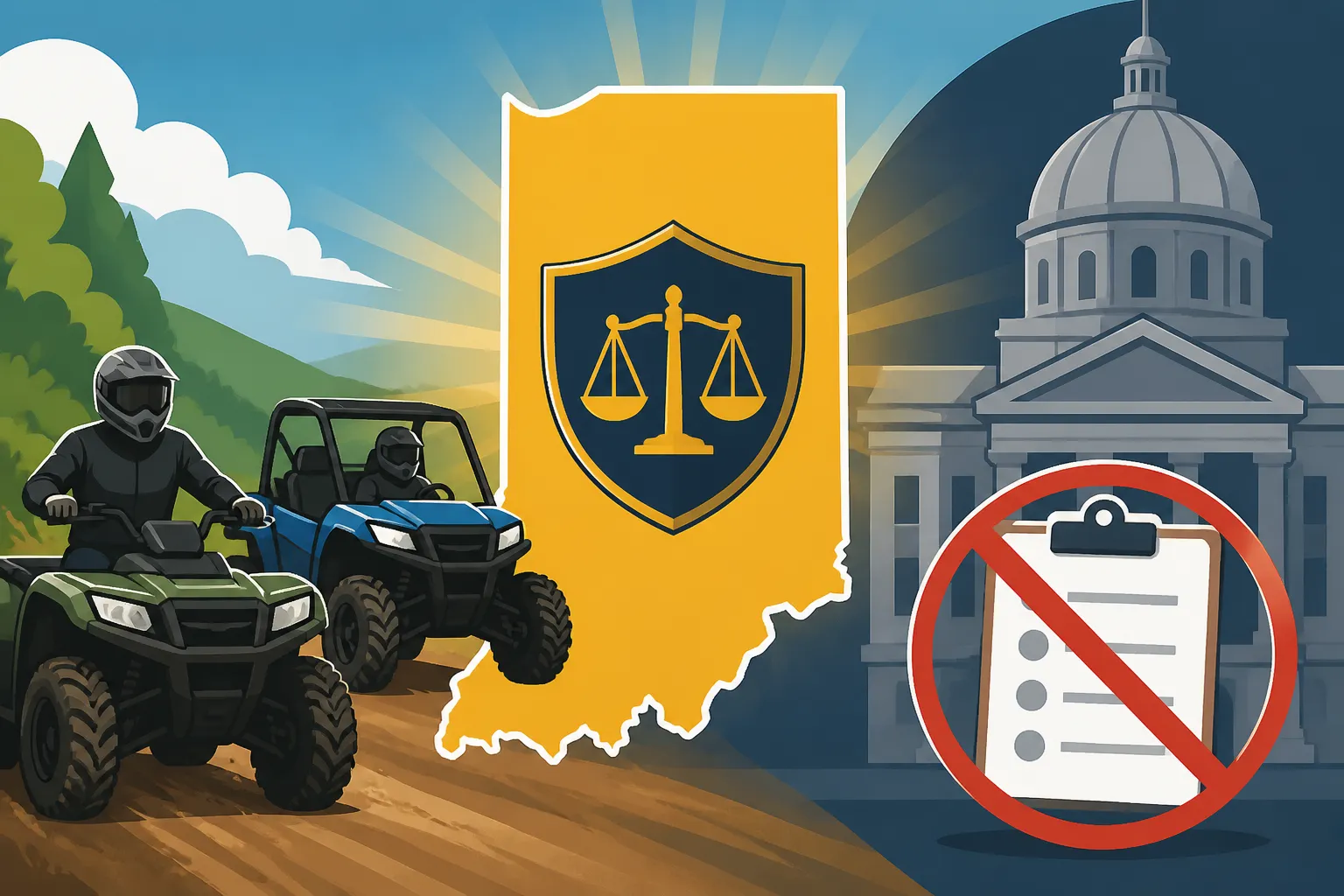
One of the most significant limitations placed on county ordinances is regarding driver's licenses. An Indiana county cannot demand that an ORV operator possess a driver's license to operate an ORV on its designated roads. This is explicitly stated in Indiana law. For many riders, especially younger ones, this is a huge relief. The state's reasoning is that ORVs are generally considered recreational vehicles, and while operating them requires skill and responsibility, it doesn't necessarily require the same type of licensing as a conventional motor vehicle designed for highways.
Consider a scenario where a 16-year-old, who legally operates their quad on trails with an ATV safety certificate, wants to ride a designated county road to access another section of trail. If the county could demand a driver's license, that teenager would be out of luck, effectively blocking their access. The state prioritizes the ability for all eligible riders (based on state age rules) to utilize designated ORV routes without facing an additional licensing hurdle from local authorities. This doesn't mean any age can ride, as [Indiana Minimum Age to Ride an ORV] still applies, but it clarifies that a separate driver's license isn't a county prerequisite. This is a common point of confusion, so it's vital for riders to remember that if they meet the state's age requirements, a county cannot add a driver's license requirement on top of that.
Why an Indiana County Cannot Cap Weight Below 2,000 Pounds
Another critical limitation prevents counties from imposing arbitrary weight restrictions that would effectively ban many common ORVs. Specifically, Indiana law states that a county cannot prohibit the use of an ORV on its designated roads solely because the machine exceeds a certain weight, unless that weight is over 2,000 pounds. This protects owners of larger, more capable side-by-sides, which often push or exceed the 1,000-pound mark but are still well within reasonable ORV classifications.
Imagine you've invested in a robust UTV from a company like SuperATV, equipped with all the necessary gear for trail riding and perhaps some utility work. Many modern side-by-sides, especially multi-passenger models or those with heavy-duty accessories, can easily weigh 1,200 to 1,800 pounds. If a county could arbitrarily set a weight limit of, say, 1,000 pounds, a significant portion of the ORV community would be excluded from legally using those roads. The 2,000-pound threshold provides a reasonable upper limit that aligns with the capabilities of road infrastructure while still allowing most common ORVs to be ridden. This limitation prevents counties from indirectly banning a large segment of the ORV population simply by imposing restrictive weight caps. For more on this, you can look up [Indiana Rules for a Machine Over 2,000 Pounds].
What a Local ORV Ordinance Is Not Allowed to Require
Beyond driver's licenses and weight caps, Indiana law also places other, more general limitations on what a county can demand in its ORV ordinances. These limitations ensure a degree of uniformity and prevent counties from imposing requirements that are overly complex, unnecessary, or contradictory to state regulations. For example, a county typically cannot require specific safety courses beyond what the state might recommend or require for youth riders. They also can't demand specialized permits or fees that duplicate or go beyond the state's registration and titling processes.
Furthermore, counties generally cannot set lower speed limits for ORVs than for other vehicles on the same road, nor can they dictate specific equipment requirements that aren't already covered by state law (such as demanding certain types of tires or suspension, unless directly related to safety on their specific roads and not already regulated). While counties can certainly mandate things like proper lighting for night riding, they cannot invent entirely new categories of required safety gear that would place an undue burden on riders. The intent here is to maintain a predictable environment for ORV operators across the state, ensuring that while local access may vary, the fundamental rules for what's expected of a rider remain consistent. The idea is that [What a Local ORV Ordinance Is Not Allowed to Require] should be a clear guideline for counties.
Common County Requirements (Within State Limits)
While state law limits what counties cannot demand, it's equally important to understand what they can and often do require within those boundaries. These are the aspects of local ordinances that riders must pay close attention to, as they represent the specific rules that open roads in particular counties to ORV traffic. Ignoring these legitimate local requirements can still lead to fines and legal trouble, even on a road that is technically "open."
Mandatory Insurance and Proof of Coverage
One of the most frequent requirements you'll encounter in county ORV ordinances is mandatory insurance. While Indiana state law doesn't broadly mandate insurance for ORVs on private land or dedicated trails, counties that open their roads often view insurance as a critical safeguard for public safety and liability. If you're involved in an accident on a public road, regardless of who is at fault, proper insurance can protect you and others from the financial fallout. Many counties will require proof of liability insurance, often specifying minimum coverage amounts similar to what's required for conventional motor vehicles.
When riding in a county with such an ordinance, it's not enough to just have insurance; you must also be able to prove it. This typically means carrying a physical or digital copy of your insurance card or certificate. Imagine a scenario where you're riding with friends in Vanderburgh County, which has specific insurance requirements for ORVs on its designated roads. If a conservation officer stops you for a routine check, they will likely ask for your proof of insurance, alongside your [Indiana Fines for an Unregistered ORV] decal. Failing to provide this could result in a citation, even if your machine is otherwise perfectly legal to be on that road. It’s always best practice to contact your insurance provider to ensure your policy covers ORV use on public roads in your specific county. You can also research [Indiana ORV Insurance Requirements] for a general overview.
Age Restrictions and Supervision Rules
Counties also have the authority to implement age restrictions and supervision rules for ORV operators on their designated roads, as long as these rules align with or are not less restrictive than state law. For example, while Indiana state law generally sets a minimum age for operating an ORV unsupervised, a county might choose to maintain stricter supervision requirements for younger riders on their public roads, citing increased safety concerns in a mixed-traffic environment.
Take, for instance, a 15-year-old rider who is permitted to ride unsupervised on private land under state guidelines. If that rider wants to use an open county road in a specific county, the local ordinance might require them to be directly supervised by an adult, even if state law doesn't. This means an adult must be present and capable of intervening if necessary. These rules are designed to protect younger riders who might not have the experience or judgment to navigate public roads safely, especially with other vehicles present. Always check the specific ordinance of the county you plan to ride in, particularly if you have a youth rider in your group. It’s a good idea to know [Indiana Rules for a Rider Under 14] as a baseline.
Lighting and Safety Equipment Mandates
When an ORV leaves the confines of a private trail and enters a public road, even a designated one, it automatically enters an environment with different safety expectations. Consequently, many county ordinances will include mandates for specific lighting and safety equipment. This often includes requirements for headlights, taillights, brake lights, and sometimes even turn signals, especially if operating after dark or during periods of reduced visibility. These requirements align with standard motor vehicle safety practices and are essential for making ORVs visible to other drivers.
Beyond lighting, counties might also reinforce helmet laws for specific age groups or for all riders, even if state law might have slight variations for private property. Some ordinances might require a slow-moving vehicle (SMV) emblem, particularly for machines that don't meet higher speed minimums, to alert faster-moving traffic. It’s not uncommon for a county to require that your ORV meets the same general safety equipment standards as a slow-moving farm implement or other utility vehicle when on public roads. For example, Vanderburgh County has a dual light rule at night. These regulations are about ensuring that your ORV is adequately equipped to share the road safely, increasing your visibility and signaling capabilities. Before heading out, make sure your machine, perhaps with an aftermarket lighting kit from SuperATV, complies with all [Indiana Lighting Requirements for ORVs].
Navigating Indiana's Varied County Road Systems
With the "closed by default" rule, the flexibility for counties to open roads, and the state-imposed limitations on what those counties can demand, you can see why navigating Indiana's ORV road system can feel like a maze. There isn't a single, uniform set of rules across the entire state. Instead, riders must be diligent in their research and mindful of where they are riding at all times. This section helps you understand how to approach this complex landscape.
Researching Local Ordinances Before You Ride
The single most important step for any ORV owner planning to ride on public roads in Indiana is to research the specific local ordinances of the county they intend to visit. Do not assume that because one county has opened its roads, neighboring counties have done the same, or that they have the exact same rules. The internet is your friend here: check county government websites, specifically looking for county commissioners' or county council meeting minutes or codified ordinances. Many counties will have a dedicated section on their website detailing their ORV rules or maps of designated roads.
Imagine you're planning a weekend trip to a new area of southern Indiana, hoping to explore some trails and use county roads to connect them. Before you even load your machine onto the trailer, you should be looking up "Hancock County's Open County Roads" or "Dearborn County's Section 70.04" to understand their specific provisions. Some counties might only open a handful of roads, while others might open a broader network. Some might have more stringent insurance requirements, while others might focus more on age and supervision. A quick phone call to the county sheriff's department or highway department can also clarify any uncertainties. This proactive research can save you a lot of headache and potential [Indiana Fines for an Unregistered ORV].
Riding Designated Roads Versus Crossing Highways
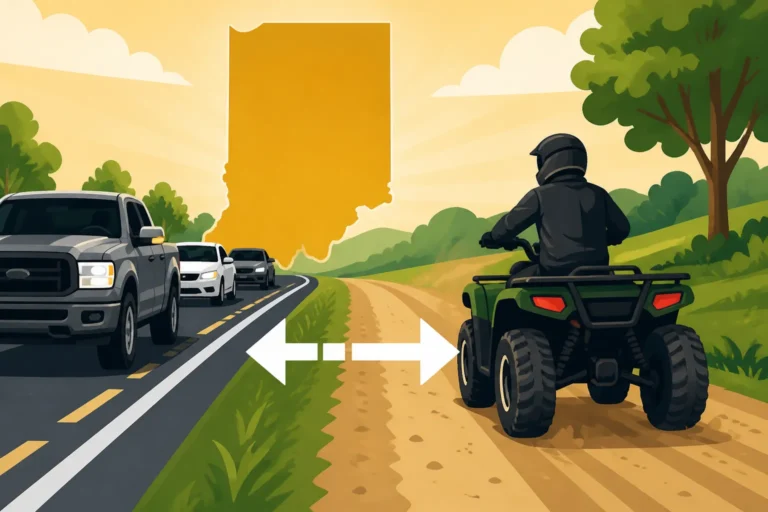
Even within counties that have opened roads to ORVs, there are often specific rules distinguishing between riding on designated roads and merely crossing a highway. Generally, while a county might open its own county roads, state highways (marked as "SR" or "US" routes) typically remain off-limits for continuous ORV travel, even if they pass through an ORV-friendly county. The exception is usually for crossing.
When an ordinance permits ORVs on county roads, it usually means you can travel along those roads. However, if you need to get from one designated county road to another and a state highway lies between them, you often can only cross the state highway, not ride alongside it for any distance. Crossing typically involves stopping, yielding to all traffic, and proceeding at a right angle to the highway, getting off as quickly and safely as possible. You should always consult [Indiana Rules for Crossing a Highway]. Furthermore, limited-access highways (interstates and major divided highways) are almost universally forbidden for ORV use, even for crossing. Understanding this distinction is vital for staying legal and safe when navigating varied road types. An Indiana officer will be checking for this if you get pulled over roadside.
Advocating for Change: Influencing Local ORV Road Access
For many ORV enthusiasts, the current patchwork of regulations can be frustrating. You might live in a county where ORV road access is severely limited, or even non-existent, despite a strong local riding community. The good news is that these ordinances aren't set in stone, and local governments are often responsive to their constituents. Advocating for change, whether it's opening more roads or refining existing rules, is a powerful way to shape the future of ORV riding in your area.
Engaging with Your Local Government
If you want to see changes in your county's ORV road access, the most effective way to make your voice heard is by engaging directly with your local government. This means attending county commissioner or council meetings, writing letters, or sending emails to your elected officials. Don't just show up to complain; come prepared with thoughtful proposals, data, and a clear understanding of the existing laws, including [Why Indiana Limits What a County May Demand]. For example, you might highlight how opening certain roads could boost local tourism by connecting to existing trail systems, or how it could provide practical utility for farmers in rural areas.
Forming or joining a local ORV club can amplify your voice. A unified group carries more weight than individual complaints. These groups can work together to research proposed road segments, identify potential safety concerns and solutions (like recommending speed limits or specific signage), and present a well-organized argument to local authorities. Often, county officials are simply unaware of the demand for ORV road access or the specific needs of the riding community. By providing constructive input, you can educate them and influence their decision-making process.
Understanding the Balance Between Access and Safety Concerns
When advocating for increased ORV road access, it's crucial to acknowledge and address the legitimate safety concerns that local officials and other residents might have. Simply demanding that all roads be open without considering safety is unlikely to be successful. Instead, frame your arguments in a way that demonstrates a commitment to responsible riding and public safety. This might involve proposing specific safety measures, such as mandatory helmet use on designated roads, stricter speed limits for ORVs, or advocating for rider education programs.
For instance, if a county is hesitant to open roads due to concerns about high-speed collisions, you might propose that only roads with lower speed limits (e.g., 35 mph or less) be designated for ORV use. You could also suggest clear signage, similar to what a company like SuperATV might produce for private parks, to warn other drivers about ORV presence. By demonstrating that the ORV community is willing to take proactive steps to ensure safety, you build trust and increase the likelihood of your proposals being considered. It's about finding a balance where access is expanded responsibly, ensuring that the benefits of opening roads outweigh any potential risks.
Disclaimer
This article is for general informational purposes only and does not constitute professional advice. Laws, prices and regulations vary by location and change over time. Consult a qualified professional for guidance on your specific situation.