What Happens If Your Permit Stays in the Truck
Leaving an Indiana ORV permit or receipt in the truck can turn a simple gate check into a frustrating problem once you are on the trail. The key is knowing which document the rules say must be with you, what a trail-use permit does—and does not—prove, and what to do if you discover the paperwork is back at the parking area.
A trail-use permit is not the same as registration
At a state ORV property, several kinds of paperwork can be involved, and they serve different purposes. A registration is tied to the machine. A motorized trail-use permit covers riding at a particular DNR property. A daily receipt is proof of the day’s trail-use payment. Keeping these distinctions straight matters when a permit, receipt, or registration document is left in the truck.
The Indiana Department of Natural Resources says a valid daily receipt must be in the vehicle operator’s possession at all times. That is the clearest carry requirement for a rider who has paid for a daily visit. Leaving the receipt in the truck means you are away from the vehicle operator’s possession of that proof while riding. The DNR does not specify a particular fine or automatic outcome for a receipt left behind, so do not assume either that a ticket is inevitable or that a verbal explanation will settle the issue.
A trail-use permit also is not an ORV registration. The Indiana Department of Natural Resources says a motorized trail-use permit is not considered registration. The permit lets you use the designated trail system under its rules; it does not replace the registration or other vehicle status Indiana requires. You can read more about the distinction in Indiana ORV Permits Explained and Indiana’s Daily and Annual Trail Permits.
| Document or authorization | What it does | What to keep in mind |
|---|---|---|
| ORV registration | Registers the machine with the state | A trail-use permit does not replace it |
| Daily trail-use receipt | Records a paid daily visit | The Indiana Department of Natural Resources requires the valid receipt to be in the operator’s possession |
| Annual trail-use permit | Covers eligible trail use under the permit’s terms | Do not treat it as vehicle registration |
| Out-of-state motorized trail-use permit | Lets eligible nonresident visitors ride at Redbird and Interlake | It is limited to those properties and is not registration |
For a day visit, the practical question is not just whether someone in your group bought a pass. It is whether you can show the required proof while you are the person operating the ORV. If one person pays for several machines or carries the group’s paperwork, make sure each operator understands what document they are expected to have and where it is.
An annual permit may be more convenient than purchasing a daily permit for each visit, but it still should not be confused with registration. The Indiana Department of Natural Resources says the annual ORV trail-use permit costs $95 per ORV and the daily ORV trail-use fee costs $15 per ORV, with the daily fee including property entrance; those figures are as of November 2026. Permit terms and current amounts can change, so check the DNR’s current information before planning a trip. For help separating trail access from entrance charges, see Why the Entrance Fee Is Separate.
Nonresident visitors have an additional distinction to watch. The Indiana Department of Natural Resources says out-of-state visitors can purchase an Out of State Motorized Trail Use permit for use at Redbird SRA and Interlake SRA, and that permit is valid only at those two properties. It is not a general Indiana registration and does not authorize riding on other places or public roads. For the registration side of a visit, Does Indiana Honor Out-of-State Registration? explains the separate issue.
If you discover the receipt is in the truck
First, stop and work out exactly what is missing. A daily receipt, an annual trail-use permit, the machine’s registration certificate, and a registration decal are not interchangeable. Check what you purchased and what the operator needs to carry before deciding how to fix the problem.
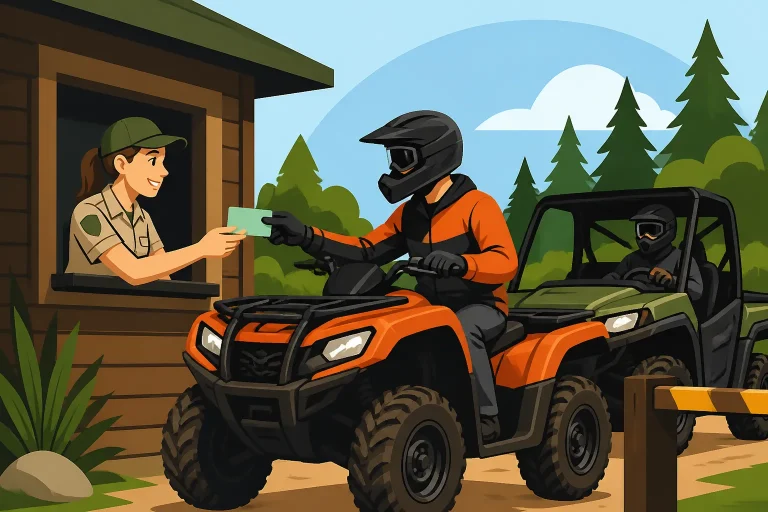
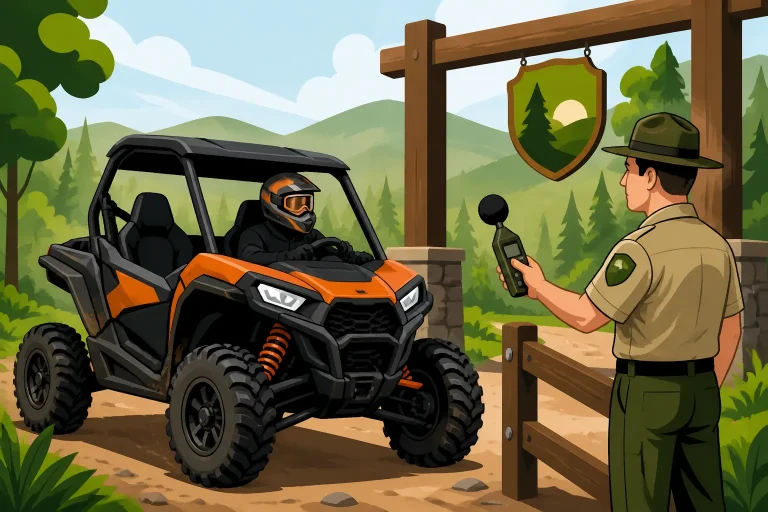
If you are still at the gate or staging area, ask the gate staff what they need to see and whether you can return to the truck to retrieve the original receipt. If you are already on a trail, do not assume that a photo, a text message, or another rider’s copy counts as having the valid daily receipt in your possession. The DNR’s stated rule is about the operator having the receipt; the facts do not establish that a photo or another person holding the receipt is an accepted substitute.
The safest practical response is to pause the ride and contact park staff or a ranger for direction. Explain plainly that the receipt is in the truck and ask how to retrieve or verify it. Follow their instructions rather than continuing to ride on the assumption that the receipt can be produced later. The DNR does not set out a specific on-trail cure or guaranteed grace period for this situation, so it is better to ask than to rely on an informal workaround.
If the machine is at the staging area and you can reach the truck without further riding, retrieve the receipt before setting out again. If the truck is elsewhere or you cannot get back without using the trail, ask staff how they want you to proceed. Avoid moving the ORV through a restricted area or riding farther just to fetch paperwork unless park staff tells you that is permitted.
For an annual permit, keep the permit confirmation or other proof available, but do not assume that carrying it replaces a required daily receipt in a situation where you paid for a daily visit. The right document depends on the type of access you bought. If you are unsure whether your pass applies to the machine or the property, ask the gate staff to confirm before you leave the entrance area. Showing a Permit at an Indiana Gate covers the practical gate check, while Buying an ORV Permit Online Before You Leave Home can help you prepare before departure.
If what you left in the truck is the machine’s registration certificate rather than the trail receipt, treat that as a separate issue. Indiana requires applicable ORVs to be registered, while the trail-use permit is a different authorization. The Indiana Department of Natural Resources says ORV registration must include a registration number specific to the machine. Do not present a trail pass as if it were vehicle registration. For the registration document question, see Riding Without Your Registration Certificate in Your Pocket.
What a trail permit does not excuse
A trail-use permit does not make an otherwise unregistered machine legal, and it does not expand where you may ride. According to the Indiana Department of Natural Resources, ORVs and snowmobiles purchased after December 31, 2003 must be registered, subject to listed exemptions. The DNR also says all off-road vehicles operated in Indiana must be registered with the BMV and display valid decals unless exempt. The trail-use permit is not a substitute for either requirement.
Some riders may qualify for an exemption from Indiana registration. The Indiana Bureau of Motor Vehicles says a nonresident operating an ORV registered in another state is exempt from Indiana registration for up to 20 days in one year. The BMV also says an operator with a bill of sale from a dealer or private individual that is no more than 45 days old is exempt from registration. Those are registration rules, not proof that a trail-use fee has been paid.
The distinction is especially important for an out-of-state rider. A nonresident’s home-state registration and an Indiana trail permit answer different questions. A trail-use permit for Redbird or Interlake does not automatically satisfy requirements for riding an Indiana roadway. The Indiana Department of Natural Resources says out-of-state visitors who want to drive on Indiana roadways open to ORV use must have their machines registered in their home state or through the Indiana BMV. Local road access is also governed by county rules, so confirm the route before using it. Indiana’s Twenty-Day Visitor Rule and Indiana Rules for Riding a County Road address those separate issues.
Likewise, buying a permit does not let a rider leave marked routes or use a closed area. The Indiana Department of Natural Resources says vehicles may be operated only in designated areas and must stay on marked trails. A valid receipt helps establish that the required trail-use payment was made; it does not override trail restrictions, property rules, or safety requirements.
Do not confuse proof of payment with the decal displayed on the machine. Indiana’s BMV issues a certificate of registration and decals for a registered ORV, and the DNR says registration decals should be displayed as required. A receipt tucked into a pocket cannot take the place of a missing registration decal, just as a decal on the machine does not prove that you paid for access to a specific trail area.
For an ORV that needs registration or a replacement document, the relevant process goes through the BMV, not the park gate. The Indiana Department of Natural Resources says replacement registration documents or decals must be processed at a BMV License Branch. If your concern is a missing or damaged decal, Replacing a Lost Indiana ORV Decal is a better fit than treating the trail-use receipt as a replacement.
A simple routine to keep proof with the operator
The easiest fix is to make the paperwork part of your pre-ride check instead of something you remember after unloading. Before leaving the gate or staging lot, confirm that the operator has the document that applies to the day’s ride and that the machine itself meets its registration and decal requirements.
Use a small document pouch or a sealed pocket in your riding gear for the receipt or permit proof. A waterproof organizer can protect paper from mud and rain; if you shop for one on Amazon, choose a size that fits your riding gear and check that it closes securely. Keep registration paperwork separate from trail receipts so you do not mistake one for the other.
A useful routine is:
- Confirm whether the visit uses a daily receipt, an annual permit, or an out-of-state trail-use permit.
- Put the relevant proof with the person who will operate the ORV, not only in the truck or with a passenger who may stay behind.
- Check that the ORV has its required registration status and displayed decal.
- Keep the park’s contact information accessible in case staff need to clarify a document question.
- Before moving onto the trail, check that everyone in the group has the required gear and understands the property rules.
If several people are riding, do not assume one person’s paperwork automatically covers everyone. Trail permits and fees may be charged per ORV. The Indiana Department of Natural Resources says the daily ORV trail-use fee and annual ORV trail-use permit are each assessed per ORV. Check the current permit terms for each machine and make sure each operator knows where the relevant proof is kept. Does Every Machine in the Truck Need Its Own Permit? explains that planning question in more detail.
Keep the receipt with the operator for the ride, then store it safely afterward if you need a record of the visit. A phone photo can be useful as a personal backup, but the stated DNR rule requires the valid daily receipt to be in the operator’s possession. Do not rely on a picture as a substitute unless park staff confirms that it is acceptable.
The bottom line is straightforward: if your daily receipt is still in the truck, do not assume that being paid is enough to satisfy the carry requirement. Pause, retrieve it if practical, and ask park staff for direction if you cannot. And keep the paperwork categories separate: a trail-use permit provides access under its terms, while vehicle registration and decals address the machine’s registration status.
Sources
- Indiana Department of Natural Resources — State Parks: ORV/Snowmobile Registration FAQs (checked November 3, 2026)
- Indiana Department of Natural Resources — State Parks: Motorized Recreation (checked November 3, 2026)
- Indiana Department of Natural Resources — State Parks: Motorized Recreation (checked November 3, 2026)
- Indiana Bureau of Motor Vehicles — Registrations & Plates: Off-Road Vehicles and Snowmobiles (checked November 3, 2026)
- Indiana Department of Natural Resources — State Parks: Interlake Off-Road State Recreation Area (checked November 3, 2026)
- Indiana Bureau of Motor Vehicles — Registrations & Plates: Off-Road Vehicles and Snowmobiles (checked November 3, 2026)
Disclaimer
This article is for general informational purposes only and does not constitute professional advice. Laws, prices and regulations vary by location and change over time. Consult a qualified professional for guidance on your specific situation.