Indiana Gives You Twenty Days to Register
A short visit to Indiana can raise a confusing question: does your ATV or UTV need an Indiana registration, or will its home-state registration do? The answer depends on how long you ride in the state and where you plan to go. Here’s how the visitor exemption works, where a trail-use permit fits, and what to do before your trip runs past the limit.
What Indiana’s twenty-day rule means
Indiana gives nonresidents a limited exception to its normal registration requirement. According to the Indiana Bureau of Motor Vehicles, a nonresident may operate an ORV or snowmobile registered in another state or country in Indiana for no more than 20 days in one calendar year without Indiana registration.
That is a limit on operation in Indiana, not a special registration that travels with the vehicle. Your out-of-state registration needs to be valid, and the exemption does not mean you can operate indefinitely just because the machine is registered at home. If you expect to ride in Indiana beyond the allowed period, arrange the appropriate Indiana registration before relying on the exemption any longer. For more on how the rule applies to visitors, see Indiana’s Twenty-Day Visitor Rule and Twenty Days on an Out-of-State Registration.
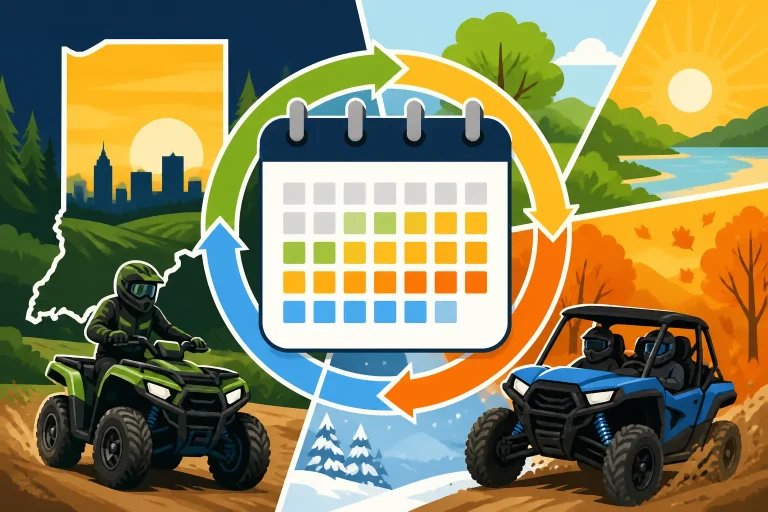
The phrase “in one calendar year” matters. The rule is not described as a rolling stretch of time. Keep your own record of the days you operate in Indiana, especially if you make several trips rather than one continuous visit. The Indiana Bureau of Motor Vehicles states the limit as 20 days in one calendar year; it does not give a separate counting method for trips, partial days, or time when the machine is stored. If those details affect your plans, confirm how the BMV applies the rule before you ride. Counting Days Across a Calendar Year covers the day-count question in more detail.
Indiana generally requires ORVs and snowmobiles to be registered with the BMV and to display valid decals unless an exemption applies. The Indiana Department of Natural Resources says the BMV handles Indiana ORV and snowmobile registrations. A registration is associated with the individual machine and includes a specific registration number, owner information, and vehicle details; it is not simply proof that you paid to enter a riding area.
| Your situation | What the twenty-day rule means |
|---|---|
| Your ORV is registered in another state or country and you are visiting | You may operate it in Indiana for up to 20 days in one calendar year without Indiana registration, according to the Indiana Bureau of Motor Vehicles. |
| Your out-of-state machine is not registered at home | The visitor exemption for a machine registered elsewhere does not fit your situation. If you plan to ride on Indiana roadways open to ORVs, the Indiana Department of Natural Resources says you need home-state registration or Indiana BMV registration. |
| You plan to ride at Redbird or Interlake | An out-of-state motorized trail-use permit may be available for those DNR properties, but that permit is not an ORV registration. |
| You bought the machine recently | A separate bill-of-sale exemption may apply. It is not the same as the nonresident visitor exemption. |
| You want to operate beyond the visitor limit | Do not assume the out-of-state exemption continues. Contact the BMV about Indiana registration and confirm any property-specific permit requirements. |
The most useful distinction is between the visitor registration exemption and a park permit. The twenty-day rule concerns whether a qualifying out-of-state machine needs Indiana registration during a limited visit. A motorized trail-use permit concerns access to particular riding properties. One does not automatically replace the other everywhere in the state.
Where you plan to ride changes what you need
For an out-of-state rider, a trip to a designated DNR riding area can involve a different permit option than a ride on an Indiana roadway. The Indiana Department of Natural Resources allows out-of-state visitors to Redbird Off-Road State Recreation Area and Interlake Off-Road State Recreation Area to buy an Out of State Motorized Trail Use permit in lieu of state ORV registration for riding at those properties. The permit is valid only at Redbird and Interlake.
The Indiana Department of Natural Resources lists the Out of State Motorized Trail Use permit at $20 per ORV as of November 2026. Check with the DNR or the property before traveling to confirm current permit details and operating conditions. A motorized trail-use permit is not an ORV registration, so don’t treat it as permission to ride your machine on public roads or at other locations.
That limitation is especially important if you plan to ride from a trail area onto a roadway. According to the Indiana Department of Natural Resources, an out-of-state visitor who wants to drive on Indiana roadways open to ORV use must have the ORV registered in the home state or through the Indiana BMV. A trail permit for Redbird or Interlake does not meet that roadway-registration requirement.
Road access is a separate question from registration. Indiana counties make their own rules about ORV use on public roads, and a road may be closed to ORVs even if your machine is properly registered. Restrictions can vary by county and may cover eligible roads, vehicle types, hours, insurance, age, equipment, or other conditions. Check the rules for the specific county and route instead of assuming that registration makes a roadway legal. Indiana Rules for Riding a County Road and How to Find an Indiana County ORV Ordinance can help you sort out that local layer.
If you are choosing between trail riding and road riding, use this practical distinction:
- Redbird or Interlake only: Check whether the Out of State Motorized Trail Use permit is the right option for your visit. It applies only at those two DNR properties.
- Indiana roadways open to ORVs: Make sure your machine has valid registration from your home state or Indiana BMV registration, then check whether the particular county road is open to ORVs.
- Other riding locations: Confirm that the property allows ORV use and find out what registration, permit, or access rules apply there. The two-property trail permit is not a statewide permit.
- A mix of trails and roads: Treat the trail permit and roadway registration as separate requirements. Verify both before setting out.
For a first visit to one of the state areas, What an Ohio Rider Needs to Ride Redbird may help with trip planning. If your destination is Interlake, see Bringing a Michigan Registered Machine to Interlake. The core point is the same for either destination: a property-specific permit does not turn into general Indiana registration.
If your visit may last longer than the exemption
Start by checking the machine’s paperwork and your likely riding schedule. If the ORV is registered in another state or country, keep evidence of that current registration with you and track your Indiana operating days. The visitor exemption is capped at 20 days in one calendar year under the Indiana Bureau of Motor Vehicles’ rule. If you expect to exceed that, contact the BMV before your plans do.
Out-of-state owners who are not registered in their home state cannot simply rely on the out-of-state registration exemption. The Indiana Department of Natural Resources says that an owner in this situation who wants to drive on Indiana roadways open to ORVs must apply for Indiana registration in person at a BMV branch. If that describes your machine, ask the BMV what documents it requires for your specific case before making the trip. Indiana ORV Registration for a Nonresident explains the Indiana registration route.
A recent purchase can create a different, temporary exemption. According to the Indiana Bureau of Motor Vehicles, an operator with a bill of sale from a dealer or private individual that is no more than 45 days old is exempt from registration. The Indiana Department of Natural Resources says the bill of sale must include the purchase date, make, model, and VIN. Keep the document with you, and make sure the information matches the machine.
Do not confuse that short-term bill-of-sale exemption with the visitor rule. One applies to a recently purchased vehicle with qualifying proof of sale; the other applies to a nonresident’s machine registered in another state or country. They have different conditions and do not necessarily solve the same problem. A bill of sale is also not the same as an Indiana registration or an out-of-state registration.
Title requirements are separate again. According to the Indiana Bureau of Motor Vehicles, ORVs purchased after December 31, 2009, must be titled with the BMV, and owners must apply for a certificate of title within 45 days of purchase to avoid an administrative penalty. The bill-of-sale registration exemption does not erase that title obligation. If you are buying a machine or sorting out missing paperwork, see Indiana ORV Title Requirements and Indiana ORV Registration Paperwork.
Once you know which route applies, confirm the current process with the BMV. Indiana ORV registrations are handled through the BMV, and an owner who needs Indiana registration should not assume that a park permit, a bill of sale, or paperwork from another state will automatically substitute. The BMV issues a certificate of registration and decals for a registered machine. For the general steps, use Registering an ORV in Indiana.
A pre-trip check for out-of-state riders
Before loading the ATV or UTV, work through a few practical checks. This can prevent the common mistake of arriving with a valid park permit but no registration suitable for the roads you intended to use.
- Confirm the machine’s registration status. If you plan to rely on Indiana’s nonresident exception, check that the ORV is registered in another state or country. The Indiana Bureau of Motor Vehicles limits that exception to 20 days in one calendar year.
- Count your planned Indiana riding days. Include all the trips you make during the calendar year, not just the visit you are planning now. If you may go over the limit, ask the BMV about registration before the trip.
- Identify every place you intend to ride. The out-of-state motorized trail-use permit applies only to Redbird and Interlake. It is not a general permit for other properties or public roads.
- Separate trail access from road access. If you want to use a roadway open to ORVs, check both the machine’s registration and the county’s road rules. A trail-use permit alone is not enough.
- Carry the relevant documents. Bring your registration certificate or other applicable paperwork, and keep a qualifying bill of sale with you if you are relying on the recent-purchase exemption. The paperwork should identify the machine clearly.
- Ask the BMV about exceptions or unusual paperwork. This is particularly important if the machine is not registered in its home state, the ownership documents are incomplete, or your plans may run past the visitor exemption.
The bottom line: Indiana’s twenty-day allowance is a limited registration exemption for qualifying nonresident machines, not a statewide riding permit. A valid out-of-state registration can cover a short visit under the rule, while Redbird and Interlake have a separate trail-use permit option for out-of-state visitors. Roadway riding brings its own registration and county-access questions. Decide where you will ride first, then match your paperwork to that use.
Sources
- Indiana Department of Natural Resources — State Parks: ORV/Snowmobile Registration FAQs (checked November 3, 2026)
- Indiana Department of Natural Resources — State Parks: Motorized Recreation (checked November 3, 2026)
- Indiana Department of Natural Resources — State Parks: Motorized Recreation (checked November 3, 2026)
- Indiana Bureau of Motor Vehicles — Registrations & Plates: Off-Road Vehicles and Snowmobiles (checked November 3, 2026)
- Indiana Department of Natural Resources — State Parks: Interlake Off-Road State Recreation Area (checked November 3, 2026)
- Indiana Bureau of Motor Vehicles — Registrations & Plates: Off-Road Vehicles and Snowmobiles (checked November 3, 2026)
Disclaimer
This article is for general informational purposes only and does not constitute professional advice. Laws, prices and regulations vary by location and change over time. Consult a qualified professional for guidance on your specific situation.