Indiana Spark Arrester Rules
Indiana spark arrester rules can be confusing because a registration or trail permit does not necessarily settle what equipment a riding area requires. The practical answer depends on where you ride and the rules in effect there. Learn what a spark arrester does, how to check whether one is required, and what to inspect before loading your ATV or UTV.
What a spark arrester does and when rules may apply
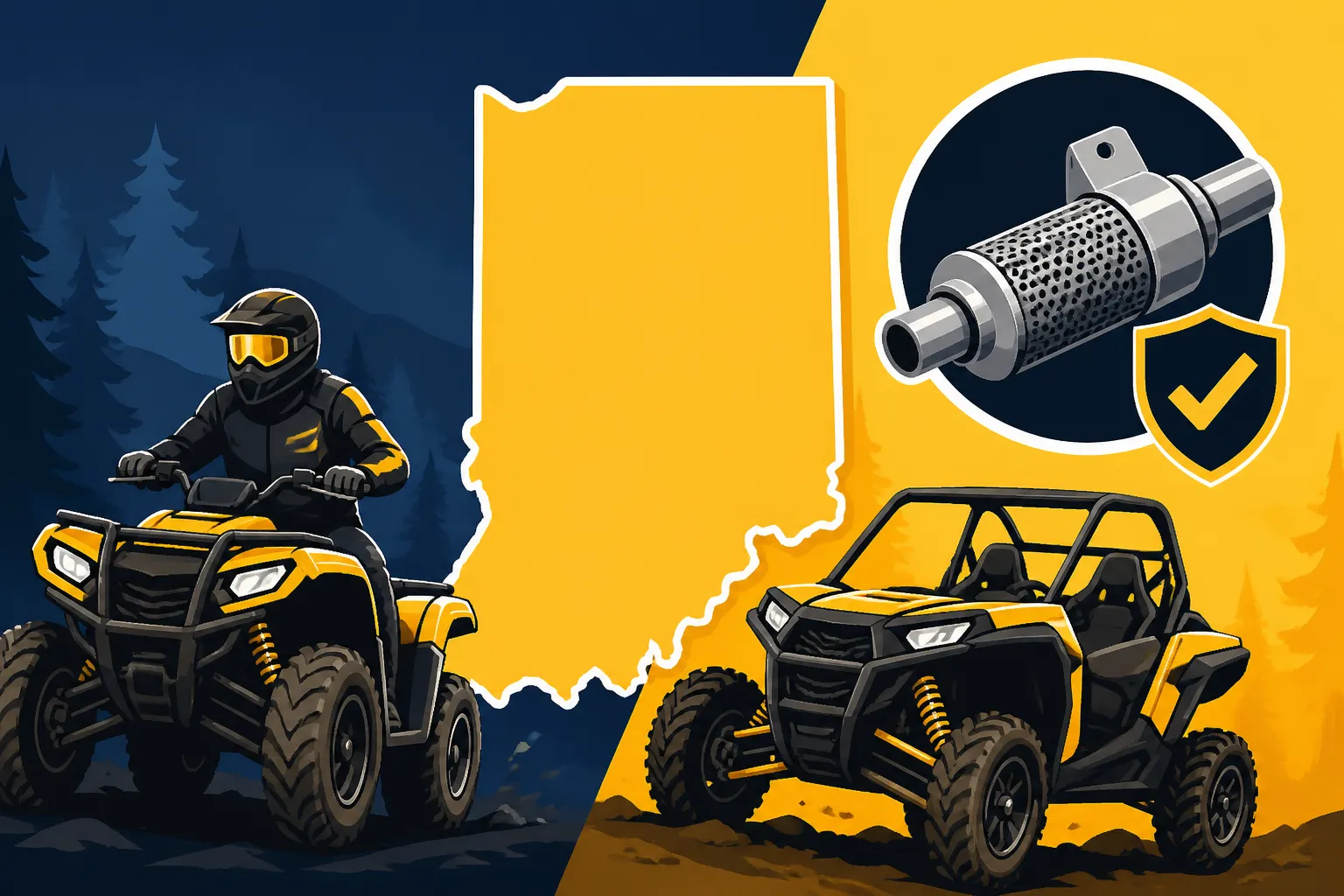
A spark arrester is a device in an engine’s exhaust system designed to keep hot particles from leaving the exhaust. That matters in dry or fire-prone conditions, where a stray ember could ignite leaves, grass, or other vegetation. It is not just another name for a muffler, and a quieter exhaust is not automatically a spark-arresting exhaust.
For Indiana riders, the key point is that there is not one simple answer that applies to every road, trail, park, and private property. Equipment rules can depend on the land manager, the riding area, and current fire or operating restrictions. A permit that allows a machine onto a particular area does not, by itself, confirm that the machine meets every equipment requirement.
Before riding, check the rules for the exact place you plan to use. This matters whether you are heading to a public riding area, a private pay-to-ride park, or land where you have permission to ride. The rules for one location do not necessarily carry over to another. [Indiana Rules for Riding a Private Park] can help explain why a private park’s own conditions may matter alongside general riding rules.
A facility might require an arrester, specify an approved type, or impose additional requirements during elevated fire risk. It may also have rules about exhaust noise, trail access, or temporary closures. A spark arrester does not make a machine legal to ride where vehicles are otherwise prohibited, and it does not replace a required permit. For related access requirements, see Indiana ORV Permits Explained and Indiana Trail Closures to Check.
| Riding location or situation | What to verify before you go |
|---|---|
| Public riding area | The current land-manager rules, posted notices, and any fire-related restrictions |
| Private off-road park | The park’s equipment and noise requirements, including any rules for particular trails |
| Private land | The landowner’s conditions and any local or fire-related restrictions that apply |
| A route crossing different properties | The rules of each land manager or property owner along the route |
| A newly modified or repaired exhaust | Whether the device is still intact and meets the riding area’s requirements |
Do not assume that Indiana’s statewide permit system, a decal, or an approved registration answers the equipment question. Those may address access or vehicle requirements, while a park or land manager may separately set conditions for exhaust equipment. If the wording is unclear, ask the operator or land manager before arriving rather than relying on another rider’s recollection.
Fire conditions can change what is allowed even when a machine has been accepted at the same site before. A restriction may be posted at an entrance, announced by the operator, or attached to a temporary closure. Check current notices before you leave, and read the information at the gate when you arrive. Indiana Rules for Riding a Closed Trail covers why an open-looking route should not be treated as available if it has been closed.
How to confirm what your ATV or UTV needs
Start with the official rules for the place you intend to ride. Search for equipment or vehicle requirements on the park or land manager’s own materials, and look for terms such as “spark arrester,” “spark arresting device,” or “USFS-qualified” if the rules use that wording. If you cannot find a clear answer, contact the operator and describe your machine and exhaust setup.
Be specific when asking. “Is my ATV okay?” may get a broad answer that does not address a modified exhaust. Better questions include:
- Is a spark arrester required for this machine on the trails I plan to use?
- Does the requirement specify a particular approval or rating?
- Is an aftermarket exhaust acceptable if it has an intact spark-arresting component?
- Are there current fire restrictions that affect vehicle access?
- Is there a separate noise limit or inspection at the entrance?
Keep the answer tied to the place and date you are planning to ride. A park’s policy may differ from the rules at another park, and a temporary restriction may change access without changing the machine itself. If you visit several riding areas in one season, check each one separately.
Also check whether the rules distinguish between types of machines or exhaust systems. A stock exhaust might include a spark-arresting component, but you should not assume that it does without checking the owner’s manual or asking the manufacturer. An aftermarket muffler may be quieter yet still lack a spark arrester. Conversely, a properly equipped exhaust can still fail a park’s separate noise requirement. Indiana Sound Limits at an ORV Park explains why sound rules are a separate issue.
The device’s description matters. A spark arrester is not the same as a flame arrestor, which is associated with preventing flame from traveling back through a system. Nor is an ordinary exhaust screen automatically compliant with every park rule. If a riding area specifies a particular standard, use a device that the manufacturer identifies as meeting that requirement and retain the product information in case you need to confirm what is installed.
When you buy a replacement, match it to the machine and exhaust. Check the exhaust manufacturer’s fitment details and the riding area’s stated requirement before ordering. A marketplace listing, including one on Amazon, may use general wording that does not establish approval for a particular trail system. If the listing does not clearly identify the device and its compatibility, confirm with the exhaust manufacturer or the park before relying on it.
Inspecting and maintaining the arrester
A spark arrester only helps if the right part is installed and remains in working condition. Before each trip, inspect the exhaust when the machine is cool. Look for a missing end cap, loose fasteners, a damaged screen, cracks, heavy corrosion, or evidence that the exhaust has been modified. If you cannot identify the arrester or its condition, check the owner’s manual or ask a qualified service technician.
Follow the manufacturer’s maintenance instructions. Some designs require periodic cleaning because carbon can build up and affect exhaust flow. Do not remove a screen or internal component to improve performance unless the manufacturer’s instructions and the riding area’s rules allow the resulting setup. Removing a part that serves as the arrester can leave the machine out of compliance, even if the exhaust still sounds normal.
A quick pre-ride check is useful, but it does not replace proper service. Have a damaged or questionable unit inspected before riding somewhere that requires one. Avoid improvising with a generic screen, wire mesh, or a homemade insert. A part that physically fits may not have the correct design, durability, or approval for the applicable rule.
If you have made exhaust changes, keep the product information and installation details with your machine records. This can help you answer questions at the gate and make it easier to check whether the setup still matches the riding area’s requirements. It is especially useful when a previous owner modified the machine or when the exhaust has been repaired with parts from different manufacturers.
Pay attention to changes in sound, exhaust flow, or performance after maintenance. Those signs do not prove the arrester has failed, but they can indicate a loose, blocked, damaged, or incorrectly installed component. Stop and investigate rather than removing parts to get back on the trail. Never inspect a hot exhaust with bare hands, and do not work on it while the engine is running.
A practical pre-ride checklist
Use this routine before transporting your machine and again when you reach the riding area:
- Confirm the location’s current rules. Check the official park or land-manager information for spark arrester wording, equipment requirements, fire restrictions, and closures.
- Identify what is installed. Check the machine’s manual, exhaust documentation, or service records to confirm whether the setup includes a spark arrester.
- Check any approval requirement. If the riding area specifies a standard or qualification, make sure the installed component is identified as meeting it.
- Inspect the exhaust while cool. Look for a missing, loose, damaged, altered, or heavily corroded part.
- Check separate noise rules. A spark arrester does not guarantee that the machine meets an area’s sound requirements.
- Ask if anything is uncertain. Contact the operator before riding, especially after an exhaust change or when a temporary fire restriction may be in effect.
- Read the gate notices. Follow current instructions on arrival, even if you checked the rules earlier.
If a staff member or land manager says your setup does not meet the requirement, do not assume you can ride because your machine is registered or because the device looks intact. Ask what specific requirement applies and whether there is an accepted way to verify or correct the issue. If you cannot resolve it at the site, leave the machine unloaded and confirm the requirements before a later visit.
The safest approach is straightforward: treat the spark arrester as a location-specific equipment question, not a detail that a decal or permit automatically settles. Confirm the rule with the place you will ride, keep the exhaust in good condition, and check current notices before setting out.
Disclaimer
This article is for general informational purposes only and does not constitute professional advice. Laws, prices and regulations vary by location and change over time. Consult a qualified professional for guidance on your specific situation.