Indiana Rules for a Rider Aged 15
A 15-year-old may be able to ride an ATV or UTV in Indiana, but age alone does not settle the question. The machine, riding area, supervision and permit requirements all matter. Here’s how to sort out the main rules before a teenager heads to a trail, private park or other public riding area.
What a 15-year-old may operate in Indiana
The key distinction is between a smaller ORV, such as a quad or dirt bike, and a full-size vehicle, such as many side-by-sides. Indiana’s rules for young riders on public land can require direct adult supervision, while full-size vehicle operation has a separate age and driver’s-license threshold.
For a 15-year-old, the practical takeaway is straightforward: do not assume that permission to ride a youth-sized ATV also means permission to drive a full-size UTV. The vehicle’s category and the rules of the specific property matter. Review Indiana Minimum Age to Ride Public Land and Indiana Rules for a Full-Size Vehicle Operator before choosing a machine.
| Situation | What to check for a 15-year-old |
|---|---|
| Youth-sized ATV or dirt bike on public land | Whether an adult parent or guardian must directly supervise the rider |
| Full-size UTV or other full-size vehicle | The operator age and driver’s-license rules for that machine and location |
| State ORV area | The required trail permit, supervision rules, helmet rules and posted restrictions |
| Private riding park | The park’s own minimum age, supervision, passenger and waiver requirements |
| Private property | The landowner’s permission and any applicable safety or local rules |
A 15-year-old who meets the rules for operating a particular machine still needs to be physically capable of controlling it. A vehicle that is too large, powerful or heavy for the rider can be unsafe even if an adult is present. Choose a machine the teen can manage from the seat, including its throttle, brakes, steering and shifting. For UTVs, check that the rider can use the seat belt correctly and reach the controls without stretching.
For more on the under-16 supervision standard, see Under Sixteen and Direct Parental Supervision. “Supervision” should not be treated as simply having an adult somewhere at the park. Before riding, check what the property considers direct supervision and how close the supervising adult must stay. How Close a Supervising Parent Has to Stay covers that practical question.
Supervision, helmets and safe operation
When a 15-year-old rides on public land, plan on an adult parent or guardian being actively involved. That means staying close enough to observe the rider, respond quickly and make sure the teen follows trail rules. A parent who drops a teenager at the trailhead and rides somewhere else may not satisfy a direct-supervision requirement.
The supervising adult should also help set clear boundaries before the ride:
- Identify which trails the teen may use and whether any are closed, difficult or intended for larger vehicles.
- Agree on where the group will stop and what to do if the rider becomes separated.
- Make sure the teen knows not to leave the marked trail or follow another rider onto an unfamiliar route.
- Check that the rider understands basic hand signals, passing etiquette and how to respond when meeting another vehicle.
- Set a pace that leaves room to stop safely, rather than expecting the teenager to keep up with faster or more experienced riders.
Helmet rules are another part of the plan. Rules can depend on the location and the type of machine. A helmet requirement may apply to a young rider even when an adult is riding nearby; an enclosed UTV cab does not automatically settle every helmet question. Confirm the rules for the specific riding area and vehicle, and use a properly fitted helmet rather than relying on a passenger’s or parent’s equipment. See Indiana Helmets at Redbird and Interlake for the rules at those state riding areas.
For a UTV, check the seat-belt requirement as well as the helmet rule. Everyone should use the restraint provided for their seating position, and passengers should be in seats designed for passengers. Do not let a 15-year-old ride in a cargo bed, stand on a running board or use a seat intended for a different purpose.
A supervising adult can make a ride safer, but supervision does not make an unsuitable machine suitable. Keep the vehicle within the teenager’s ability, avoid steep or unfamiliar terrain on an early ride and stop if the rider is tired, anxious or struggling to control it. A short practice session on a simple, permitted route is often a better start than a long ride on challenging ground.
Permits, registration and the riding location
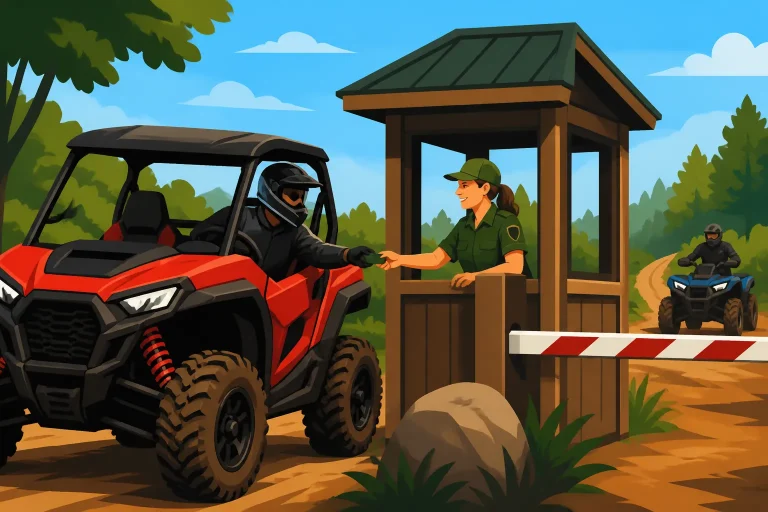
Age and supervision are only part of the checklist. A rider may also need the correct permit for the area, and the machine may need valid registration or other documentation. Do not confuse an Indiana BMV registration decal with a trail-use permit: they serve different purposes, and having one does not necessarily satisfy the requirement for the other.
Before taking a 15-year-old to a state ORV area, find out what permit the machine needs and whether the permit must be displayed or carried. Requirements are generally tied to the vehicle, not the age of the person operating it. A parent’s permit for one machine should not be assumed to cover a second machine in the trailer. Do You Need a Permit for Indiana ORV Trails? explains when a trail permit is needed.
The riding area also matters. Indiana’s state ORV areas, private parks, private land and other public properties may have different operating requirements. A teenager’s permission to ride at one venue does not automatically carry over to another. Check the current rules for the exact destination, including its age limits, supervision terms, permitted machine types, trail closures and hours.
If the machine is registered outside Indiana, separate two questions: whether it may be used on Indiana trails, and whether it needs an Indiana trail permit. A temporary registration exemption does not necessarily remove the trail-permit requirement. The visitor rule is described in Indiana’s Twenty-Day Visitor Rule; confirm how it applies to the machine’s registration and your riding plans.
Use this pre-ride checklist:
- Identify the machine. Confirm whether it is a youth-sized ATV, dirt bike, full-size UTV or another type of vehicle.
- Check the rider rule. Verify the minimum age and whether a 15-year-old may operate that category at the chosen venue.
- Arrange direct supervision. Confirm who must supervise and how close the adult must remain.
- Check the permit and registration. Make sure the machine has the required documents and trail authorization.
- Review safety requirements. Check helmets, seat belts, passengers, lights and any other location-specific rules.
- Read the day’s notices. Trail status, access conditions and local restrictions can change. Check the park’s current information before loading.
- Match the route to the rider. Choose a trail the teenager can handle and stay together throughout the ride.
If the teenager is using a rented machine, don’t assume the rental agreement covers every public-land requirement. Ask the rental provider what registration and permit the machine carries, then verify any operator-age, supervision and waiver rules with the riding venue. Indiana Rules for a Rented Machine is a useful starting point.
A practical plan for a 15-year-old’s ride
The safest approach is to confirm the rules in this order: machine, location, supervision, permit and protective equipment. That sequence helps avoid a common mistake—checking only whether a teenager is old enough to ride, then discovering at the gate that the vehicle, permit or venue rule does not fit.
For example, a 15-year-old planning to ride a youth-sized quad at a state ORV area should check the under-16 supervision rule, the park’s helmet requirements, and the permit required for that quad. A different check is needed for a full-size UTV: the operator-age and licensing rules may prevent the teenager from driving it, even if an adult accompanies the group. The adult may still be able to operate the UTV with the teenager riding as a permitted passenger, subject to the park’s passenger and restraint rules.
For private property, ask the landowner what is allowed rather than assuming that public-land rules are the only rules that apply. Permission to ride does not remove the need for safe equipment and adult judgment. If the ride is at a commercial park, read its rules before arriving; staff may enforce age limits, waiver conditions or machine restrictions that differ from another property.
It can help to keep the documents and emergency information together in a dry, accessible place. Have the supervising adult carry the permit or proof the venue requires, know the park’s contact process and agree on a meeting point in case the group is separated. If a teen is new to riding, spend time on basic controls and stopping before entering busier trails.
Rules can vary by property and may change. If a detail is unclear—especially whether a 15-year-old may operate a particular UTV—ask the park or land manager before the trip. A quick confirmation is better than relying on a general age rule that may not cover the machine or location.
Disclaimer
This article is for general informational purposes only and does not constitute professional advice. Laws, prices and regulations vary by location and change over time. Consult a qualified professional for guidance on your specific situation.