Riding Outside a Town’s Corporate Limits
Navigating Indiana's laws about where you can legally ride your ATV or UTV can feel like trying to solve a riddle wrapped in an enigma, especially when you start looking beyond designated trails. It's incredibly frustrating to think you're doing everything right, only to find out you've unknowingly crossed an invisible line into an area where your machine isn't welcome. This guide is here to shed some light on the often-confusing rules surrounding riding off-road vehicles on public roads, specifically focusing on what happens when you venture outside the defined "corporate limits" of a city or town and out into the wider county.
The General Rule: Why Indiana Roads Are Closed by Default
Let's start with the baseline, which is probably the biggest source of confusion for many ORV owners in Indiana: generally speaking, off-road vehicles aren't allowed on public roads. It's not like a regular car where you assume you can drive it anywhere unless a sign tells you not to. With ATVs and UTVs in Indiana, it's the opposite: assume roads are closed unless you find specific permission. This fundamental principle is crucial for understanding all the exceptions and nuances that follow.
Understanding Corporate Limits and Unincorporated Areas
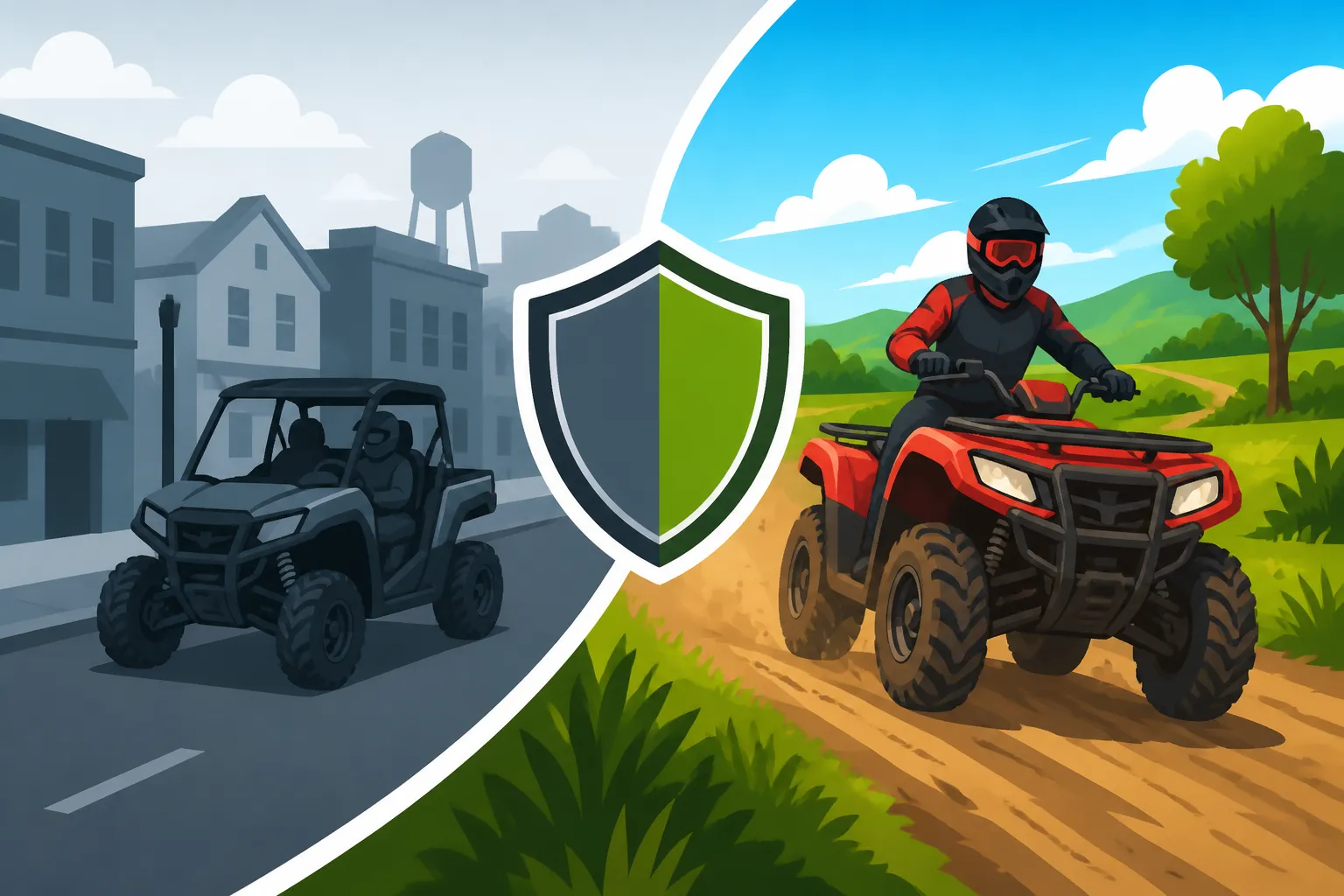
When we talk about "corporate limits," we're referring to the legally defined boundaries of an incorporated city or town. Inside these limits, municipal ordinances (local laws) often dictate a stricter stance on ORVs, frequently banning them outright from streets and public property. Once you cross that invisible line, however, and enter the "unincorporated" areas of a county, the rules can change, but not always in the way you might hope.
Many riders mistakenly believe that once they're "out in the county," away from city lights and dense traffic, they're free to roam on county roads. Unfortunately, that's not automatically the case. The state law still generally prohibits ORVs on public roads, regardless of whether you're in a city or an unincorporated area. The key difference is who has the authority to create exceptions to this general rule. While cities can create their own bans, counties have specific powers granted by the state to open their roads under certain conditions. So, while you're outside city limits, you're not necessarily "street legal" by default; you're simply in an area where a county might have made specific provisions.
The Shoulder and Ditch Exception
Now, here's where it gets a little less straightforward, and a very specific allowance comes into play. Indiana law does provide a narrow exception that allows ORVs to operate on the "shoulder" or "right-of-way" of a public highway, or in the ditch alongside it. This isn't a free pass to cruise down the road, though. This specific allowance is intended for travel alongside the road, not on the paved surface itself.
You have to maintain a safe distance from the traveled portion of the highway. Think of it as being able to use the very edge or the immediate grassy area next to the road, but never the actual driving lanes. This rule is often misunderstood, leading to citations. The intent is generally for riders to access private property or to travel short distances where no other off-road path is available. It's definitely not for extended joyrides. You must always yield to all other traffic, pedestrians, and cyclists, and be prepared to stop or move off the right-of-way if necessary. Furthermore, this exception doesn't apply to limited-access highways like interstates or major parkways, which remain completely off-limits. For more detail, you might want to look at [Indiana Rules for Riding a Highway Shoulder] and [Riding a Ditch Beside a Hancock County Road].
How Counties Can Open Their Roads to ORVs
While the state law generally keeps ORVs off public roads, it explicitly grants counties the power to change this. This is where the real local variation comes into play and why you absolutely cannot assume that what's legal in one county is legal in another. Understanding how a county can open its roads is key to responsible riding.
The Process of a County Ordinance
A county isn't just allowed to open its roads on a whim. They have to follow a specific process. This typically involves the county's legislative body—usually the County Commissioners or County Council—passing a local ordinance. This ordinance will lay out specific rules about where, when, and how ORVs can be ridden on public roads within their jurisdiction. It's a formal, legal process that includes public hearings, votes, and official publication of the new rules.
When a county decides to open its roads, they're taking on the responsibility of managing that use, which often involves considering safety, road wear, and community impact. Riders often wish there was a universal rule, but this county-by-county approach means you have to do your homework. Some ordinances might open all unincorporated county roads, while others might designate specific routes or areas. The details matter significantly. If you're curious about the general process, check out [How an Indiana County Opens Its Roads].
What an Indiana County Ordinance Cannot Require
Even when a county decides to open its roads, there are limits to what they can demand from riders. State law places certain restrictions on county ordinances to prevent them from imposing overly burdensome or conflicting rules. For example, a county ordinance generally cannot require an ORV operator to have a driver's license to ride on designated county roads, as long as the rider meets the state's age requirements for ORV operation (which is generally 16 for unsupervised riding). This can be a huge relief for younger, but legally permitted, riders.
Similarly, a county typically cannot set a weight limit for ORVs below 2,000 pounds, ensuring that most standard ATVs and UTVs aren't arbitrarily banned based on their size or heft. They also can't require special county-specific registration or fees beyond what the state already requires. This prevents a patchwork of local bureaucratic hurdles. However, counties can and often do impose rules about things like insurance, lighting, and passenger limits. It's a delicate balance between local control and statewide consistency, and it means that while [Why an Indiana County Cannot Demand a License] is true, they can still set other rules that affect your ride.
Navigating Specific County Ordinances and Their Nuances
This is where the rubber meets the road, quite literally. Because counties have the power to open their roads, the rules can vary wildly from one county line to the next. What's perfectly legal in Hancock County might get you a ticket a few miles south in Johnson County if they haven't passed a similar ordinance. This isn't just a minor detail; it's the difference between an enjoyable ride and a hefty fine.
Examples of Counties with Open Roads
Let's look at a few examples to illustrate this point. Some counties have taken the step to open their roads, often with specific stipulations.
- Hancock County: This county, for instance, has embraced opening its roads to ORVs with certain guidelines. Riders need to adhere to rules regarding speed, time of day, and safety equipment. What's often overlooked is that even in counties that have "opened" their roads, the initial general state prohibition on ORVs on highways still applies. So, the shoulder and ditch riding exception is still key for crossing certain roads, even if the county roads themselves are open. [Hancock County's Open County Roads] offers a good insight into this.
- Dearborn County: Over in southeastern Indiana, Dearborn County also has an ordinance, specifically Section 70.04, which designates certain public roadways for ORV use. These ordinances usually detail requirements like minimum operator age (often 18, even if the state's general ORV age is 16), proof of insurance, and specific lighting for night riding. [Dearborn County's Section 70.04] is a good resource for riders in that area.
- Vanderburgh County: Down near Evansville, Vanderburgh County has a quite detailed and comprehensive ordinance. They've gone so far as to create a color-coded map, making it visually clear which roads are open, which are closed, and where specific restrictions apply. Their rules often include mandatory insurance certificates, specific lighting requirements (like two headlights and two taillights after dark), and an 18-year-old minimum age for operators on public roads. You'll find that urbanized areas within the county, like the cities of Evansville or Darmstadt, typically remain closed to ORVs, even if surrounding unincorporated areas are open. [Vanderburgh County's Marked Road Map] is an essential tool for riders there.
These examples highlight that even when a county does open its roads, it's never a free-for-all. There are always specific rules and regulations to follow, and they can vary dramatically in their details.
Practical Steps for Riders: Checking Local Rules
So, what's a responsible ORV owner to do before hitting the trails that might involve some road connectors? The most crucial step is to do your homework. Don't rely on hearsay or what a friend said about another county.
- Identify Your Route: Pinpoint the exact county or counties where you plan to ride.
- Contact County Officials: The best source of information is usually the county highway department, the sheriff's office, or the county clerk's office. They can direct you to the official ordinance, if one exists, and clarify any ambiguities.
- Review the Ordinance: Read the actual text of the ordinance. Don't skim. Look for details on:
- Which roads are open (all, specific routes, or none).
- Operating hours (daylight only, specific times).
- Age requirements for operators.
- Insurance requirements.
- Equipment requirements (lights, mirrors, spark arresters). Consider adding accessories from companies like SuperATV to ensure your machine is compliant with any lighting or safety equipment requirements.
- Passenger rules.
- Penalties for violations.
- Check for Maps: Some counties, like Vanderburgh, provide helpful maps. Always consult these if available.
- Understand the "Why": These rules are often put in place for public safety and to manage potential conflicts with other road users. Approaching them with a spirit of compliance will make for a better experience for everyone.
Remember, ignorance of the law is not a valid defense. Getting caught riding illegally can result in significant fines and even impoundment of your machine. [Indiana Local Ordinances on ORV Riding] is a good starting point for understanding how to find these local rules.
Important Safety and Legal Considerations Beyond County Lines
Even when you're riding in a county that has opened its roads, or you're utilizing the ditch and shoulder exception, there are overarching safety and legal considerations that still apply. These aren't county-specific; they are state-level requirements or common-sense safety practices that every rider needs to know.
Crossing State and Limited-Access Highways
One of the trickiest maneuvers for ORV riders is crossing a public road, especially when it's a state highway or a county road that isn't designated for ORV use. You can't just zip across. Indiana law is very clear on how this must be done safely and legally.
First, you must come to a complete stop before entering the highway right-of-way. This isn't a rolling stop; it's a full, momentary halt. Second, you must yield to all traffic on the highway. This means waiting until the road is completely clear or until you have ample time to cross without impeding any vehicles. Third, you must cross at a right angle to the highway. This means going straight across, perpendicular to the flow of traffic, not diagonally or weaving with the road. The goal is to minimize your time spent in the active lanes and make your movement predictable to other drivers.
Limited-access highways, like Interstates or major state routes with controlled access, are generally never permissible for ORV operation, including crossing. These roads are designed for high-speed vehicular traffic, and ORVs are prohibited for safety reasons. Even if you're riding a highly accessorized machine with features like a wide stance or beefed-up suspension from a brand like SuperATV, it won't make it legal to use these types of roads. This is a critical safety rule and one that officers take very seriously. For more information, see [Crossing a Road on an ORV in Indiana].
Helmet Laws, Age Restrictions, and Other Statewide Rules
Beyond road access, remember that several fundamental statewide rules apply to all ORV operation in Indiana, whether you're on a trail, private land, or a designated county road:
- Helmet Law for Minors: Indiana law requires all ORV operators and passengers under 18 years of age to wear a federally approved helmet. This rule applies everywhere, including on private property, designated trails, and any county roads that allow ORVs. It's not just a suggestion; it's the law, and it's there for a reason: your safety. For those riding a UTV, even if it has a roll cage, if you're under 18, the helmet rule still applies unless you're in an enclosed cab. For more on this, check out [Indiana Helmet Law for Riders Under 18].
- Age Restrictions for Operators: Generally, an individual must be at least 16 years old to operate an ORV without direct adult supervision. Riders between 14 and 16 can operate an ORV if they are supervised by an adult at least 18 years old. Riders under 14 must be supervised by an adult on public land, and even on private land, they need supervision. Always confirm the specific age requirements in any county ordinance, as some counties, like Vanderburgh, raise the minimum age for road use to 18.
- Operating Under the Influence: Just like with cars, operating an ORV under the influence of alcohol or drugs is illegal and extremely dangerous. The same DUI laws apply, and the penalties can be severe.
- Sound Limits and Spark Arresters: Many areas, even designated riding parks, have rules about excessive noise. Your ORV must also be equipped with a spark arrester in good working order to prevent wildfires, particularly when riding in wooded or grassy areas.
- Registration and Decals: While this article focuses on road use, remember that your ORV generally needs to be registered with the Indiana Bureau of Motor Vehicles (BMV) and display a current decal unless it falls under a specific exemption (like being used exclusively for farming on private land). An officer checking you roadside, even on an open county road, will likely want to see proof of registration.
Staying compliant with these rules ensures not only your safety but also the longevity of ORV access in Indiana. We all want to enjoy our machines, and responsible riding is the best way to keep trails and designated roads open for years to come.
Disclaimer
This article is for general informational purposes only and does not constitute professional advice. Laws, prices and regulations vary by location and change over time. Consult a qualified professional for guidance on your specific situation.