Indiana Rules for Riding a Sidewalk
It's incredibly frustrating when you're trying to figure out where you can and cannot legally ride your ATV or UTV in Indiana. You might be looking for a quick way to get from your house to a friend's down the street, or maybe you just need to bypass a busy intersection, and the idea of using a sidewalk pops into your head. After all, it seems like a straightforward, traffic-free path. However, taking your off-road vehicle onto a sidewalk, even for a short distance, comes with a specific set of rules and, more often than not, outright prohibitions. This guide is here to untangle the confusion and lay out the definitive Indiana rules regarding ORV use on sidewalks, helping you understand why it’s generally not an option and what the consequences could be.
The Baseline: Sidewalks Are for Pedestrians, Not ORVs in Indiana
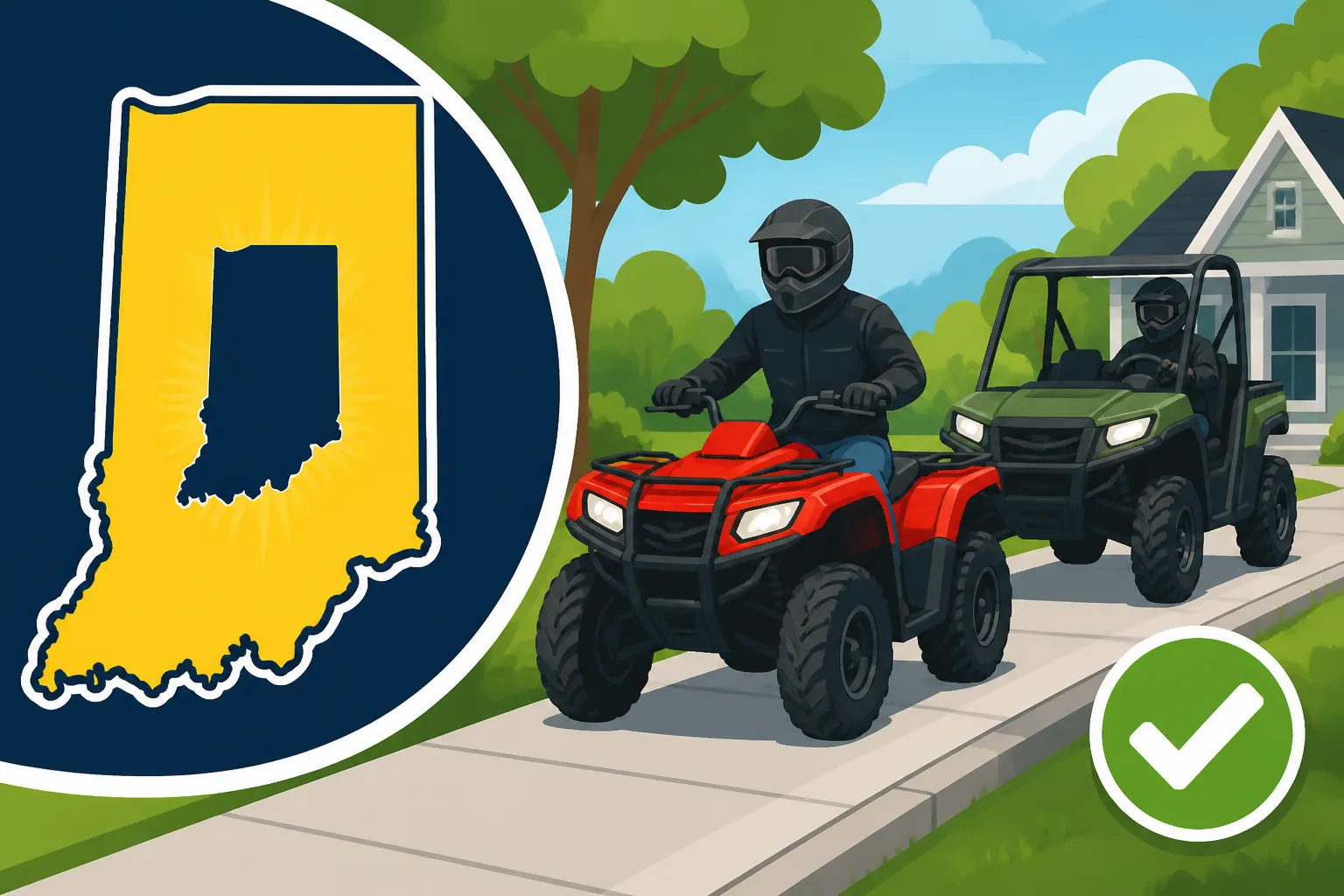
Let's cut right to the chase: in Indiana, sidewalks are overwhelmingly designated for pedestrians, and off-road vehicles (ORVs) like ATVs and UTVs are generally prohibited from using them. This isn't just a suggestion; it's rooted in state law and local ordinances designed to ensure public safety and protect infrastructure. Many riders, especially those new to the ORV scene or visiting from other states, often assume a paved path is just another surface to traverse. However, the legal definition and intended use of a sidewalk are quite clear, setting them apart from trails or designated ORV routes.
Imagine you've just installed some fantastic new upgrades from SuperATV on your side-by-side, and you're eager to test them out. Your garage is a block away from your buddy's, and the path is tempting. A quick spin down the sidewalk seems harmless, a way to avoid the main road's traffic. But this seemingly convenient shortcut is actually a violation of the rules. Sidewalks are fundamentally considered part of the public right-of-way, but they are carved out specifically for foot traffic, not motorized vehicles, particularly those designed for off-road environments.
This general prohibition is a critical piece of information for all Indiana ORV owners to understand. It means that whether you're in a bustling city like Indianapolis or a smaller town in rural Indiana, the expectation is that your ATV or UTV will stay off the pedestrian paths. You might see other small vehicles, like electric wheelchairs or very low-speed mobility scooters, on sidewalks, but these are specifically allowed due to their design and purpose, which is very different from an ORV. It's easy to look at a wide, empty sidewalk and think, "What's the harm?" but the law makes a clear distinction.
The Fundamental Prohibition Against Sidewalk Riding
The primary reason ORVs are barred from sidewalks is their classification and design. Indiana law has specific definitions for various types of vehicles, and an ORV falls into a category distinct from passenger cars, bicycles, or even golf carts that might, in very limited circumstances, be allowed on certain paths. Sidewalks are extensions of pedestrian zones, meant to provide a safe space for people walking, jogging, or using non-motorized mobility aids. Introducing a heavy, powerful, and often fast off-road vehicle into this environment instantly creates a safety hazard.
Think about the sheer weight and power of your average ATV or UTV. These machines, even smaller models, weigh hundreds of pounds and are capable of speeds far exceeding a brisk walk. Now consider a narrow sidewalk, often lined with houses, fences, and bushes, creating blind spots. The potential for a serious accident involving a pedestrian, cyclist, or even a pet is incredibly high. It’s not just about speed; it’s about the vehicle's footprint, noise, and the unexpected nature of an ORV in a space traditionally reserved for foot traffic.
Furthermore, the legal framework often treats ORVs operating on sidewalks as a clear breach of traffic regulations, even if you don't think of a sidewalk as a "road." Municipalities have local ordinances that reinforce state laws regarding pedestrian ways, making it explicit that motorized vehicles are unwelcome. This means that any quick run on a sidewalk, no matter how short or seemingly innocent, could put you at odds with local law enforcement. It's a risk that's simply not worth taking, especially when there are clear, legal alternatives for getting your machine where it needs to go, such as trailering it or using designated [Indiana Rules for Riding a County Road] if your county allows it.
Distinguishing ORVs from Other Vehicles on Pedestrian Paths
It’s easy to get confused when you see different types of conveyances on paths that look like sidewalks. You might spot a golf cart in a specific residential community, an electric bicycle on a multi-use trail, or even a utility vehicle being operated by park staff. This can lead to the assumption that your personal ATV or UTV might also be permitted. However, Indiana law makes specific distinctions that are crucial to understand. [How Indiana Defines an Off-Road Vehicle] clearly sets ORVs apart. They are designed for off-pavement use, often have aggressive tires, powerful engines, and a build that is fundamentally different from vehicles allowed on pedestrian ways.
Golf carts, for instance, sometimes have very limited allowances on certain local streets or even very specific pathways within private communities, but these allowances are highly regulated and rarely extend to general public sidewalks. The key difference lies in their design, speed, and the specific intent of their use, usually for short-distance travel within a defined, low-speed area. An ORV, on the other hand, is built for challenging terrain, high maneuverability, and substantial power, making it entirely unsuitable for a shared pedestrian space.
Even electric bicycles, which are becoming increasingly popular, typically have different classifications than ORVs and are often subject to different rules regarding path use, sometimes being allowed on multi-use trails where ORVs are not. The intent of the law is to protect the most vulnerable users of a public space. A person walking, jogging, or pushing a stroller needs to feel safe, and the presence of a 500-pound ATV or a 1,500-pound UTV, even moving slowly, fundamentally undermines that safety. This distinction means that your SuperATV-enhanced machine, while incredible on the trails, simply doesn't belong on the sidewalk.
Why ORVs and Sidewalks Don't Mix: Safety and Infrastructure Concerns
Beyond the letter of the law, there are very practical and serious reasons why ORVs are prohibited from sidewalks. These reasons boil down to fundamental issues of safety for the public and the preservation of public property. It’s not just about avoiding a ticket; it’s about preventing accidents and costly damage that impacts everyone in the community. As an ORV owner, understanding these underlying concerns can help reinforce why adherence to the rules is so important.
Imagine a beautiful, well-maintained sidewalk in a quiet residential area. Now picture a powerful UTV with aggressive, knobby tires rumbling down it. The visual alone highlights the inherent incompatibility. Sidewalks are not engineered to withstand the weight, forces, or tire types of off-road vehicles. This isn't theoretical; it's a real-world problem that can lead to significant issues for both riders and the communities they ride in.
The safety implications are perhaps the most immediate and concerning aspect. When you're on a trail, you expect other ORVs, and you're prepared for that environment. On a sidewalk, people are expecting tranquility and safety from vehicular traffic. Introducing an ORV dramatically alters that expectation and introduces unacceptable risks. This is why discussions around [Indiana Rules for Riders Under 14] or [Indiana Helmet Law for ORV Riders] often focus on controlled environments; sidewalks are anything but controlled for ORV operation.
Safety Risks to Pedestrians
The most significant concern with ORVs on sidewalks is the immense safety risk they pose to pedestrians. Sidewalks are narrow, often winding through residential areas with blind corners, driveways, and landscaping that can obstruct views. Pedestrians, including children, the elderly, and those with disabilities, rely on these paths for safe passage, expecting only foot traffic or slow-moving, non-threatening mobility devices. An ORV, with its size, weight, speed capabilities, and noise, shatters this expectation and creates an extremely dangerous situation.
Consider a common scenario: a child playing in their front yard suddenly darts onto the sidewalk to retrieve a ball, or an elderly person steps out from behind a large hedge. An ORV, even at a seemingly slow speed, has a much longer braking distance and less immediate maneuverability than a person on foot or even a bicycle. The sheer mass of an ATV or UTV, especially one equipped with heavy-duty accessories or aggressive tires like those from SuperATV, means that any impact could be catastrophic. The sudden appearance and noise of an ORV can also startle pedestrians, leading them to react unpredictably, which can further increase the risk of an accident.
Furthermore, many ORVs, particularly those with modified exhausts, can be quite loud. This noise can be startling and disorienting for pedestrians, masking other sounds and preventing them from hearing the vehicle approaching. This is especially problematic for individuals with hearing impairments or those using headphones. The entire design and operational characteristics of an ORV are simply incompatible with the inherent safety requirements of a pedestrian zone, making their presence a direct threat to public well-being. This is why, when discussing legal places to ride, the focus is always on designated areas like [Redbird Off-Road State Recreation Area] or [Interlake Off-Road State Recreation Area], not urban pedestrian paths.
Damage to Public Infrastructure
Beyond the immediate safety concerns, operating an ORV on a sidewalk can inflict significant and costly damage to public infrastructure. Sidewalks, bicycle paths, and paved trails are engineered for pedestrian loads and sometimes light vehicle loads, not for the concentrated weight, powerful torque, and aggressive tire treads of off-road vehicles. The consequences of this mismatch can be severe and expensive for local municipalities and taxpayers.
The average ATV or UTV can weigh anywhere from several hundred pounds to over 2,000 pounds, and that weight is often distributed unevenly across knobby, high-traction tires. These tires, designed to grip dirt, mud, and rocks, are incredibly destructive to paved surfaces. Driving an ORV repeatedly, or even just once, over concrete or asphalt sidewalks can cause:
- Cracking and Spalling: The weight and vibrations can lead to stress cracks in concrete slabs, eventually causing pieces to break off (spalling).
- Rutting and Potholes: On asphalt paths, the tires can dig into the surface, creating ruts and potholes that become trip hazards for pedestrians and cyclists.
- Damage to Edges and Curbs: The heavy weight and sharp turns can chip away at the edges of sidewalks and curbs, compromising their structural integrity.
- Subsurface Erosion: Water can seep into cracks created by ORVs, eroding the soil beneath the pavement, leading to further collapse and costly repairs.
These damages aren't just cosmetic; they create tripping hazards, make paths unsafe for wheelchairs and strollers, and ultimately require public funds to repair. What might seem like a minor convenience for an ORV rider becomes a major headache and financial burden for the community. The very features that make your machine excellent for [Indiana Trails With Mud] or [Indiana Trails With Hill Climbs] are precisely what make it detrimental to urban pedestrian infrastructure. This is a key reason why [Where Indiana Allows ORVs on Public Roads] is so strictly defined and limited, rarely encompassing sidewalks or other pedestrian-specific infrastructure.
The Exception That Proves the Rule: Limited, Specific, and Rare Scenarios
While the general rule is a resounding "no" to ORVs on sidewalks, it's worth briefly touching on the extremely rare and specific circumstances where a motorized vehicle might be seen on a path that resembles a sidewalk. It’s crucial to understand that these situations are almost universally tied to private property or official government use and do not, under any normal circumstances, extend to the average ORV enthusiast riding on public sidewalks. These are not "loopholes" for you to exploit, but rather specific carve-outs for highly controlled environments.
It's common for ORV owners to hear about an exception to a rule and latch onto it, hoping it applies to their situation. However, when it comes to sidewalks, the exceptions are so narrow and context-specific that they almost certainly won't apply to your recreational riding. The intent behind these limited exceptions is never to enable general public access for ORVs on pedestrian paths.
For instance, you might encounter a situation on a very large farm or a private industrial complex where there are paved pathways. These might look exactly like municipal sidewalks. If the private landowner explicitly permits ORV use on their private paths, that is a completely different scenario from a public sidewalk. This highlights the importance of understanding [Indiana Landowner Permission Requirements] – if it's not your land and you don't have explicit permission, you're likely trespassing and violating ORV usage rules.
Private Property and Designated Use
The most common "exception" people might misinterpret is when ORVs are used on private property that happens to have paved paths or "sidewalks" within its boundaries. For example, a sprawling farm might have paved lanes or concrete paths connecting barns or various sections of the property. If the landowner has given you explicit permission to ride your ORV on their land, including these private paths, then it's generally permissible. However, this is fundamentally different from a public sidewalk in a town or city.
On private property, the owner sets the rules, as long as they don't violate broader state or federal laws. So, if your friend owns a massive estate with intricate paved trails, and they say you can ride your UTV, including your SuperATV-equipped machine, on those trails, then you're usually in the clear. But the moment those private paths connect to or become a public sidewalk, the rules change immediately. Your permission from a private landowner does not supersede public ordinances or state laws regarding public rights-of-way.
It's a critical distinction that often trips people up. Just because a path is paved doesn't make it a public sidewalk that all rules apply to uniformly. Always verify if the land is public or private, and if private, ensure you have explicit, written permission from the landowner for ORV use. Without that, you could be facing not only ORV violations but also trespass charges. Remember, [Indiana Rules for Riding Private Land] hinge entirely on permission and understanding the boundaries.
Emergency or Official Use Scenarios
Another set of scenarios where you might see an ORV on a path resembling a sidewalk involves emergency services, utility workers, or authorized government personnel. For example, a police officer on patrol might use an ATV in a park or on a path to respond to an emergency, or a utility worker might need to access a difficult-to-reach area to repair infrastructure. These are specific, authorized uses that are exempt from general ORV prohibitions.
These machines are often part of a [Government Machines on the Indiana Exempt List] and are operated by trained individuals for official duties. They are not recreational rides. A conservation officer patrolling a state recreation area might use an ORV on paths that pedestrians also use, but they are doing so under specific authorization and for law enforcement purposes. The rules and exemptions for these situations are not applicable to the general public looking for a convenient shortcut.
It's important not to see these rare instances as a precedent for personal use. They are highly regulated and specific to the function being performed. Your personal decision to ride your ATV down a public sidewalk for convenience, even if you see a park ranger doing something similar in a park, is not protected by these official use exemptions and will likely result in a citation.
Consequences of Ignoring Sidewalk Rules
Alright, so we've established that riding your ATV or UTV on an Indiana sidewalk is generally a no-go. But what actually happens if you decide to disregard these rules? It's not just a minor slap on the wrist. The consequences can range from significant fines to potential legal liabilities that could seriously impact your wallet, your insurance, and your ability to enjoy your ORV in the future. Nobody wants their fun outing to end with an expensive and avoidable interaction with law enforcement.
Many ORV owners are focused on the exciting aspects of their machines – the power, the off-road capability, the customizations from SuperATV. They might not give much thought to the legal repercussions of operating outside designated areas. However, ignorance of the law is rarely an excuse, and law enforcement in Indiana takes ORV regulations seriously, especially when public safety is at stake.
The potential penalties should be a strong deterrent. Beyond the immediate financial hit, there's the stress, the time spent dealing with legal processes, and the potential for a tarnished record. It's a reminder that responsible ORV ownership extends to understanding and respecting the rules of the road – or, in this case, the rules of the sidewalk. [Indiana Fines for Illegal ORV Road Use] gives you a sense of how seriously the state takes these infractions.
Fines and Legal Penalties
If you're caught operating an ORV on a public sidewalk in Indiana, you're likely facing a citation for a Class C ORV infraction. This isn't a parking ticket; it carries a significant monetary penalty. [What a Class C ORV Infraction Costs in Indiana] can be hundreds of dollars, and that's just for the initial violation. The exact amount can vary depending on the local ordinance, the county, and the discretion of the officer. But it's rarely a cheap lesson.
Beyond the initial fine, you could face additional charges depending on the circumstances:
- Property Damage: If your ORV causes damage to the sidewalk itself, landscaping, or private property (like a mailbox or sprinkler head), you could be held liable for the repair costs, potentially facing civil lawsuits in addition to fines.
- Reckless Endangerment: If your riding behavior is deemed particularly dangerous or puts pedestrians at extreme risk, you could face more serious charges, escalating beyond a simple infraction.
- Operating an Unregistered ORV: If your machine isn't properly registered with the state, that's an additional separate violation, incurring further fines. [Indiana Fines for an Unregistered ORV] are separate and stackable.
- Machine Impoundment: In some cases, law enforcement has the authority to impound your ORV, adding towing and storage fees to your growing bill before you can even get it back.
Imagine trying to explain to your family why your weekend ride turned into a multi-hundred-dollar fine, plus potential costs for property damage and getting your machine out of impound. It quickly overshadows any perceived convenience of a sidewalk shortcut. The legal system isn't designed to be lenient on behaviors that endanger public safety and damage public property.
Owner Liability and Insurance Implications
One of the most overlooked, yet potentially devastating, consequences of riding an ORV on a sidewalk is the issue of owner liability and its impact on your insurance. In Indiana, [Why an Indiana Owner Is Liable] for their vehicle's operation is a serious consideration. If you are operating your ORV illegally on a sidewalk and an accident occurs, you, as the owner and operator, are almost certainly going to be held responsible for any damages or injuries that result.
Let's consider a worst-case scenario: you're riding your UTV on a sidewalk, and a child, unseen, runs out from behind a parked car or a bush. Even if you're going slowly, the sheer mass of an ORV makes a collision devastating. You could be facing massive medical bills for the injured party, pain and suffering damages, and potentially a lawsuit that could drain your finances for years.
This is where your insurance comes into play, or rather, where it might not. Most standard ORV insurance policies have clauses that exclude coverage for incidents occurring while the vehicle is being operated illegally. Riding on a sidewalk, which is typically a prohibited area for ORVs, would very likely fall under such an exclusion. This means your insurance company could deny any claims, leaving you personally responsible for all damages, medical costs, and legal fees.
While Indiana does not mandate ORV insurance for all riding scenarios, certain county ordinances that allow limited road use might require it, as highlighted in [Indiana ORV Insurance Requirements]. However, even if you have a policy, operating outside the bounds of the law, such as on a sidewalk, puts you at significant financial risk. The cost savings of a "shortcut" are minuscule compared to the potential millions in liability. It’s simply not worth gambling with your financial future and the safety of others for a brief, illegal ride.
Indiana ORV Use: Allowed vs. Prohibited Zones
To help clarify where you can and cannot ride your ORV in Indiana, here's a general overview. This table is not exhaustive but highlights common scenarios.
| Category | Generally Allowed (with proper registration/permits) | Generally Prohibited |
|---|---|---|
| Public Paths | Designated ORV trails (e.g., Redbird, Interlake State Recreation Areas) | Sidewalks, bicycle paths, pedestrian-only trails, rail trails |
| Public Roads | Specific county roads if designated by local ordinance (check local county rules) | State highways, interstate highways, most public roads by default |
| Private Land | Your own property, or private property with explicit landowner permission | Private property without permission (trespassing) |
| Other Public Lands | State Forests (limited designated areas), Fish & Wildlife Areas (very limited access) | State Parks (unless specifically designated for ORVs), Hoosier National Forest |
Disclaimer
This article is for general informational purposes only and does not constitute professional advice. Laws, prices and regulations vary by location and change over time. Consult a qualified professional for guidance on your specific situation.