Indiana Rules for a Full-Size Rig on a Trail
A full-size 4×4 can look trail-ready, but that does not mean every Indiana ORV trail is open to it. Access, permits, vehicle limits and operator rules depend on the property and route. Here’s how to check whether your rig is allowed, what paperwork to confirm and what to do before unloading.
First check whether the trail allows your vehicle
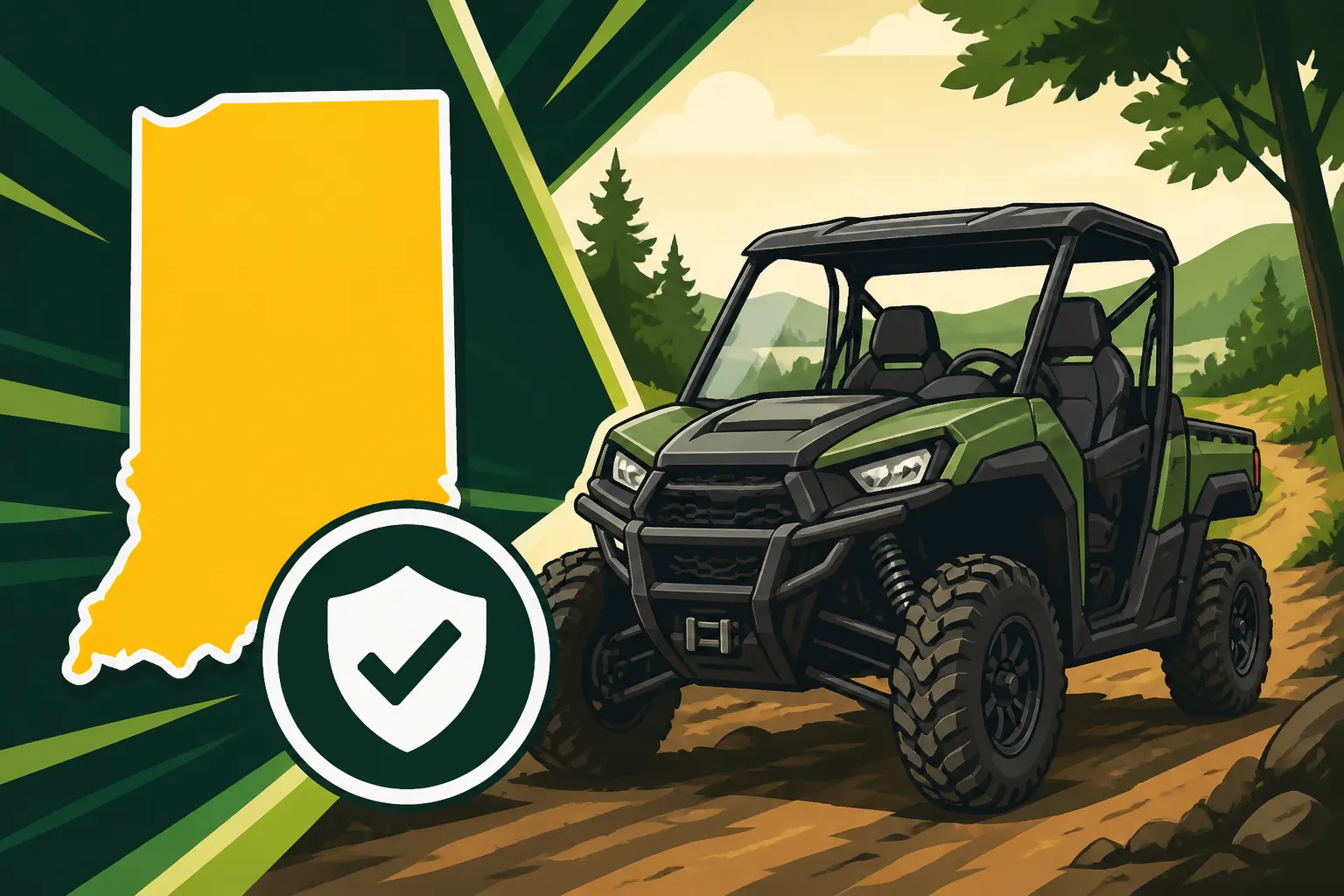
“Full-size rig” usually means a truck, Jeep or other full-size four-wheel-drive vehicle, not a side-by-side. That distinction matters: a trail or permit intended for ATVs and UTVs does not automatically cover larger vehicles. Nor does a street-legal registration give a truck permission to leave public roads and drive on a trail.
Indiana does not have one statewide rule that opens every off-road route to every kind of vehicle. Access is controlled by the land manager and the rules for the particular property. A marked trail may be limited by vehicle type, width, weight or other conditions. A route shown on a map may also be closed temporarily or restricted to certain users.
Before planning a trip, identify the exact riding area and the route you want to use. Check the current map and posted notices, then ask the park office if the material does not clearly say that full-size vehicles are allowed. State recreation areas, private parks and other properties can have different rules. Do not rely on a friend’s past visit or assume that a trail suitable for a side-by-side can handle a truck.
Ask the land manager these questions:
- Are full-size trucks or Jeeps allowed on this property?
- Which specific trails or routes are open to them?
- Are there limits on vehicle width, weight, length or equipment?
- Does this vehicle need a separate trail permit, or does a different pass apply?
- Are there current closures, weather restrictions or seasonal limits?
- What are the age, license and supervision requirements for its operator?
These questions help prevent a common mix-up: permission to enter a property is not necessarily permission to drive every route on it. A gate pass or entrance payment may cover access to the recreation area without authorizing a full-size vehicle on an ATV-only trail. If the answer is unclear, stay on an approved route until staff confirms otherwise.
For a general explanation of permits at Indiana riding areas, see Do You Need a Permit for Indiana ORV Trails?. Rules for a particular park can add restrictions beyond the general permit requirement, so check both. Before you leave, review Indiana Trail Closures to Check and confirm the property’s current hours through its official information.
Sort out permits, registration and entry fees
A full-size vehicle may need more than one kind of authorization, and the terms can be confusing. A vehicle’s road registration, an off-road trail permit and an entrance fee do different jobs. One should not be treated as a substitute for another.
A street-registered truck or Jeep may be legal to drive on public roads, but that does not establish that it is permitted on a particular trail. Likewise, an ORV trail permit does not make a vehicle street legal. Trail access depends on the property’s rules, while road use depends on the vehicle’s legal status and the rules for the road.
Indiana’s daily and annual trail permits are associated with riding at designated state ORV areas. Whether a specific full-size truck or Jeep needs one, and whether that vehicle is accepted on the relevant trails, should be confirmed with the property before purchase. Don’t infer eligibility from a permit description written mainly for ATVs, dirt bikes or UTVs. For more background, see Indiana’s Daily and Annual Trail Permits and Where to Buy an Indiana ORV Permit.
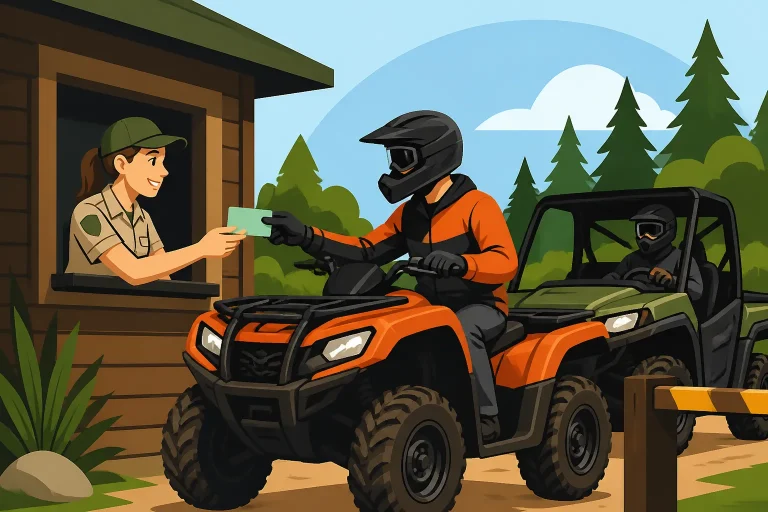
An entrance fee may be separate from a trail permit. Paying to enter a park does not necessarily pay for trail use, and holding an annual trail permit does not necessarily cover every entrance charge. Confirm both requirements for the property and the vehicle. The same principle applies at private parks: their passes, waivers and vehicle rules are set by the operator, not by a state ORV permit.
| Item | What it generally covers | What it does not prove |
|---|---|---|
| Road registration | Permission to use public roads, subject to applicable road rules | Permission to drive on a trail |
| Trail permit | Trail use where the permit applies and the vehicle is eligible | Access to every route or park |
| Entrance fee | Entry to a property under its admission rules | Permission to use a restricted trail |
| Park waiver or check-in | A required step under that property’s rules | That the vehicle meets all trail restrictions |
If you need to buy a permit, check the official seller or park instructions for the current process and requirements. Keep proof of purchase accessible, and ask whether it must be displayed on the vehicle or shown at the gate. Avoid buying a pass for an ATV or UTV and assuming it applies to a full-size rig unless the seller or land manager confirms that it does.
Check the operator and equipment rules before unloading
Even when a trail allows full-size vehicles, the driver must meet the applicable operator requirements. Do not assume that rules for a small ORV automatically transfer to a full-size truck or Jeep. The property may set age, license, supervision or passenger requirements specifically for full-size vehicles. Ask about those rules before bringing a young driver or passenger. See Indiana Rules for a Full-Size Vehicle Operator for related operator questions.
Seat belts are another important distinction. A full-size vehicle generally has belts and seating designed for occupants, while an ATV does not. Follow the vehicle’s required occupant restraints and the property’s rules. If children will ride along, confirm that each passenger can use an appropriate seat and restraint; never carry more people than the vehicle is designed to hold. Indiana’s public-land rules may also have specific requirements, so review Indiana Helmet and Seat Belt Rules on Public Land.
The route itself matters as much as the vehicle. A full-size rig can damage a narrow trail, get stuck in a section built for smaller machines or block access for other users. Stay on routes specifically approved for your vehicle. Do not drive around a barrier, pass a closure sign or make a new route through vegetation to avoid an obstacle. For more on trail boundaries, see [Indiana Rules for Riding Off the Trail].
Before the trip, inspect the machine and its recovery equipment. A vehicle that fits the trail on paper may still be a poor choice if it is too wide for the route, has inadequate clearance or cannot be recovered safely. Check tires, steering, brakes, lights, fluids and recovery points. Carry a first-aid kit, basic tools, water and a way to communicate if service is unreliable. Use recovery gear only when it can be used safely and without damaging the trail or putting bystanders at risk.
A practical pre-trip sequence is:
- Name the exact property and route. Do not plan around a general description such as “ORV trails in Indiana.”
- Confirm full-size access. Get a clear answer from the land manager for your truck or Jeep, not just for “ORVs” in general.
- Ask about vehicle limits. Check width, weight, length, equipment and any route-specific restrictions.
- Confirm permits and fees. Ask whether the rig needs a trail permit, an entrance payment or another pass.
- Check operator and passenger rules. Confirm age, license, supervision and restraint requirements.
- Check for closures and conditions. Mud, storms, maintenance or seasonal restrictions can change which routes are usable.
- Follow signs on site. If a posted notice conflicts with an old map or general information, stop and ask staff before proceeding.
For an organized outing or a group ride, make sure every driver understands the route restrictions. One vehicle being eligible does not mean every vehicle in the group is. A full-size rig might be allowed on one route while an ATV or UTV in the same group follows a different set of approved trails.
If your planned route is not clearly open to full-size vehicles, choose a property that confirms access rather than testing the rule at the trailhead. That simple check can save a wasted trip, avoid a citation and help protect trails that were not built for larger vehicles.
Disclaimer
This article is for general informational purposes only and does not constitute professional advice. Laws, prices and regulations vary by location and change over time. Consult a qualified professional for guidance on your specific situation.