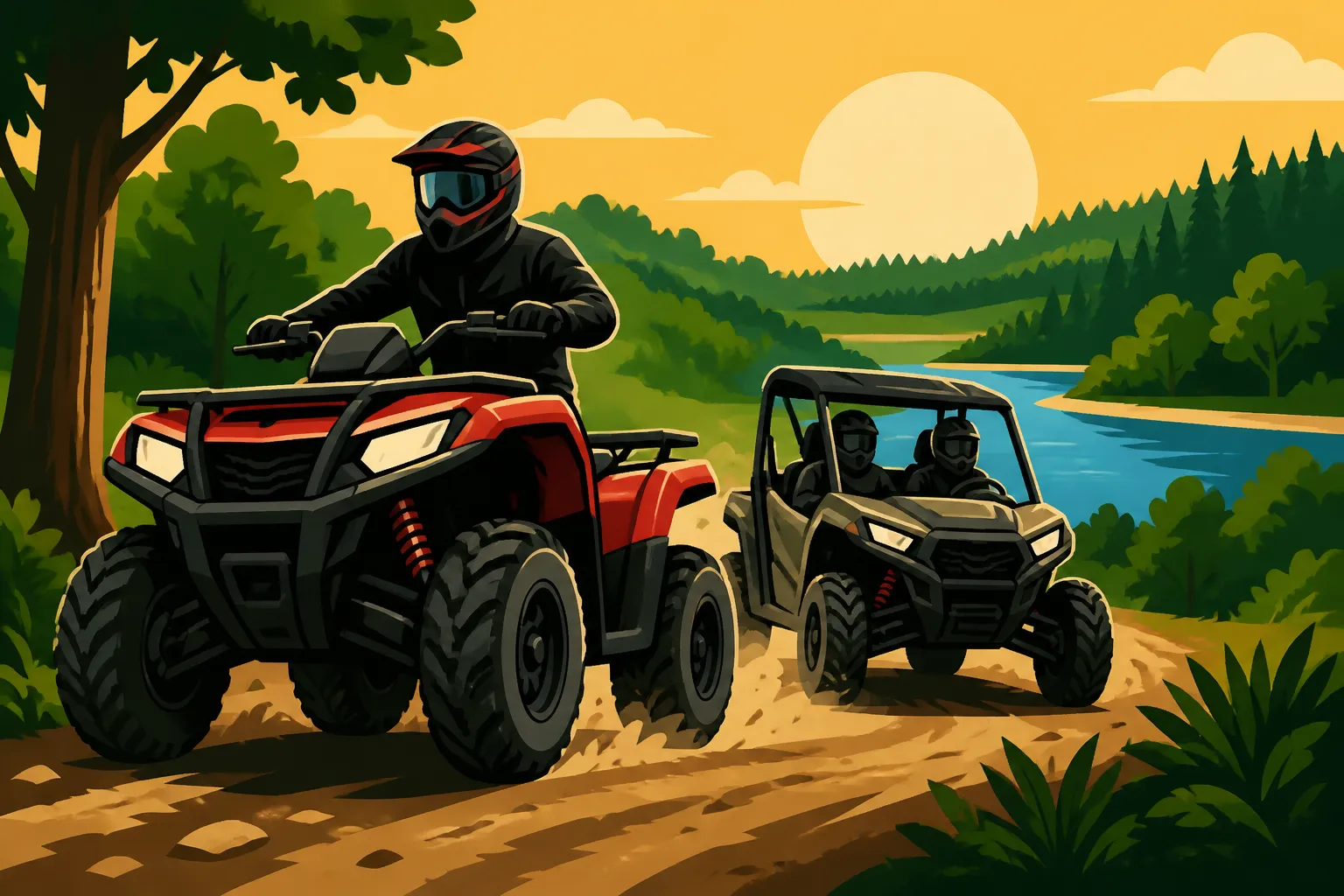
Indiana Riding Near a State Park
A state park can look like the perfect base for an Indiana ATV or UTV weekend, but nearby does not mean open to riding. State park trails and roads may be off-limits to off-road machines, even when a legal riding area is only a short drive away. This guide explains how to tell the difference, find nearby places to ride, and plan a trip without an unwanted gate-side surprise.
Can You Ride an ATV or UTV Inside an Indiana State Park
The first thing to check is whether you mean riding in a state park or riding near one. Indiana has established off-road riding areas, but you should not assume that a state park’s hiking trails, campground roads, or access roads are open to ATVs or UTVs. Riding permission depends on the specific property and the routes it designates.
State parks are not automatically ORV parks
A trail on a map can look inviting and still be closed to motorized use. State parks may have hiking, horseback, biking, or maintenance routes that are not available to recreational off-road vehicles. Even a wide gravel lane can be off-limits unless the property’s rules specifically allow your machine there.
That distinction is easy to miss when you are planning from home. A rider might see a campground, a wooded trail network, and a nearby road and picture unloading the ATV right at the campsite. But a place that welcomes camping or mountain biking is not necessarily a place where you can ride a quad or side-by-side. Check the park’s official rules and map before bringing your machine onto the property. [Indiana Rules for Riding in a State Park] offers more detail on that boundary.
Nearby riding does not mean riding between properties
“Near a state park” usually means using the park for a separate activity and trailering your machine to a designated riding area. It does not generally mean that you can ride from a state park campground to a nearby ORV park by taking public roads, shoulders, or informal trails.
For example, if you stay near Turkey Run State Park and plan a ride at a private off-road park, treat them as separate destinations. Keep the ATV or UTV on its trailer between them unless you have confirmed that every part of a proposed route is legally open to your vehicle. [Where Indiana Allows ORVs on Public Roads] explains why a road that looks convenient may not be a legal connector.
A useful starting point is [Where to Ride an ORV in Indiana], which helps distinguish designated riding areas from places that are simply scenic or close to a state park.
Check the rules for the exact property and route
Do not rely only on a general travel listing, a social media post, or a map pin. Look for the current rules published by the land manager or park operator. Confirm the property name, permitted vehicle types, open areas, hours, seasonal closures, and any required permits or entrance fees.
When two properties sit close together, their rules can be very different. A state recreation area may have designated ORV trails, while a nearby state park may prohibit recreational machine use on its trails. A private park may set its own requirements, including waivers or separate access rules. Make a short list of the places you will actually enter, then verify each one independently.
Indiana Riding Areas to Consider Near a State Park
Indiana’s two state ORV areas are useful starting points for a trip that combines off-road riding with a visit to a nearby park or town. They are not interchangeable, and they are not the same thing as an ordinary state park. Check the official property information before you travel so you know which gate, rules, permits, and vehicle requirements apply.
Redbird near Dugger
Redbird Off-Road State Recreation Area is in the Dugger area of Sullivan County. It is a designated motorized riding destination, unlike a typical state park trail system. Riders planning a visit should check the current trail information, permitted vehicle rules, hours, and access requirements before loading up.
Redbird can make sense for a southern Indiana weekend built around riding, local camping, or a visit to another nearby destination. But don’t plan on riding your machine from the park to a state park, nearby town, or lodging unless you have confirmed that the connecting route is legal for your specific vehicle. Trailering is often the practical answer, even when the places look close on a regional map. See [Redbird Off-Road State Recreation Area] for a focused overview.
Interlake near Lynnville
Interlake Off-Road State Recreation Area is near Lynnville, across Pike and Warrick counties. Its designated riding setting is distinct from the surrounding countryside and from nearby public lands that may not permit off-road riding. Before you go, check the site’s current access information and trail notices rather than assuming a trail shown in an app is open.
Interlake may suit riders who want to make a full day or weekend of riding and build other local stops around it. If you are staying at a state park or campground elsewhere, plan the machine transport separately. A short drive on a map can still involve public roads where an off-road machine may not be allowed. [Interlake Off-Road State Recreation Area] and [Indiana's Two State ORV Areas Compared] can help you compare these destinations.
Private parks near state-park destinations
Indiana also has private off-road parks. A private park may be a practical option when a state park is the lodging or sightseeing base for your trip, but the two properties remain separate places with separate rules. Verify the private park’s operating schedule, fees, waiver requirements, permitted machine types, and trail conditions directly before setting out.
Badlands Off Road Park near Attica is one example of a private destination riders may consider when visiting the region around Turkey Run. Haspin Acres near Laurel is another private riding option in southeastern Indiana. Neither example means the nearby state park allows ORV riding; they are separate destinations, and the machine should be transported between them unless a legal route has been confirmed. For more options, see [Indiana's Private Off-Road Parks].
| Trip plan | What to confirm | Practical approach |
|---|---|---|
| Stay at a state park and ride elsewhere | State park rules, the ORV park’s access rules, and transport route | Keep the machine trailered between properties |
| Visit a state ORV area | Current hours, trails, vehicle rules, permits, and entrance requirements | Check the property’s official information before leaving |
| Visit a private off-road park | Operating schedule, fees, waiver, machine eligibility, and trail conditions | Contact or check the operator’s information directly |
| Follow a mapped route between destinations | Whether every road or trail segment is legally open to your machine | Do not treat a map line as permission to ride |
How to Plan a State Park and ORV Weekend
A little advance planning saves the most frustration at the trailhead. The key is to plan the lodging, riding destination, and travel between them as separate parts of the trip.
Choose the riding area before booking the overnight stay
Start with the place where you will actually ride, then look for suitable lodging and other activities nearby. If you book a state park cabin or campsite first because it looks close to a trail on a map, you may later discover that the “trail” is not open to ORVs or that you need to trailer a longer distance than expected.
Make a simple itinerary with the riding property’s name, its entrance location, where you will park or unload, and how you will reach it from your overnight stop. This matters especially for a family trip: a scenic state park can be a great place to hike or camp, but the riding day may still require a separate drive and trailer setup.
Mapping tools can help with the logistics. I use onX Offroad as a planning aid to get a sense of distances and nearby routes, but I treat the map as a starting point—not proof that riding is allowed. A drawn route does not replace the land manager’s rules or a current road-use designation.
Check permits, fees, and vehicle requirements
A common planning mistake is assuming that the machine’s registration is the only paperwork or payment needed. A riding area may have its own permit, entrance charge, or other property-specific requirement. Those are separate questions from whether the vehicle is registered or otherwise compliant for its intended use.
Before departing, confirm what applies to each machine in your group. If you are taking both an ATV and a UTV, do not assume one permit or one set of rules automatically covers both. Check the destination’s official instructions and keep any required documents accessible. [Indiana's Daily and Annual Trail Permits] explains trail-permit considerations, and [Indiana Trail Maps From the DNR] is a helpful starting point for official mapping information.
Verify trail conditions and closures shortly before travel
Indiana weather can change the character of a ride quickly. Rain can make clay and reclaimed mine terrain slick, while a dry stretch can mean dust, loose ground, or rougher ruts. A route that worked well on a previous visit may be closed or less suitable on the day you plan to go.
Check the riding area’s notices close to your departure, especially after heavy rain or during a season when closures are possible. If you are traveling several hours, it is worth confirming that the property is open before you load. [Indiana Trail Conditions Before You Ride] and [Indiana Trail Closures to Check] cover the sort of last-minute checks that can save a wasted drive.
I also use onX Offroad to get a broader sense of the area and help organize a route plan, then compare that plan with the official property information. If the app’s map and the park’s posted rules seem to disagree, follow the land manager’s instructions and ask the park for clarification.
Maps, Routes, and Legal Access
The map you use to plan a trip can be helpful without being authoritative. Different maps show different things: a trail line, a public road, a property boundary, or a route suggested by another user. None of those details automatically establishes that your ATV or UTV may travel there.
Separate navigation from permission
Use maps to answer practical questions: How far is the riding area from the campground? Where is the entrance? Is there a fuel stop along the drive? How much time should you allow for towing? Then verify permission separately with the organization responsible for the property or road.
onX Offroad can be useful for visualizing your trip and checking the surrounding area, but a route displayed in a mapping app should not be treated as authorization to ride. Roads may have restrictions, private land may be involved, and a line on a screen may not reflect a temporary closure. Save the official contact details for the riding property so you can ask about anything unclear.
Avoid making your own connector trail
A tempting shortcut can become a trespass or road-use problem. Do not cut across a field, follow a utility corridor, use a trail that appears to connect two public properties, or ride along a road shoulder just because it seems like the easiest way to avoid reloading the trailer. Confirm access and vehicle eligibility first.
This is particularly important around state parks, where a boundary may meet private land, a county road, or another public property with different restrictions. If the route crosses a public road, confirm whether your specific machine is allowed on that road and whether the local rules permit the trip. [Indiana Rules for Riding a County Road] and [Indiana Rules for Riding a Highway Shoulder] explain why these details matter.
Keep a backup plan
Have a second activity ready in case the trail area is closed, muddy, or unsuitable for your group. That might be a hike at the state park, a visit to a nearby town, or a change to another riding day. A backup plan is especially useful when traveling with children or riders who are new to the area; no one wants the whole weekend to depend on a single gate being open.
If camping is part of the plan, confirm whether the campground accommodates your vehicle and trailer, and whether overnight parking or unloading is permitted. Some riders find it easier to camp near the riding destination and visit a state park as a separate outing. Others prefer a state park stay and accept the extra towing. [Camping Near Indiana ORV Trails] offers more planning ideas for a ride-focused overnight trip.
A Practical Checklist Before You Leave
Before loading, write down the name of the riding property, its address or entrance location, and the number to call if you need to confirm access. Check the current operating information, trail notices, vehicle rules, and any required permit or entrance payment. If the trip includes a state park, confirm its rules separately rather than assuming that nearby ORV access extends onto park trails.
Also check the towing basics: trailer capacity, tie-downs, fuel, and enough room to unload safely at the destination. Keep registration documents and any required riding permits available, and make sure each rider understands where the machine may be used. If you have planned a route on onX Offroad or another map, compare it with official property and road information before treating it as rideable.
The simplest way to avoid confusion is to think in three separate questions: Where will we sleep? Where are we legally allowed to ride? How will we transport the machine between those places? When those answers are clear, a state park and ORV weekend can fit together smoothly without mistaking proximity for permission.
Disclaimer
This article is for general informational purposes only and does not constitute professional advice. Laws, prices and regulations vary by location and change over time. Consult a qualified professional for guidance on your specific situation.