Filing an Ownership Affidavit for a Quad With No Paperwork
It's a familiar scenario for many Indiana off-road enthusiasts: you've finally gotten your hands on that awesome ATV or UTV, perhaps a great deal from a private seller, or maybe it's been passed down through the family. The only problem? The paperwork is nowhere to be found. No title, maybe just a scribbled receipt, or worse, nothing at all. This situation can feel like a huge roadblock to getting your machine legal and out on the trails. This guide is here to walk you through the process of filing an ownership affidavit with the Indiana Bureau of Motor Vehicles (BMV), so you can navigate this challenge with confidence and get your off-road vehicle properly registered and titled.
The Frustration of Missing Paperwork: Why It Happens
We've all been there, or know someone who has. You’re excited about your new-to-you off-road vehicle, only to find yourself staring at a pile of nothing where the title should be. It’s incredibly frustrating and can make you feel like you’ve hit a brick wall. But take a deep breath; you're not alone, and there's a path forward.
Common Scenarios for Lost or Absent Documents
There are many reasons why an ORV might not come with a clear title or a proper bill of sale. It’s not always a sign of something shady; often, it’s just life getting in the way or a lack of understanding of the rules.
When you purchase a machine privately, especially if it’s an older model, the seller might not have taken the time to title it themselves. Perhaps they bought it from someone else with no paperwork, and the cycle continued. Sometimes, a quick handshake and a cash transaction feel sufficient at the moment, but later, when you head to the BMV, you realize the mistake. A hastily written "bill of sale" on a napkin, if it exists at all, won't cut it. This is why having a robust [An Indiana Bill of Sale for an ORV] is so crucial, even for private sales.
Another very common scenario is inheriting an ORV. Grandpa had this old quad out in the barn for years, and now it's yours. He rode it on the farm, never bothered with a title or registration, and now that you want to take it to Redbird or Interlake, you realize you have no official proof of ownership. The machine has a great sentimental value, but the official chain of custody is a mystery. For older machines, remember that Indiana's titling requirements changed significantly around 2009. If your machine was bought new after December 31, 2009, it absolutely requires a title. If it was purchased before that date, it's considered "title-optional," meaning a title wasn't initially required, but you still need a solid chain of ownership to register it today. This distinction is often misunderstood and can be a source of confusion, tying into why [Why Indiana Titles Machines Bought After 2009] is such an important cutoff point and why [Why a 2009 Purchase Date Splits Indiana Owners] can make things complicated.
The Importance of a Clear Chain of Ownership
You might wonder why the BMV cares so much about this paperwork. It's not just to make your life difficult, I promise! The state needs to ensure that the person registering and titling a vehicle is its rightful owner. This protects both you and the state from fraud, theft, and disputes down the line. Without a clear chain of ownership, proving the machine is legally yours can become a real headache, especially if it ever needs to be transferred, sold, or if there's an issue with a stolen vehicle. The BMV needs to connect the machine's unique identifier—its Vehicle Identification Number (VIN) or serial number—to a specific owner. You want to avoid a situation where you've invested time and money in registering a machine only to find out later that someone else has a legitimate claim to it. This is also why [Titling an ORV in Indiana] is such a critical step for new machines or those recently changing hands.
Understanding the Indiana Ownership Affidavit (Form 55584)
When you're facing the problem of no paperwork, Indiana's Ownership Affidavit, officially known as Form 55584, becomes your best friend. It’s designed precisely for these kinds of situations, offering a pathway to establish ownership when traditional documents are absent.
What Is an Ownership Affidavit and When Do You Need It?
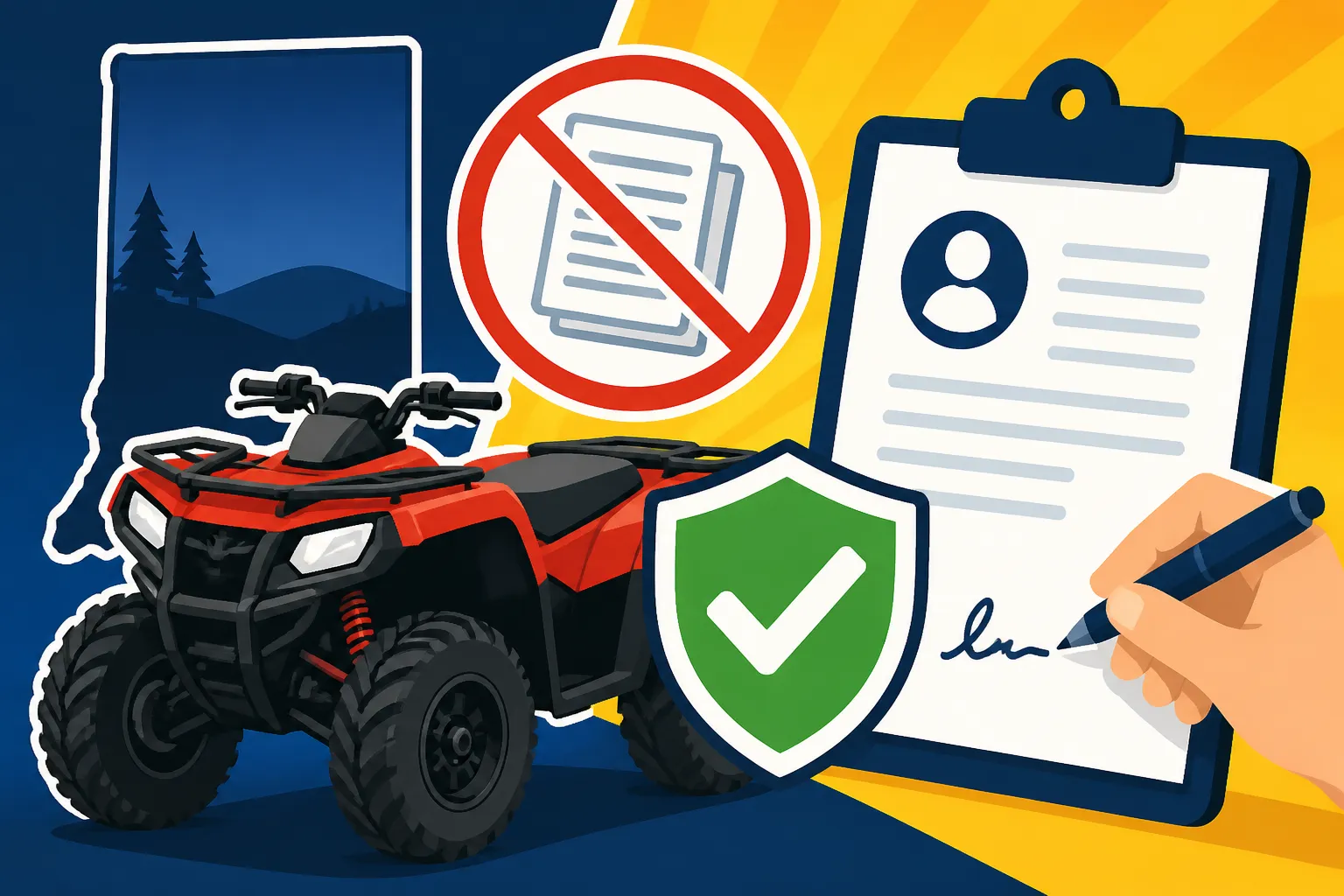
An Ownership Affidavit (State Form 55584) is a legal document where you, as the claimant, declare under penalty of perjury that you are the rightful owner of a specific vehicle or ORV. It's your sworn statement, backed by any supporting evidence you can provide, that you legally possess the machine and why you don't have a traditional title or bill of sale. You typically need this form when:
- You purchased an ORV from a private seller and received no title and/or an inadequate bill of sale. Maybe the seller didn't have the title, or the bill of sale was missing crucial information like the VIN or a clear purchase price.
- You inherited an ORV and the deceased owner never had a title or the title cannot be located.
- You found an abandoned ORV and followed the legal process to claim it (though this is a rarer and more complex scenario).
- You’ve owned the machine for a long time and never titled or registered it, and now you want to, but the original paperwork is gone.
This affidavit isn't exclusively for ORVs; it's used for various types of vehicles when the standard titling process is hindered by missing documents. However, for our purposes, it’s the key to getting your quad or side-by-side squared away. The core idea is to put into writing, officially, everything you know about how you came to own the machine, leaving no stone unturned for the BMV. The BMV wants to understand your unique story.
Key Information the Affidavit Requires
Form 55584 asks for specific details to help the BMV understand your claim. It’s comprehensive for a reason, aiming to cover all bases and ensure a clear understanding of your situation. [What Indiana's Ownership Affidavit Asks For] is very direct.
First, you'll need to provide your personal information: your full name, address, and contact details. This establishes who is making the claim.
Next, you'll detail the off-road vehicle itself. This is where accuracy is paramount. You'll need the ORV's make, model, year, and crucially, its Vehicle Identification Number (VIN) or serial number. Finding this number can sometimes be a challenge on older machines, but it's absolutely essential. This unique identifier is how the BMV tracks the vehicle's history and prevents duplicate claims. For specific guidance, see [Indiana ORV Serial Number Requirements]. If your machine doesn't have a legible VIN, that’s another hurdle, but one that can sometimes be addressed by applying for a Special Identification Number.
Then comes the narrative section. This is your chance to explain how you came into possession of the ORV. Did you buy it? Were you gifted it? Did you inherit it? Be as specific as possible, including dates, names of previous owners (if known), and any circumstances surrounding the transfer.
Finally, you must clearly state why the standard ownership documents (title, valid bill of sale) are missing. Was it lost? Was it never issued? Was the seller unable to provide it? Be honest and thorough. The BMV isn't looking to trip you up; they're looking for a complete and credible explanation. If you have any partial documentation, even if it's not a full title, this is where you mention it and attach copies.
Step-by-Step: Filing Your Ownership Affidavit in Indiana
The thought of dealing with government paperwork can be daunting, but breaking down the ownership affidavit process into manageable steps makes it much less intimidating. It's a journey, not a sprint, and gathering everything beforehand will save you a lot of time and potential headaches.
Gathering Your Supporting Evidence
This is arguably the most critical part of the entire process. The Ownership Affidavit is your sworn statement, but it carries much more weight when backed by tangible evidence. Think of it like building a case; the more proof you have, the stronger your argument.
- Bills of Sale (Even Informal Ones): Did you get any kind of receipt or written agreement when you bought the machine? Even if it's not a perfectly legal, notarized document, include it. A handwritten note with the seller's name, date, and description of the ORV is better than nothing. It shows intent and a transaction.
- Old Registration Cards, Photos, or Any Proof of Purchase: If the machine was previously registered in another state, or you have old registration cards from Indiana (even if expired), those are valuable. Photos of the machine with you or a previous owner at a specific date can also help establish a timeline. Any document that links the machine to an owner, even indirectly, is helpful.
- Affidavits from Previous Owners: If you can track down the person who sold you the ORV, or even the person they bought it from, ask them to write and sign a simple affidavit stating they sold the machine to you (or your predecessor) on a certain date. This adds significant credibility to your claim. They don't need a fancy lawyer; a simple, notarized statement from them confirming the transaction can be incredibly valuable. Tools like LawDepot can provide templates for simple affidavits or a "quitclaim bill of sale" that might be useful in these situations, offering a structured way to get those statements.
- The Role of a "Quitclaim Bill of Sale": While not as common for ORVs as a standard bill of sale, a quitclaim bill of sale is sometimes used in situations where a seller isn't entirely sure of their full ownership rights but wants to transfer whatever interest they do have. It essentially says, "I'm giving you any and all rights I might have to this item." While it doesn't guarantee a perfect title, it can be another piece of evidence showing a transfer of possession. You can often find customizable templates for various legal documents, including different types of bills of sale, through online services like LawDepot. Remember, it's about building a comprehensive picture for the BMV.
Completing and Notarizing the Affidavit
Once you've gathered all your supporting documents, it's time to tackle the affidavit itself. You can usually download State Form 55584 from the Indiana BMV website, or pick one up at any license branch.
Take your time filling out every section accurately. Double-check the VIN/serial number, make sure all dates are correct, and clearly articulate your story about how you acquired the ORV and why the paperwork is missing. Attach copies of all your supporting evidence directly to the affidavit. Make sure everything is legible.
Critically, the Ownership Affidavit must be notarized. This means you'll need to sign the document in front of a notary public, who will then verify your identity and witness your signature. Notaries are readily available at banks, credit unions, many shipping stores (like UPS stores), and some license branches. Don't sign the form until you are in front of the notary! The notary public's seal legally certifies that you are who you say you are and that you personally signed the document.
Submitting Your Application to the BMV
With your notarized affidavit and all supporting documents in hand, you’re ready to visit a local Indiana license branch. While you might handle registration renewals online, for a complex process like an ownership affidavit and initial titling, an in-person visit is usually required and highly recommended. This allows you to speak directly with a BMV representative who can review your paperwork and answer any questions. For details on where to go, check out [Where to Register an ORV in Indiana].
When you go, make sure to bring:
- Your completed and notarized State Form 55584.
- All your supporting documentation (originals and copies, just in case).
- Your valid Indiana driver's license or state ID.
- Payment for any applicable titling and registration fees.
- Proof of residency (if needed, like a utility bill).
The BMV representative will review your submission. They may ask clarifying questions. Be prepared to explain your situation clearly and concisely. If everything is in order, they will accept your application. Then comes the waiting game. The BMV will process your application, which can take some time, especially if it's a unique or complex case. Don't expect to walk out with a title on the same day. You can find more details on general processing times in [Indiana ORV Registration Processing Time].
Potential Hurdles and How to Overcome Them
While the ownership affidavit provides a clear path, the road isn't always perfectly smooth. There can be challenges, but knowing what they are and how to approach them can save you a lot of stress.
Dealing with an Unknown Previous Owner
One of the trickiest situations is when you have no idea who the previous owner was, or if the machine has passed through many hands informally. If you don't even have a bill of sale, it's tough.
Your first step should always be to thoroughly inspect the ORV for its VIN or serial number. This is crucial. If you can find it, you might be able to use it to perform a basic check to see if the machine has been reported stolen. While the BMV cannot give you personal information about previous owners, they can often tell you if there are any flags on the VIN. This is why [Checking a VIN Before an Indiana Purchase] is always recommended. Unfortunately, if the VIN comes back as stolen, you'll likely have to surrender the machine.
If the previous owner is truly unknown and you have absolutely no paper trail, the BMV might still accept your affidavit, but they will scrutinize it heavily. Your personal sworn statement becomes even more important. Be prepared to explain how you came to possess the machine in as much detail as possible, even if it's just, "I bought it from a guy in a parking lot, and he gave me no paperwork." Honesty, even about an informal transaction, is often better than trying to fabricate details.
If Your Affidavit Is Denied
It's disheartening, but sometimes an ownership affidavit application can be denied. This usually happens if the BMV finds inconsistencies in your story, if there's a competing claim on the VIN, or if they deem your supporting evidence insufficient.
If your application is denied, the BMV should provide you with a reason. Don't just give up. Understand why it was denied. Was there a specific piece of information missing? Do they believe the ORV might be stolen? Did you miss a crucial step?
Your options typically include:
- Providing more information: Can you find additional evidence? Can you track down a witness to the sale? Can you get that informal bill of sale notarized by the seller after the fact?
- Consulting legal counsel: If it's a valuable machine and the situation is complex, a lawyer specializing in property law or vehicle titles might be able to help you navigate the appeal process or suggest alternative legal avenues.
- Applying for a Special Identification Number (SIN): In some very specific cases, particularly for homebuilt machines or those where the original VIN is completely illegible or non-existent, the BMV might allow you to apply for a Special Identification Number. This is a unique number assigned by the state. This is not a common solution for every "no paperwork" scenario but can be a last resort for truly unique situations. If this sounds like your situation, you'll want to look into [Getting a Special Identification Number for a Homebuilt Quad].
The "Special ID Number" Option for Homebuilt or Very Old Machines
As mentioned, if your ORV is truly unique—perhaps it's custom-built, or so old that it never had a recognizable VIN/serial number, or the original number is entirely unreadable—you might be able to apply for a Special Identification Number (SIN) through the BMV. This is a more involved process than just filing an ownership affidavit, as it often requires an inspection by a law enforcement officer or a BMV investigator to verify the machine's origin and to ensure it's not stolen. The SIN essentially gives your machine a new, state-assigned identity, allowing it to be titled and registered. This is not a workaround for simply losing a title, but rather a solution for machines that genuinely lack a standard identifying number. It's a testament to the BMV's willingness to find a solution for unique cases, provided you can prove legitimate ownership in some other way.
Navigating the complexities of ORV ownership without proper paperwork can be tricky, but understanding the tools available, like the Ownership Affidavit, can make all the difference.
| Document Type | Purpose | When It's Used | Key Information Provided |
|---|---|---|---|
| Ownership Affidavit | Sworn statement establishing ownership when standard documents are missing. | When no title/valid bill of sale exists. | Claimant details, ORV details (VIN), explanation of acquisition. |
| Bill of Sale | Proof of transaction between buyer and seller. | Private sales, dealer sales. | Buyer/seller names, ORV description, VIN, sale price, date. |
| Title | Official document proving legal ownership. | Required for machines bought after 2009; often needed for transfer. | Owner's name, ORV description, VIN, lienholder info. |
| Previous Registration | Proof a machine was previously legal, often from another state. | Supporting evidence for ownership affidavit or out-of-state transfer. | Previous owner, ORV details, registration dates. |
| Notary Public Seal | Legal verification of signature on affidavit. | Mandatory for Ownership Affidavit. | Notary's signature, seal, expiration date. |
This article is for general informational purposes only and does not constitute professional advice. Laws, prices and regulations vary by location and change over time. Consult a qualified professional for guidance on your specific situation.