Indiana Helmet and Seat Belt Rules on Public Land
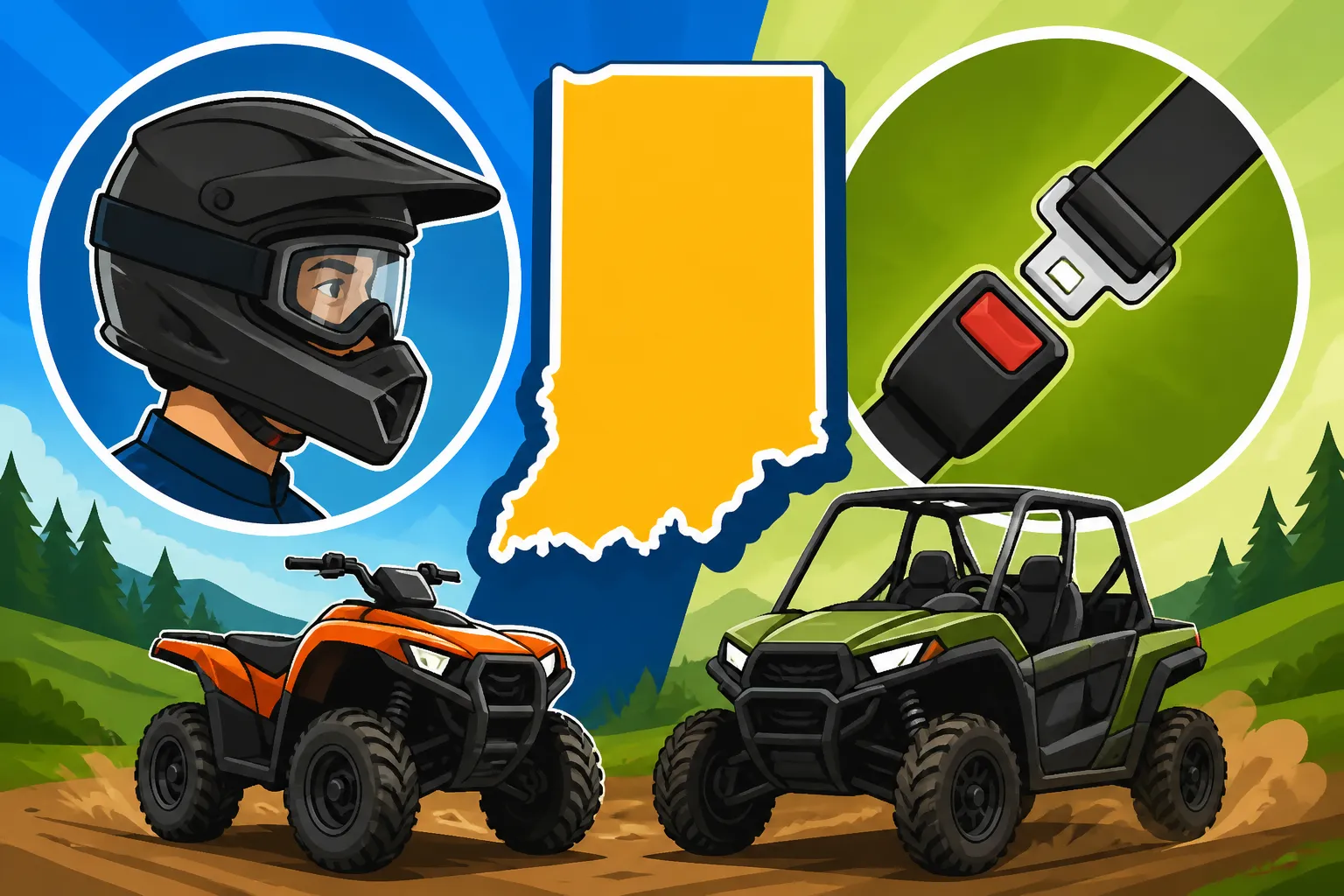
Indiana’s helmet and seat-belt rules depend on who is riding, what kind of machine they are in, and whether the ride is on public land. A full-size side-by-side with a cab is not treated like an open ATV, and a helmet does not replace a seat belt. This guide explains the practical distinctions and what to check before unloading.
First, know what “public land” means for these rules
Indiana’s public-land requirements matter at places where the state allows off-road riding, including the state’s off-road recreation areas. They are separate from the rules for riding on private property, county roads, and private pay-to-ride parks. A rule that applies at one kind of location may not settle what is required at another.
For riders, the main practical point is that a state recreation area is not a rule-free zone just because the route is off-road. State land can have requirements for helmets, seat belts, vehicle use, permits, and where you may ride. Redbird and Interlake are popular examples, but check the rules for the specific property you plan to visit. Start with Indiana Helmets at Redbird and Interlake and [Indiana Rules for Riding a Reclaimed Mine Park] if those locations are on your itinerary.
“Public land” also does not mean every public surface is open to ATVs and UTVs. A state forest, fish and wildlife area, public road, and designated ORV recreation area can all have different access rules. A helmet requirement does not grant permission to ride somewhere that is closed to ORVs. For example, Why Hoosier National Forest Bans ATV Riding explains why being public land does not automatically make a place an ATV trail.
The rules in this article concern protective equipment while riding on public land. They do not replace the need to check:
- Whether the property allows your type of machine
- Whether the trail or route is open
- Which permit or entrance fee applies
- Age and supervision requirements
- Local rules for any public road you may use
A permit and the correct gear solve different problems. A permit may authorize access under the property’s program, while a helmet or seat belt helps meet safety requirements. One does not stand in for the other. For the permit side of the trip, see Indiana’s Daily and Annual Trail Permits and Where to Buy an Indiana ORV Permit.
When a helmet is required
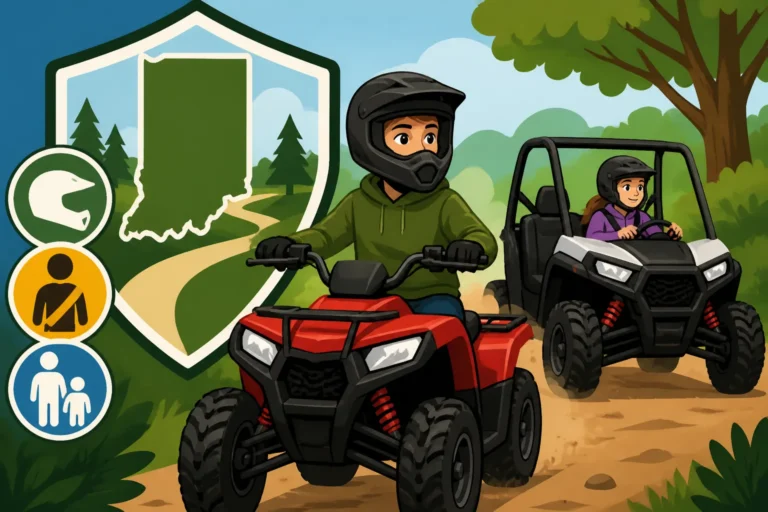
For off-road riding on Indiana public land, riders under 18 should expect to wear a protective helmet unless a specific, applicable exception covers their vehicle and situation. The safest practical approach is simple: if a rider is under 18, bring a helmet that fits and plan to wear it. Do not assume that a UTV’s roll cage, windshield, doors, or seat belts automatically make a helmet optional.
That matters because “UTV” describes a broad range of machines. Some are open vehicles with a roll cage and bench seats. Others have more substantial enclosures. A roll cage can reduce some risks, but it is not the same thing as an enclosed cab. If you are relying on an exception, confirm that the vehicle actually meets the relevant definition and that all conditions of the exception are satisfied.
A helmet should fit the rider, stay secured under the chin, and be suitable for off-road use. A helmet that is too loose, damaged, or not properly fastened can provide less protection than intended. For younger riders, check fit again as they grow. A helmet handed down from an older sibling may look serviceable but still be the wrong size or condition.
The enclosed-cab question
Indiana has an enclosed-cab exception relevant to the helmet rule, but it should not be read as “any UTV with a roof is exempt.” A roof or roll cage alone does not necessarily make a vehicle an enclosed-cab machine. The details of the vehicle and the conditions attached to the exception matter.
In practical terms, do not count on the exception just because your side-by-side has a windshield, soft doors, a roof, or a rear panel. If a minor will ride in the machine, plan to bring a helmet unless you have confirmed that the specific machine qualifies and that the rule allows the rider to go without one under the circumstances. The related explanation in The Enclosed Cab Exemption in Indiana can help you think through the distinction.
Even if an exception applies, a helmet may still be the sensible choice. Enclosures vary, and a cab does not eliminate the possibility of a rollover, impact, or a rider striking an interior surface. On rough trails, a securely fitted helmet can be useful even when it is not legally required.
Adults and good practice
Do not treat the under-18 threshold as a suggestion that adults do not need helmets in every setting. A park may impose its own conditions, a vehicle or activity may have separate requirements, and a helmet is sensible protection on uneven, rocky, muddy, or unfamiliar trails. Check the current rules for the land you are visiting rather than assuming that the minimum age-based requirement is the full safety standard.
If you are shopping for helmets, Amazon may offer a wide range of sizes and styles, but use the manufacturer’s fit guidance and inspect the helmet in person when possible. Look for a suitable certification label and a secure fit, not just a familiar brand or a low-profile design. A helmet that does not fit the rider is not a good substitute for one that does.
When seat belts are required
If an ORV is equipped with seat belts, occupants should expect to use them. This is especially important in a side-by-side, where the seating position and vehicle design are built around a restraint system. The practical rule is to buckle up whenever the machine provides a belt for that seat, regardless of whether the rider is an adult or a child.
Seat belts are not optional accessories to ignore because the trail is short or the vehicle is moving slowly. A machine can tip or stop abruptly at low speed, especially on a side slope, rut, bank, or uneven descent. A belt helps keep the occupant in the seat and within the protective space of the vehicle. It works as part of the machine’s safety design, not as a replacement for careful driving.
Before leaving the staging area, make sure:
- Every occupied seat has the correct occupant seated in it.
- Each occupant can fasten the belt properly.
- The belt is not twisted, frayed, stuck, or visibly damaged.
- The belt is snug enough to restrain the occupant without being routed incorrectly.
- Children are seated in positions appropriate for their size and the vehicle’s design.
- No one is riding in a cargo bed or other place without a proper seat and restraint.
Do not carry extra passengers beyond the number of designated seats. A passenger perched on a lap, cargo rack, or bed may have no effective restraint and can shift the machine’s balance. Even if a short ride seems harmless, the roughest section may come unexpectedly.
For more detail about how belts apply to side-by-sides, see Seat Belts for Indiana Side-by-Side Occupants. The key distinction is that a belt requirement follows the vehicle’s equipment and seating, while the helmet rule often turns on the rider’s age and the nature of the vehicle. They are related safety measures, but they are not interchangeable.
A belt does not automatically replace a helmet
A common point of confusion is whether wearing a seat belt means a helmet is no longer needed. In general, do not assume that it does. A qualifying enclosed cab may affect the helmet requirement, but the belt alone does not make every open or partly enclosed UTV exempt. A side-by-side with a roll cage and belts may still require a helmet for an under-18 rider.
That is why the specific vehicle matters. If your machine has a roof and belts but open sides, or if you have added aftermarket doors, do not decide for yourself that it qualifies as an enclosed cab. Check the current state rule and the park’s posted requirements. When the answer is uncertain, wearing the helmet is the safer and simpler choice.
How the rules differ by machine
The equipment requirement can be easier to understand when you compare common vehicle types. This table is a practical guide, not a substitute for the current rule at the property you visit.
| Machine or situation | Helmet approach on public land | Seat-belt approach |
|---|---|---|
| Open ATV or quad | Riders under 18 should wear a helmet. Adults should check property rules and consider wearing one as standard protection. | Most open ATVs do not have seat belts, so there is usually no belt to use. |
| Dirt bike | Riders under 18 should wear a helmet. A suitable helmet is also sensible for adult riders. | Dirt bikes generally do not have seat belts. |
| Open side-by-side with roll cage | An under-18 rider should wear a helmet. Do not assume a roll cage creates an enclosed-cab exception. | Occupants should use the belts provided for their seats. |
| Side-by-side with roof, windshield, or partial doors | Treat the machine as potentially still open unless you confirm it qualifies for an exception. Under-18 riders should wear helmets. | Use the seat belts provided. |
| Side-by-side with an enclosed cab | Check whether the specific cab and circumstances meet the applicable exception. Do not infer eligibility from appearance alone. | Use the belts provided, even if a helmet exception applies. |
| Machine with no seat belt installed | Do not add riders to seats or locations that were not designed for them. Check whether the machine and use are allowed. | Do not assume that removing or disabling a belt removes a requirement. |
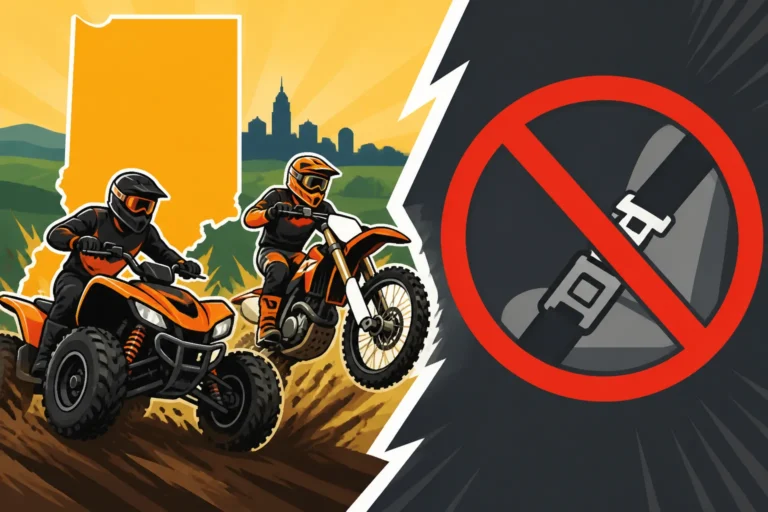
ATVs and dirt bikes generally lack the seating and restraint system found in a side-by-side. That does not make them exempt from helmet rules. It means the belt question usually does not arise in the same way. See Why Quads and Dirt Bikes Skip the Belt Rule for that distinction.
For a side-by-side, the reverse is often true: the vehicle may provide both belts and a roll cage, but that does not automatically answer the helmet question. The occupants should buckle up, and younger riders should wear helmets unless the specific enclosed-cab exception applies. Why Under-18 Riders Wear Helmets in a UTV addresses the point that a UTV is not necessarily exempt simply because it has a cage or restraint system.
Children and teenagers need two separate checks
When a minor is riding, think about equipment and supervision as separate questions. A properly fitted helmet does not satisfy a supervision rule, and an adult riding nearby does not make a missing helmet acceptable. Before the trip, check the rider’s age against the rules for the machine, the land, and the activity.
Indiana has additional rules affecting young riders, including requirements for younger children that are separate from helmet and seat-belt use. Some rules concern whether a child may operate a machine and how closely an adult must supervise. Those details matter when deciding whether a child should ride independently, as a passenger, or not at all on a particular trail. For more, see Indiana Supervision for Riders Under 14 and Under Sixteen and Direct Parental Supervision.
A parent or responsible adult should also assess whether the child can:
- Sit securely in the designated seat with feet and hands positioned safely
- Fasten and release the belt correctly, if the machine has one
- Wear a helmet that fits without blocking vision or hearing
- Follow instructions and remain seated while the machine is moving
- Handle the trail conditions without pressure to keep pace with older riders
A passenger seat does not automatically make a machine appropriate for every child. Check the vehicle manufacturer’s guidance as well as state and property rules. A child who cannot reach a footrest or remain stable in the seat may be unsafe even if the vehicle has a belt.
For a UTV, confirm that the belt can be adjusted to fit the child rather than leaving slack or riding across the neck. Never place a child in a seat that lacks the intended restraint. If the child is riding in a machine with an open cab, a helmet should be part of the plan.
The property’s age rules may also differ from rules for riding on private land or public roads. A child who is allowed to ride in one setting may not be allowed to operate in another. Read Indiana State Park Rules for Riders Under 16 before planning a state recreation area visit.
What to check before you leave home
A quick check before the trailer is loaded can prevent a frustrating problem at the gate. Rules can vary by property and may change, so verify the current requirements through the official information for the site you plan to visit. Do not rely only on what another rider remembers from a previous season.
Check the place and the machine
Confirm that the destination permits your kind of ORV and that the trails you intend to ride are open. Then identify the machine’s safety equipment: how many designated seats it has, whether each seat has a belt, and whether the cab is fully enclosed or only partly covered. If you are relying on a helmet exception, verify it before you travel.
Keep the machine in its intended configuration. Do not remove, bypass, or modify a belt to avoid using it. Do not treat aftermarket doors or a windshield as proof that a vehicle meets a legal definition. If you have questions about a modified machine, ask the relevant property office or agency before riding.
Pack gear that fits
For each under-18 rider, bring a properly fitting helmet, even if you believe an exception might apply. A spare adult helmet is not an adequate plan for a child unless it fits correctly. Check the chin strap, shell, interior padding, and any manufacturer guidance on damage or replacement.
Amazon can be useful for comparing helmet styles and accessories, but a listing photo cannot confirm fit. Check the helmet’s size chart and certification details, and make sure the rider can fasten it securely. If the rider wears goggles, confirm the helmet and goggles work together without gaps or pressure points.
For UTV passengers, check seat belts before the trip, not at the trailhead. If a belt is damaged or will not latch, do not use that seat until it is repaired. Carrying an extra passenger in a cargo area is not a safe workaround.
Keep the rest of the trip legal
Equipment compliance is only one part of a public-land ride. Confirm that required permits are current and that you understand where riding is allowed. Keep registration or permit documents available as required by the applicable program. A decal or permit does not authorize riding off designated routes.
If the route involves a road, do not assume that public-land riding rules apply there. Road use has its own restrictions, and many Indiana roads are closed to ORVs unless a specific legal exception or local designation applies. See Indiana Rules for Riding a County Road and Indiana Rules for Crossing a Highway if your route could involve public-road riding.
Common mistakes to avoid
Most equipment problems come from treating similar-looking vehicles or situations as identical. These are the assumptions most likely to cause trouble:
- “It has a roll cage, so the kids do not need helmets.” A roll cage alone does not establish that a UTV has an enclosed cab.
- “The belts mean the helmet is optional.” A belt does not automatically create a helmet exemption.
- “It is a short ride, so the child can skip the helmet.” The requirement does not depend on whether the ride is short or slow.
- “The machine has belts, but we only need them on difficult trails.” Use the belts whenever the occupied seats are equipped with them.
- “The park accepted this setup last time.” Staff, rules, vehicle configurations, and posted requirements can differ or change.
- “A public place is open to any ORV.” Public ownership does not automatically mean ORV access.
- “A helmet is enough for the whole trip.” Permits, supervision, trail restrictions, and vehicle rules remain separate obligations.
- “A passenger can sit in the bed for one short stretch.” A cargo bed is not a substitute for a designated passenger seat and restraint.
When in doubt, take the conservative route: have minors wear helmets, buckle every occupant into the seat provided, and confirm any claimed exception with the appropriate official source before riding. That approach avoids relying on a narrow interpretation at the gate and adds protection when conditions are rougher than expected.
A simple pre-ride checklist
Use this list before each public-land ride, especially if you are bringing children or switching machines:
- Confirm that the destination allows your machine and that the intended trail is open.
- Check the current property rules for helmets, belts, rider ages, supervision, permits, and equipment.
- Bring a properly fitting helmet for each rider under 18.
- If you believe an enclosed-cab exception applies, confirm that the specific machine qualifies and that the exception covers the rider.
- Inspect each seat belt and have every occupant use the belt provided for that seat.
- Carry only the number of people the machine is designed to seat.
- Check that children can sit securely and that their belts fit correctly.
- Keep required permits and other documents accessible.
- Review road and crossing rules separately if the route leaves the trail system.
- Recheck the rules before a later visit instead of relying on memory.
This is a practical safety routine, not a guarantee that every condition has been covered. When a machine is modified, a rider is very young, or an exception is central to your plan, get a clear answer from the land manager before setting out.
Disclaimer
This article is for general informational purposes only and does not constitute professional advice. Laws, prices and regulations vary by location and change over time. Consult a qualified professional for guidance on your specific situation.