Riding After a Week of Indiana Rain
A week of Indiana rain can turn a familiar trail into slick clay, standing water, and deep ruts—sometimes before the weather app shows another drop. The hard part is knowing whether riding will be manageable or whether it will damage the trail, your machine, or both. This guide explains how to assess conditions, make a safer go-or-no-go decision, and prepare if you ride.
Why a Week of Rain Changes Indiana Trails
Clay, mine ground, and low spots hold water differently
Indiana trails can change dramatically after several wet days. On reclaimed mine ground, clay may become slick and sticky, while higher sections can drain faster than hollows, shaded cuts, and low-lying trail segments. A trail that looks firm near the parking area may become greasy farther in, particularly where water runs across the route or collects in ruts.
The surface matters as much as the amount of rain. A short shower after a dry spell may leave some ground rideable, while steady rain over several days can saturate the soil below the surface. That hidden moisture makes the ground softer than it looks. Tires can break through a thin crust and sink, especially on a steep climb or a heavily trafficked turn.
This is one reason riders can have very different experiences at the same park on the same day. A rocky or elevated section may be passable, while a nearby clay bench is slick enough to make steering unpredictable. If you ride reclaimed ground, Indiana’s Reclaimed Mine Riding offers useful context for why these surfaces can behave differently from ordinary packed dirt.
More throttle can make a bad section worse
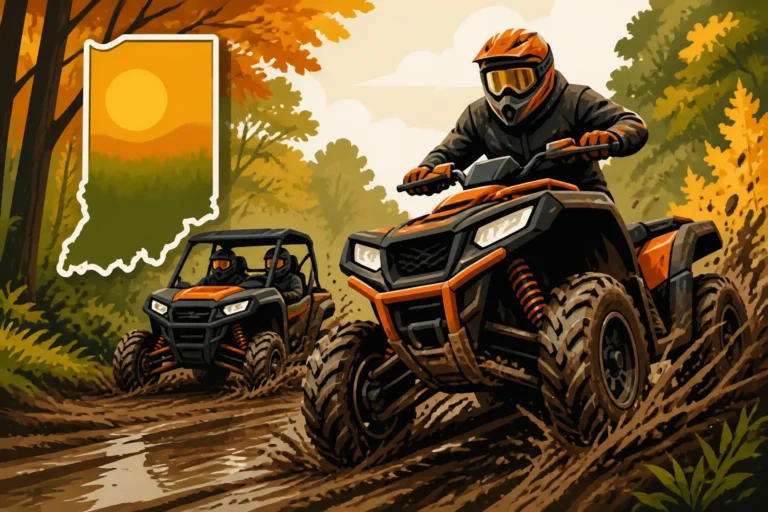
When tires lose traction, the instinct is often to add throttle. On wet clay, that can spin the tires, dig a deeper hole, and throw mud onto the machine without helping it move forward. If several riders try the same line, the rut can quickly become deeper and more difficult for everyone behind them.
Ruts are not just cosmetic. A deep channel can pull a tire sideways, catch a footrest, or make a machine lean unexpectedly. Water-filled ruts also hide rocks, branches, and uneven ground. If a trail has already been churned up, turning around may be safer than trying to force a way through. See Reclaimed Clay That Turns to Grease and Ruts Left by a Wet Weekend at Redbird for more on how a wet surface can deteriorate under repeated traffic.
A useful rule is to judge the trail by what your tires are doing, not by how confident you felt on it last weekend. If the machine starts sliding when you are moving slowly, or the ground is deforming under light throttle, stop and reassess. Riding harder is rarely a good way to improve traction on saturated ground.
How to Decide Whether to Ride
Check more than the forecast
A forecast tells you what may happen in the sky; it does not tell you whether a particular trail is firm enough to ride. Check the park’s official notices, phone line, or posted updates before loading the trailer. Closures and conditions can change after rain, and a trail may be open while still being a poor fit for your machine, experience level, or riding group.
Look for details that answer practical questions: Are trails closed, are certain areas restricted, is the park reporting standing water, and are there special instructions for visitors? For public riding areas such as Redbird and Interlake, confirm information through the relevant official park channels rather than relying only on a general map or a post from another rider. The articles Indiana Trails Closed After Rain and Indiana Trail Closures to Check First are useful reminders to verify restrictions before you leave.
A trail app such as onX Offroad can help you understand your route and avoid losing track of where you are, but a mapped trail should not be treated as proof that the route is open or currently passable. Use onX Offroad alongside current park information, and be ready to change your plan if local staff report poor conditions. Cell service can also be unreliable in parts of southern Indiana, so download or save what you need before heading out.
Make a go-or-no-go call based on the whole group
Consider the machine, the rider, the route, and the conditions together. A capable machine with aggressive tires does not make a saturated hillside safe for an inexperienced rider. Likewise, a group with children or riders on smaller machines may need a much easier route—or may be better off postponing the trip.
The table below can help organize the decision. It is not an official park rating; it is a practical way to think through what you see and hear before unloading.
| What you find | What it may mean | A sensible response |
|---|---|---|
| The park reports a closure or asks riders to stay off certain trails | The route is restricted regardless of how it looks at the entrance | Follow the notice and choose another activity or date |
| Tires leave deep impressions in the staging area | The soil may be saturated beyond the trail itself | Ask park staff about conditions and consider postponing |
| A test ride shows frequent sliding or tire spin | Traction may be poor and control can become unpredictable | Avoid steep, narrow, or heavily rutted routes |
| Standing water hides the trail surface | Obstacles and rut depth may be difficult to judge | Do not assume the water is shallow; turn around if uncertain |
| The trail is firm on higher ground but soft in low areas | Conditions vary across the park | Ride conservatively and avoid the visibly soft sections |
| Other riders are creating deeper ruts or getting stuck | The route may be deteriorating with traffic | Stop, give space, and consider leaving the area |
If you are unsure, ask park staff rather than trying to infer the whole trail system from the gate. You can also check Indiana Trail Conditions Before You Ride for a broader approach to pre-trip planning. A delayed trip can be frustrating, especially after loading machines and arranging a full day away, but it is easier to reschedule than to recover a stuck machine or repair a trail damaged by a wet weekend.
If You Choose to Ride After Rain
Start slowly and adjust the route
Once you arrive, do not assume conditions are consistent from the parking area to the far side of the property. Begin with an easy, familiar section and keep your speed low enough to react to slick patches, washouts, or hidden obstacles. If the machine begins to slide, ease off rather than making a sudden steering correction or opening the throttle sharply.
Leave extra space between machines. A rider ahead may stop suddenly, lose traction, or need room to turn around. Avoid following closely through muddy sections, where a stopped machine can block the route and leave the next rider with little room to choose another line. If your group includes less experienced riders, agree in advance on a turnaround point and a way to regroup if someone gets separated.
Use maps as navigation aids, not as a reason to continue into questionable terrain. onX Offroad may help you keep track of your location and planned route, but it cannot tell you whether a particular rut is safe to cross or whether the ground beneath standing water is firm. Follow posted signs and staff instructions, and do not leave marked routes to bypass a muddy section. Indiana Trail Etiquette on Shared Ground is a helpful companion for riding with care around other visitors and the property.
Keep traction changes modest and recover carefully
A little preparation can help, but no tire setup can make saturated ground predictable. If you are thinking about pressure, use the machine and tire maker’s guidance as your starting point and make only appropriate adjustments. Lowering pressure too far can increase the chance of tire damage or bead problems, while pressure that is not suited to the terrain can affect handling. Tire Pressure for Reclaimed Clay can help frame that decision without treating one setting as right for every machine.
If you get stuck, pause before digging deeper. Have the group stop and leave room around the machine. Avoid standing in a place where a vehicle could slide or roll toward you, and use a winch only if you know how to anchor and operate it safely. If the ground is soft enough that recovery gear is simply pulling the machine deeper, stop and contact park staff or a qualified recovery resource rather than escalating the situation.
Also think about visibility. Mud can cover lights, reflectors, and the registration decal, and wet grit can work into moving parts. Give the machine a careful rinse before loading it, especially around the radiator, suspension, brakes, and underbody. Do not spray sensitive electrical components aggressively. The practical checklist in Washing a Machine Before You Load can help you avoid hauling a layer of trail mud home and discovering a problem later.
Plan the Trip Around Conditions, Not Just the Calendar
Keep a flexible plan and a useful turnaround point
A rain-affected ride goes more smoothly when everyone knows the plan can change. Before unloading, agree on the route, the expected pace, and what conditions will make the group turn back. Decide how you will handle a mechanical problem or a rider who wants to stop. This is particularly useful when machines have different ground clearance, tire setups, or experience levels.
If you are visiting a park for the first time, consider choosing a shorter route and leaving room for breaks. You can explore more when conditions are good; after a wet week, a short ride that ends before anyone gets tired or stuck is often a better day than an ambitious loop that turns into a recovery operation. Save a map offline if possible, and tell someone outside the group where you plan to ride and when you expect to return.
Park-specific information can make planning easier. For instance, review Redbird Off-Road State Recreation Area before visiting Redbird, and verify the park’s own notices for the day you intend to go. onX Offroad can help you orient yourself, but keep the official trail map and posted directions in mind as well. A map is most helpful when it supports a conservative plan rather than encouraging you to push farther into uncertain conditions.
Know when postponing is the better ride
If staff have closed trails, respect the closure. If the ground is visibly saturated, machines are sliding at low speed, or the group would need to cross deep water without knowing what lies beneath it, postponing is a reasonable decision. This is not being overly cautious; it is recognizing that wet conditions can turn a relaxing outing into a safety and recovery problem.
You might still make the trip worthwhile by switching to a different activity, scouting the area on foot where permitted, or planning a return after the ground has had time to drain. Avoid assuming that a certain number of dry hours guarantees good conditions. Shade, soil type, elevation, and traffic all affect how quickly a trail firms up, so ask the park for current guidance rather than relying on a fixed waiting period.
Finally, consider what your group will leave behind. Staying on open routes, avoiding repeated attempts through a soft section, and turning around when the trail is deteriorating can help protect the riding area for the next visit. A muddy ride can be memorable for the right reasons, but if each pass makes the route worse, calling it early is often the most considerate choice.
Disclaimer
This article is for general informational purposes only and does not constitute professional advice. Laws, prices and regulations vary by location and change over time. Consult a qualified professional for guidance on your specific situation.