Indiana Trails Closed After Rain
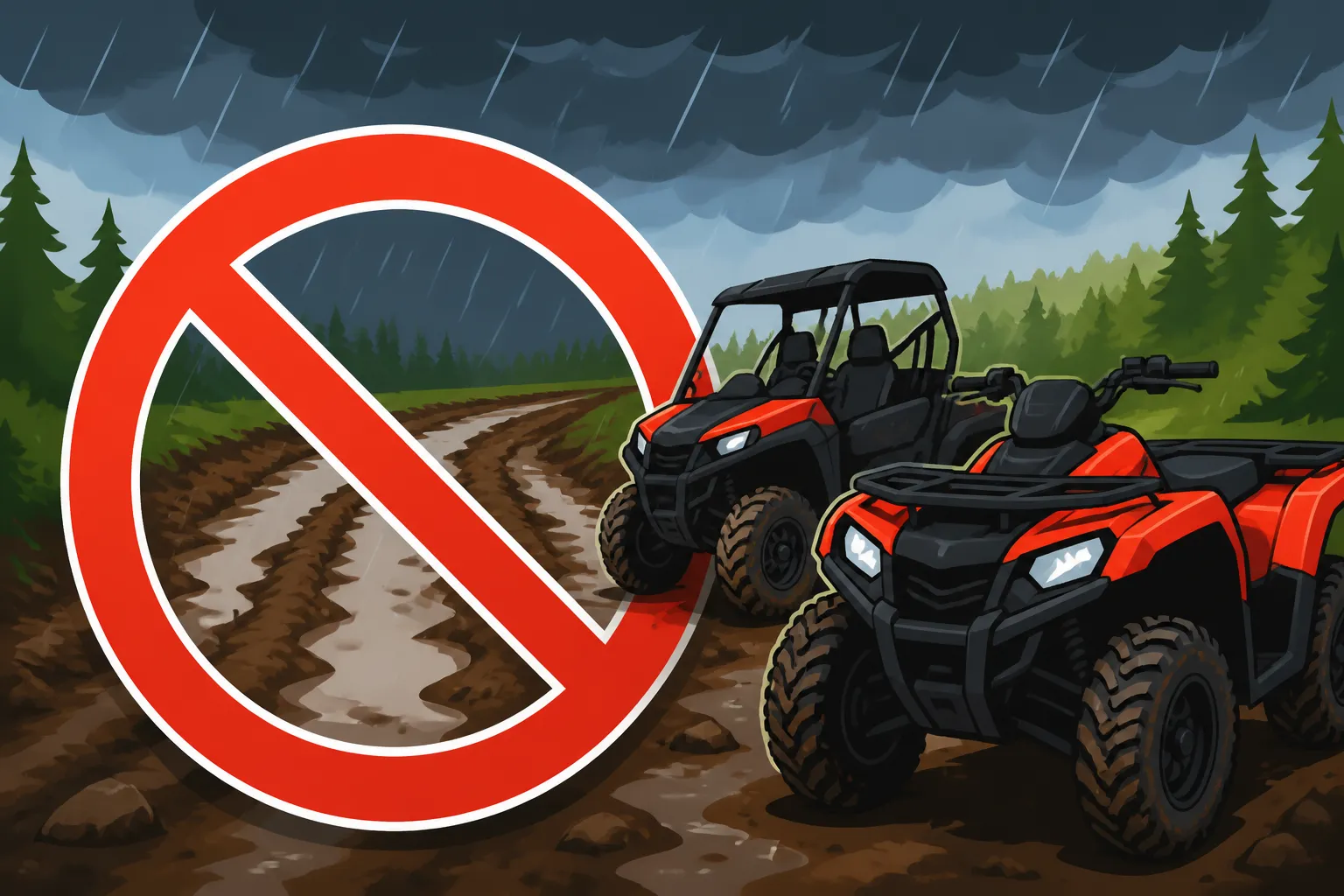
Rain can turn an Indiana trail from rideable to risky faster than many riders expect. Reclaimed clay gets slick, ruts deepen, and a route that looked manageable at the trailhead may become difficult a short distance in. This guide explains why parks close after rain, how to check conditions before towing out, and what to do if the trails are wet but still open.
Why Indiana trails close after rain
Reclaimed ground changes quickly
Many Indiana riding areas include land shaped by past mining, with clay, loose soil, steep slopes, and uneven benches. Those conditions can make a dry trail fun and varied, but wet ground behaves differently. Clay can become slick and cling to tires, while water runs down slopes and collects in low spots. A familiar climb may suddenly offer much less traction.
At places such as Redbird Off-Road State Recreation Area near Dugger or Interlake near Lynnville, a route can include several kinds of terrain in one ride. One section may drain well while another holds water or turns greasy. That is why a report from one parking area—or a rider’s experience on one loop—may not describe the whole property.
The problem is not just that a muddy trail is unpleasant. Slipping can send a machine sideways on a hill, and a vehicle that loses traction may dig deeper as the rider tries to power through. If you’re trying to understand why the ground can get so slick, [Reclaimed Clay That Turns to Grease] explains the issue in practical terms.
Closures can protect trails and riders
A park may close some or all trails after rain to reduce damage, prevent unsafe riding, or give the ground time to drain. A closure can also help protect trail features that are difficult to repair once tires have carved deep channels into them.
Ruts are more than cosmetic. They can redirect water into the trail, making erosion worse during the next storm. They may also catch a tire or make a narrow section hard to pass safely, particularly for a wider side-by-side. The damage left by one wet weekend can affect everyone who rides that trail later. [Ruts Left by a Wet Weekend at Redbird] looks at how that damage can build.
A closure does not always mean every part of a park is equally saturated. It means riders should follow the park’s posted direction rather than deciding that a section “looks fine.” Conditions can vary from one hill or low spot to the next, and staff may be responding to hazards that are not obvious from the entrance.
Open does not always mean easy
If a park is open, that is not a promise that every trail will feel comfortable for every rider or machine. Rain may have passed, but the ground can stay wet after the sky clears. Shaded sections, low areas, and heavily used routes can take longer to dry than exposed, well-drained ground.
Think about your group’s experience and equipment before setting off. A newer rider on a youth ATV, for example, may find a slick slope intimidating even when an experienced rider considers it manageable. A heavy UTV may have a different impact on soft ground than a smaller machine. If you’re not confident that your group can turn around safely, choose a different route or postpone the trip.
How to check conditions before you leave
Start with the park’s own updates
Before loading machines, check the riding area’s official website, social accounts, recorded notices, or other channels it uses for operating updates. Look for the date and time of the notice, whether the closure applies to the whole property or only certain trails, and any instructions about reopening.
This matters especially if you’re driving to a destination such as Redbird, Interlake, Haspin Acres, or Badlands Off Road Park. A general forecast for southern or central Indiana cannot tell you whether the trails at a particular park are open. A storm can affect one area more heavily than another, and ground conditions may remain poor after the rain stops.
For a broader pre-trip routine, see [Indiana Trail Conditions Before You Ride] and [Indiana Trail Closures to Check First]. Use them alongside the park’s own update rather than treating a map or a rider’s post as the final word.
Call if the notice is unclear
If a post is old, vague, or doesn’t say whether a particular section is open, contact the park before hitching up. Ask specific questions: Are trails open today? Are any areas closed because of rain? Are there restrictions for ATVs or UTVs? Has the park posted a reopening update?
A quick call can prevent a frustrating drive with a trailer, fuel, and a full group in tow. It can also help you avoid relying on a comment from someone who rode several days ago. [Calling a Park Office Before You Load] is a useful reminder to resolve uncertainty before you leave home.
When you arrive, read the signs at the entrance and any notices posted near staging areas. Conditions can change, and an update from earlier in the day may no longer be the most relevant information. [Reading the Gate Board Before You Unload] covers why that last check is worth the minute it takes.
Use maps for orientation, not permission
A mapping tool can help you understand where trails run, plan a route, and see how far you are from the staging area. Riders may use onX Offroad to orient themselves and review mapped routes before a trip. Still, a route appearing on a map does not prove that it is open, passable, or permitted for riding today.
Check the park’s current notices for closure information, then use a map to help with navigation. If you use onX Offroad, compare its route information with the park’s own directions and posted signs. Save the information you may need before entering areas with weak cell service, but do not let a mapped line persuade you to bypass a closed trail.
| What you need to know | Best place to check | Why it matters |
|---|---|---|
| Whether the park is open | Official park update or direct contact | Rain-related closures can change |
| Which trails are closed | Current park notice and entrance signs | A partial closure may affect only certain areas |
| Whether a route suits your group | Park guidance, trail map, and your own judgment | Wet conditions can raise the difficulty |
| How to find your way | Park map or a navigation app such as onX Offroad | Maps help with orientation but do not confirm access |
| What to do if conditions worsen | Park rules and safe turnaround options | A route that becomes difficult should not be forced |
What to do if trails are wet but open
Choose a conservative route
If the park is open after rain, start with a route your least-experienced rider can handle. Avoid making a steep, slick climb the first test of the day. Give the group time to assess traction, visibility, and how the ground feels under the tires.
Wet conditions can make it harder to stop or change direction on a slope. Leave more space between machines, keep a steady pace, and avoid abrupt steering or aggressive throttle. If a rider is uncomfortable, turn back together rather than splitting the group or pressuring someone to continue.
A navigation app such as onX Offroad can help you keep track of your position and possible return routes, but it cannot make a slippery hill safe. Look for clearly open routes, follow posted markers, and stay within the park’s designated riding areas.
Don’t power through a problem section
When tires start spinning, adding more throttle can dig the trail deeper without moving the machine forward. If you reach a stretch that feels unsafe, stop somewhere stable if possible and reassess. Do not block a blind turn or stand in the path of approaching riders while discussing what to do.
Turning around can be the sensible choice even if you’ve driven a long way to ride. A machine stuck in deep mud can become a recovery problem, and several vehicles trying to push through the same soft spot can worsen damage. If the group cannot pass safely without tearing up the route, head back or ask park staff for direction.
For more on considerate riding when trails are shared, read [Indiana Trail Etiquette on Shared Ground]. The same basic idea applies after rain: make choices that protect other riders, staff, and the trail—not just your own chance of getting through.
Avoid making your own route
A closed section is not an invitation to ride around a barrier, cut across an unmarked hillside, or follow tire tracks off the designated trail. Bypassing a muddy spot can widen the disturbed area and create a new drainage problem. It can also put you into terrain that has not been assessed or marked for riding.
Stay on authorized trails, obey signs, and ask staff if you are unsure where a route goes. If you ride with a group, make sure everyone knows that a closure applies even if the trail looks passable from a distance. That is particularly important when a lead rider moves ahead and the rest of the group cannot see the route clearly.
When to postpone and plan another ride
Know when the trip is no longer worth the risk
Postpone the ride if the park confirms a closure, if you cannot get a clear answer about access, or if your group would need to take a route beyond its comfort level. The same applies when heavy rain is still falling, water is running across the trail, or the approach road and staging area appear unsafe.
A change of plan is frustrating, particularly after arranging time off, loading machines, and organizing friends. But a wasted drive is usually easier to recover from than a damaged machine, an injury, or a trail that needs repair. If a park closes, ask whether staff have information about reopening or whether another permitted riding area is operating. Private parks may set their own schedules and rain policies, so check each property directly. [Indiana's Private Off-Road Parks] offers more context on riding options outside state recreation areas.
Make a rain-aware backup plan
Before a weekend trip, pick a backup date or another activity in case the trails close. If you’re traveling from Indianapolis, Fort Wayne, Evansville, or farther away, check the status before you commit to the drive—not just the night before. Weather and ground conditions can change between planning and departure.
Keep a short checklist for every trip:
- Check the riding area’s latest official update.
- Confirm any rain-related closure or restriction directly if needed.
- Review the route and make sure it suits the least-experienced rider.
- Check the trailhead signs when you arrive.
- Turn around if conditions become unsafe or damage is occurring.
Use onX Offroad or another suitable map as a planning aid, and keep the park’s own rules and notices in front of you. The most useful pre-ride information is not simply whether rain fell; it is whether the specific area is open and whether the conditions make sense for your group.
Rain does not automatically cancel every Indiana ride, but it can change the ground quickly and unevenly. Check the park’s current guidance, respect closures, and be ready to choose a different day when the trails need time to recover. For a closer look at how rain affects ride planning, see [Indiana Riding After Heavy Rain] and [Indiana Trails Closed After Rain].
Disclaimer
This article is for general informational purposes only and does not constitute professional advice. Laws, prices and regulations vary by location and change over time. Consult a qualified professional for guidance on your specific situation.