Are ATVs Street Legal in Indiana?
It’s a common frustration for many ATV and UTV owners across Indiana: you just want to take your machine down the road a mile or two to a friend’s house, or maybe to the local gas station to fill up, but you're not sure if it's even allowed. The rules around riding off-road vehicles on public roads in the Hoosier State can feel like a tangled mess of "maybes" and "buts," leaving many riders scratching their heads. This guide is here to untangle that confusion, offering a clear, empathetic, and realistic look at Indiana's stance on ATVs and UTVs on public roads, and how you can stay on the right side of the law.
The General Rule: Are ATVs Street Legal in Indiana?
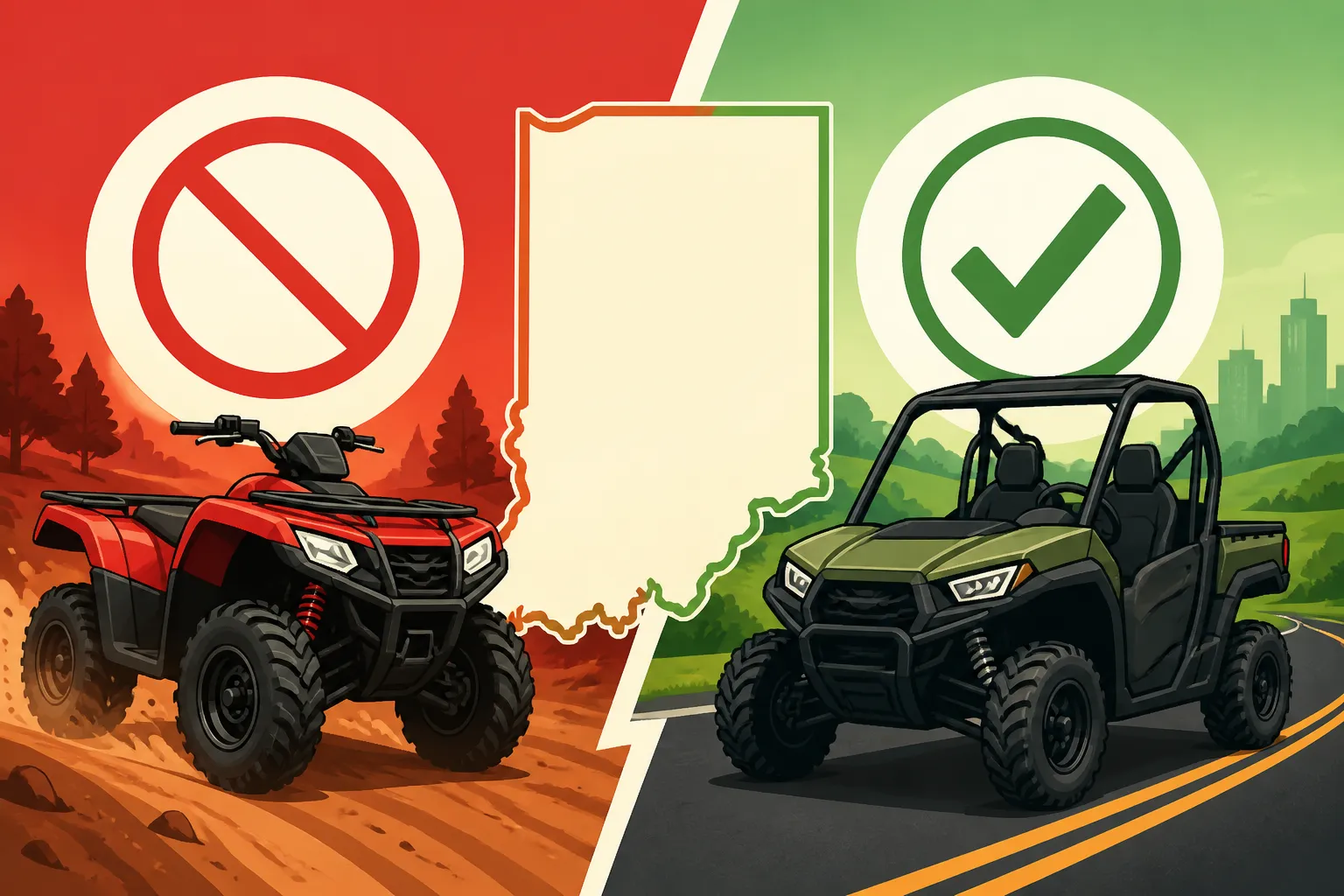
Let's cut right to the chase because this is the biggest question on everyone's mind: generally speaking, ATVs and UTVs are not street legal in Indiana. I know, I know, it's probably not the answer you were hoping for, especially if you've seen someone else riding one on a paved road. But the state's default position is that these machines are designed for off-road use, not for sharing the asphalt with cars and trucks. It's a common misconception that simply adding turn signals or a horn suddenly makes your quad or side-by-side road-ready, but that's rarely the full picture in Indiana.
The Indiana Department of Natural Resources (DNR) and the Bureau of Motor Vehicles (BMV) work together to regulate these machines, and their definitions clearly classify ATVs and UTVs as off-road vehicles, intended for trails, fields, and private property. This fundamental classification is why you can't just hop on your machine and cruise down Main Street like you would in a car. It's a safety thing, primarily, as these vehicles handle very differently on paved surfaces, often lack the full suite of safety features found in street vehicles, and can be harder for other motorists to see.
Why Indiana Roads Are Closed by Default
The primary reason Indiana roads are closed to off-road vehicles by default boils down to public safety and infrastructure. Think about it: ATVs and UTVs are built with knobby tires for traction on dirt and mud, a suspension designed for bumps and jumps, and often don't have things like sealed cabins, seat belts, or even proper turn signals and brake lights required for highway use. They are not designed to reach highway speeds safely, nor are their braking systems always adequate for emergency stops on pavement. [How Indiana Defines an Off-Road Vehicle] goes into more detail about what differentiates these machines from typical street vehicles.
This isn't just about the state being overly cautious; it's about minimizing the risk of accidents involving machines that perform very differently than passenger cars. The wear and tear on roads from ATVs and UTVs, especially those with aggressive tires, is also a consideration. So, while it might feel restrictive, the default "no" is rooted in a desire to protect all road users and maintain the integrity of our roadways.
The Exceptions: Shoulder, Ditch, and Crossing
Now, here's where things get a little less restrictive. Indiana law does provide a few very specific, limited exceptions to the "no road riding" rule. These aren't blanket allowances, but rather narrow circumstances where an ORV might legally touch a public road.
-
Riding the Shoulder or Ditch: You may be allowed to operate an ORV on the shoulder or in the ditch of a public highway, but only if there is sufficient width to ride away from the traveled portion of the highway, and you're not riding on a limited-access highway (like an interstate). This means no riding on the paved part of the shoulder if it's narrow and puts you too close to traffic. This exception is usually for getting from one field to another or reaching a legal trail access point, not for joyriding down the side of the road. It also comes with the significant caveat that local ordinances can further restrict or even prohibit this. [The Shoulder and Ditch Exception in Indiana] details these rules further.
-
Crossing a Road: An ORV can cross a public highway, but you must do so at right angles to the highway and at a location where the crossing is safe. This means no diagonal cuts across multiple lanes! You must also come to a complete stop before crossing and yield to all traffic on the highway. This is often used when a trail or private property is bisected by a road, allowing riders to continue their journey safely. [Crossing a Road on an ORV in Indiana] is a must-read if this applies to your riding.
It's crucial to understand that these are exceptions to the general rule, not an invitation to ride freely. They require extreme caution and adherence to specific conditions, and they can be overruled by local ordinances.
How Counties Can Open Their Roads
This is the real game-changer for many Indiana riders, and where the "street legal" question gets its most nuanced answer. While the state says ATVs and UTVs aren't generally street legal, it gives individual counties the power to decide otherwise for certain roads within their jurisdiction. This means your machine might be legal on county roads in one part of Indiana but strictly forbidden just a few miles down the road in another county. It’s enough to make you feel like you need a legal degree just to plan a ride!
The Process for Local Ordinances
For a county to open its roads to ORVs, the county commissioners (or equivalent local governing body) must pass an ordinance. This isn't a quick or easy process. It typically involves public hearings, community input, and careful consideration of safety, noise, and environmental impacts. The ordinance will specify which roads, if any, are open to ORV traffic, and often includes specific rules regarding:
- Age of operators: Many ordinances require operators to be 18 years or older, even if state law allows younger riders on private property or designated trails.
- Proof of insurance: Counties can mandate that riders carry specific liability insurance.
- Lighting and safety equipment: Requirements for headlights, taillights, brake lights, turn signals, and mirrors may be imposed, often exceeding minimal off-road requirements. Many riders turn to aftermarket suppliers like SuperATV for these kinds of upgrades, ensuring their machines meet local safety standards.
- Hours of operation: Restrictions on night riding might be included.
- Speed limits: Lower speed limits than regular vehicle traffic might be set.
If you're thinking about riding county roads, your absolute first step should be to investigate if your specific county has passed such an ordinance, and then read it very carefully. [How to Find an Indiana County ORV Ordinance] can guide you in this critical research.
What a County Ordinance Can (and Cannot) Require
While counties have significant power to regulate ORV use on their roads, their authority isn't limitless. State law places some important restrictions on what local ordinances can demand:
- No Driver's License Mandate (for ORV-specific license): A county cannot require a special "ORV driver's license" in addition to a standard motor vehicle driver's license if they require one at all. If they allow ORV operation by adults, they generally rely on the existing state driver's license system.
- Weight Restrictions: Counties cannot restrict the weight of ORVs below 2,000 pounds. This is important because many larger side-by-sides can easily exceed this weight, and a county can't arbitrarily ban them if they meet other criteria. [Why Your County Cannot Ban a Heavier Machine] explains this in more detail.
- No Additional Registration: A county cannot require its own separate ORV registration beyond the state's required registration and decal through the Indiana BMV. Some cities, like Tell City, have tried this, but it's generally not allowed for county-wide ordinances.
Understanding these limitations helps you advocate for your riding rights and ensures that any county ordinance you encounter is legal and fair. It's a delicate balance between local control and consistent state guidelines, and sometimes, a little education can go a long way in discussions with local officials.
Specific County Examples and Rules
Let's dive into some real-world examples to illustrate how different counties have approached ORV use on their roads. This is where the concept of "street legal" truly becomes hyper-local and varies dramatically across the state.
Hancock County's Open County Roads
Hancock County, located just east of Indianapolis, is an example of a county that has embraced ORV use on many of its county roads. They've passed an ordinance that allows ORVs on most county roads, excluding state highways and roads within city or town limits. This means if you're riding in Hancock County, you might be able to traverse county roads to connect trails or access amenities, provided you follow their specific rules.
Typically, Hancock County's ordinance includes requirements like:
- Operators must be at least 18 years old and hold a valid driver's license.
- Machines must be registered with the Indiana BMV and display the current decal.
- Headlights, taillights, brake lights, and turn signals are generally required.
- A rearview mirror is also a common requirement.
- Speed limits are often set lower than the posted vehicle speed limit, usually around 25-30 mph.
Riders in Hancock County often appreciate the flexibility, but it's not a free-for-all. You still need to be aware of your surroundings, yield to other traffic, and absolutely avoid state roads. The shoulder and ditch exception [Riding a Ditch Beside a Hancock County Road] also applies here, but always remember to ride safely away from moving traffic.
Vanderburgh County's Marked Road Map
Vanderburgh County, home to Evansville in the southwest corner of the state, offers a more controlled and visually clear approach. Instead of opening all county roads, Vanderburgh County has implemented an ordinance that designates specific roads as open for ORV use, often indicated by a color-coded map. This approach allows them to manage safety and impact more precisely.
Their map might use colors like:
- Green or Blue Roads: Open to ORV traffic, with specific rules.
- Red Roads: Closed to ORV traffic.
Vanderburgh County's rules are quite specific, and typically include:
- Age: Operators must be at least 18 years old. [Why Road Riding Starts at Eighteen in Indiana] highlights similar age restrictions often seen in county ordinances.
- Insurance: Proof of liability insurance is a must. [Vanderburgh's Insurance Certificate Requirement] is a key point here.
- Lighting: Two headlights and two taillights are often required, especially for night riding. [Vanderburgh's Dual Light Rule at Night] ensures machines are visible.
- Helmets: Riders under 18 must wear a helmet.
- No riding within city/town limits: Like most counties, ORV use is restricted to unincorporated county roads. [Riding Outside Evansville's Limits] explains this common restriction.
The distinct color-coded map means riders need to plan their routes carefully and check the map before heading out. For riders needing to equip their UTVs with proper lighting or mirrors to meet these specific local requirements, aftermarket parts from a company like SuperATV can be a practical solution, offering a range of robust and compliant accessories.
It's clear that while the state sets the foundation, the actual riding experience on public roads hinges heavily on whether your local county has acted, and what their specific rules entail.
Important Rules for Road Riding
Even if you're in a county that permits ORV use on its roads, there are universal safety requirements and behaviors you absolutely must adhere to. Think of these as the baseline rules for responsible road sharing, regardless of where you are in Indiana. Violating these can not only put you and others at risk but also lead to significant fines and penalties. [What a Class C ORV Infraction Costs in Indiana] can give you an idea of the potential financial consequences.
Indiana Helmet Law for ORV Riders
Indiana has a specific helmet law that applies to ORV riders, and it's particularly relevant when you're operating on or crossing public roads. While it doesn't apply to every adult rider in every situation, it's a critical safety measure, especially for younger riders.
- Riders Under 18: Any person operating or riding as a passenger on an ORV who is under 18 years of age must wear a helmet. This applies on public land, private land, and absolutely when operating on any road segment where ORVs are permitted. This isn't just a suggestion; it's the law. [Indiana Helmet Law for Riders Under 18] details this mandate.
- Enclosed Cabs: There's an important nuance for UTVs. If a UTV has an enclosed cab (meaning it has a roof and full doors that enclose the occupants), then the helmet requirement for those under 18 may be waived. However, seat belts are still mandatory for all occupants in such a setup. Always check the specific wording of the law and any local ordinances, as enforcement can vary.
Even if you're an adult rider over 18 and riding a quad, and you're not legally required to wear a helmet, it's always, always a good idea to protect your head. A serious accident can happen in an instant, and a helmet is your best defense. Many trail systems, including Redbird and Interlake, also strongly recommend or even require helmets for all riders, regardless of age.
Lighting and Safety Requirements
When you're out on any public road, visibility is key. Cars and trucks are larger, faster, and often aren't expecting an ORV. That's why proper lighting and other safety features are non-negotiable for road use.
- Headlights and Taillights: If you're riding after sunset or before sunrise, or during periods of reduced visibility (fog, heavy rain), your ORV must have at least one headlight and one taillight illuminated. Many county ordinances will bump this up to requiring two headlights and two taillights for better visibility, especially for wider UTVs. For an enhanced safety and visibility, especially at night or in adverse weather, consider upgrading your machine’s lighting with high-quality LED options, which can be found from specialized retailers like SuperATV.
- Brake Lights: Your ORV must have functioning brake lights that illuminate when you apply the brakes.
- Turn Signals: While not always explicitly required by state law for shoulder/ditch use, most county ordinances that open roads to ORVs will mandate turn signals. Hand signals are generally not sufficient for road riding where other vehicles expect traditional indicators.
- Rearview Mirror: A rearview mirror (or mirrors, depending on the machine's width) is typically required to allow you to see traffic approaching from behind.
- Spark Arrester: All ORVs operated in Indiana, especially on public lands or areas prone to wildfires, must be equipped with a U.S. Forest Service approved spark arrester. This prevents sparks from escaping the exhaust and igniting dry vegetation.
It's not just about meeting the minimum legal requirements; it's about being seen and staying safe. Ensure all your lights are clean and functioning before every ride, and consider adding reflective tape or brightly colored flags to increase your visibility.
What an Indiana Officer Checks Roadside
Imagine you're cruising down a permitted county road, following all the rules, and suddenly you see flashing lights in your rearview mirror. What will an Indiana conservation officer or local sheriff's deputy be looking for? Knowing this can help you be prepared and avoid unnecessary trouble.
Here's a breakdown of what an officer will likely check during a roadside stop for an ORV on a public road:
- Registration Decal: Your ORV must be properly registered with the Indiana BMV and display the current registration decal. The decal should be clearly visible and mounted in the designated area, usually on the forward half of the machine. [What an Indiana Officer Checks Roadside] covers this in detail.
- Paperwork: You should have your physical registration certificate with you. While some officers might accept a photo on your phone, it's always safer to carry the original document.
- Proof of Insurance: If the county ordinance requires insurance for road riding (and many do), expect to be asked for proof. This is typically an insurance card from your provider.
- Operator's Age and License: The officer will verify your age and, if required by local ordinance, your valid driver's license. If you're riding with a minor, they'll check their age and helmet compliance.
- Safety Equipment: All required lights, brake lights, turn signals, and mirrors will be checked for functionality. They may also look for a spark arrester.
- Compliance with Local Ordinance: The officer will confirm you are on a designated ORV road and adhering to all specific rules of that county's ordinance (e.g., speed limits, hours of operation).
- Impairment: Just like with any other vehicle, operating an ORV under the influence of alcohol or drugs is strictly prohibited and carries severe penalties. [Indiana DUI Rules for ORV Riders] are clear and apply to ORVs too.
Remember, a positive attitude and cooperation with the officer go a long way. Always be polite, provide the requested documentation, and calmly answer any questions. It’s better to be over-prepared than to face fines or citations for non-compliance.
| Requirement | General State Rule (Shoulder/Ditch/Crossing) | Common County Ordinance Requirements |
|---|---|---|
| Registration | Required (BMV decal) | Required (BMV decal) |
| Operator Age | No specific minimum for ORV* | Often 18+ with valid driver's license |
| Helmet | Required for under 18 | Required for under 18 (some UTV cab exemptions) |
| Headlights | Required for night/low visibility | Required (often two), functional |
| Taillights | Required for night/low visibility | Required (often two), functional |
| Brake Lights | Functional | Functional |
| Turn Signals | Not explicitly state-required | Often required |
| Rearview Mirror | Not explicitly state-required | Often required |
| Insurance | Not state-required | Often required |
| Road Type | Shoulder/Ditch/Crossing only | Designated county roads only (no state highways) |
| Speed Limit | Common sense; often 25-30 mph in ordinances | Set by ordinance, usually below posted car limit |
| Spark Arrester | Required | Required |
*Note: While Indiana has general age recommendations for ORV operation, counties often impose stricter age limits (18+) for road use due to the inherent risks of mixing ORVs with street traffic.
Disclaimer
This article is for general informational purposes only and does not constitute professional advice. Laws, prices and regulations vary by location and change over time. Consult a qualified professional for guidance on your specific situation.