Crossing a Road on an ORV in Indiana
Riding an ATV or UTV in Indiana can be an absolute blast, whether you're tearing up the trails at Redbird or enjoying some open-air adventure on private land. However, one of the trickiest and most commonly misunderstood aspects of ORV ownership in the Hoosier State is how to legally and safely navigate public roads, particularly when it comes to simply crossing them. It’s a point of major frustration for many riders who just need to get from point A to point B, or connect two sections of trail, only to be met with confusing rules and the fear of a costly ticket. This comprehensive guide is here to untangle the complexities of crossing a road on an ORV in Indiana, ensuring you understand the letter of the law and how to protect yourself while still enjoying your machine.
The Basics of Indiana's Road Rules for ORVs
Indiana’s approach to off-road vehicles on public roads is often described as restrictive, and for good reason. Unlike some states that might have more lenient "street legal" conversions or widespread road access, Indiana largely keeps ORVs off paved surfaces. This foundational understanding is crucial before we even talk about crossing. Many riders mistakenly assume that because they own the machine, they can use it to traverse short distances on public roads, or that a quick dash across a two-lane road is harmless. Unfortunately, the law doesn't always see it that way.
Why Roads Are Closed by Default
The core principle in Indiana is that all public roads, streets, and highways are closed by default to off-road vehicles. This isn't a suggestion; it's a legal directive. The state legislature has determined that ORVs, including ATVs, UTVs, and dirt bikes (unless specifically designed and registered for street use, which is a different category altogether), are not inherently compatible with the infrastructure and safety requirements of public roadways. This default closure is in place to protect both ORV operators and conventional vehicle drivers, minimizing potential conflicts and accidents. It means you can't just hop on your quad and ride down the street to your neighbor's house, even if it's just a hundred yards. The roads are considered off-limits unless an explicit exception is made by law, or a local ordinance provides specific, limited permission. Understanding [Why Indiana Roads Are Closed by Default] is the first step in avoiding legal trouble.
The reasons behind this default closure are multifactorial. For one, ORVs typically lack many of the safety features required for on-road vehicles, such as turn signals, side mirrors, and often, appropriate lighting for night travel. Their tires are designed for off-road traction, not pavement grip, which can lead to unpredictable handling on asphalt or concrete, especially at higher speeds or during emergency maneuvers. Furthermore, the speed differentials between ORVs and conventional cars can create dangerous situations, particularly on busier roads. It's a blanket rule designed to streamline enforcement and prioritize public safety.
Understanding the "Right-of-Way" Exception
While the default rule keeps ORVs off roads, Indiana law does carve out specific exceptions, primarily focused on allowing necessary passage. One of the most common and vital exceptions is the "right-of-way" allowance, which explicitly permits ORVs to cross a public road under very specific conditions. This isn't a carte blanche to ride on the road, but rather a tightly controlled privilege to move across it. It's designed for situations where a trail, a piece of private property, or a designated riding area is split by a public thoroughfare, and crossing is the only practical way to continue the journey.
This exception is often a lifeline for riders who frequent areas like the vast trail networks that might be bisected by county roads or rural routes. Without this provision, many popular riding spots would become segmented and far less enjoyable. However, this exception comes with a heavy burden of responsibility on the ORV operator to perform the crossing safely and strictly within the legal parameters. It's not about convenience; it's about minimizing risk in a necessary movement. Many riders mistakenly think "right-of-way" means they have the right to ride on the shoulder, but that's incorrect; it refers specifically to the act of crossing.
What Indiana Defines as an Off-Road Vehicle
Before you even think about crossing a road, it's vital to know if your machine falls under Indiana's definition of an Off-Road Vehicle (ORV). This classification dictates how the rules apply to you. In Indiana, an ORV is generally defined as a motorized vehicle designed to travel over unimproved terrain and that has a width of 50 inches or less, a weight of 2,000 pounds or less, and a wheelbase of 60 inches or less, OR a vehicle designed to travel over unimproved terrain that is not a golf cart, dune buggy, or snowmobile, and is not required to be registered under IC 9-18.1. That’s a mouthful, but essentially, it covers your standard ATVs, many dirt bikes, and even some smaller side-by-sides. However, the width and weight limits are key. Larger UTVs, especially those wider than 50 inches or heavier than 2,000 pounds, might be classified differently, or face additional restrictions, especially in counties that have opened their roads to ORVs. Understanding [How Indiana Defines an Off-Road Vehicle] is fundamental to knowing your rights and responsibilities.
The specific definitions are critical because they determine not only registration and titling requirements but also how your machine interacts with road laws. For instance, a wider side-by-side might be considered a "full-size off-road vehicle" in some local ordinances, which could alter where and how it can be ridden or crossed. It’s not just about what it looks like; it's about the technical specifications. Always check your machine's dimensions against the state's ORV definitions and any local ordinances that might apply in the area you plan to ride. This due diligence can save you from a misunderstanding that could lead to a citation or, worse, an accident.
Specific Rules for Crossing Public Roads
When the law does permit an ORV to cross a public road in Indiana, it comes with a very specific set of requirements that are non-negotiable. These aren't suggestions; they are mandates designed to ensure the crossing is as brief and safe as possible, minimizing disruption to other traffic. Ignoring even one of these rules can turn a legal crossing into an illegal maneuver, carrying potential fines and risks. Think of it as a highly choreographed movement that you must execute flawlessly.
The Mandate for a Complete Stop
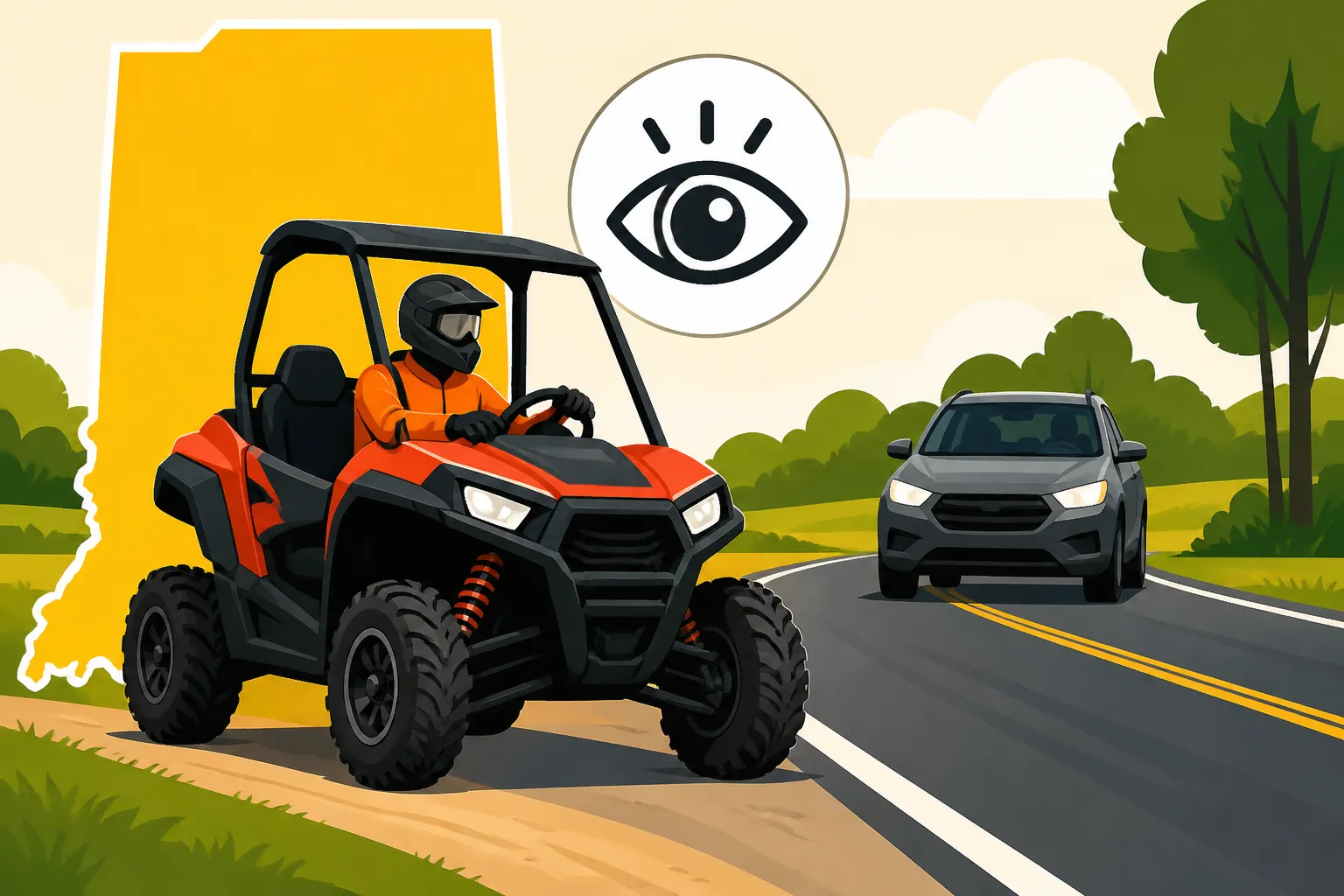
This is arguably the most critical rule: you must bring your ORV to a complete stop before crossing a public road. This isn't a rolling stop; it's a full, unequivocal halt. Just like you would at a stop sign in your car, your wheels must cease all forward motion. This pause allows you to thoroughly scan for oncoming traffic from all directions, including pedestrians and cyclists, and to assess the road conditions. Failing to make a complete stop is not only illegal but incredibly dangerous, as it significantly reduces your reaction time and the visibility you have of potential hazards. Many tickets are issued for this exact infraction because it's an easily observable violation. For more on this, refer to [A Complete Stop Before an Indiana Crossing].
Imagine you're approaching a two-lane county road that splits your favorite trail at Redbird Off-Road State Recreation Area. You can't just slow down and coast across. You must pull up to the edge of the pavement, or just before the shoulder if it's wide enough, and come to a dead stop. Engage your brakes, look left, right, then left again. Check your mirrors if you have them, and be aware of any blind spots, especially if you're riding a UTV with a cab. This momentary pause is your chance to gather all the necessary information to make a safe decision. It's a small inconvenience that offers a huge safety benefit.
Crossing at Right Angles: Why It Matters
Once you've stopped and determined the coast is clear, the law requires you to cross the road at a right or ninety-degree angle to the flow of traffic. This means you should aim to cross straight across the road, perpendicular to the lanes. You should not travel diagonally across the road, nor should you drive down the road for any distance, even on the shoulder, before initiating your cross. The goal is to minimize the time your ORV spends in the travel lanes of the public road. A diagonal crossing increases the distance traveled on the road, prolongs your exposure to traffic, and can make your intentions less clear to other drivers. Learn more about [Crossing at Right Angles in Indiana].
Think about it from the perspective of a driver in a car. If they see an ORV approach and stop, then cross directly, it's a predictable movement. If the ORV starts to drift or turn, it introduces uncertainty, which can lead to misjudgments and accidents. Crossing at a right angle ensures the quickest and most direct path from one side of the road to the other. It also helps maintain control of your machine, as turning sharply while crossing can be unstable on some ORVs, especially if the surface changes from dirt to pavement. Maintain a steady, appropriate speed to execute the crossing efficiently once you've started.
Yielding to All Traffic: A Non-Negotiable Rule
This rule goes hand-in-hand with making a complete stop: you must yield the right-of-way to all oncoming traffic that constitutes an immediate hazard. This means that if there's any vehicle, cyclist, or pedestrian approaching that could be put at risk by your crossing, you must wait. You do not have the right-of-way, ever, when crossing a public road on an ORV. The burden is entirely on you, the ORV operator, to ensure the crossing can be completed safely without impeding or endangering anyone else. This is a fundamental principle of road safety and a key legal requirement. Consult [Yielding to All Traffic at a Crossing] for deeper insight.
This often means exercising patience, especially on busier roads or during peak travel times. It might feel frustrating to wait, but the alternative—forcing another vehicle to brake sharply or swerve—is simply not an option. An ORV, by its nature, offers less protection than a car, and an encounter with a full-size vehicle will almost always result in severe consequences for the ORV operator. Err on the side of caution. If there's any doubt about whether you have enough time or space to cross safely, wait for a larger gap in traffic. This rule underscores the idea that road crossings are a privilege, not a right, for ORV riders.
Navigating Different Types of Roads
The general rules for crossing apply across the board, but the type of road you encounter can subtly change the dynamics of your crossing. Understanding these distinctions is important, especially given Indiana's diverse road network, from quiet rural lanes to bustling state highways. Knowing which roads are absolutely off-limits, even for crossing, and which might allow for more frequent crossings due to local ordinances, is key to staying legal and safe.
Crossing County and Local Roads
Most ORV trail systems and private lands in Indiana are crisscrossed by county roads or other local, non-state-maintained roads. These are often the most common types of roads you'll encounter that require crossing. While the strict rules of stopping, yielding, and crossing at right angles still apply, county and local roads can be designated as open to ORV traffic by local ordinance. When a county designates certain roads as ORV-friendly, it often means you can actually ride on those roads, not just cross them, provided you adhere to the specific rules set by that county. However, without such an ordinance, the default "closed" rule applies, and you are only allowed to cross. It’s crucial to know the local ordinances for the county you're riding in.
For example, in a county that has not opened its roads, you might be riding a trail that ends at County Road 400 S, picking up again on the other side. Here, you'd execute a legal crossing: stop, look, yield, cross straight. But if you were in a county like Hancock County, which has opened all its county roads to ORVs, the rules would be different for riding on that road, even if you still needed to cross a state highway. The takeaway is: always check the local laws. Don't assume that because one county has open roads, all of them do. This local variation is why [How an Indiana County Opens Its Roads] is such a critical topic for ORV riders.
Why Limited-Access Highways Stay Closed
This is a non-negotiable point: you cannot cross limited-access highways on an ORV in Indiana. This includes interstates (like I-65, I-70, I-74) and many major state highways that have controlled access points, on-ramps, and off-ramps, and generally higher speed limits. These roads are designed for high-speed vehicular traffic, and an ORV attempting to cross would pose an extreme danger to both the operator and the highway traffic. There are no exceptions in Indiana law that permit an ORV to cross these types of roads. If your intended route takes you to a limited-access highway, you must find an alternative, such as trailering your machine across or rerouting entirely. Find out more about [Why You Cannot Cross a Limited-Access Highway].
The dangers here are self-evident. The speeds involved on limited-access highways are vastly different from those on a county road. Drivers on these roads expect high-speed traffic and are often not looking for slow-moving vehicles attempting to cross perpendicular to the flow. The sheer momentum and braking distances of vehicles traveling at 70 mph or more make any interaction with an ORV incredibly risky. Furthermore, these highways typically lack the clear sight lines and predictable traffic patterns that allow for safe ORV crossings on smaller roads. Attempting such a crossing would not only be illegal but could easily be fatal.
Bridging Gaps: Crossing a Bridge on a Designated ORV Road
While the general rule is "no riding on roads," there's a nuanced situation when it comes to bridges, especially if you're on a county road that has been designated for ORV use. If a county ordinance explicitly opens certain roads to ORVs, and that road includes a bridge, then riding your ORV across that bridge as part of your permitted travel on that designated road is typically allowed. However, the same rules regarding speed, yielding, and general road safety apply. You're riding as a legal vehicle on a designated ORV road, not just crossing. The distinction is important.
If you are on a non-designated road and simply need to cross a bridge that spans a river or ravine to connect two parts of a trail, the challenge is amplified. The "right angle" rule for crossing becomes difficult or impossible on a bridge. In such cases, the safest and most legally sound approach would be to find an alternative route that avoids using the bridge or to trailer your machine across. Bridges are often narrow, have limited shoulders, and offer constrained visibility, making them inherently more dangerous for ORV crossings than a typical flat road section. Always prioritize safety and legality; if a crossing feels unsafe or potentially illegal due to the structure of the road (like a bridge), it's best to avoid it.
Equipment and Rider Requirements for Road Crossings
It's not just about how you cross the road; it's also about who is riding and what condition your machine is in. Indiana has specific requirements for operators and machines that apply not just to trail riding but also to any instance where an ORV might interact with public roadways, even for a brief crossing. Ensuring your machine is properly equipped and that the rider meets age and safety standards is crucial for compliance and safety.
Lighting Requirements for Visibility
When you're crossing a public road, especially during dawn, dusk, or at night, your visibility is paramount. Indiana law often requires ORVs to be equipped with at least one headlight and one taillight that are illuminated when riding after dark or when visibility is otherwise limited. While these rules primarily pertain to riding in general, they are absolutely critical during a road crossing. A driver of a conventional vehicle needs to see you clearly and well in advance to react appropriately. Having bright, functioning lights can literally be a life-saver. Brands like SuperATV offer a range of aftermarket lighting solutions, from LED light bars to replacement headlights and taillights, that can significantly enhance your visibility, far beyond what basic factory lights might provide. While not strictly mandated for every daylight crossing, improving your visibility is always a wise investment.
Consider upgrading your lighting, even if you primarily ride during the day. A flash of a bright LED headlight or a distinct taillight can catch a driver's attention faster than a dim, stock bulb. This is especially true in areas with heavy tree cover or when the sun is low in the sky, creating glare. Beyond legal compliance, it's about making yourself impossible to miss. Having proper lighting isn't just for you; it's for the safety of everyone else on the road, ensuring they can perceive your presence and predict your movement during that critical crossing window.
Indiana's Helmet Law and Road Crossings
Indiana has specific helmet laws for ORV riders, and these laws apply regardless of whether you're on a trail, private property, or briefly crossing a public road. Specifically, all ORV operators and passengers under 18 years of age must wear a DOT-approved helmet when riding an ORV. This rule is absolute and applies to every ride. If you have a teenager or a child on your machine, whether as a driver or a passenger, and you intend to cross a road, they must be wearing a helmet. Violating this rule can result in fines and is a significant safety risk. It's not worth the gamble. Learn more about [Indiana's Helmet Law for Riders Under 18].
Even for riders 18 and older, while a helmet isn't legally mandated, it is highly recommended by virtually every safety organization and experienced rider. When you're crossing a public road, even for a few seconds, you are exposed to moving traffic at potentially high speeds. A helmet provides critical protection in the event of a collision or even a simple tip-over. Don't let complacency lead to a preventable injury. Just because you're "just crossing the road" doesn't diminish the risk. Safety gear, especially a helmet, should be a non-negotiable part of your riding ensemble, irrespective of age or location.
Age and Supervision for Young Riders
Indiana also has rules regarding the age of ORV operators and the necessity of supervision for minors. Generally, a person must be at least 14 years of age to operate an ORV. For riders under 14, direct supervision by an adult is required. These rules apply universally to ORV operation, including the act of crossing a public road. If a minor is operating an ORV and needs to cross a road, they must meet the age requirements, and if under 14, the supervising adult must be present and capable of intervening. It's the adult's responsibility to ensure the minor understands and adheres to all crossing procedures.
Furthermore, some local ordinances (in counties that have opened roads to ORVs) may impose additional age restrictions for riding on designated public roads, often requiring the operator to be 18 years of age and possess a valid driver's license. While these specific age limits for riding on roads don't directly apply to a simple crossing on an otherwise closed road, it highlights the importance of understanding the rules for minors. As the owner or supervising adult, you are often held liable for the actions of a minor operating your machine. Ensuring they are properly trained, equipped, and supervised during road crossings is paramount.
The Legalities of Improper Road Crossings
Ignoring Indiana's ORV road crossing laws can lead to more than just a stern talking-to. The state takes these regulations seriously, and enforcement officers are empowered to issue citations that carry significant penalties. Understanding the potential legal consequences is essential for any ORV owner or operator who intends to interact with public roads, even for a momentary crossing. A little knowledge here can save you a lot of money and hassle.
Fines for Illegal ORV Road Use
Attempting an illegal road crossing—whether by failing to stop, not yielding, traveling diagonally, or using a prohibited road—can result in a Class C infraction in Indiana. A Class C infraction carries a potential fine that can be quite substantial. While specific amounts can vary, you could be looking at hundreds of dollars for a single offense. These fines are not trivial and can quickly add up, especially if you're found to be in violation of multiple aspects of the law (e.g., no helmet and an illegal crossing). This doesn't even account for potential court costs or administrative fees. The cost of a ticket vastly outweighs the perceived convenience of rushing a crossing. Explore [Indiana Fines for Illegal ORV Road Use] for detailed information.
Beyond the immediate fine, repeated offenses or particularly egregious violations could lead to more severe consequences. While ORV infractions don't typically impact your driver's license in the same way car violations do, they can still create a record. It's always best to be informed and compliant to avoid these financial and legal headaches. Don't make the mistake of thinking a small, rural road is less likely to be patrolled; conservation officers and local law enforcement are vigilant about ORV safety and adherence to road rules across the state.
Owner Liability for Offenses
A critical aspect of Indiana's ORV law is owner liability. As the owner of the off-road vehicle, you can be held responsible for violations committed by others while operating your machine. This means if you lend your ATV or UTV to a friend or family member, and they commit an illegal road crossing (or any other ORV infraction), you, as the owner, could be held liable. This is a powerful incentive to ensure that anyone who rides your machine is fully aware of and complies with all state and local laws, especially concerning road interactions. Lending your machine comes with significant responsibility.
This liability extends beyond just fines. In the unfortunate event of an accident during an illegal road crossing, the owner could face civil liability for damages or injuries, even if they weren't the one operating the machine at the time. This underscores the importance of not only educating anyone who uses your ORV but also potentially ensuring they have adequate insurance coverage. While Indiana doesn't mandate ORV insurance statewide, it's a wise investment, especially when considering the potential for owner liability.
What an Indiana Officer Checks Roadside
If you're stopped by an Indiana conservation officer, county sheriff's deputy, or state police trooper while on or near a public road with your ORV, they will likely be checking for several key things. First and foremost, they'll verify your registration and decal. All ORVs in Indiana must be registered with the Bureau of Motor Vehicles (BMV) every three years, and the decal must be properly affixed to the forward half of your machine. Next, they'll check for compliance with road rules, particularly if they observed you crossing. Did you stop? Did you yield? Did you cross at a right angle? They'll also look for helmet compliance for any riders under 18, and potentially proper lighting if it's dark or visibility is poor. Find out more about [What an Indiana Officer Checks Roadside].
Additionally, they might check for spark arresters on your exhaust (required in state riding areas) and general machine condition, though the focus on a roadside stop for road crossing would typically be on the immediate infraction and basic legal requirements. Be prepared to present your ORV registration certificate if asked. Many experienced riders keep their paperwork in a waterproof bag or container, or even a clear pouch attached to the machine. Remaining polite and cooperative during a stop is always the best approach, regardless of the situation.
Practical Tips for Safe and Legal Crossings
Knowing the rules is one thing; applying them safely and consistently in the real world is another. Beyond legal compliance, there are practical strategies you can employ to make your ORV road crossings as safe and uneventful as possible. These tips focus on preparation, awareness, and responsible riding habits that benefit everyone on the road.
Planning Your Route to Minimize Crossings
The best way to avoid issues with road crossings is to minimize the need for them in the first place. Before you head out, especially if you're exploring a new area, take the time to plan your route carefully. Use maps (physical or digital, like those from SuperATV that might overlay trails) to identify where trails intersect with public roads. Look for alternative routes that might avoid busy intersections or state highways altogether. Sometimes, taking a slightly longer trail through the woods can be safer and more enjoyable than repeatedly navigating road crossings.
If crossings are unavoidable, try to identify the safest spots. Look for intersections with good sight lines in both directions, where traffic is typically slower, or where there's a clear shoulder to pull off onto while waiting. Avoid blind curves, hillcrests, or heavily wooded areas that obstruct your view or make you less visible to oncoming traffic. Being proactive in your route planning can significantly reduce your exposure to risk and the chance of encountering legal trouble.
Riding With a Group: Best Practices
When riding with a group, coordinating your road crossings is essential for safety. The "every rider for themselves" approach is incredibly dangerous. Instead, designate a lead rider and a tail rider. The lead rider should approach the crossing, make a complete stop, and assess traffic. Once clear, they can signal the rest of the group to follow, ensuring there’s a sufficient gap for everyone to cross safely without stopping in the middle of the road.
It's often a good idea for the lead rider to position themselves in a way that provides clear visibility to oncoming traffic, potentially even using hand signals or a bright flag to indicate their intention to cross. For larger groups, it might be necessary to cross in smaller batches, allowing larger gaps in traffic for each segment of the group. Never assume that because the first rider crossed safely, the entire group can follow immediately. Each rider must still make their own assessment and follow the stop, yield, and cross rules. Communication within the group (via hand signals or comms systems) is key to a smooth, safe crossing.
Being Prepared: Paperwork and Awareness
Always carry your ORV registration certificate with you when you ride. As mentioned earlier, an officer will likely ask for it during a stop. Keeping it in a waterproof container, perhaps in your glove box or a dedicated map pouch, ensures it stays dry and legible. Some riders even take a photo of their registration on their phone as a backup, though a physical copy is preferred. Additionally, being aware of your surroundings, even when not crossing, is vital. Pay attention to road signs that indicate the nature of the road you're approaching, and be mindful of traffic patterns.
Beyond paperwork, mental preparedness is crucial. Always anticipate potential hazards, especially at road crossings. Drivers of conventional vehicles may not be expecting an ORV, so ride defensively. Assume they haven't seen you until you've made eye contact or received a clear acknowledgment. This heightened state of awareness, combined with adherence to legal requirements and proper equipment, creates the safest possible riding environment. Remember, [Indiana's Three-Year ORV Registration] ensures your machine is legally recognized, which is the foundation of any interaction with public land or roads.
Situational Scenarios and Common Misconceptions
Despite clear rules, riders often face unique situations or hold onto common misconceptions about ORV road use. Addressing these specific scenarios and clarifying common misunderstandings can help you navigate the complexities of Indiana's laws with greater confidence. The details truly matter here.
Crossing a County Road From One Field to Another
This is a classic rural scenario: you're working on the farm, or simply riding across private property, and a county road divides two sections of land. You need to get your quad or side-by-side from one field to the field directly across the road. The rules for crossing a public road still apply fully. Even though you're moving between your own property, and perhaps only traveling a few feet on the pavement, you must:
- Stop completely at the edge of the road.
- Look thoroughly for all traffic, yielding to anything that could be an immediate hazard.
- Cross at a right angle, straight across the road, minimizing your time on the pavement.
- Ensure any riders under 18 are wearing DOT-approved helmets.
Do not assume that because it's your land, or a quiet country road, these rules are relaxed. An Indiana conservation officer or local sheriff's deputy can still issue a citation for improper crossing, regardless of your intention to stay on private land. The moment your wheels touch the public road surface, you are subject to the laws governing that roadway. This scenario is a prime example of where the "right-of-way" exception is designed to be used safely.
When a Road Becomes a State Route: Knowing the Boundaries
One common pitfall for riders is not realizing when a county road transitions into a state route. Many rural state routes might look similar to county roads – two lanes, no shoulder, surrounded by farmland. However, the moment that road becomes a state route (indicated by state route signs, different road markings, or simply knowledge of the area), the possibility of even crossing it changes dramatically. While you can cross some state roads that are not limited-access highways, the traffic speeds and volumes are often much higher, increasing the risk. Furthermore, counties that have opened their roads to ORVs almost universally exclude state routes from that designation.
Always be aware of the road classification. If you're unsure, treat any unfamiliar road as if it's a state route or high-traffic area, meaning increased caution and a preference for avoiding the crossing if possible. Using navigation apps that display road numbers or having a good physical map can help you identify these transitions before you get there. You may be legally permitted to cross a non-limited-access state route, but the emphasis on safety, extreme caution, and yielding to all traffic becomes even more pronounced. Understanding [Where a County Road Becomes a State Route] is crucial for safe navigation.
The Difference Between Designated ORV Roads and Crossing Permits
It's easy to conflate the idea of "street legal" ORVs or designated ORV roads with the act of simply crossing a road. In Indiana, they are distinctly different.
- Designated ORV Roads: Some Indiana counties have passed ordinances that explicitly open certain county roads (or even all county roads) to ORV traffic. On these designated roads, you are generally allowed to ride your ORV as if it were another vehicle, typically with specific restrictions on speed, time of day, and rider age/license requirements. For example, Vanderburgh County has a map of designated ORV roads, but also rules about [Vanderburgh's Eighteen-Year-Old Operator Rule].
- Crossing a Road: This is the act of traversing a road (that is not a designated ORV road) for the sole purpose of getting from one side to the other, under strict conditions (stop, yield, right angle, minimal time on road). You are not permitted to ride on the road.
There isn't a "crossing permit" you can obtain that grants you special privileges to ignore the rules for crossing. The right to cross is inherent in state law, but it's always conditional on strict adherence to safety protocols. The rules are in place to allow necessary connections without promoting widespread ORV use on public roads. Never confuse the ability to cross a road with the right to ride on it, unless that specific road has been explicitly opened by a local ordinance. Always ensure your machine is registered with [Registering an ORV in Indiana] to avoid additional penalties if stopped.
Disclaimer
This article is for general informational purposes only and does not constitute professional advice. Laws, prices and regulations vary by location and change over time. Consult a qualified professional for guidance on your specific situation.