Which Adult Signs an Indiana Waiver
If you’re taking a child or teenager to ride an ATV or UTV in Indiana, the waiver can raise an awkward question: can any adult in the group sign, or does it have to be a parent or legal guardian? The safest approach is to have the parent or legal guardian sign for a minor and confirm the riding area’s own requirements before leaving home.
Who should sign an Indiana ATV or UTV waiver
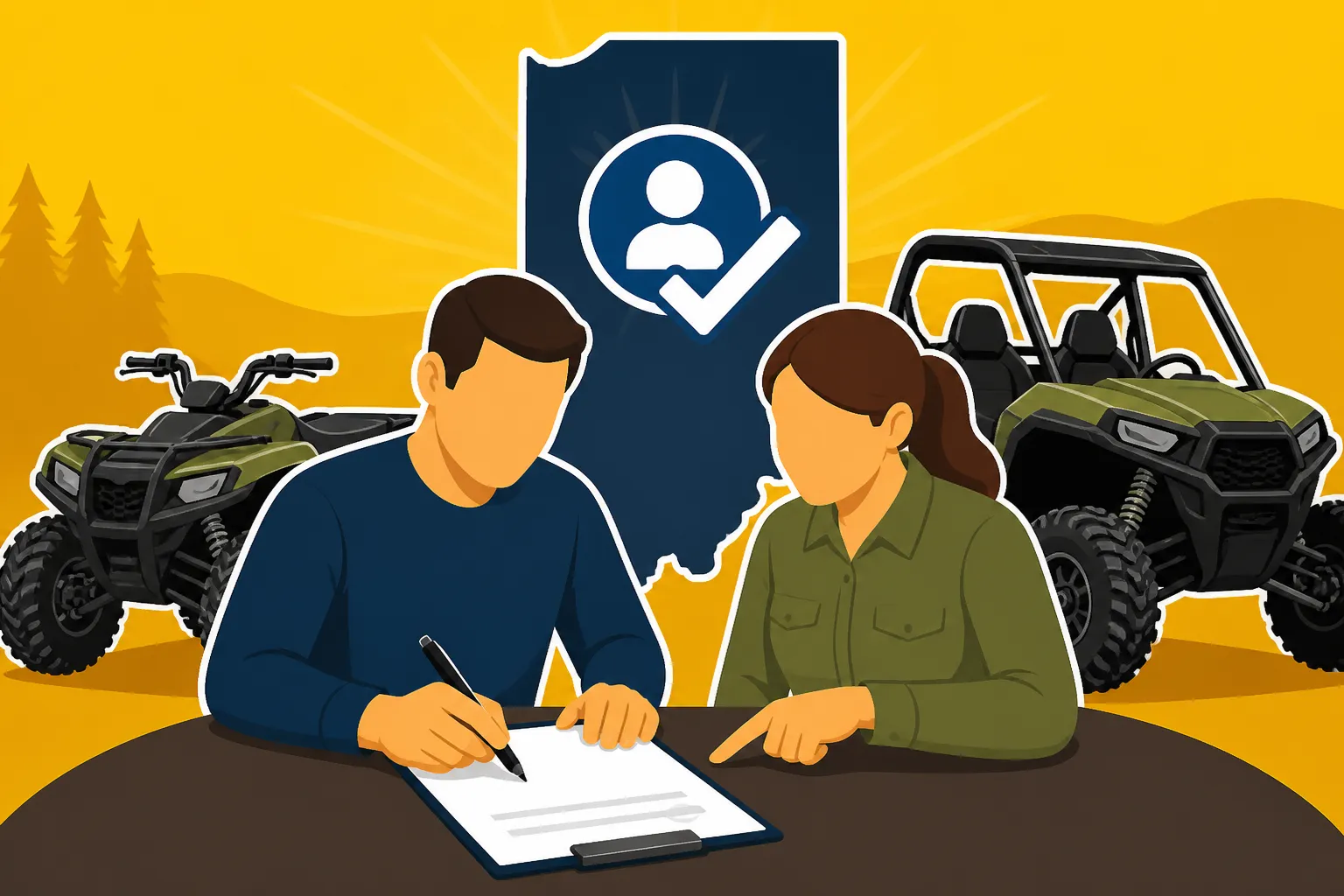
For an adult rider, the adult generally signs their own waiver. For a rider under 18, a parent or legal guardian is the safest person to sign the minor’s release. A grandparent, aunt, uncle, family friend, or other accompanying adult should not assume that being present gives them authority to sign on the child’s behalf.
The exact form and acceptance rules depend on the park, event, rental business, or other property owner. Some places may have their own requirements for a parent or guardian to sign in person. Others may explain how to submit a form in advance or what documentation they accept when a parent or guardian cannot attend. Ask the facility directly rather than relying on a generic waiver found online.
| Rider or situation | Safest person to sign | What to confirm |
|---|---|---|
| Adult rider | The rider | Whether each adult must sign individually |
| Minor riding with a parent | The parent or legal guardian | Whether the facility requires an in-person signature |
| Minor riding with another adult | The parent or legal guardian | Whether the facility accepts advance paperwork or another arrangement |
| Rental machine used by a minor | The parent or legal guardian, plus any required rental paperwork | Minimum age, who may operate, and who signs each form |
| Organized ride or event | The rider if an adult; parent or legal guardian for a minor | Event-specific forms, deadlines, and supervision conditions |
A waiver is a property owner’s or event organizer’s document about participation and risk. It is separate from a state trail permit, machine registration, rental agreement, or permission to operate a particular vehicle. Signing one does not, by itself, establish that the rider meets the age, supervision, equipment, or site rules.
That distinction matters because people often arrive prepared for only one requirement. An adult may have signed the waiver, but the facility could still require a separate permit or proof that the machine is eligible for the trail. For a rented machine, there may also be a rental contract or additional release. Review each form separately, and do not assume one signature covers every rider or vehicle.
If you are taking a minor to public riding land, check the applicable age and supervision requirements as well as the waiver. The rules for riding public land are a separate issue from who signs the property’s paperwork. See Indiana Minimum Age to Ride Public Land and Under Sixteen and Direct Parental Supervision when planning a trip with younger riders.
When a parent cannot attend
If a child is riding with a grandparent or another trusted adult, contact the facility before the trip. Explain who is bringing the minor and ask exactly what the facility requires from the parent or legal guardian. Do not assume a text message, a phone call, or a note will be enough; the facility may require its own form or a particular signing process.
Ask clear questions, such as:
- Does a parent or legal guardian have to sign the waiver?
- Must that person be present at check-in?
- Can the form be completed before the visit?
- Does the facility require any additional information or documentation?
- Does the accompanying adult need to sign a separate acknowledgment?
- Are there separate age or supervision rules for the minor’s machine?
Use the facility’s current form and follow its instructions. If it offers a way to complete the waiver before arrival, check whether the form must be printed, electronically submitted, witnessed, or signed at the site. A form that looks complete may still be rejected if it does not follow the facility’s process.
The same caution applies when the adult who usually handles the paperwork is not the child’s legal guardian. A stepparent, relative, or family friend may be the child’s regular caregiver, but the facility may still require a parent or legal guardian to sign. If there is a court-appointed guardian or another formal arrangement, ask the facility what it will accept rather than guessing.
When parents share custody, it is also sensible to check whether the facility has any specific requirements for the adult who signs. A waiver is not a substitute for resolving a disagreement about whether a child may participate. If there is a custody order or other restriction that affects travel or activities, follow it and seek qualified advice if its meaning is unclear.
Keep a copy of any completed form and the facility’s instructions with the trip information. A copy can help if staff have a question at check-in, but it does not guarantee acceptance if the venue requires a different procedure. Confirm the details close enough to the visit that you are using the facility’s current process.
Waivers at parks, events, and rentals
There is no reason to assume that every Indiana riding location uses the same waiver. A private off-road park, rental operator, club ride, race, and public recreation area may each handle paperwork differently. The terms may also depend on the rider’s age, the type of machine, or whether the activity is a regular visit or an organized event.
Private parks and organized events
A private park sets its own admission and participation procedures, subject to applicable law. The park may require an adult to sign for themselves and a parent or legal guardian to sign for a minor. It may also have site-specific rules about who can supervise a young rider, what machines may be used, and where riders may go.
An organized ride or event can add paperwork beyond the park’s usual waiver. The organizer may have separate registration, safety, or participation forms. If the event takes place on public land, a special event process may apply as well. See Indiana Rules for a Group Ride and Indiana Permits for a Race or Event for related planning questions. Ask the organizer which forms apply to minors and whether the parent or guardian must be present.
Do not treat a signed waiver as permission to leave marked trails, use a closed route, or ride a machine that does not meet the site’s rules. It records agreement to the terms of participation; it does not replace the venue’s operating requirements.
Rental machines
Rentals often involve more than one document. A business may use a waiver along with a rental agreement, safety instructions, and rules for who may operate the machine. If a minor is involved, ask whether the business allows that age group to ride or operate a rental at all, and who must sign each form.
The adult who signs paperwork should understand what the minor will be allowed to do. Signing a waiver does not necessarily mean the minor may drive every machine, ride as a passenger, or operate without an adult nearby. Confirm the rental company’s minimum-age, supervision, passenger, and equipment rules before paying or unloading.
For more on how rental requirements can differ from ordinary riding, see Indiana Rules for Riding a Rented Machine. If a rental is part of a visit to a state recreation area, confirm separately whether the rental includes any required trail permit or whether that must be handled another way.
Public riding areas and permits
At a public riding area, a waiver or check-in form is only one part of planning. Riders may also need to follow site rules, obtain the required permit, and meet the applicable age and supervision conditions. Check the current facility information for the specific area you plan to visit rather than assuming that a form used at one site works elsewhere.
A permit is generally tied to its own rules and purpose; it is not the same document as a waiver. For help distinguishing the paperwork, see Indiana Permits & Reciprocity—do not rely on a waiver as proof that a permit requirement has been met. If you are buying a permit at the entrance, review Buying Your ORV Permit at the Park Gate before you go.
Also check the rules for protective gear and the specific machine. For instance, waiver acceptance does not settle whether a helmet is required for a minor at a particular riding area. Review Indiana Helmets at Redbird and Interlake alongside the site’s current instructions.
A practical checklist before you leave
A little preparation can prevent a wasted drive, especially when a minor is riding with someone other than a parent. Confirm the waiver process and the riding rules with the specific venue, then keep the paperwork easy to find during check-in.
- Identify the riding location. Find out whether it is a private park, public recreation area, rental business, or organized event. Each may have a different process.
- Ask who must sign. For a minor, start with the parent or legal guardian. If that person will not attend, ask the facility what it accepts before making plans.
- Check the current form. Use the venue’s own waiver and follow its instructions for signatures, submission, and check-in.
- Confirm age and supervision rules. Ask who may operate the machine, whether a minor can ride as a passenger, and how close the supervising adult must stay.
- Separate the documents. Check whether the trip also requires a permit, registration, rental agreement, event form, or other paperwork. A waiver does not replace those requirements.
- Bring the needed information. Keep the completed forms and any instructions available for check-in. If the facility says a specific adult must be present, plan around that requirement.
- Recheck before a special event or rental. Event and rental paperwork may differ from ordinary park admission, even at a familiar location.
The straightforward answer is that a parent or legal guardian should sign a waiver for a minor unless the facility confirms another accepted arrangement. An accompanying adult should not sign in place of a parent or guardian without checking first. Confirming the venue’s process, age rules, and separate permit requirements before departure is the most reliable way to avoid problems at the gate.
Disclaimer
This article is for general informational purposes only and does not constitute professional advice. Laws, prices and regulations vary by location and change over time. Consult a qualified professional for guidance on your specific situation.