$45 in Day Permits for Three More Machines
A group can arrive with a machine already covered and still need to budget for everyone else. At Indiana’s daily ORV trail rate, three additional machines add up to $45. The key is that the charge applies per off-road vehicle, not per group, and a trail-use permit is different from BMV registration.
Why three additional machines add $45
Indiana’s daily ORV Trail Use fee is $15 per off-road vehicle, and the Indiana Department of Natural Resources says that fee includes entrance to the property. That makes the math straightforward: three additional machines at $15 each come to $45 for the day.
| Additional machines | Daily fee per ORV | Total for those machines |
|---|---|---|
| One | $15 | $15 |
| Two | $15 | $30 |
| Three | $15 | $45 |
The $45 covers the daily trail-use fees for those three machines. It is not a single group pass, and it does not cover an unlimited number of vehicles. If another ORV joins the ride, plan on another per-machine charge.
The fee is useful to calculate before loading up, especially when a family or group is hauling several ATVs, UTVs, or dirt bikes. The relevant question is not how many people are in the group, but how many ORVs need daily trail use. If one machine is already covered by a separate valid permit, the others still need their own coverage.
For example, if the group brings a machine that has its own valid annual trail-use permit plus three machines needing daily passes, the daily total for those three is $45. The annual permit does not turn into a group pass; it applies per ORV. For a broader comparison of daily and annual options, see Indiana’s Daily and Annual Trail Permits and One Annual Permit and Three Day Passes.
The Indiana Department of Natural Resources lists the daily fee as $15 per ORV, as of November 2026. Trail-use fees and park policies can change, so confirm the current amount and the rules for the specific riding area before you leave.
What the $45 covers, and what it does not
The daily ORV trail-use fee is for riding at an Indiana off-road property that accepts the permit. The Indiana Department of Natural Resources says the daily ORV Trail Use fee includes entrance to the property. That is different from assuming a trail permit automatically covers every charge, vehicle, or riding location.
Redbird Off-Road State Recreation Area and Interlake Off-Road State Recreation Area are Indiana DNR ORV properties. A pass or permit should be understood according to its stated scope: the daily fee is tied to each ORV, while a separate annual trail-use permit is also priced per ORV. If your plan includes a visit to another park, check that property’s own admission and trail rules rather than assuming an Indiana state-property permit works there.
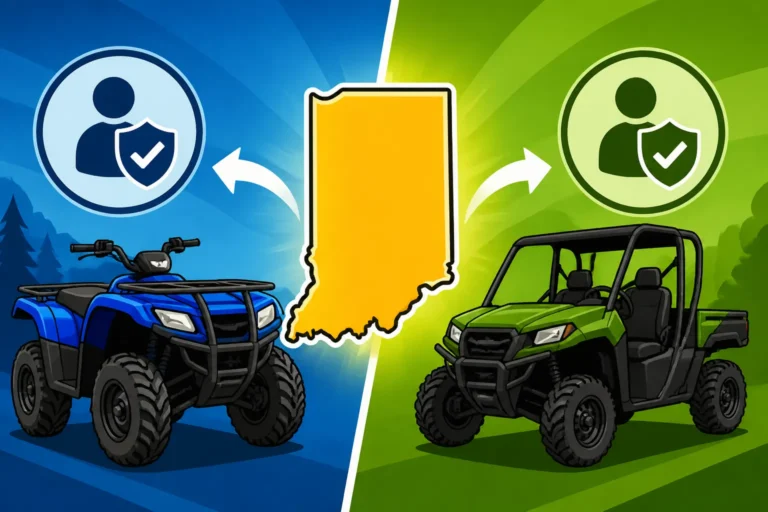
It also helps to separate trail-use permission from vehicle registration. A motorized trail-use permit is not an ORV registration, according to the Indiana Department of Natural Resources. The permit helps authorize trail use under the applicable park rules; it does not replace the registration requirement that applies to an ORV.
This distinction matters most for visitors and for anyone who plans to use public roads. According to the Indiana Department of Natural Resources, nonresident ORVs registered in another state or country may be operated in Indiana for no more than 20 days in one calendar year without Indiana registration. For an out-of-state visitor riding at Redbird or Interlake, the agency also offers an annual Out-of-State Motorized Trail Use permit for $20 per ORV, as of November 2026. That permit is valid only at those two DNR properties.
The out-of-state trail-use permit is not a general substitute for registration. According to the Indiana Department of Natural Resources, out-of-state visitors who want to drive on Indiana roadways open to ORV use must have the ORV registered in their home state or through the Indiana BMV. If the vehicle is not registered in its home state, the owner must apply in person at an Indiana BMV branch to register it for that road use.
| Situation | What to check |
|---|---|
| Indiana ORV riding at an eligible state riding area | Daily trail-use fee or annual trail-use permit for each ORV |
| Out-of-state ORV used only at Redbird or Interlake | Whether the Out-of-State Motorized Trail Use permit fits the trip |
| Out-of-state ORV driven on an Indiana road open to ORVs | Home-state registration or Indiana BMV registration |
| Riding somewhere other than Redbird or Interlake | The riding area’s own permit and admission rules |
For the out-of-state distinction, Indiana’s Out-of-State Annual Permit and Does Indiana Honor Out-of-State Registration? explain why a trail permit and registration answer different questions. If your trip is focused on a single property, check its current requirements before you head out; a permit valid at one location should not be treated as statewide authorization.
Count every ORV before you pay
A common budgeting mistake is to count riders or vehicles in the towing group instead of the machines that will actually be ridden. The daily fee is charged per ORV. Three machines needing daily coverage cost $45, whether they arrive on one trailer or in separate vehicles.
Before paying, make a simple list of the machines and the coverage each one has:
- Write down each ATV, UTV, dirt bike, or other ORV in the group.
- Mark which machines have a valid annual trail-use permit, if any.
- Count the machines that still need daily trail-use coverage.
- Multiply that number by the current per-ORV daily fee.
- Confirm that the permit is accepted at the property you plan to ride.
That check avoids paying for the wrong number of passes or assuming one permit covers multiple machines. Does Every Machine in the Truck Need Its Own Permit? covers the per-vehicle issue in more detail. And if you are deciding whether daily passes or an annual permit make more sense, Who an Indiana Day Permit Actually Suits can help you weigh trip frequency against upfront cost.
Keep the permit or proof of payment available while riding. The Indiana Department of Natural Resources says a valid daily receipt must be in the vehicle operator’s possession at all times. A phone photo may be a useful backup for your own records, but do not assume it replaces whatever proof the property requires. Confirm the accepted form with the park before departure.
The same preparation applies when more machines are added at the last minute. Recount the ORVs and update the total before leaving, rather than splitting a group payment based on the number of riders. If the group adds three machines that need daily permits, the added amount is $45 at the Indiana DNR rate.
The pass also does not remove the need to follow trail rules. Indiana DNR properties require vehicles to stay in designated areas and on marked trails. Operators should check the property’s current conditions and rules, then make sure every rider knows which routes are open and what equipment requirements apply.
Keep trail permits separate from BMV registration
Daily trail-use coverage does not settle whether the ORV is properly registered. According to the Indiana Department of Natural Resources, ORVs purchased after December 31, 2003 must be registered, unless an exemption applies. The Indiana BMV handles Indiana ORV registrations.
There are limited exemptions that can matter to a visitor or someone who has just bought a machine. According to the Indiana Bureau of Motor Vehicles, nonresidents operating an ORV registered in another state are exempt from Indiana registration for up to 20 days in one year. The BMV also says an operator with a bill of sale from a dealer or private individual that is no more than 45 days old is exempt from registration during that period.
Those exemptions are about registration, not payment for riding at a particular property. A nonresident may still need to arrange the appropriate trail-use permit for Redbird or Interlake, and a daily pass does not extend the time a nonresident may operate an ORV in Indiana without registration. Keeping those requirements distinct prevents an expensive misunderstanding at the property or on the road.
Indiana registration also involves more than a decal alone. According to the Indiana Department of Natural Resources, an ORV registration must identify the specific vehicle and include the owner’s name and address, year, manufacturer, make, model, and VIN. The BMV issues the registration and decals. For the separate paperwork process, see Indiana ORV Registration Paperwork and How Indiana ORV Registration Works.
A useful pre-trip check is to ask two separate questions for every machine:
- Is this ORV properly registered, or does it qualify for an applicable registration exemption?
- Does this ORV have the trail-use coverage required for the property we are visiting?
A “yes” to one does not automatically answer the other. This is particularly important for out-of-state machines, newly purchased ORVs, and machines being hauled to a DNR riding area for a day trip.
If you are traveling to Redbird or Interlake, confirm both the trail-use permit and the vehicle’s registration status before loading. The $45 calculation is simple; the useful planning step is making sure that it applies to the right three machines and does not get mistaken for broader authorization.
Sources
- Indiana Department of Natural Resources — State Parks: ORV/Snowmobile Registration FAQs (checked November 3, 2026)
- Indiana Department of Natural Resources — State Parks: Motorized Recreation (checked November 3, 2026)
- Indiana Department of Natural Resources — State Parks: Motorized Recreation (checked November 3, 2026)
- Indiana Bureau of Motor Vehicles — Registrations & Plates: Off-Road Vehicles and Snowmobiles (checked November 3, 2026)
- Indiana Department of Natural Resources — State Parks: Interlake Off-Road State Recreation Area (checked November 3, 2026)
- Indiana Bureau of Motor Vehicles — Registrations & Plates: Off-Road Vehicles and Snowmobiles (checked November 3, 2026)
- Indiana Bureau of Motor Vehicles — Dealer_ORV_or_snowmobile_Registration_Packet.pdf?language_id=1 (checked November 3, 2026)
- Indiana Department of Natural Resources — State Parks: Interlake Off-Road State Recreation Area (checked November 3, 2026)
Disclaimer
This article is for general informational purposes only and does not constitute professional advice. Laws, prices and regulations vary by location and change over time. Consult a qualified professional for guidance on your specific situation.