Indiana Fines for Riding a Closed Trail
Riding a trail marked closed in Indiana can turn a day out into a citation, even if you have a valid permit. The consequence depends on where the trail is, why it is closed and what rule the officer says was broken. Here’s how to understand the potential penalties, avoid making the situation worse and respond if you receive a citation.
What riding a closed trail can mean in Indiana
A closed trail is not simply a route that looks inconvenient or difficult. A closure may be posted at a trail entrance, shown on an official map, announced by a park or land manager, or created temporarily because of weather, maintenance, safety concerns or another management need. The exact rules depend on the land and the authority responsible for it.
An Indiana ORV permit does not give a rider permission to ignore a closure. Permits and closures answer different questions: a permit may be required to ride in an area, while a closure restricts where or when riding is allowed. Buying the right permit, displaying it correctly and having proof of registration do not make a closed trail open. For background on the permit itself, see Indiana’s Daily and Annual Trail Permits.
Closures can be permanent or temporary. A trail may be closed for the season, for repairs, after heavy rain, or while staff address a hazard. A route can also be open to some users but closed to motorized vehicles. Check the specific notice rather than assuming that a visible path is available to ride. Indiana Rules for Riding a Closed Trail explains the distinction between being in an approved riding area and following its restrictions.
The potential consequences can vary. Depending on the location and circumstances, a rider may face a citation or other enforcement action for violating a park rule, permit condition, land-use restriction or applicable law. Additional issues may arise if the rider damages the trail, ignores a barrier, trespasses, or creates a safety risk. Those are not automatically the same offense, and a closed-trail citation does not necessarily mean every possible consequence applies.
| Situation | What it may mean | What to do |
|---|---|---|
| Official sign says the trail is closed | The route is not available for riding under the stated restriction | Turn around and use an open, designated route |
| A gate or barrier blocks the entrance | The closure is clearly marked, even if the trail beyond it looks passable | Do not go around, move or cross the barrier |
| The closure is temporary or weather-related | Conditions or maintenance may have made the route unsafe or unavailable | Check current notices before unloading |
| The trail is not marked on the current riding map | It may not be an authorized route, even without a closure sign | Stay on designated routes and ask park staff if unsure |
| You receive a citation | An officer or ranger believes a rule was violated | Read the citation carefully and follow its response instructions |
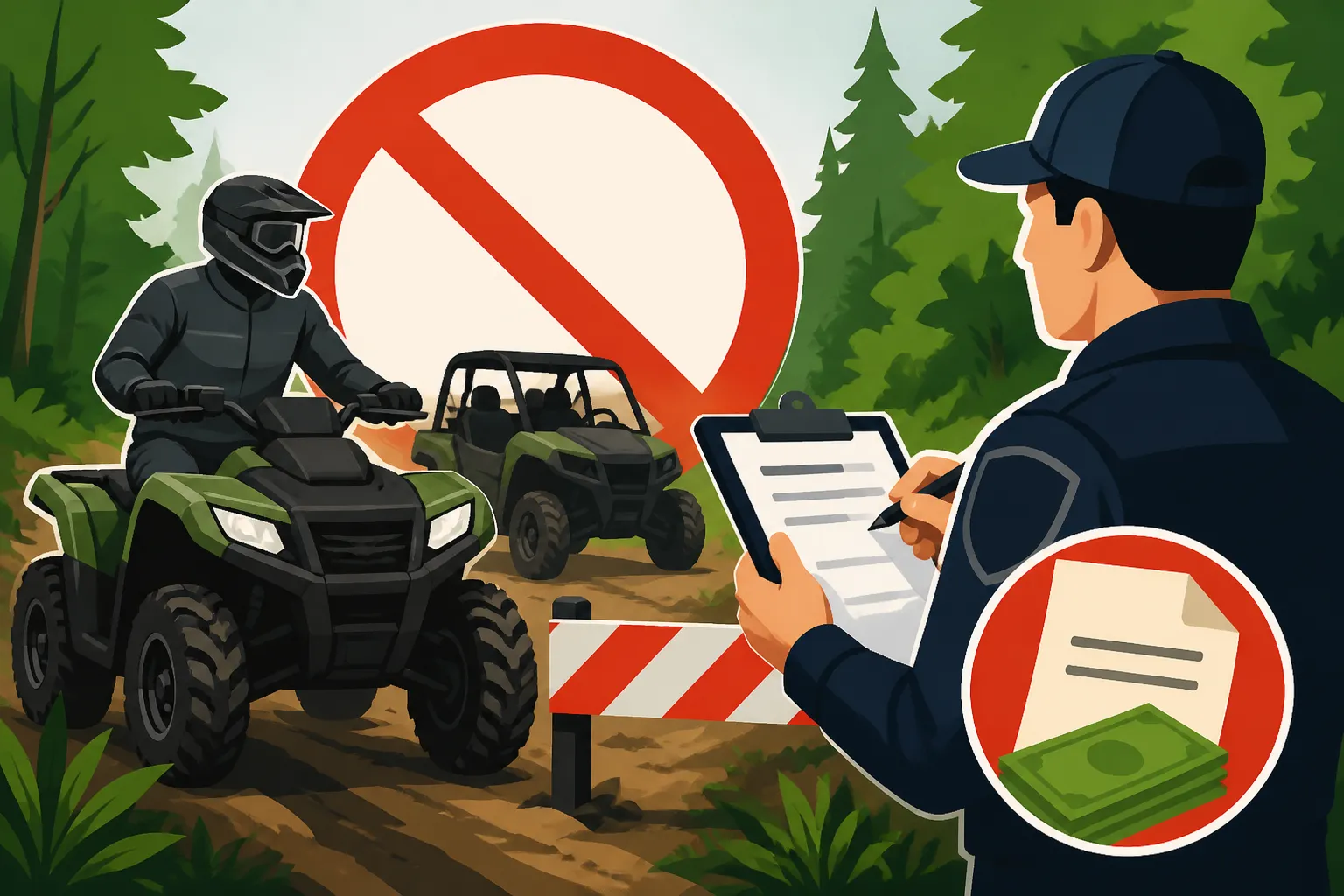
The clearest practical rule is to treat a posted closure, gate or barrier as a stop sign. Do not assume a closure is optional because other riders have used the trail, the route appears dry, or the barrier is easy to bypass. Riding around a sign may also make it harder to explain that you misunderstood the restriction.
What affects the fine or other penalty
There is no single fine that applies to every closed-trail situation across Indiana. The amount and process can depend on the governing rule, the property, the alleged conduct and how the citation is handled. State recreation areas, private riding parks and other managed properties may have different rules and enforcement procedures. The citation should identify the alleged violation and tell you how to respond.
Some factors that can affect how a case is treated include:
- Where the trail is located. The responsible land manager and applicable rules may differ between public and private property.
- What notice was provided. A signed closure, a barricade or a clear official notice may matter when establishing that a route was restricted.
- What the rider did. Accidentally entering a route and deliberately moving a barrier are not identical circumstances.
- Whether damage or danger resulted. Trail damage, unsafe riding or interference with a closure may lead to additional attention beyond the basic route violation.
- Whether another rule was also involved. Riding without a required permit, leaving designated routes or trespassing can raise separate issues. See Indiana Fines for Riding Without a Permit and [Indiana Rules for Riding Off the Trail] for those related situations.
A rider should not assume that a closed-trail violation will be treated like an unregistered machine or an illegal road ride. Different conduct can involve different rules. The general topic of road-related enforcement is covered in Indiana Fines for Illegal ORV Road Use, but a trail closure should be assessed under the rules for the specific riding area.
A citation also does not always mean the final amount is fixed at the roadside. It may identify a court, agency or other process for responding. Any listed amount, due date, hearing option and payment method should be checked directly on the citation and with the office named there. Deadlines can matter: paying a citation may affect your options, so do not ignore the instructions or assume that contacting the park alone resolves it.
If a ranger or officer stops you, remain calm, follow lawful directions and avoid arguing about the closure on the trail. You can ask which rule is alleged and where the citation explains how to respond. If you believe the closure was not visible or the route was incorrectly identified, make a factual note as soon as practical. Record the location, time, sign wording, trail marker and conditions. Photos can help document what you observed, but do not enter a restricted area again to take them.
How to avoid a closed-trail citation
The safest approach is to check the current status before you travel, then confirm it again when you arrive. Trail information can change, and a map saved on your phone may not reflect a recent closure. Use the riding area’s official notices or contact the property directly if the status is unclear. Indiana Trail Closures to Check First and Checking an Indiana Trail Notice First are useful reminders to verify conditions before setting out.
Follow this routine:
- Check the official trail information before leaving. Look for closure notices, seasonal restrictions and alerts from the land manager. If a site publishes a map, confirm that it is current rather than relying on an old screenshot.
- Read the entrance signs and gate board. Notices at the property may be more recent than information you found earlier. Reading the Gate Board Before You Unload covers why the posted information at the entrance matters.
- Stay on marked, open routes. Do not treat an unmarked track, utility path or cut-through as an authorized trail. If a route is not clearly open, choose one that is.
- Turn around at a closure. Do not pass a barricade, move a sign, ride around a gate or follow another vehicle through. A visible track beyond a barrier does not cancel the closure.
- Ask staff when signs conflict or the boundary is unclear. A park office can clarify the route status before you ride. If you cannot confirm that it is open, avoid it. See Calling a Park Office Before You Load.
- Keep your permit and paperwork separate from route permission. Carrying the required permit may be important, but it does not authorize a closed trail. If you need help understanding permit coverage, Where to Buy an Indiana ORV Permit explains where permits are obtained.
Weather deserves particular attention. Rain can make a trail unsafe or vulnerable to damage, and a route that was open during a previous visit may later be closed. Even if no closure sign is visible at the staging area, look for notices at trail junctions and obey barriers farther along the route. If conditions are deteriorating, turn back rather than trying to reach the end of a loop.
If you receive a citation, read the document from start to finish. Check the alleged violation, location, response deadline and instructions for requesting a hearing or contesting the matter. Keep copies of relevant permit documents, maps, official closure notices and any photographs you took from a lawful location. If the matter is serious, involves alleged property damage, or is unclear, seek qualified legal advice instead of relying on assumptions about what a fine should be.
A practical way to reduce confusion is to plan a backup route. If your intended trail is closed, use another route that is expressly open or choose a different riding area. Do not let a long drive, a paid entrance fee or a group’s schedule pressure you into crossing a closure. A fee or permit buys access under the applicable rules; it does not guarantee that every trail will be open.
Disclaimer
This article is for general informational purposes only and does not constitute professional advice. Laws, prices and regulations vary by location and change over time. Consult a qualified professional for guidance on your specific situation.