Riding Lawrence County’s 40 Miles
Lawrence County Recreational Park’s advertised 40 miles of off-road riding can make for a full day, but the experience depends on more than distance: trail conditions, machine size, weather, and park rules all matter. This guide helps you plan a safer, less stressful visit near Springville, Indiana, from choosing a route to checking what to bring before you unload.
What to expect from Lawrence County’s 40 miles of riding
The mileage is a network, not one continuous loop
Think of the 40 miles as a trail network rather than a single route that you can follow from start to finish. Your actual ride will depend on which trails are open, the kind of machine you bring, and how much time you want to spend on the property. A group taking regular breaks, helping a newer rider, or stopping to check the map may cover much less than a group riding steadily.
That difference matters when you are planning a day around a trailer, a family schedule, or a long drive. Avoid treating the advertised mileage as a promise that every trail will be open or appropriate for every vehicle. Conditions and closures can change, and some sections may be unsuitable for your machine or experience level.
Before your trip, check the park’s current information and ask about available trail maps, open routes, machine restrictions, and any special event or maintenance closures. If you use a navigation app such as onX Offroad, treat it as a planning aid—not as confirmation that a route is currently open or permitted. Follow posted signs and directions from park staff over any route displayed on your phone.
Match your machine to the trails and the group
A quad, side-by-side, and dirt bike can feel very different on the same property. A wide side-by-side needs enough clearance and room to negotiate turns; a dirt bike rider may move at a different pace from a family group on ATVs. Ask the park which trail types are open to your machine before you load up, rather than assuming that a trail shown on a map is suitable for every vehicle.
Lawrence County Recreational Park is worth researching if your group includes more than one kind of machine. The distinction between ATV routes and single-track riding can affect both the route you choose and how you share it. For more on that distinction, see [Separate ATV and Single-Track Trails](Separate ATV and Single-Track Trails).
A useful pre-trip question is not just, “Can my machine ride there?” Ask whether the park has any limits related to width, vehicle type, passenger setup, or required equipment. Those details can affect whether your group can stay together and whether a particular trail is a reasonable choice. If you are new to the area, start conservatively, then choose more demanding routes only after you understand the terrain and conditions.
| Before you go | Why it matters | What to check |
|---|---|---|
| Trail availability | Routes can close or change with conditions | Open trails, closures, and any event schedule |
| Machine type and width | Not every route suits every vehicle | ATV, UTV, dirt bike, and width restrictions |
| Skill and group pace | A long day can feel difficult for newer riders | Easier route options and a realistic ride plan |
| Fees and entry requirements | Park policies can differ from state trail rules | Current gate fees, waivers, and required permits |
| Weather and trail conditions | Rain can turn firm ground into difficult mud | Recent rainfall, surface conditions, and advisories |
| Maps and navigation | Phone coverage and app maps may be limited or outdated | Park map, posted signs, and offline navigation |
Plan your route, time, and arrival
Choose a ride that fits your group’s experience
For a first visit, plan a manageable ride instead of trying to cover as much ground as possible. A group with children or first-time riders may need time for instructions, water breaks, and adjustment stops. Experienced riders may be comfortable covering more distance, but they still need to account for trail intersections, changing conditions, and the possibility that part of the network is closed.
If you are bringing a mixed-ability group, agree on a pace and regrouping plan before leaving the staging area. Pick obvious places to stop, and make sure everyone knows what to do if the group gets separated. Riders who are still learning may benefit from beginning on easier terrain; [Indiana Trails for Beginners](Indiana Trails for Beginners) offers more context for choosing an appropriate first ride.
Use a current park map alongside any digital planning tool. onX Offroad can help you review your route and understand the surrounding area before the trip, but a phone map should not replace the park’s own directions or posted trail markers. If you save an area for offline use, make sure the map is available before you arrive, especially if your route passes through places with unreliable cell service.
Build a practical day around the drive and the ride
A full ride day starts before the first trail. Give yourself enough time to arrive, check in, handle any paperwork, unload safely, and review the current rules. Rushing through those steps is a common way to miss a restriction or discover that someone’s gear is still in the truck.
Bring water, snacks, basic first-aid supplies, and clothing suited to changing weather. Pack a phone charger or battery pack, but do not assume that you will have dependable service everywhere. A paper or downloaded map is a helpful backup. If you are traveling with several machines, confirm that everyone knows where the group will meet if a rider needs to return to the staging area early.
If you are considering staying nearby, confirm lodging and camping details directly with the park or the provider you plan to use. Do not assume that camping, overnight parking, or facilities are available just because a place has trails. The broader guide to [Indiana Private Off-Road Parks](Indiana Private Off-Road Parks) can help you compare what to check when planning an off-road trip.
Check conditions, rules, and riding etiquette
Rain can change the day’s ride
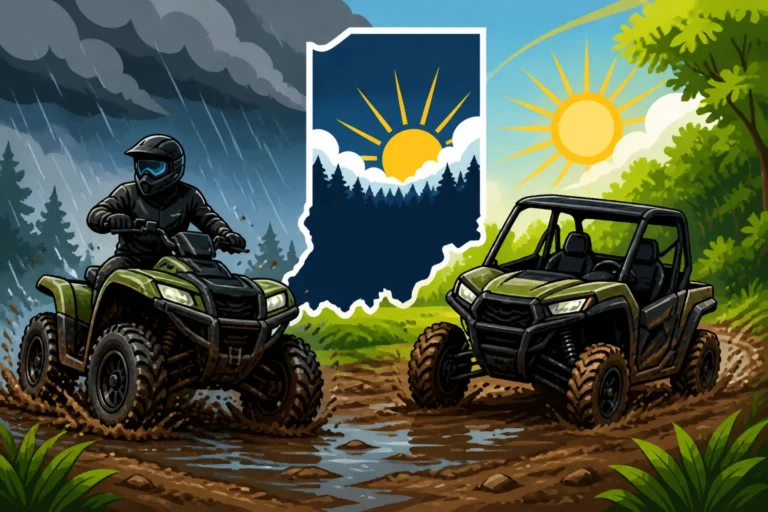
The same trail can be pleasant when dry and difficult after a soaking rain. Mud may hide ruts, make climbs slippery, and reduce traction for both ATVs and UTVs. Riding through soft ground can also deepen damage, so obey closures and avoid entering trails that are clearly posted as closed or too wet for use.
Check the forecast, but also ask about recent conditions. A dry morning forecast does not tell you how much rain fell overnight or how quickly a particular section drains. For more on planning around wet ground in the state, see [Indiana Riding After Heavy Rain](Indiana Riding After Heavy Rain) and [Indiana Trail Conditions Before You Ride](Indiana Trail Conditions Before You Ride).
If conditions are poor, changing your plan is often the better call. You might choose a shorter ride, postpone the trip, or spend more time on routes the park identifies as suitable. Do not use an app’s apparent route line as evidence that a muddy trail is open. onX Offroad can support navigation and pre-trip planning, but current park notices and on-site signs should guide your decisions.
Share trails with care and follow the park’s rules
At intersections and narrow sections, slow down and be ready to encounter another rider. Keep a safe following distance, pass only when it is safe and allowed, and avoid stopping where other riders cannot see you in time. If your group includes both faster and slower riders, agree on how the faster riders will wait and regroup rather than pressuring less experienced members to ride beyond their comfort zone.
Stay on designated routes and follow posted directions, speed limits, and equipment requirements. A trail that looks inviting may be closed, reserved for another vehicle type, or outside the permitted riding area. Respecting those boundaries helps keep the property usable and reduces the chance of an unpleasant conversation with staff or another rider.
Good trail manners matter just as much on a county property as they do elsewhere. Leave gates and signs as you find them, pack out trash, and give other groups room. The practical guidance in [Indiana Trail Etiquette on Shared Ground](Indiana Trail Etiquette on Shared Ground) is useful for planning a ride where different vehicles and experience levels share the same area.
Prepare your machine and avoid common trip problems
Do a basic inspection before loading
A short pre-ride inspection can prevent a long delay. Check tire condition and pressure, brakes, lights, controls, fuel, and visible leaks. Look over tie-downs and the trailer before leaving home, then recheck the load after you have driven a short distance. Bring the tools and small supplies you already know your machine may need, rather than counting on finding the right item near the park.
For a UTV, check seat belts and make sure passengers understand how to use them. For any machine, confirm that the rider has a properly fitting helmet and clothing suited to the weather and terrain. If you are borrowing or renting a vehicle, ask who is responsible for maintenance, safety equipment, and any required registration or park paperwork.
Keep your plan simple enough that a mechanical issue does not strand the whole group. Make sure at least one person knows the route back to the staging area, and carry a way to contact your group if you become separated. A saved map from onX Offroad may help with orientation, but do not rely on phone service as your only way to communicate.
Confirm costs and entry requirements before departure
Fees and park procedures can change, so check the park’s current instructions before you travel. Ask what the gate charge covers, whether each machine needs a separate payment, whether waivers are required, and what forms of payment are accepted. Also ask about age requirements, passengers, noise rules, and any equipment restrictions that apply to your group.
Do not assume that a state trail permit automatically covers riding at Lawrence County Recreational Park. Park access rules depend on the property and the type of facility. Confirm the requirements with the park itself, and keep any confirmation, waiver, or receipt accessible while you ride.
Finally, leave room in your schedule for arrival and check-in. If the park is hosting an event or has a special operating schedule, your usual plan may not fit. A quick check before departure can save you from hauling machines all the way to Springville only to find that a trail, service, or access point is unavailable.
Disclaimer
This article is for general informational purposes only and does not constitute professional advice. Laws, prices and regulations vary by location and change over time. Consult a qualified professional for guidance on your specific situation.