Fuel Between Indiana Trailheads
Planning fuel between Indiana trailheads can be trickier than the ride itself. A machine may burn more than expected in deep mud, while a rural fuel stop can sit well off your route—or be closed when you reach it. This guide helps you plan fuel for your ATV or UTV, your tow vehicle, and the miles between riding areas.
Plan fuel around your whole trip
Separate machine fuel from tow-vehicle fuel
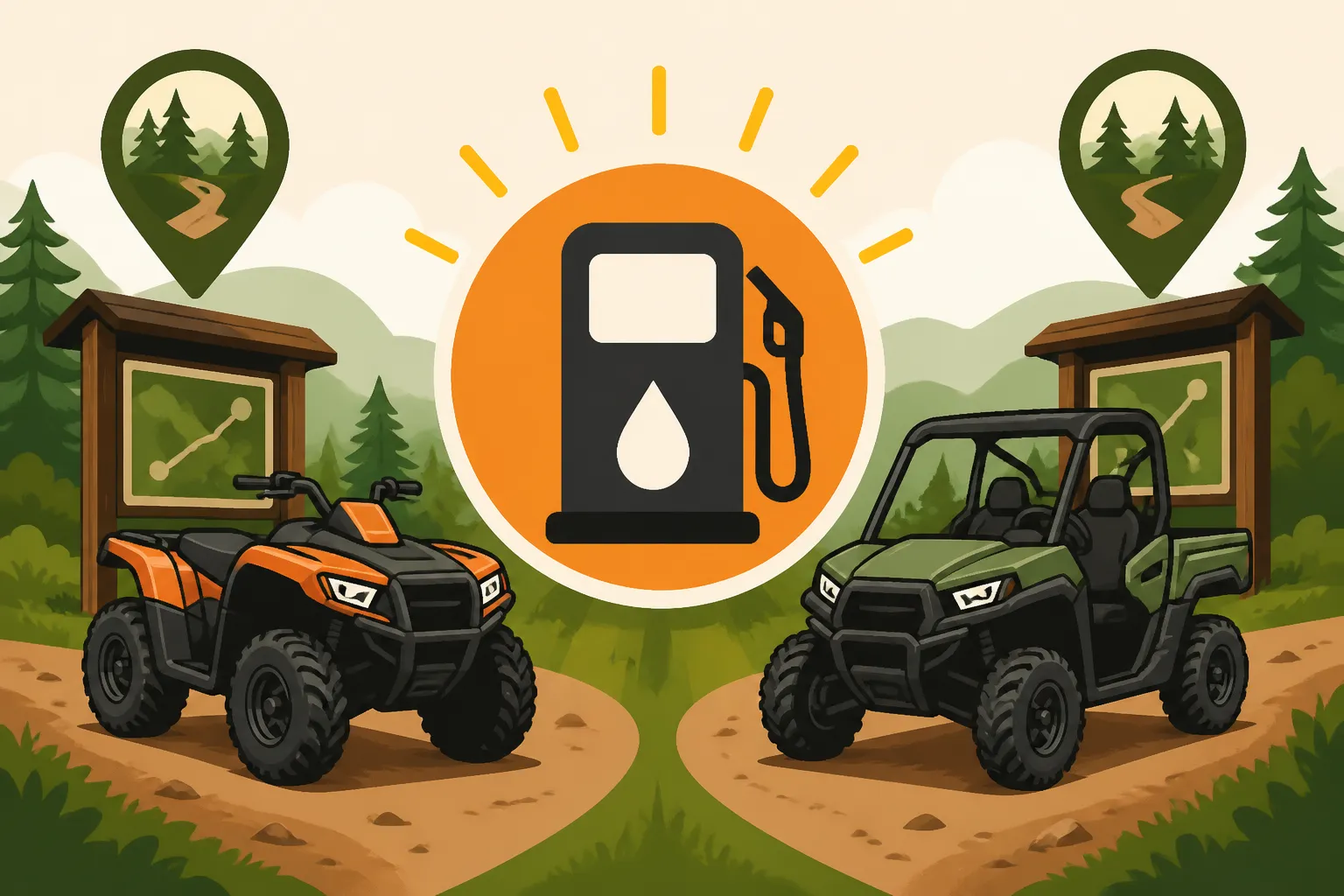
When riders talk about “fuel between trailheads,” they may mean two different things: gasoline for the ATV or UTV on the trail, or fuel for the truck and trailer on the road. Plan for both. A tow vehicle pulling a loaded trailer can use fuel differently from the same vehicle travelling empty, and the machine may use more fuel in demanding trail conditions than it does on an easy ride.
Start by estimating the machine’s fuel use from your own riding history. Note how much fuel you use during a typical outing, then consider what changes when you ride longer, climb hills, crawl slowly, or spend time in mud. If you are riding somewhere unfamiliar, build in a margin rather than planning to use nearly the entire tank. A ride that looks short on a map can involve repeated stops, slow technical sections, and detours around a closed trail.
Treat the truck’s route as a separate plan. Mark fuel stops along the drive to the riding area and on the return route, especially if you are towing through rural parts of southern Indiana. Do not assume the nearest station is directly beside the highway or has space for a truck and trailer. A quick call or an up-to-date map check can help you avoid discovering that a listed stop is inconvenient for your rig.
Estimate consumption for the kind of ride you expect
A machine’s fuel range is not a fixed number. It varies with the model, load, terrain, riding style, maintenance, and conditions. A steady ride on smoother ground may use less fuel than repeated climbing, wheelspin, or slow riding through sticky clay. A passenger or added cargo can also affect how hard a machine works.
Think through the day you are planning. A beginner-friendly loop with frequent breaks is different from a long day exploring a large riding area. Redbird near Dugger and Interlake near Lynnville are examples of southern Indiana destinations where riders may want to spend substantial time on the trails. Before leaving, check the park’s current information, your route, and your own machine’s fuel capacity. Redbird Off-Road State Recreation Area and Interlake Off-Road State Recreation Area are useful starting points for understanding the destinations themselves.
If you have never measured fuel use on your machine, do a conservative test closer to home. Begin with a known amount of fuel, ride a familiar route in conditions similar to your planned outing, and record how much remains. This will not guarantee the same result on another day, but it gives you a more grounded estimate than relying on a best-case range from a brochure or another rider’s machine.
Build a reliable fuel-stop plan
Check stops along the towing route
A map can show fuel stations, but a marker alone does not tell you whether the stop suits a tow vehicle. Check access, hours, and whether there is room to turn around with a trailer. A station on a busy road may be less practical than one a few minutes farther along a quieter route. If you are travelling toward a rural destination, identify at least one backup stop in case your preferred option is unavailable.
This is especially helpful when trailering across Indiana or coming from another state. Mark the last convenient fuel stop before the final stretch, then note another option for the return trip. If you are riding in a group, agree on the stop before setting out; one driver’s “we can make it” may not match another driver’s fuel gauge or trailer setup. Trailering an ORV Across Indiana covers related planning considerations for getting a machine to a riding area.
Use a route planner or mapping tool to inspect the corridor, but confirm important details close to departure. onX Offroad can help you review off-road routes and plan around riding areas; use a separate check for public-road fuel stops, opening information, and access for your vehicle. Save key locations before you leave if your route may pass through places with weak mobile coverage.
Find out what fuel access exists at the riding area
Never assume a trailhead, park office, campground, or nearby business sells fuel for your machine. Fuel access can vary by property and can change, so check directly with the riding area before you load the trailer. Ask whether fuel is available on-site, whether riders must leave the property to find a station, and whether leaving and re-entering affects your plans or admission.
Private riding parks and state recreation areas do not all operate the same way. A nearby town may have fuel, but the closest station could be farther away than it appears, particularly if roads do not connect directly to the trail area. Use Indiana’s Private Off-Road Parks and Where to Ride an ORV in Indiana to compare destination types, then verify practical details for the specific property you intend to visit.
Also check whether you are allowed to carry and store fuel at your campsite or staging area. Follow the park’s rules, use an approved container, and keep fuel away from heat, sparks, and places where it could spill into soil or water. Do not leave a loose fuel can in a hot vehicle or unsecured in a trailer.
| Fuel-planning question | What to check | Why it matters |
|---|---|---|
| How much fuel will the machine use? | Your own riding history and expected terrain | Range can change with mud, hills, load, and riding style |
| Is there fuel near the trailhead? | Park information and a direct check with the property | A nearby map marker may not mean convenient access |
| Can the tow vehicle reach the station easily? | Hours, entrance, turning space, and trailer access | A station can be open but awkward or impractical with a trailer |
| Is mobile coverage reliable? | Route and park coverage, plus saved offline information | You may need directions when a live map will not load |
| What is the backup plan? | A second stop and enough reserve to reach it | One closed or inaccessible station should not derail the trip |
Carry fuel and ride with a safety margin
Decide whether to refuel on the way or carry a reserve
For many riders, the simplest plan is to arrive with the machine’s tank full and the tow vehicle fueled before the final stretch. That reduces the need to hunt for fuel after unloading. If your ride plan requires extra fuel, work out how much you need before the trip and carry it only in an approved, properly secured container, following the park’s requirements and the container’s instructions.
Do not calculate your reserve as though every drop in the container will be usable. Keep a margin for a longer-than-expected route, a detour, or conditions that increase consumption. In a group, make sure each rider understands whether the plan assumes everyone begins full and whether anyone needs to stop earlier. A rider who quietly has a smaller tank or a machine that burns more fuel can change the group’s timing.
Avoid topping off in a way that creates spills, and do not refuel near smoking, flames, hot engine parts, or other ignition sources. Shut the machine down and follow the manufacturer’s refueling instructions. Clean up any spill promptly and keep fuel away from waterways and drains. These basics are easy to overlook when everyone is eager to get riding, especially after a long drive and trailer unload.
Prepare for dead zones and changing conditions
A fuel plan that exists only on a phone screen can fail when service drops. Before leaving home, save the address and directions to your riding area, fuel stops, and backup locations. Keep an offline map or written notes with the key road names and turns. If you use onX Offroad for route planning, download the information you need while you still have a reliable connection, and keep a separate record of the road route to your fuel stops.
Cell service can be inconsistent in parts of southern Indiana. Check Cell Dead Zones in Southern Indiana as you prepare, but do not rely on a mobile connection for every navigation decision. Tell someone your destination and expected return time, particularly if your group is splitting up or travelling to an unfamiliar area. Before riding, review Indiana Trail Conditions Before You Ride so weather or closures do not force an unplanned change to your day.
Weather can affect fuel use, too. Wet, heavy ground may slow a machine and encourage more throttle; a route that takes longer than expected can mean more engine running and additional fuel use. If conditions change, shorten the ride rather than pushing the machine to its estimated limit. Keep enough reserve to get back to the staging area without depending on a fuel stop you have not confirmed.
A practical checklist for fuel between trailheads
Before you leave home
Make your plan while you still have time to adjust it. Confirm the riding area’s rules and fuel arrangements, check the route for suitable fuel stops, and make sure your truck has enough fuel for the drive and return. If you are travelling between riding areas in one day, treat each leg as its own plan. Do not assume you can simply ride or drive directly from one trail system to another; access and road rules are different from trail access.
For the machine, start with a full tank where appropriate and bring only the reserve fuel you need. Check the fuel cap, tank, and any container for leaks or damage. Make sure containers are secured so they cannot tip, rub against sharp equipment, or shift during the drive. Keep them separated from passengers and anything that could create heat or sparks.
Put the address and phone number for the riding area somewhere accessible, and save directions before entering a low-service area. If you use onX Offroad to understand trail routes and nearby riding areas, pair that planning with a road map for the fuel stops. Planning Fuel for a Southern Indiana Loop can help you think through the logistics of a longer ride day.
At the trailhead and between riding areas
Before unloading, check the fuel level and compare it with the ride you intend to do. If someone in your group has less fuel, adjust the route or make a refueling plan before leaving the staging area. Agree on a turnaround point or a minimum reserve. It is much less stressful to shorten a loop early than to guess at the last few miles with a nearly empty tank.
Between riding areas, refuel the tow vehicle before the gauge becomes urgent. If you are heading from one park to another, verify the road route and the access rules for each property; a mapped trail connection should not be treated as permission to ride on public roads. Indiana’s Two State ORV Areas Compared can help with destination planning, while the individual park’s own information should guide your visit.
Finally, leave the area with the fuel plan still intact. Recheck the truck, secure any remaining containers, and make sure nobody is counting on a station that has not been confirmed. A little preparation makes the day more relaxed: you can focus on the ride instead of watching the fuel gauge and hoping the next stop is open.
Disclaimer
This article is for general informational purposes only and does not constitute professional advice. Laws, prices and regulations vary by location and change over time. Consult a qualified professional for guidance on your specific situation.