Seat Belts for Indiana Side-by-Side Occupants
A side-by-side’s seat belts are easy to overlook when you are focused on trail permits, helmets, and getting everyone loaded. In Indiana, though, occupants must wear installed seat belts while an off-road vehicle is operated on public property. Here’s where that rule applies, how it differs from helmet and permit requirements, and what to check before your ride.
Indiana’s seat-belt rule for side-by-sides
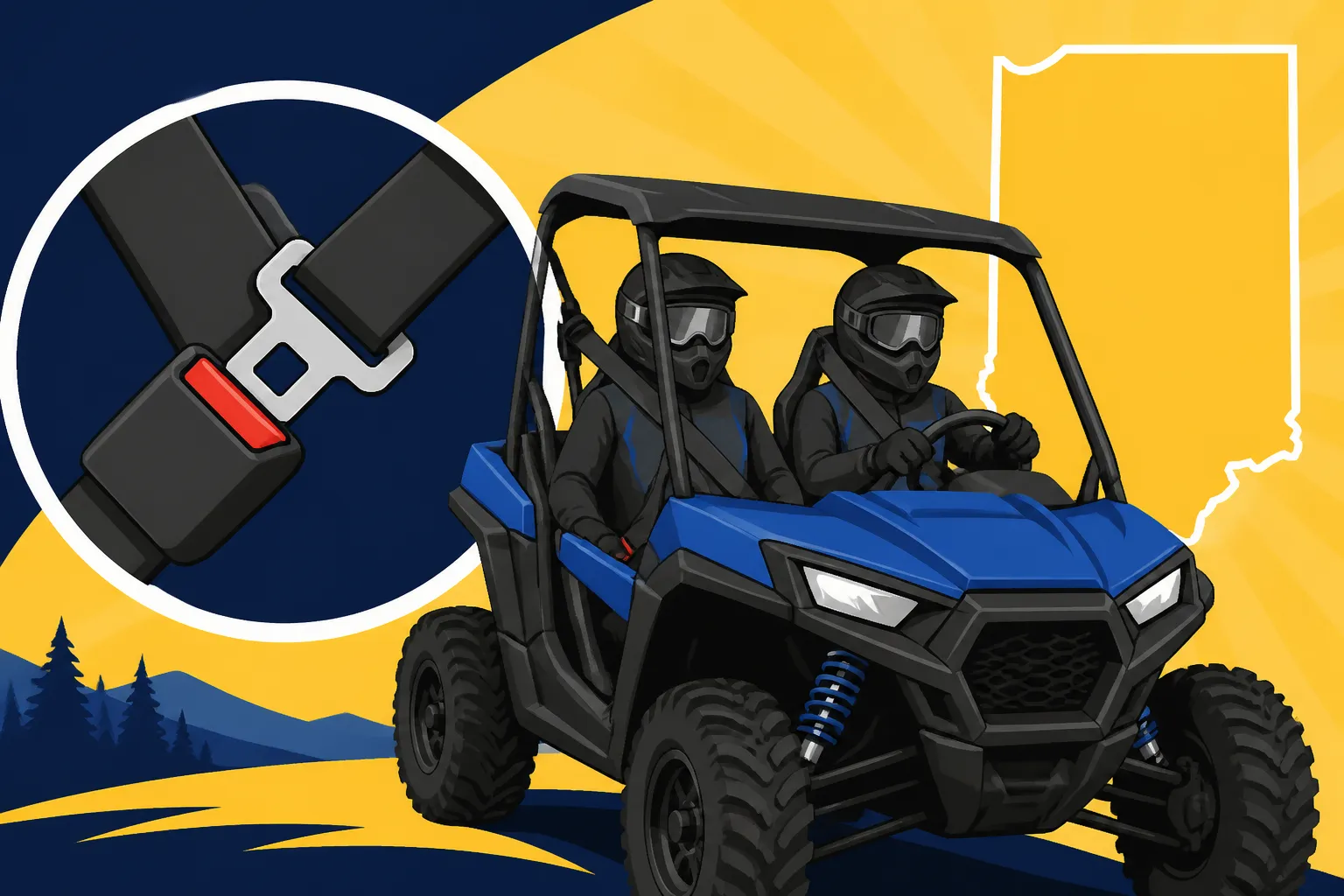
Indiana requires occupants of an off-road vehicle to wear seat belts when the vehicle is equipped with them while it is operated on public property. A side-by-side with factory-installed belts is the common example: every occupant should be seated in an approved seat and buckled in before the machine moves.
The rule is not a substitute for the vehicle’s owner manual or manufacturer instructions. Follow those instructions about how to position the lap belt and shoulder belt, how many people the machine can carry, and which seats are intended for occupants. A belt that is twisted, routed incorrectly, or attached to damaged hardware may not protect the rider as intended.
A few practical points help prevent confusion:
- If the machine has seat belts, use them. Do not assume a slow trail pace, a short ride, or an experienced driver makes them optional.
- Match each occupant to a designated seat and restraint. Do not carry extra riders on a cargo area, fender, or other place without a passenger seat and belt.
- Keep the belt fastened for the entire ride, including short trips around a staging area or campground where riding is permitted.
- Do not remove, disable, or modify the restraints to make entry easier or to accommodate an extra passenger.
The rule is about wearing a belt when one is provided; it does not mean every type of off-road vehicle must be retrofitted with belts. Quads and dirt bikes generally do not have seat belts because riders sit astride the machine rather than inside a belted seat. A side-by-side’s seating and restraint system makes the belt requirement relevant.
This is one part of the larger set of public-land requirements. Indiana Helmet and Seat Belt Rules on Public Land covers how restraint requirements fit alongside helmets and other safety rules. A permit, registration decal, or out-of-state plate does not replace the obligation to use the safety equipment required for the vehicle and location.
| Situation | Practical approach |
|---|---|
| Side-by-side has working seat belts and is on public property | Everyone rides in a designated seat and wears the belt |
| Side-by-side has a belt that is frayed, stuck, or missing a buckle | Repair it before riding; do not treat a defective restraint as usable |
| Quad or dirt bike has no seat belt | Do not add a belt as a substitute for the rules that apply to that machine |
| Ride is on private property | Check the property owner’s rules and any applicable law; do not assume public-land rules answer every question |
| Rental machine has belts | Use them and ask the rental provider to explain any unfamiliar restraint system |
Where the rule applies and how permits fit in
The seat-belt requirement described here applies when an off-road vehicle is operated on public property in Indiana. That scope matters. A private farm, private trail, or pay-to-ride park may have its own requirements, and a park can set entry or operating conditions for visitors. Check the rules for the specific property instead of assuming that every place uses identical terms.
Public-land safety rules are also separate from access permits. A trail permit can authorize access to a designated riding area, but it does not waive belt requirements. Likewise, having a valid registration or an out-of-state machine does not make an occupant exempt from using installed belts.
For state off-road areas, riders should confirm the current permit and entrance requirements as well as the safety rules. Do You Need a Permit for Indiana ORV Trails? explains the permit question, while Indiana Rules for a Rented Machine is useful if the side-by-side is rented rather than privately owned. A rental provider may give instructions or have additional rules, but those do not cancel requirements that apply at the riding location.
Out-of-state visitors should treat equipment rules and reciprocity as two different checks. A machine’s registration status may affect whether it can be operated in Indiana and whether a visitor needs a permit. It does not ordinarily change how occupants must ride once they are on public property. If you are bringing a machine from another state, review Does Indiana Honor Out-of-State Registration? and Indiana Twenty-Day Visitor Rule as separate questions from seat belts.
A useful pre-trip check is to answer these questions for the exact ride:
- Is the property public, private, or a managed park with its own rules?
- Does the location permit the type of machine you plan to bring?
- Is a trail permit, entrance fee, or other access authorization required?
- Does the side-by-side have seat belts, and are they functional?
- Are there additional rules for passengers, helmets, age, or the specific vehicle class?
That prevents a common mistake: treating “I have a permit” as if it answers every operational question. A permit addresses access. Belts, helmets, passenger limits, and safe operation remain separate considerations.
Seat belts, helmets, passengers, and enclosed cabs
Seat belts and helmets are not interchangeable. A belt helps keep a seated occupant within the protective space of a side-by-side. A helmet protects the head. Where helmet rules apply, buckling in does not remove the helmet obligation.
Indiana has a helmet rule for certain riders on public land, including riders under 18, with an exception related to an enclosed cab. That exception concerns the helmet rule; it should not be read as permission to skip a seat belt. If the vehicle has belts, occupants still need to use them as required. For the details, see The Enclosed Cab Exemption in Indiana and Indiana Helmets at Redbird and Interlake.
Passengers also need to fit the machine’s actual seating arrangement. A side-by-side’s capacity is not just a matter of how many people can squeeze inside. Each passenger needs a designated position and the correct restraint. Children should be seated and belted according to the vehicle maker’s instructions, with any age-specific rules checked separately. Do not assume an adult can hold a child safely in a seat while the vehicle is moving.
Before taking a passenger, confirm that:
- The vehicle has a seat designed for that person.
- The seat belt reaches and fastens properly without being altered.
- The rider can sit back in the seat with the belt positioned as intended.
- The number of occupants does not exceed the machine’s stated capacity.
- Helmets and other protective equipment are available when required.
The same careful distinction applies to vehicle categories. A side-by-side is not treated like a quad simply because both are off-road vehicles. A passenger rule or helmet exception that applies to one kind of machine may not apply to another. Indiana Rules for Carrying a Passenger and Indiana Rules for a Full-Size Vehicle Operator can help sort out questions that depend on vehicle type, operator age, or the riding location.
Do not rely on a roll cage alone as a reason to leave belts unfastened. The cage is part of the machine’s protective structure, while the belt helps keep occupants positioned within it. If a machine has both, use the restraint as designed. Avoid riding with a door or side net open unless the owner manual allows it and the property’s rules permit that setup. Never reach outside the protective area to hold an object or steady another rider while moving.
Inspecting belts and using them correctly
A quick restraint check before each outing can catch problems before they become harder to spot on a trail. Belts may be exposed to mud, water, grit, sunlight, and repeated pulling. A buckle can become clogged; webbing can fray; a retractor may stop winding smoothly. Any one of those problems is a reason to pause and assess the system rather than assume it will work when needed.
Start with a visual and hands-on check:
- Pull the belt out far enough to inspect the webbing from end to end. Look for cuts, fraying, melted areas, severe fading, or stitching that is coming apart.
- Check the buckle for dirt, stones, or damage. It should latch securely and release when intended.
- Make sure the belt retracts and extends without sticking. Follow the manual if the retractor behaves differently than expected.
- Inspect visible mounting points and hardware for looseness, corrosion, deformation, or missing parts.
- Sit in each occupied seat and fasten the belt. Check that it lies flat and fits the rider as designed.
- Confirm that occupants know how to release the buckle and can reach it without leaning across another rider.
A belt that looks fine from the outside may still have damage at a mounting point or within the retractor. If you are unsure, use the manufacturer’s inspection guidance or have a qualified repair shop examine it. Do not make a temporary fix with rope, a cargo strap, a hardware-store buckle, or an improvised extension. Restraints are safety components, not general-purpose tie-downs.
Replacement parts need to match the machine and restraint system. If you shop online, including on Amazon, verify the exact make, model, year, seat position, and part compatibility before ordering. A listing that says “universal” is not enough to confirm that the belt, buckle, and mounting hardware are appropriate for your side-by-side. When fit or installation is uncertain, a dealer or qualified technician is the safer source of guidance.
Keep the belt clean and dry when practical, and avoid harsh cleaners or solvents unless the manufacturer approves them. Mud may conceal damage or keep a buckle from latching, so clean the assembly according to the manual. Do not store belts twisted beneath seats or trapped under cargo. If the machine has been in a rollover, collision, or other hard impact, have the restraint system inspected and replace components when the manufacturer calls for it.
A practical checklist before riding
For a straightforward trip, separate your preparation into three parts: vehicle, occupants, and access. That makes it less likely that a paperwork question distracts from a safety problem, or that a working belt is mistaken for complete compliance.
Vehicle
- Confirm the side-by-side is allowed at the destination.
- Check the belts, buckles, seats, and mounting points.
- Make sure no seat or belt has been modified in a way the manufacturer does not approve.
- Carry only the number of riders the vehicle is designed to accommodate.
- Review the manual for the correct belt fit and any age or size restrictions.
- Check that doors, nets, or other occupant restraints are secured as intended.
If the belt will not latch or retract, do not carry a passenger in that position. A belt that appears to work only when pulled at an unusual angle is not a problem to solve by forcing it. Repair the restraint or use another properly equipped vehicle.
Occupants
- Explain to every rider that the belt stays fastened while the machine is moving.
- Make sure each passenger can sit correctly and operate the buckle.
- Check helmet requirements separately from belts.
- Give children a properly sized seat and restraint; do not hold a child on an adult’s lap.
- Keep hands, arms, and legs inside the vehicle’s protective area.
If someone cannot fit the belt properly, do not add a pad, knot, or extension to make it seem secure. Consult the machine’s instructions and choose a safe alternative. A passenger’s comfort matters, but a restraint must still work as intended.
Access and paperwork
- Verify the destination’s current permit, entrance, and operating rules.
- Confirm registration or visitor requirements that apply to the machine.
- Review local restrictions for passengers, helmets, age, and vehicle type.
- Keep required documents accessible without storing them where they interfere with riding or restraint use.
For a rented machine, ask the provider to show how the belt fastens and releases before leaving the rental area. If you are visiting from out of state, check the registration and permit rules before loading the trailer. These administrative checks matter, but they are separate from the physical belt inspection.
At the staging area, take a final moment before moving: driver and passengers seated, belts fastened, doors or nets secured, and everyone ready. Recheck after a stop if anyone has gotten out or shifted seats. That simple routine is more reliable than assuming a belt was fastened because the machine has one.
Frequently Asked Questions
Do all side-by-side occupants have to wear seat belts in Indiana?
When a side-by-side is equipped with seat belts and is operated on public property, occupants are required to wear them. Follow the manufacturer’s instructions and use the restraint for every occupied designated seat.
Does a seat belt replace a helmet?
No. Seat belts and helmets serve different purposes. A helmet requirement may apply based on the rider, vehicle, or location, even when everyone is belted. Check the applicable helmet rule separately.
Does having an out-of-state registration exempt visitors from the belt rule?
No. Registration reciprocity and occupant safety rules are separate issues. Visitors should confirm that their machine meets Indiana’s access and registration requirements, then follow the safety rules that apply where they ride.
Do I have to install belts on a quad or dirt bike?
The rule discussed here concerns using belts when an off-road vehicle is equipped with them. It does not mean a rider should add a belt to a machine designed to be operated without one. Follow the vehicle’s design and applicable rules.
What if a belt is damaged or will not latch?
Do not carry an occupant in that seat until the restraint is repaired or replaced appropriately. Consult the owner manual, manufacturer, dealer, or qualified repair shop rather than improvising a fix.
Disclaimer
This article is for general informational purposes only and does not constitute professional advice. Laws, prices and regulations vary by location and change over time. Consult a qualified professional for guidance on your specific situation.